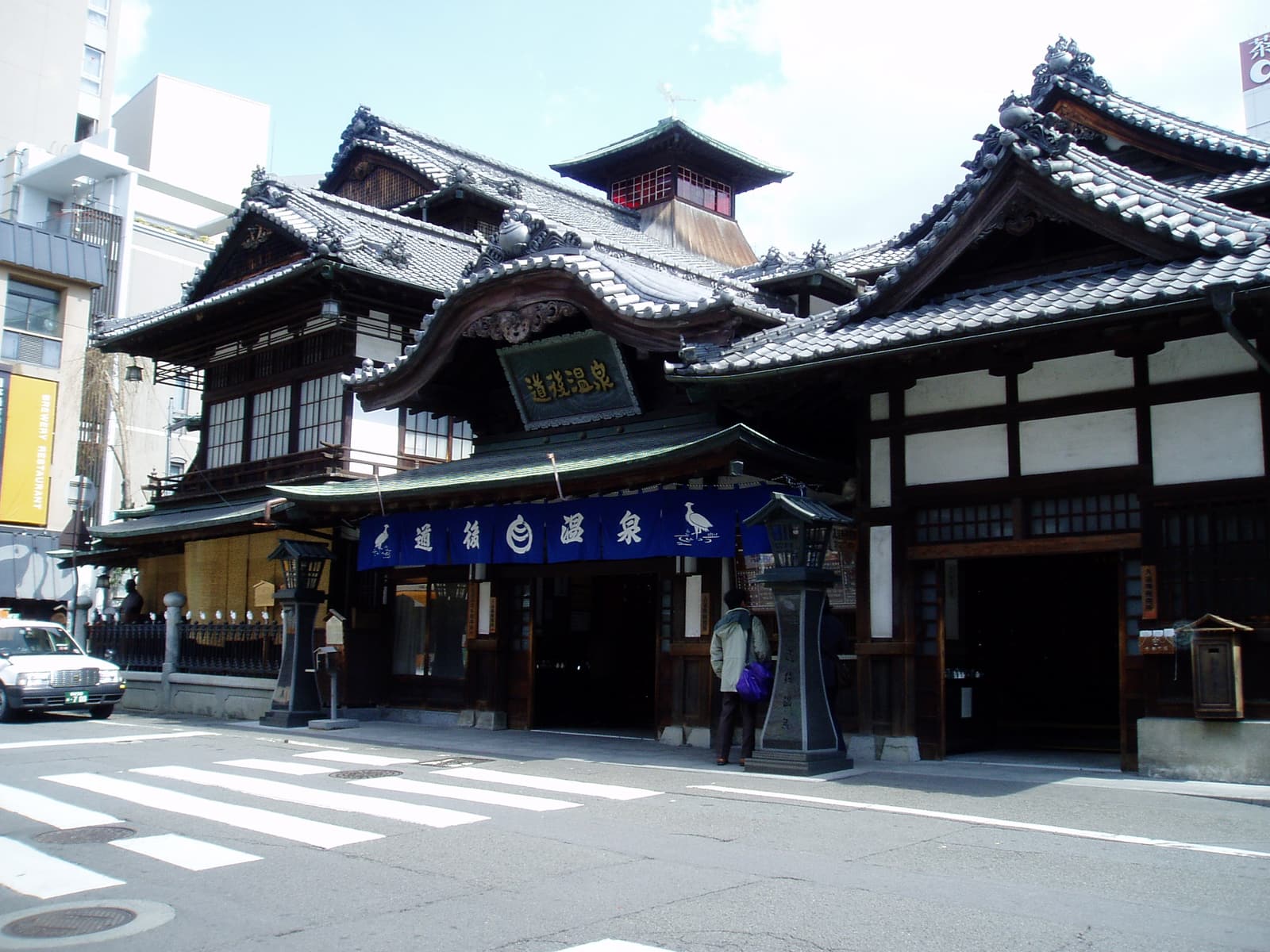
The useful way to visit Dogo Onsen is not to arrive after dinner, photograph the wooden bathhouse, and wonder why the whole neighborhood feels like a souvenir queue. Treat it as a local public bath with a famous shell. The best first pass is tighter: ride the tram to Dogo Onsen Station, be ready for the 6:00 a.m. opening or the late-evening shoulder, take the simplest Kami-no-Yu bath, cool down at the clock-and-footbath plaza, then leave through the arcade before the visit turns into a checklist.[1][2][4]
This is a ritual lens, not a spa review. The anchor is Dogo Onsen Honkan itself, a public bathhouse that the official site describes as the symbol of a hot spring area said to have about 3,000 years of history. The current building was designated a National Important Cultural Property in 1994, stayed partly open through conservation work that began in 2019, and fully reopened on July 11, 2024 before the repair project finished later that year.[1] That matters on the ground because the Honkan is both a famous sight and an operating bath. If you behave as if it is only a museum exterior, you miss the small mechanics that make Matsuyama feel different from a through-city on the Shikoku circuit.
Start with the transport, because Dogo is much easier when you let the tram do the narrowing. JNTO puts Dogo Onsen about a five-minute walk from the Dogo Onsen tram stop through the shopping arcade, and notes that tram #5 from JR Matsuyama Station takes about 30 minutes.[5] The official Dogo FAQ gives a similar local measure: about 25 minutes from JR Matsuyama Station to Dogo Onsen Station by tram, then a three-minute walk to the Honkan.[2] The practical move is to avoid taxis inside central Matsuyama unless luggage or weather forces it. The tram turns the onsen into a civic endpoint, not a resort bubble.
The cleanest timing is either early or deliberately late. Matsuyama's tourism page, updated as correct as of March 2026, lists the Kami-no-Yu lower-floor course at 6:00-23:00, with last admission at 22:30, and the basic adult fee at 700 yen.[4] The official Dogo FAQ repeats the 6:00-23:00 operating span, while the Honkan page lists a 60-minute use time for the basic bath and higher courses that add rest rooms, Tama-no-Yu access, or Yushinden viewing.[1][2] For a first visit, do not overbuy the experience. The local-feeling version is the simplest bath, not the most elaborate package.
That sounds counterintuitive because the building is famous. But the Honkan's value is not only old wood and the red-glass Shinrokaku tower. It is the sequence. You put shoes away, lock the changing-room locker, wash before entering the tub, keep hair and towels out of the water, sit while showering, wipe yourself before returning to the changing area, and hydrate afterward.[3] These rules are not decorative etiquette. They are what make a shared bath function when tourists, ryokan guests, and habitual bathers use the same building.
The non-local trapline is predictable. The first mistake is treating the Honkan as a hotel. It is not; the official FAQ says the Honkan, Asuka-no-Yu, and Tsubaki-no-Yu are for bathing only and do not provide overnight accommodation.[2] The second is arriving empty-handed and annoyed about towels. Shampoo, conditioner, body soap, and hair dryers are provided at the Honkan, but towels are a rental or purchase item; the FAQ and Honkan shop list rental towel and bath-towel options, so bring a small towel if you want to move quickly.[1][2] The third is wearing swimwear, wrapping a towel into the bath, or standing under the shower like a gym user. Matsuyama's official bathing guide is blunt: no swimwear in the tub, no towels in the water, wash first, sit to shower.[3] The better alternative is simple: copy the rhythm before you copy the aesthetics.
Use the station plaza as the second anchor, not another attraction to collect. The official Dogo tourist page says the Botchan Karakuri Clock performs hourly from 8:00 a.m. to 10:00 p.m., with half-hour performances on weekends, holidays, and peak seasons. The adjacent Hojo-en footbath runs 6:00 a.m. to 11:00 p.m. and is free.[6] This is where the route gets its local softness. Come out of the bath, do not immediately chase dinner, and give yourself ten quiet minutes by the clock or footbath. If you bathed early, the plaza is still assembling itself. If you bathed late, it becomes the decompression chamber before the tram back downtown.
Here are the local moves that make the visit work:
- Arrive for opening or the late shoulder. The Honkan opens at 6:00, and last entry for the basic course is 22:30; the busiest-feeling middle of the day is the least interesting first version.[2][4]
- Choose Kami-no-Yu downstairs first. At 700 yen for adults and 60 minutes, it gives the core bath rhythm without making you manage rest-room timing on a first pass.[1][4]
- Bring or rent a towel intentionally. Soap and dryers are covered at the Honkan; towels are not something to assume away.[1][2]
- Wash like the bath depends on you. It does. Hair up, towel out, shower seated, body clean before entering.[3]
- Do not bring outside food or drink into the bathhouse. The FAQ explicitly says not to bring them into the public bath facilities.[2]
- Use the tram stop as your reset point. From JR Matsuyama Station, expect roughly 25-30 minutes by tram; from the stop, the Honkan is only a few minutes on foot.[2][5]
- Cool down at the clock or footbath before shopping. The free footbath is open 6:00-23:00, and the clock gives the plaza a public rhythm.[6]
- Photograph the facade after bathing. The building reads differently once you have used it as intended.[1][3]
Expected spend is modest if you keep the route disciplined: 700 yen for the basic Honkan bath, plus towel rental or purchase if needed, plus tram or bus fare depending on your arrival point.[1][2][4] If you want to compare baths, the official three-bathhouse ticket covers the Honkan, Tsubaki-no-Yu, and Asuka-no-Yu over two days for 1,400 yen for adults, but that is better for an overnight Dogo stay than a rushed single evening.[1] If you are arriving from Matsuyama Airport, Iyotetsu lists the limousine bus to Dogo Onsen at 1,200 yen cash or 1,180 yen cashless; from central Matsuyama, the tram is the more atmospheric choice.[7]
The neighborhood detail to notice is the white heron. Dogo's official page says the Shinrokaku tower's red glass and white heron are symbols of the main building, and that the time drum there has been selected among Japan's notable soundscapes.[1] This is why the bathhouse does not need a heavy itinerary around it. Dogo is already a sound-and-water district: tram bell, arcade footfall, clock performance, bath bucket, towel, drum. The good route keeps those sounds legible.
Do not turn this into a food crawl, even though the arcade will tempt you. JNTO rightly notes that wandering in yukata, mikan juice, Botchan dango, and local souvenirs are part of the district's pleasure.[5] Keep them secondary on a first visit. The main mistake visitors make in historic onsen towns is collecting atmosphere without joining the local system that produces it. In Dogo, that system is public bathing: not luxury, not spectacle, but a shared sequence of small courtesies.
The go details are compact. Best window: 6:00-7:30 a.m. if you sleep nearby, or after the dinner rush but before the 22:30 last-entry line. Route cue: JR Matsuyama Station -> tram #5 / Dogo Onsen Station -> arcade -> Dogo Onsen Honkan -> Botchan Karakuri Clock / Hojo-en footbath -> tram back. Queue reality: basic bathing is straightforward, while private rooms and special courses can require advance reservation up to the previous day.[2] Where to stand or sit: stand back from the Honkan entrance until your course choice is clear, sit to shower inside, and sit at the footbath only after rinsing your feet and making room for others.[3][6]
Matsuyama becomes clearer when Dogo Onsen is not treated as a set piece. Use the building at the hour it opens, follow the bath logic, and let the tram carry you back into the city with wet hair and a slower pulse.
Sources
- Dogo Onsen official site, "Dogo Onsen Honkan" - current Honkan history, 2024 reopening, course structure, 60-minute basic bath, three-bathhouse ticket, amenities, shop prices, cashless note, and Shinrokaku details.
- Dogo Onsen official site, "Frequently asked questions" - current access times, reservation rules, no-overnight rule, closure note, towel and locker guidance, and outside food/drink rule.
- The Official Website of Tourism Matsuyama, "How to enjoy Dogo Onsen" - local bathing etiquette for lockers, swimwear, hair, washing, towel use, seated showering, drying off, hydration, and yukata wearing.
- The Official Website of Tourism Matsuyama, "Dogo Onsen Honkan" - March 2026 basic information confirming address, five-minute tram-station walk, 6:00-23:00 Kami-no-Yu hours, 22:30 last admission, 700 yen adult fee, and daily operation note.
- Japan National Tourism Organization, "Dogo Onsen" - official national tourism overview with tram approach, five-minute arcade walk, #5 tram from JR Matsuyama Station, Botchan clock, shopping arcade, and cultural context.
- Dogo Onsen official site, "Tourist information" - station-area details for the hot spring supply facility, Botchan Karakuri Clock performance times, Hojo-en footbath hours, and nearby Dogo Park/temple context.
- Iyotetsu official English information page - airport limousine fare to Dogo Onsen, route-map links, Botchan train weekend/holiday operation, and Matsuyama transit context.
- Wikimedia Commons, "File:Dogo-onsen Honkan.jpg" - photographic source for the article image, showing Dogo Onsen Honkan in Matsuyama.