Marseille has grander panoramas and louder harbor set pieces, but one of the city's cleanest public-room sequences is smaller. As of March 29, 2026, Mucem's official visit page lists J4 and Fort Saint-Jean open from 10:00 to 18:00, closed on Tuesdays, with the footbridge between J4 and the fort closing 30 minutes before the site closes.[1] The FAQ adds the key budget fact: the outdoor spaces are free, and you only need a ticket for the indoor exhibitions.[2] That combination tells you how to use this part of Marseille. Treat it as a timed seam, not as a museum errand.
The seam matters because Fort Saint-Jean is not a side terrace added to a museum. Mucem's own site describes the fort as a 15,000-square-meter historic complex with 12,000 square meters of gardens, linked both to the J4 building and to the Panier by a 70-meter footbridge.[3] Marseille's tourism office gives the thicker local layer: the site reaches back to a 12th-century commandery, carries the square tower built by King Rene in the mid-15th century, and was folded into Louis XIV's defensive reshaping of the harbor in 1660.[4] In Marseille terms, that is the right scale. One old-port threshold, one modern cultural block, one pedestrian crossing between them.
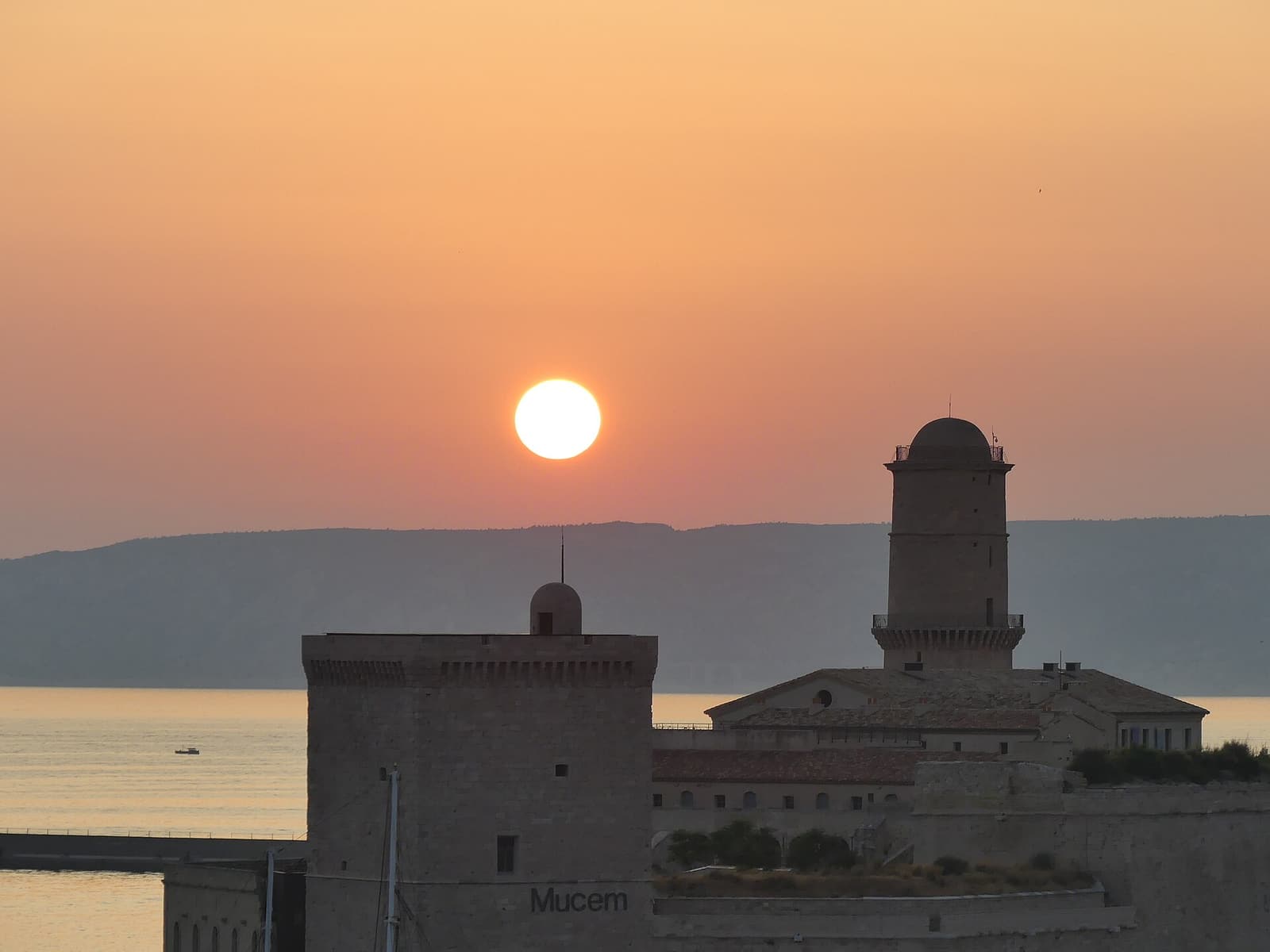
The cover image keeps the atmosphere honest. It is a real sunset photograph of Fort Saint-Jean with the Mucem mark visible on the waterfront edge.[8] What it catches is the point of the route: Marseille here reads in layers of mineral surface and sea light, with the newer institution staying attached to older fortification rather than replacing it.
The seam in one line
- J4 exterior ramps for the arrival.
- Fort Saint-Jean for the stay.
Do them in that order and the harbor opens correctly.
Anchor 1: J4 should stay a moving approach
Local Marseille coverage treats the J4 esplanade as the big port-front deck where the cathedral side, the museum edge, and the fort begin touching each other.[5] That is useful because this route does not need a heroic arrival. It needs a clean one. Starting on the J4 side gives you the sea first, the dark mesh facade second, and the fort only after the harbor has already widened in front of you. The site then behaves like a gradient rather than a pile of attractions.
J4 is strongest when you treat it as moving ground. The outdoor access rule matters here.[2] If your plan is this seam and not a ticketed exhibition, you do not need to stop at the desk, queue for galleries, or let interior programming decide the rhythm. Walk the exterior ramps, take the harbor measure, and keep the body pointed toward the bridge. Marseille gets flatter when you try to consume the whole complex at once. It gets sharper when you let the J4 do only one job: air, approach, and orientation.
Anchor 2: Fort Saint-Jean is where the route becomes local
Once you cross, the route slows down. Fort Saint-Jean is where the harbor stop turns into a Marseille room. Mucem's fort page is explicit about the spatial logic: gardens, ramparts, named towers, and the short bridge toward the Panier all sit inside one preserved military envelope.[3] The tourism office's history note gives the cultural version of the same idea. This is the harbor mouth as inheritance: crusader-era foothold, royal tower, then Louis XIV fortification, now recast as public circulation and garden time.[4]
That older civic feeling still shows up in current local use. A 2025 Made in Marseille feature on large-scale works at Fort Saint-Jean treated the site as an open-air cultural ground rather than a sealed monument.[6] Marseille Secrete's sunset roundup keeps the Mucem sector in the city's evening shortlist for the same reason: it is a west-facing public edge where sea light and urban texture hold together.[7] That is why the fort should hold your longest pause. J4 gives the approach; the fort gives the Marseille habit of lingering at the edge where history, wind, and water stay in the same frame.
8 local moves that make the seam work
First, start on the J4 side, not from the Panier side, when the harbor is the reason you came. The sequence reads better with sea first and fort second.[3][5]
Second, if the exterior walk is the whole point, keep the spend at EUR 0 and skip the ticket desk. The outdoor spaces are free.[2]
Third, cross earlier than your instincts suggest. In the current 10:00-18:00 window, that means being on the J4-Fort bridge no later than about 17:15-17:20, because the bridge shuts at 17:30.[1]
Fourth, use J4 as a moving platform, not as your main sitting zone. Save the longer stop for the fort gardens and ramparts, where the harbor feels less transitional.[3][7]
Fifth, keep Tuesday in your head from the beginning. This route has no elegant workaround if the site is closed.[1]
Sixth, choose your approach by your next move rather than by habit. J4 is the hinge of the route, so come in from the side that fits the rest of your afternoon and let the fort handle the slower half.[5]
Seventh, if you want an Old Port or Panier handoff after the harbor stop, use the fort's 70-meter bridge as the exit rather than the entry. The old quarter feels better as the aftertaste, not the prologue.[3]
Eighth, remember that this is an active cultural site, not a frozen ruin. If there is event or installation traffic, adjust immediately and preserve the seam: move, cross, settle.[6]
Non-local trapline: 4 common mistakes and the better alternative
Mistake 1: treating the whole stop like a ticketed museum visit
Better alternative: separate the exterior seam from the indoor galleries. If all you want is the harbor walk, use the free outdoor access and keep moving.[2]
Mistake 2: arriving too late to cross
Better alternative: work backward from the bridge cutoff, not from sunset. The bridge closes 30 minutes before the site closes.[1]
Mistake 3: entering from the Panier and backtracking toward the sea
Better alternative: start from J4 when the goal is a sea-facing Marseille read, then let the fort deliver the slower second half.[3][5]
Mistake 4: spending the best light on J4 and never really settling in the fort
Better alternative: do one clean exterior pass on J4, then shift your body to the fort for the actual pause.[3][7]
Concrete go details
- Best window: in the current 10:00-18:00 schedule, reach J4 about 75 to 90 minutes before closing and make the fort crossing by roughly 17:15-17:20 so the 17:30 bridge cutoff does not clip the route.[1]
- Expected spend: EUR 0 for the outdoor seam; ticket cost enters only if you add indoor exhibitions.[2]
- Queue reality: the main friction is not reservations but timing: site closure, bridge cutoff, and any event-related crowding around the cultural spaces.[1][6]
- Where to stand or sit: stand and walk on the J4 exterior ramps; make the longer stop on the fort's gardens or ramparts.[3][7]
- Navigation cue:
J4 esplanade -> J4/Fort footbridge -> Fort Saint-Jean -> 70 m Panier bridge if you want a neighborhood exit.[3][5] - Numeric anchors worth remembering: 10:00-18:00 opening, Tuesday closure, bridge shutting 30 minutes early, 15,000 square meters of fort, 12,000 square meters of gardens, the 70-meter Panier bridge, and the historical hinge points of the 12th century, the mid-15th century, and 1660.[1][3][4]
- Place-specific texture: this is Marseille's harbor mouth as civic collage - fortification, garden, mesh-wrapped museum, and sea wall held together by walking rather than by spectacle.[3][4]
Marseille can easily turn into a city of one-off views. This seam avoids that trap. You arrive through J4's open concrete edge, cross before the connection shuts, and let Fort Saint-Jean hold the slower part of the evening. The city lands better when the route is organized that way.[1][3][7]
Sources
- Mucem, "J4 / Fort Saint-Jean" - official visit page with current opening hours, Tuesday closure, and the bridge-closing rule.
- Mucem, "Frequently Asked Questions" - official note that outdoor spaces are free and only indoor exhibitions require a ticket.
- Mucem, "Fort Saint-Jean" - official site page on the fort's scale, gardens, bridges, and internal spatial sequence.
- Marseille Tourism, "Fort Saint-Jean" - official local history page on the site's 12th-century origins, King Rene's tower, and Louis XIV's 1660 fortification phase.
- Made in Marseille, "L'esplanade du J4" - local Marseille coverage treating the J4 esplanade as a harbor-front public deck between the museum, the sea, and the fort side.
- Made in Marseille, "Les oeuvres spectaculaires du Fort Saint-Jean" (2025) - recent local coverage showing the fort's continuing life as an open-air cultural ground.
- Marseille Secrete, "The best places to watch the sunset in Marseille" - local roundup that keeps the Mucem waterfront among the city's evening edges.
- Wikimedia Commons, "File: Sunset on Fort Saint-Jean.jpg" - photographic image source used for the cover.