Barcelona gets sold on Montjuic through three predictable moves: escalators from Placa d'Espanya, a cable-car ticket, and a fast castle photo. The cleaner ritual is smaller. As of March 29, 2026, TMB still lists the Funicular de Montjuic out of service until mid-April 2026 and replaces it with a special shuttle bus between Paral·lel and Parc de Montjuic using the same operating hours.[1][2] The official garden page adds the current boundary that actually matters for timing: Mirador de l'Alcalde stays on winter hours, 10:00-19:00 daily through March 31, before shifting to 10:00-21:00 from April 1.[3] That combination clarifies the hill. Start at Paral·lel, let the shuttle do the lift, and spend the real stop at Mirador de l'Alcalde, where Montjuic stops behaving like a transfer problem and starts behaving like a public terrace.
That distinction matters because Montjuic is not one lookout. Barcelona's own mountain guide describes it as a 376-hectare park system with multiple access modes, viewpoints, and walking links.[4] Local Catalan reporting goes even further and frames the hill as a full 11-kilometer circular walk with 403 meters of elevation gain.[6] If you only arrive to stand in one queue and leave again, you flatten the place into infrastructure. The better move is to use the infrastructure lightly and save your time for the garden that was built to hold it.
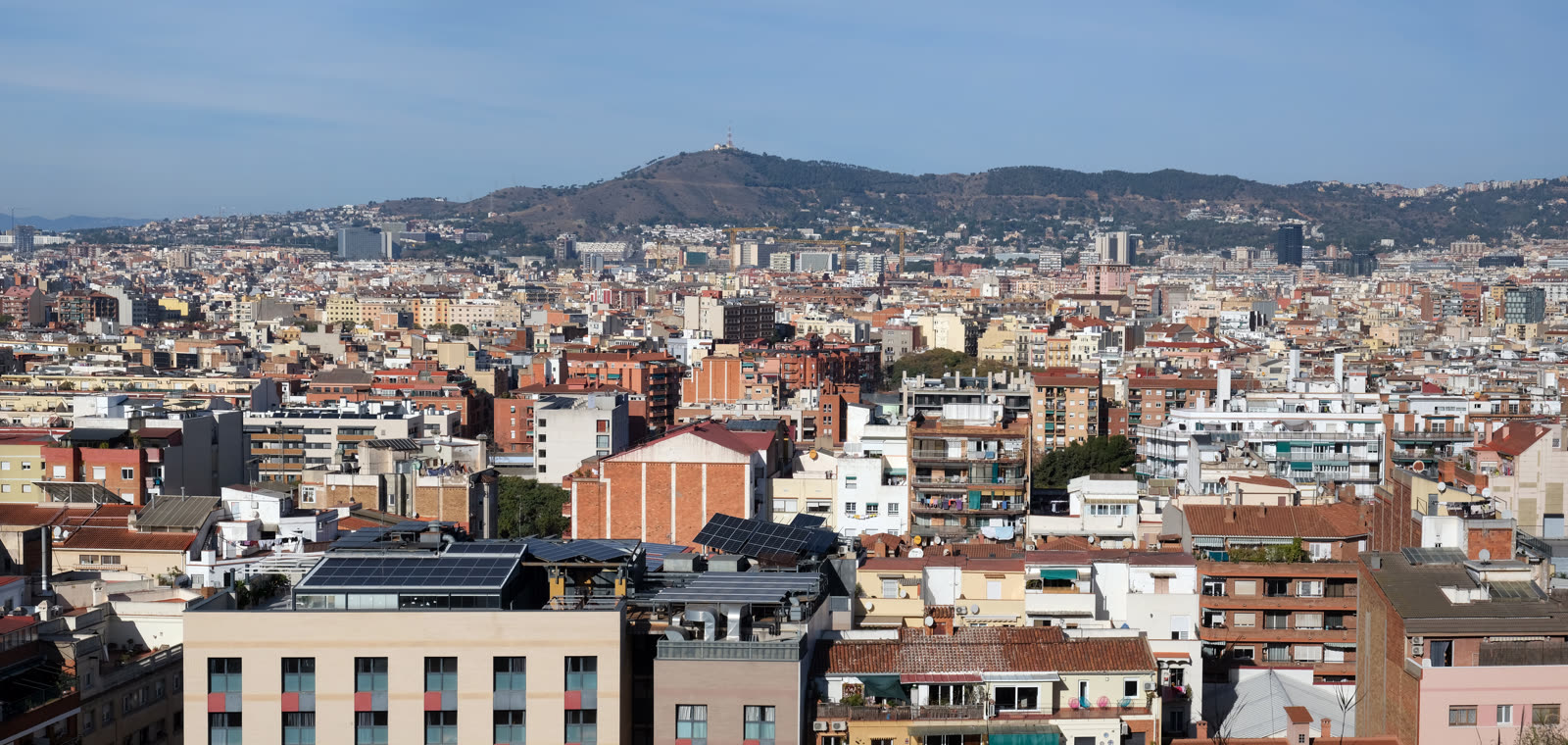
The cover image gets the scale right. It is a real 2024 photograph taken from Montjuic hill across the port and city.[9] What it catches is not a single monument but a long urban spread: water, cargo edge, apartment bands, and the upper ridges beyond. That is the right emotional proportion for this part of Barcelona. Montjuic works when the mountain still feels bigger than the attraction sitting on it.
The ritual in one line
- Paral·lel shuttle for the climb.
- Mirador de l'Alcalde for the stay.
Do them in that order and the climb stays clean.
Anchor 1: the shuttle from Paral·lel is the right lift right now
The funicular normally gets from the city to the mountain in 2 minutes.[1] While the line is shut, the replacement bus keeps the same idea intact: short lift, direct transfer, no scenic overthinking. TMB's works notice says the special service covers the route between Paral·lel and Parc de Montjuic with operating hours of 7:30-21:00 Monday to Friday and 9:00-20:00 on Saturdays, Sundays, and public holidays.[2] Barcelona Secreta's local service note adds the more useful detail for actual timing: the shuttle runs every 7-8 minutes on weekday mornings and every 10-12 minutes on afternoons, weekends, and holidays, with line 150 from Placa d'Espanya available as the fallback.[5]
That changes the best entry point. If the target is Mirador de l'Alcalde rather than the castle interior, Placa d'Espanya is no longer the clever default. Paral·lel is. It keeps the climb tight and uses the temporary replacement the way it was meant to be used: as a direct mountain access leg rather than as a detour. This is also the place to keep the ticket logic disciplined. The shuttle sits inside normal TMB travel; the cable car is a separate purchase and should stay optional unless riding up to the castle is itself the plan.[1][2][8]
The timing changes with the calendar. Until March 31, the useful version is a late-afternoon climb: reach Paral·lel about 18:15 to 18:30 so you can cross the terraces before the 19:00 winter closing window.[2][3] From April 1 onward, the garden's 21:00 summer close makes the old 40 to 50 minutes before sunset rule work again.[3] Montjuic does not need a heroic amount of time. It needs one clean ascent and a refusal to spend the best light inside the wrong queue.
Anchor 2: Mirador de l'Alcalde is where the hill becomes a room
Mirador de l'Alcalde works because it is not just a railing. The official Barcelona page describes a sequence of landscaped terraces, stairways, sloping parterres, and a fountain cascade, with one of the entrances near the Montjuic cable-car station.[3] The tourism board adds the built details that make the place feel specific rather than generic: a 180-degree panorama, the 2009 restoration, a ceramic mural by Joan Josep Tharrats, the fountain work tied to Carles Buigas, and sculpture by Josep Maria Subirachs.[7]
This is also where the hill gets its local texture. The city notes that the garden works started in 1962, after the castle was handed over to Barcelona in 1960, and that the mirador officially opened in 1969.[3] In other words, this is not an ancient accidental overlook. It is a municipal terrace built out of a specific Barcelona decision about what the mountain should become once military space started turning civic. The view is excellent, but the stronger thing here is the choreography: upper arrival, downward spill, then a calmer bench or wall once the transfer traffic clears.
That is why Mirador de l'Alcalde is a better stop than the first station-adjacent edge. The top level catches people who have just arrived and people who are about to leave. The lower terraces keep the same skyline but lose some of the transfer noise. Treat the mirador as a stepped room, not as one fixed photo marker, and the place starts making sense.
8 local moves that make the ritual work
First, start at Paral·lel, not Placa d'Espanya, when Mirador de l'Alcalde is the goal. The current replacement route is built for that climb.[2][5]
Second, treat the shuttle as access, not as the event. The mountain is the event; the bus only gets you into the right altitude band.[1][4]
Third, match the calendar to the gate. Until March 31, arrive by about 18:15-18:30 for the 19:00 winter close; from April 1, go back to the 40-50 minutes before sunset rule because the garden shifts to 21:00.[3]
Fourth, keep the fare logic clean. If you already hold a valid pass, the climb can cost EUR 0; if not, TMB's current single ticket is EUR 2.90.[8]
Fifth, once you reach Parc de Montjuic, keep moving into the mirador itself. The garden is the stop; the arrival platform is only the hinge.[2][3]
Sixth, make your longest pause on the middle or lower terraces, not the upper edge nearest the station. The same panorama survives, but the flow loosens.[3][7]
Seventh, keep line 150 as your recovery option rather than your first instinct. It is useful when you are already at Placa d'Espanya or the shuttle line bunches, but it is not the neatest first move for this specific evening.[2][5]
Eighth, take the garden geometry seriously. This is a stair-and-slope space, not a luggage-friendly flat deck; if mobility is the first constraint, a taxi drop or a bus stop nearer the entrance is the cleaner play.[3]
Non-local trapline: 3 common mistakes and the better alternative
Mistake 1: buying the cable car ticket too early
Better alternative: use the shuttle first and decide later whether the cable car is still worth extra money. For this ritual, the view terrace matters more than the ride mechanic.[1][2][8]
Mistake 2: defaulting to Placa d'Espanya because every Montjuic guide starts there
Better alternative: use Paral·lel while the replacement bus is active. It is the shorter, cleaner approach to this specific stop.[2][5]
Mistake 3: showing up at true sunset in late March and expecting a full blue-hour stop
Better alternative: while the winter schedule is still active, treat this as a late-afternoon route and get in before 19:00; after April 1, stretch it back toward sunset.[3]
Mistake 4: stopping at the first upper edge and never moving through the garden
Better alternative: make one top-to-bottom pass, then settle lower down. The mirador was built as terraces, not as one crowded lip.[3][7]
Concrete go details
- Best window: until March 31, reach Paral·lel about 18:15-18:30 so you are inside before the mirador's 19:00 winter close; from April 1, return to the 40-50 minutes before sunset rhythm. The replacement bus runs 7:30-21:00 on weekdays and 9:00-20:00 on weekends/public holidays.[2][3]
- Expected spend: EUR 0 with an already-loaded pass, or EUR 2.90 if you need a current TMB single ticket for the climb.[8]
- Queue reality: the real friction is shuttle headway plus the upper-terrace crowd; local reporting puts the shuttle at 7-8 minutes on weekday mornings and 10-12 minutes on afternoons, weekends, and holidays.[5]
- Where to stand or sit: first look from the upper arrival side, longer stop on the middle or lower terraces.[3][7]
- Navigation cue:
L2/L3 Paral·lel -> special shuttle bus -> Parc de Montjuic -> walk into Jardins del Mirador de l'Alcalde.[2][3] - Numeric anchors worth remembering: 376 hectares of mountain park, 2 minutes for the normal funicular climb, 180 degrees of panorama at the mirador, and a garden built between 1962 and 1969 after the castle transfer in 1960.[1][3][4][7]
- Place-specific texture: Montjuic is not just backdrop here; the mirador is a civic terrace with mosaic, fountain engineering, and sculpture layered into the view itself.[3][7]
Barcelona has plenty of places that turn good light into a queue-management problem. This one does not have to. Use the temporary shuttle as a narrow tool, keep the mountain leg short, and let Mirador de l'Alcalde do the slower part. In late March that means arriving before the garden closes; from April onward it stretches back into sunset again. The city opens wider when the evening is organized that way.[2][3][7]
Sources
- Transports Metropolitans de Barcelona, "Funicular de Montjuic" - official page noting the normal 2-minute public-transport lift to the mountain and the current service interruption.
- Transports Metropolitans de Barcelona, "Avis Tancament Funicular" - official notice stating that the line is out of service for about five months and replaced by a shuttle bus between Paral·lel and Parc de Montjuic with specific operating hours.
- Barcelona City Council, "Jardins del Mirador de l'Alcalde" - official page on the garden's terraces, stairways, fountain cascade, and current winter/summer opening hours.
- Barcelona City Council, "How to get to Montjuic Park and get around" - official mobility guide describing Montjuic as a 376-hectare park and outlining the hill's access network.
- Barcelona Secreta, "Montjuïc funicular closes in Barcelona for 5 months: why and alternative routes" (October 13, 2025) - local service guide with shuttle frequency notes and the line 150 fallback.
- El Punt Avui, "Montjuic 360" (December 10, 2023) - local Catalan reporting framing the hill as an 11-kilometer walking circuit with 403 meters of accumulated elevation.
- Turisme de Barcelona, "Mirador de l'Alcalde" - tourism-board page on the 180-degree panorama, 2009 restoration, and the Tharrats/Buigas/Subirachs design details.
- Transports Metropolitans de Barcelona, "Barcelona bus and metro prices" - official fares page listing the current EUR 2.90 single ticket and valid integrated options.
- Wikimedia Commons, "File: Barcelona view from Montjuic hill.jpg" - documentary photograph used for the cover image.