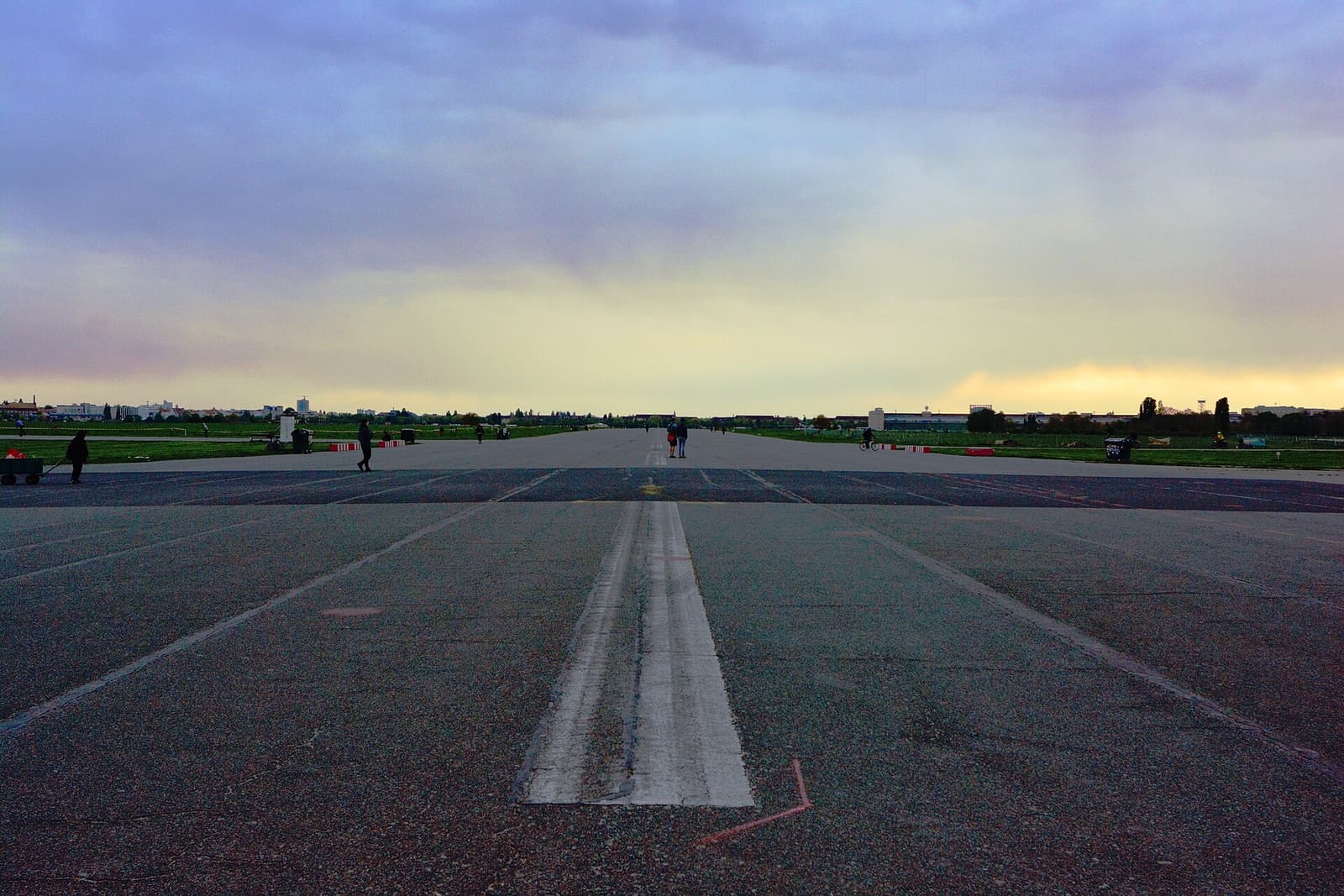
Berlin has larger monuments than Tempelhofer Feld, but few places teach the city's everyday scale faster. The former airport is now one of the world's largest inner-city parks, and Berlin's own park guide still describes the core behavior plainly: people bike and skate on the concrete runways, sit on the grass with friends, walk dogs, and use the site as open urban surplus rather than a formal attraction.[2] A recent local visitBerlin tips post still leads with riding the former runway, which is a good clue about how Berlin expects the place to be used: motion first, monument second.[7]
The right way to visit is not to "do the whole field." Use one non-food ritual instead: enter from Leinestraße on the Neukolln side, take the runway during the late-light window, then finish on the west-facing high seats on the inner meadow ring.[1][5] That sequence gives you scale, wind, local traffic, and the old-airfield strangeness without the usual first-timer mistake of wandering too long, too late, and too far from an exit.
Place-specific texture matters here. Tempelhof is not only an oversized lawn; it is a former airport whose history trail marks 20 places of remembrance, including the 1948-49 Berlin Airlift layer that still shapes how Berlin talks about the site.[3] You feel that double identity on the field itself: hard runway geometry, then a wide meadow interior that behaves like neighborhood breathing room.
Why Leinestraße is the cleanest entry for this ritual
The official visit page makes the access logic unusually clear. If you arrive from U8 Leinestraße or U8 Boddinstraße, it is roughly 5-7 minutes on foot to the six entrances along Oderstraße; if you arrive from S+U Tempelhof, the main Tempelhofer Damm entrance is about 3 minutes away.[1] For a first short visit, the Neukolln side is cleaner because it removes the terminal-building detour and gets you onto the field faster.
Leinestraße also gives you a recognition cue that is actually useful. Since spring 2025, the day bar Die Treppe has been operating out of staircase building 113 at the Leinestraße entrance, serving snacks, homemade waffles, and cold drinks daily from 12:00 until sunset.[4] Even if you buy nothing, that staircase building makes the entrance legible at a glance and gives you a reliable orientation point for the walk back out.
The local advantage is rhythm, not sightseeing completeness. Tempelhofer Feld has 3 main entrances and 7 side entrances overall, and that scale is exactly why a tight ritual beats a collector's mindset.[2] Leinestraße lets you reach the runway quickly, hold the field at human scale, and get out without a long dead walk after the light is gone.
The sunset window: how to time it
Berlin's park guide gives the seasonal constraint in numbers. In March, Tempelhofer Feld runs 06:00-19:00. In April and September, it runs 06:00-20:30.[2] That means a late-March sunset ritual is shorter and stricter than an April one.
Use this pattern.
- Enter 75-90 minutes before closing time.
- Spend the first 10-15 minutes getting onto the paved runway rather than drifting around the perimeter.
- Walk or roll the runway for 25-35 minutes while there is still side light.
- Finish with 10-20 minutes on the high seats or meadow edge, then leave before closing pressure builds.[2][5]
This is the entire trick: one runway window, one pause, one clean exit. If you try to turn the field into a full-coverage park mission, you flatten the thing that makes it good.
8 local moves that materially improve the stop
First, use Leinestraße when the field itself is the goal. Use Tempelhofer Damm only if the terminal building is part of the plan.[1][3]
Second, arrive by public transport and stop pretending there will be convenient parking. The official site says there are almost no parking spaces and explicitly tells visitors to use transit.[1]
Third, treat the runway as the anchor, not the lawn near the gate. Berlin's own city page frames the site through runway behavior for a reason: skating and cycling on the concrete are the local use pattern that turns a huge void into a social room.[2]
Fourth, in late March, think with the 19:00 closing line, not with generic "sunset park" instincts. In April you get the longer 20:30 window, but March punishes dawdling.[2]
Fifth, if you want one bought item instead of carrying your own picnic, make it a small one at Die Treppe near the entrance or exit. The point here is a field ritual, not a sit-down meal.[4]
Sixth, use the high seats as the final stop, not the first one. The park's 2025 news update says the rebuilt seats on the Neukolln side of the inner meadow ring are oriented west over the "meadow sea," which is exactly why they work best after the runway has already given you horizontal scale.[5]
Seventh, if you are walking rather than biking or skating, keep the route modest. A 60-90 minute field visit is enough for this ritual because the pay-off is atmosphere and proportion, not mileage.
Eighth, if you are going on a warm weekend afternoon, use the live crowd-timing surface on Google Maps as a quick reality check before you commit to the busiest part of the day; the field is huge, but the gate zones and food kiosks still bunch.[6] Keep one historical fact in your head while you are out there, too: the airlift memory and the 20-site history trail help the emptiness read as Berlin infrastructure with a past, not as an accidentally oversized park.[3]
Non-local trapline: 4 mistakes and better alternatives
Mistake 1: entering from Tempelhofer Damm when you mainly want the field
Better move: if your goal is runway air, skyline width, and neighborhood tempo, start from Leinestraße or another Oderstraße-side entrance.[1][3]
Mistake 2: using the first half hour on the grass near the gate
Better move: get onto the paved runway quickly. Tempelhofer Feld only becomes itself when the old airport geometry starts doing the work.[2]
Mistake 3: arriving too late in March because "parks stay open after dark"
Better move: respect the monthly closing table. In March the field closes at 19:00, and the entrances shut at the end of opening hours.[1][2]
Mistake 4: turning a free urban field into a checklist marathon
Better move: run one entry, one runway, one perch, one exit. The field works as a local reset because it is used in pieces, not conquered in full.
Concrete go details
- Best time window: enter 75-90 minutes before closing; in late March, think 17:30-18:45 rather than "whenever the sky looks nice."[2]
- Expected spend range: EUR0-10 for a field-only stop. Admission is free; anything above zero is optional drink or snack money.[1][4]
- Queue and reservation reality: no reservation, no ticket, no museum choreography; the real constraint is the seasonal closing time and how far you drift from your exit.[1][2]
- What to buy if you want one anchor item: a waffle or cold drink at Die Treppe by the Leinestraße entrance, then take it onto the field rather than lingering indoors.[4]
- Where to stand or sit: runway first, then the west-facing high seats on the inner meadow ring on the Neukolln side.[5]
- Navigation cue: if you see staircase building 113 at Leinestraße, you are in the right starting zone; if you find yourself staring at the old terminal too early, you entered for the wrong version of this visit.[4]
Berlin is full of places that reward research. Tempelhofer Feld rewards discipline instead. Keep the scope tight, let the runway do the explaining, and leave while the place still feels open.
Sources
- Tempelhofer Feld, "Plan your visit" (seasonal opening hours, free admission, transit walk times, Leinestraße/Oderstraße access, limited parking).
- Berlin.de, "Park Tempelhofer Feld" (monthly opening hours, 3 main entrances and 7 side entrances, runway-use behavior, free admission, park rules).
- visitBerlin, "Tempelhofer Feld in Berlin" (history trail with 20 remembrance sites, Airlift context, entrance geography, neighborhood framing).
- Tempelhofer Feld, "Food & drinks" (Die Treppe at staircase building 113, daily 12:00-to-sunset service, waffles, snacks, cold drinks).
- Tempelhofer Feld, "Neue Hochsitze am Wiesenmeer" (2025 park-news note on the rebuilt west-facing high seats on the Neukolln side of the inner meadow ring).
- Google Maps search, "Tempelhofer Feld Berlin" (local review stream and current crowd-timing surface).
- visitBerlin Blog, "11 tips for a visit to Tempelhofer Feld" (recent local tips post that still treats the runway ride as the signature move and confirms the field's active-use culture).
- Wikimedia Commons, "File:Tempelhofer Feld - a runway on a spring evening.jpg" (cover image source page).