Marrakech is punishing when you let Jemaa el-Fna be your first unfiltered contact with the medina. The square is too active, too soliciting, too full of crossing signals. The better move is smaller and calmer: begin at the Koutoubia side, hold the minaret as your back-marker, and enter the square at dusk from the west rather than dropping into its busiest middle by accident.[1][2][3]
That route has one non-food anchor and one public-space anchor. Koutoubia gives you vertical order before the square starts pulling sideways. Marrakech.fr describes the mosque as the city's most important mosque and identifies its minaret as 69 metres high, making it the skyline object the eye keeps returning to.[2] Jemaa el-Fna then gives you the opposite condition: not a monument but a living surface. UNESCO frames the square as one of Marrakech's main cultural spaces, tied to oral traditions, performing arts, social practices, festive events, and craft life; Marrakech.fr puts the same fact in visitor language by noting that the square changes through the day and becomes a different place after nightfall.[1][3]
The city-specific texture is that the two places are close enough to behave as one short lesson. Marrakech.fr places Jemaa el-Fna in the centre of the medina and lists Koutoubia as a nearby site roughly 447 metres away.[3] That is less a sightseeing distance than a decompression lane. If you arrive 45 to 60 minutes before sunset, you can let the garden edge and minaret settle your bearings, then enter the square as the food stalls, musicians, orange-juice stands, and terrace spectators start competing for attention.[3][4] The route costs nothing unless you choose a drink, a small tip, a snack, or a rooftop pause. It works because it treats the square as civic theater first and consumption second.
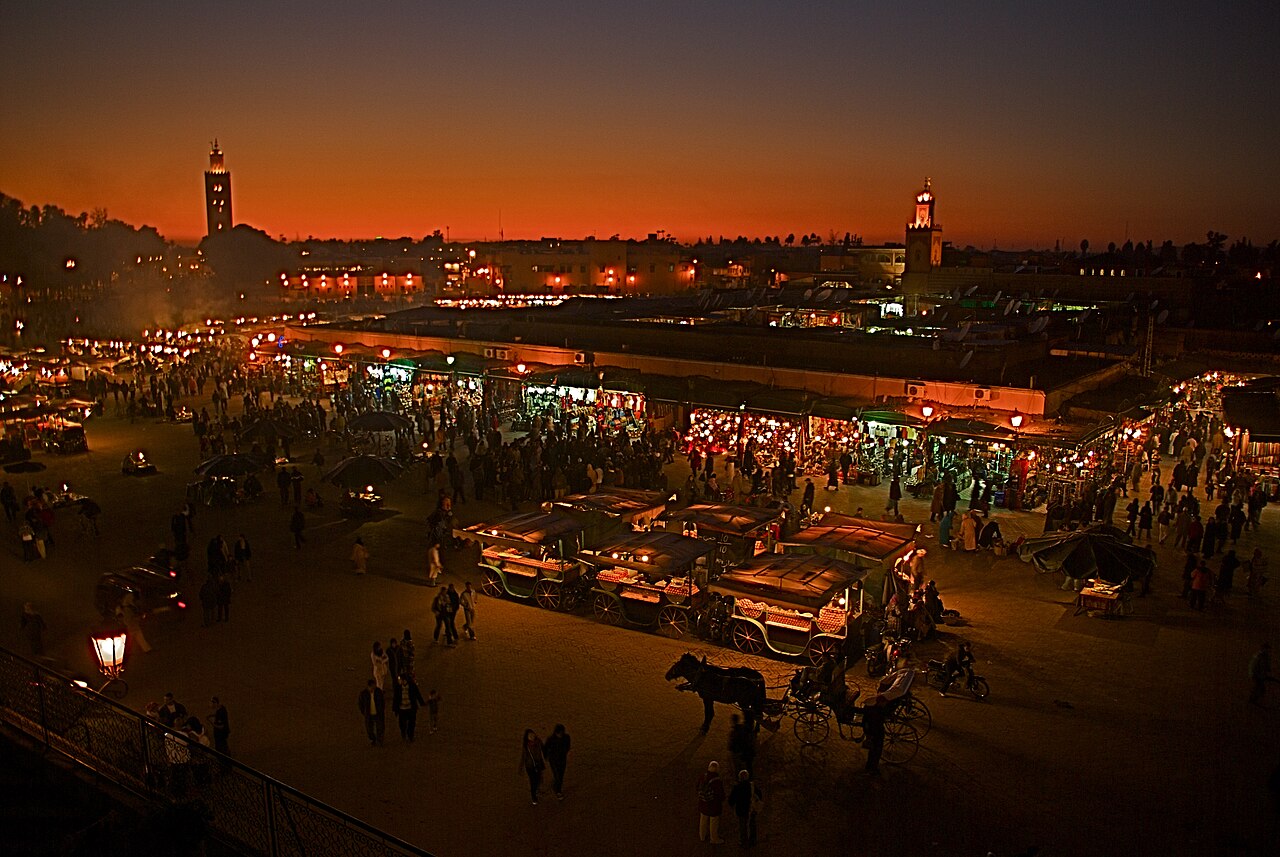
Image context: the cover uses a real 2008 documentary photograph of Jemaa el-Fna at night from Wikimedia Commons. It belongs here because the article is about reading the square's density from the Koutoubia side: crowd, stall light, public performance, and minaret all appear in one frame.[7]
Start where the city still has a fixed point
Use Koutoubia as the first anchor even if you are not trying to "visit" the mosque in the usual monument-checklist sense. The useful detail is visual, not interior. The minaret is tall enough and plain enough to keep working as an orientation tool when the surrounding streets begin to twist.[2] From the garden side, pause long enough to register two things: the tower's height above the low medina profile, and the fact that Jemaa el-Fna sits only about 5 minutes away on foot rather than far away.[2][3]
This is where many visitors waste their first Marrakech hour. They take a taxi directly to the square, step out into full performance mode, and immediately start making defensive decisions. Go-Out.ma's 2026 safety guide is useful because it is practical rather than romantic: it flags fake-guide approaches near Jemaa el-Fna, recommends asking for prices in advance, keeping small bills, photographing menus before ordering, and staying clear of snake-charmer pressure.[5] None of that means the square should be skipped. It means you need to enter it with spatial control already in your body.
The Koutoubia approach gives you that control. Keep the tower behind your right or left shoulder as you cross toward the square. Do not aim for the loudest cluster first. Enter on the western edge, let the whole field open, and make one slow perimeter pass before choosing whether to sit, photograph, eat, or keep moving. The first local move is restraint: do not spend your first five minutes buying, bargaining, or performing politeness for every invitation. Spend them reading the room.
Read Jemaa el-Fna as a changing room, not a fixed attraction
Jemaa el-Fna is easiest to misunderstand if you treat it as a single thing. Marrakech.fr separates the square by daytime and nighttime behavior: day brings orange juice, spices, henna, animal handlers, and other performers; dusk and evening bring a different arrangement of stalls, music, improvised shows, and crowd movement.[3] UNESCO's language explains why that instability matters. The square is not protected merely because it is old or photogenic. It is listed because many forms of cultural expression coexist there in public: oral performance, music, social ritual, commerce, and craft.[1]
That is also why a good visit should not collapse into a hunt for the "best stall." Food is part of the square, but making food the only agenda narrows your attention too early. Country Life's 2026 Marrakech guide captures the sensory shock of first entering Jemaa el-Fna after sunset: smoke, snake charmers, monkeys, spice smell, and the deep medina setting all arrive at once.[4] Take that as a warning about dosage. If you hit the square hungry, tired, and indecisive, every invitation feels more urgent than it is.
The better rhythm is perimeter first, terrace second, centre last. Walk the outer edge once while the light is changing. If the square feels too loud, go up to a terrace for one drink rather than standing frozen in the middle. Marrakech.fr explicitly recommends terrace viewpoints around the square as a way to watch the life below from above.[3] Once you have seen the flow from one level up, the ground level becomes easier to handle: you can decide where the music is, where a crowd is gathering, which alleys lead back to your riad side, and which encounters you are willing to engage.
8 local moves that make the route work
- Arrive before sunset, not after dark. The sweet spot is about 45 to 60 minutes before the light goes, because Koutoubia is still readable and the square is only starting to shift into evening mode.[2][3][4]
- Use the minaret as a back-marker. The 69-metre tower is the easiest visual correction when the medina starts to feel like a set of competing alleys.[2]
- Enter from the west side. Coming from Koutoubia turns Jemaa el-Fna into a field you approach deliberately, not a noise wall you suddenly fall into.[2][3]
- Make one perimeter lap before stopping. This prevents the first vendor, performer, terrace tout, or food-stall pitch from defining your whole evening.[3][5]
- Carry small cash but keep it boring. The practical band for a light square visit is roughly 0 to 80 MAD depending on whether you buy juice, tip a performer, use a bathroom, or take a terrace drink. Keep larger notes out of the negotiation.
- Ask prices before accepting anything. Go-Out.ma reduces this to a simple rule: confirm prices in advance, especially around menus, taxis, shops, and offers of help.[5]
- Do not photograph performers, animals, or henna setups casually. Recent Marrakech safety guidance is blunt that snake charmers and other photo situations can turn into payment pressure, and that people photography should be permission-first.[5]
- Exit by a known edge, not by panic. If you are staying in the medina, identify your return alley before you sit down. If leaving by taxi, walk a little away from the most touristed square edge before negotiating, because the same guide warns that taxis at major tourist points can become an overcharging point.[5]
Non-local trapline: 4 mistakes to avoid
Mistake 1: treating the square as a photo opportunity before treating it as a social space
Better move: look first, ask before photographing people, and assume any posed animal or performer photo has a price attached. That keeps the encounter cleaner and avoids the first-timer pattern repeatedly flagged in recent Marrakech safety guidance.[5]
Mistake 2: choosing the first food stall because the pitch is confident
Better move: make a lap, read menus, ask prices, and be willing to keep walking. Elfna's 2026 food-stall guide is useful because it treats stall position, dish prices, and confirmation before cooking as part of the visit, not as awkward extras.[6]
Mistake 3: arriving at peak darkness with no orientation cue
Better move: use Koutoubia before sunset. Once the square changes into its night form, the minaret gives you a stable visual exit and the western approach keeps you from starting in the densest middle.[2][3]
Mistake 4: saying yes to every "helpful" direction
Better move: ask a shopkeeper, your riad, or a clearly settled business if you need help, and keep moving past unsolicited guide offers. Go-Out.ma names the fake-guide or "helpful local" approach around Jemaa el-Fna as an avoidable friction point.[5]
Concrete go details
- Best window: 45 to 60 minutes before sunset, then stay through the first full evening turn if your energy is good.[3][4]
- Expected spend: 0 MAD for the walk; roughly 20 to 80 MAD if you add juice, a small tip, bathroom money, or a terrace drink.
- Queue or reservation reality: none for Koutoubia's exterior or Jemaa el-Fna as a public space. Rooftop seats around the square can fill at the best light, so move early if that is your decompression plan.[3][4]
- Where to stand first: the garden side near Koutoubia, then the western edge of Jemaa el-Fna before stepping into the centre.[2][3]
- Navigation cue:
Koutoubia garden edge -> western approach -> Jemaa el-Fna perimeter lap -> terrace pause if needed -> centre only after you have chosen your exit. - Numeric anchors worth keeping: 69 metres, about 447 metres between Koutoubia and the square, about 5 minutes on foot, 45 to 60 minutes before sunset, 0 to 80 MAD for a light visit, and one full perimeter lap before committing to any pitch.[2][3][5][6]
This route does not make Jemaa el-Fna quiet. That would miss the point. It makes the square legible. Koutoubia gives you a fixed line; the square gives you motion; the short walk between them gives you just enough control to enjoy the motion without letting it decide everything for you.
Sources
- UNESCO Intangible Cultural Heritage, "Cultural space of Jemaa el-Fna Square" (official listing page used for the square's status as a cultural space of oral traditions, performing arts, social practices, festive events, and craft life).
- Marrakech.fr, "Mosquee Koutoubia" (visitor page used for the mosque/minaret description, including the 69-metre minaret, exterior-viewing reality, 5-minute walking cue from Jemaa el-Fna, and nearby-distance listing).
- Marrakech.fr, "Place Jemaa el-Fna" (visitor page used for the square's day/night rhythm, its central medina location, nearby-distance cue to Koutoubia, and terrace-viewing advice).
- Country Life, "The Country Life Guide to Marrakech: Where to shop, stay and eat," February 4, 2026 (recent travel account used for the after-sunset sensory description and current visitor framing of Jemaa el-Fna).
- Go-Out.ma, "Is Marrakech Safe for Tourists? (Honest Guide)" (updated January 27, 2026; local guide used for fake-guide avoidance, small-bill advice, menu-price confirmation, photo etiquette, snake-charmer caution, and taxi-overcharging context near tourist points).
- Elfna, "Jemaa el-Fna Food Stalls Guide 2026: What to Eat, Prices & Stall Numbers" (local Medina guide used for the food-stall layout, price-confirmation habit, timing, and 2026 price context).
- Wikimedia Commons, "File:Jemaa el-Fnaa at night.jpg" (documentary photographic source page for the lead image, taken on December 19, 2008).