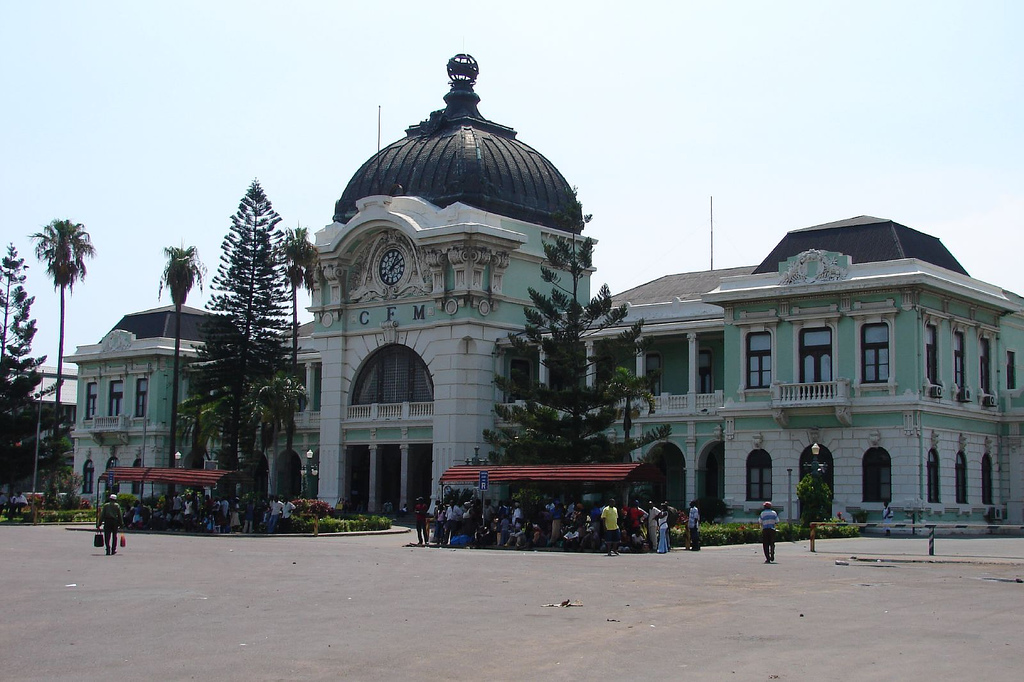
Maputo Central Railway Station offers two easy ways to misread it. From Praça dos Trabalhadores, the pale green facade and dark ribbed central dome look so ceremonial that the building can become a palace in a photograph. In retellings, that dome is often handed to Gustave Eiffel. The railway’s own history rejects the attribution: the dome was made in South Africa, and the documented station design passed through other hands [2].
The second mistake is subtler. A beautiful old station can be treated as if its only remaining work were to pose. This one is still a CFM terminal. The railway museum occupies the station, but passenger movement, staff instructions, events, and access boundaries remain part of the room. On June 20, 2026, about 2,000 children gathered here for a CFM program that included a train ride to Machava; the operator reported it on July 8 [3]. That is unusually vivid recent confirmation that the station is not a preserved shell.
Build the visit around that double identity. Arrive outside at 09:55 on a Tuesday through Friday, give the station 75 minutes from the museum’s 10:00 opening, and use only the areas staff identify as open to visitors. The aim is not to “cover” Maputo rail. It is to read one building without erasing the work that keeps it alive.
Begin with the name on the square
The first local move is to save the destination in Portuguese: Estação Central de Maputo, Praça dos Trabalhadores. For a backup pin, the community listing for Museu dos CFM gives the plus code 2HH7+W6H, Maputo [4][5]. Use the square, not a generic search for “CFM,” because the company has offices and railway facilities beyond the visitor entrance.
The recognition cue is uncomplicated: three domes above a symmetrical front, with the large ribbed dome at the center. CFM’s historical account gives the facade a width of 51 metres [2]. Stand far enough into the square to see that whole frontage, make the exterior photograph before the museum opens, then move out of the direct approach. The square is an orientation room and a transport edge, not a private forecourt.
This is the second move: take the postcard first, then put it away. The archival photograph above does something useful because it holds the entire front in one frame [7]. Once inside, repeating that same centered image is less important than noticing how the ceremonial facade connects to an operational station.
The building becomes clearer when its dates remain separate. Plans for a replacement station were already moving through the railway administration in 1904–1905. Construction began in 1908, and the first version opened on March 19, 1910, replacing a wood-and-zinc station farther down the line. Major work from 1913 changed the facade under architect Ferreira da Costa; ornament was entrusted to Pietro Buffa Buccellato, and the composition seen today was finished in 1916 [1][2]. The station is therefore not one immaculate gesture by one famous man. It is a sequence of budgets, revisions, builders, wartime supply constraints, and railway labor.
That sequence also explains the dome. CFM says the central dome has been wrongly credited to Eiffel and records that it was built in South Africa because World War I made manufacture in England difficult [2]. The correction is more interesting than the myth. It turns a borrowed celebrity anecdote into a southern African material story: a copper-colored crown assembled through the same regional world of ports, tracks, workshops, and supply routes that the station served.
Enter on the museum’s clock
The station and the museum do not share identical practical meanings. A railway building may be active when its museum is shut. Museu dos CFM publishes visitor hours of 10:00–17:00 Tuesday through Friday and 10:00–16:00 on Saturdays, Sundays, and public holidays; Monday is closed [1]. Google’s place listing and the recent community-review digest reproduce the same weekly pattern [4][5].
The third move is therefore to prefer the first weekday hour. A community guide recommends weekdays to reduce the chance of meeting a tour group, but there is no live crowd forecast [5]. Treat 10:00–11:15 as a resilient window, not a promise of emptiness. If a school group, railway event, or operational restriction changes the room, ask what is open and let the answer replace the plan.
At the threshold, use three short questions: Is the museum open now? Where does the visitor route begin? Is a guided visit available today? CFM says the museum promotes guided visits to both the permanent display and the station building [1]. Community evidence is less tidy. One Google review from July 2025 reported finding no guide, while another from August described a helpful local guide at the site [5]. The honest conclusion is not “there is always a guide” or “there never is.” Availability varies, so ask before paying and be willing to use the bilingual interpretation independently.
The official adult ticket is 50 meticais. Students, children, and visitors over 60 are listed as free, while special conditions apply to groups of at least 15 people [1]. The fourth move is to carry 100 meticais in small notes as a simple admission buffer, then ask which payment methods and concessions are being accepted that day. That buffer is advice, not a second published fee. Transport to the square and anything from the museum shop are separate.
Individual visitors are not given a timed-booking system on the official page. Do not manufacture a reservation ritual that the museum does not publish. Walk up for an ordinary visit; if a guide is essential, or if your party reaches the 15-person group threshold, use the museum contact before arrival [1]. Queue reality is similarly modest: leave 10 minutes outside for orientation, but do not assume a line. If a group is already being admitted, stand away from the doors and ask staff when individual entry resumes.
Let the terminal decide where you stand
The museum was inaugurated inside the station on June 11, 2015. Its official program includes a permanent collection, temporary exhibitions, railway excursions, talks, film cycles, performances, and special events [1]. That list matters because it describes a civic institution, not a corridor of locomotives permanently arranged for tourists.
The fifth move is to let staff define the border between museum, concourse, and platform. A tourism listing may describe displays along boarding platforms, and community photographs can make trackside access look casual [5]. Neither is permission to cross a barrier, enter a railway work area, climb on rolling stock, or follow passengers through a gate. Ask before stepping beyond the museum route. If the answer is no, the visit remains complete.
Keep the working axis clear. Do not set a bag in a doorway, stop a passenger flow for a portrait, photograph staff or travelers at close range without consent, or use a ticket queue as a viewing position. This sixth move is the practical consequence of the article’s premise: when museum and terminal needs compete, the terminal wins. CFM’s recent account of the station-to-Machava children’s train makes the operational claim concrete, while a February 2026 r/Mozambique discussion still recommends the railway station among places to visit [3][6]. Locals do not need the building flattened into either infrastructure or attraction; it can be both if visitors behave accordingly.
Inside the museum, choose three layers rather than chasing every object. First, find the station’s own construction story. Second, follow one locomotive or carriage far enough to understand what work it performed. Third, look for evidence of the present railway—staff movement, current signage, or a controlled view toward the live tracks. Reviewers consistently value the rail collection and the Portuguese-and-English information, although one recent review warns that not every object is fully catalogued [5]. The seventh move is to use the labels that exist, then ask one precise question rather than demanding a complete private tour.
The building’s beauty changes under this method. Marble, ironwork, clocks, and the dome no longer float free as “European elegance.” They become the public face of a railway that connected the port and hinterland while imposing a colonial geography of movement. The museum’s mission is to preserve and explain the history of Mozambique’s ports and railways, and the operator presents the station itself as part of that memory [1]. Read the grandeur, but also read who built, maintained, boarded, and inherited it.
The eighth move is to finish where the day’s access finishes. If a door is shut, a platform is restricted, or an event compresses the route, do not negotiate for “just one photo.” Return to the main hall, thank the staff, and exit to Praça dos Trabalhadores. A working station’s refusal is information about the place, not a defect in the visit.
Four visitor traps, and the better reading
Trap one: repeating the Eiffel story because it sounds prestigious. Community reviews rightly emphasize the architecture, but the railway’s documentary account rejects Eiffel’s authorship of the dome [2][5]. Better: read the 1908–1916 construction sequence, Ferreira da Costa’s facade revision, Buccellato’s ornament, and the South African-made dome. The real chain has more Maputo in it.
Trap two: seeing “station open” and assuming “museum open.” The railway can function while Museu dos CFM is closed, especially on Monday [1][4][5]. Better: plan for the published museum clock, verify at the entrance, and separate access to transport space from admission to the collection.
Trap three: counting on a guide because one reviewer met one. Recent community reports conflict on guide availability [5]. Better: ask at the counter, use the bilingual material if no guide is free, and contact ahead only when guided interpretation is essential.
Trap four: treating the platform as an architectural photo set. The station’s active railway and civic-event role were both visible again in 2026 [3][6]. Better: keep passenger routes clear, follow barriers, ask before trackside photography, and accept a museum-only circuit when operations require it.
A 75-minute station plan
- Anchor: Maputo Central Railway Station and the Museu dos CFM inside it; they are one place, not two itinerary stops.
- Best window: Tuesday through Friday, outside at 09:55, museum entry from 10:00, finish around 11:15 [1][5].
- Weekend fallback: 10:00–16:00, one hour shorter than the weekday museum day; Monday is not a museum day [1].
- Expected spend: official adult admission 50 MT; carry 100 MT in small notes as a buffer and confirm payment at the counter. Listed concessions and transport are separate [1].
- Reservation reality: ordinary individual visits are presented as public opening hours, not timed slots. Parties of 15 or more, or visitors who require a guide, should contact the museum ahead [1].
- Queue allowance: hold 10 minutes for the square and entrance. A group may change access, but no fixed queue time is published [5].
- Navigation cue:
Praça dos Trabalhadores → dark central dome → main entrance → ask for Museu dos CFM; backup pin 2HH7+W6H [4][5]. - Where to stand: center the facade only from the square; inside, move to the side before stopping and let staff identify the visitor route.
- What to read: the 51-metre frontage, the 1910 core, the 1913–1916 facade, one railway vehicle, and one sign of present operation [1][2].
- Abort condition: Monday closure, a special event, or a staff instruction that removes the museum route. Keep the exterior view and return another day rather than testing a railway boundary.
Maputo Central does not need Eiffel to become memorable. Its stronger story is visible in the gap between facade and platform: a station revised over years, crowned by a dome made across the border, turned partly into a museum, and still required to move people. Stand in the square long enough to see the central dome. Then go inside ready to yield. The building looks grander once its work is allowed to remain in the frame.
Sources
- Portos e Caminhos de Ferro de Moçambique, “Museu dos CFM” — official museum page for the station and museum chronology, public hours, 50 MT ticket, concessions, 15-person group threshold, guided visits, programs, and visitor contact.
- Portos e Caminhos de Ferro de Moçambique, “100 Years of the CFM Station” — official institutional history covering the 1904 plans, 51-metre frontage, 1908–1910 build, 1913–1916 facade work, documented designers and craftspeople, and the erroneous Eiffel attribution.
- Portos e Caminhos de Ferro de Moçambique, “CFM celebra Mês da Criança com passeio de comboio, concurso infantil e diversas actividades” (July 8, 2026) — recent primary confirmation of roughly 2,000 children gathering at Central Station and a June 20 train trip from the station to Machava.
- Google Maps, “Museu dos CFM” — direct local place and review listing used for the entrance pin, current weekly-hours cross-check, and community wayfinding.
- Wanderlog, “Museu dos CFM, Maputo” — community-review digest and local listing with the 2HH7+W6H pin, weekly hours, weekday crowd advice, bilingual-display reports, and contrasting July–August 2025 reports about guide availability.
- r/Mozambique, “Must do in Maputo?” (February 2026) — recent local-community discussion recommending the CFM railway station within a short list of Maputo cultural places.
- Maurits and Marjol, “Maputo Train Station.jpg,” Wikimedia Commons — catalogue page for the real exterior photograph made from Praça dos Trabalhadores on December 23, 2006 (CC BY-SA 2.0; Commons valued image).