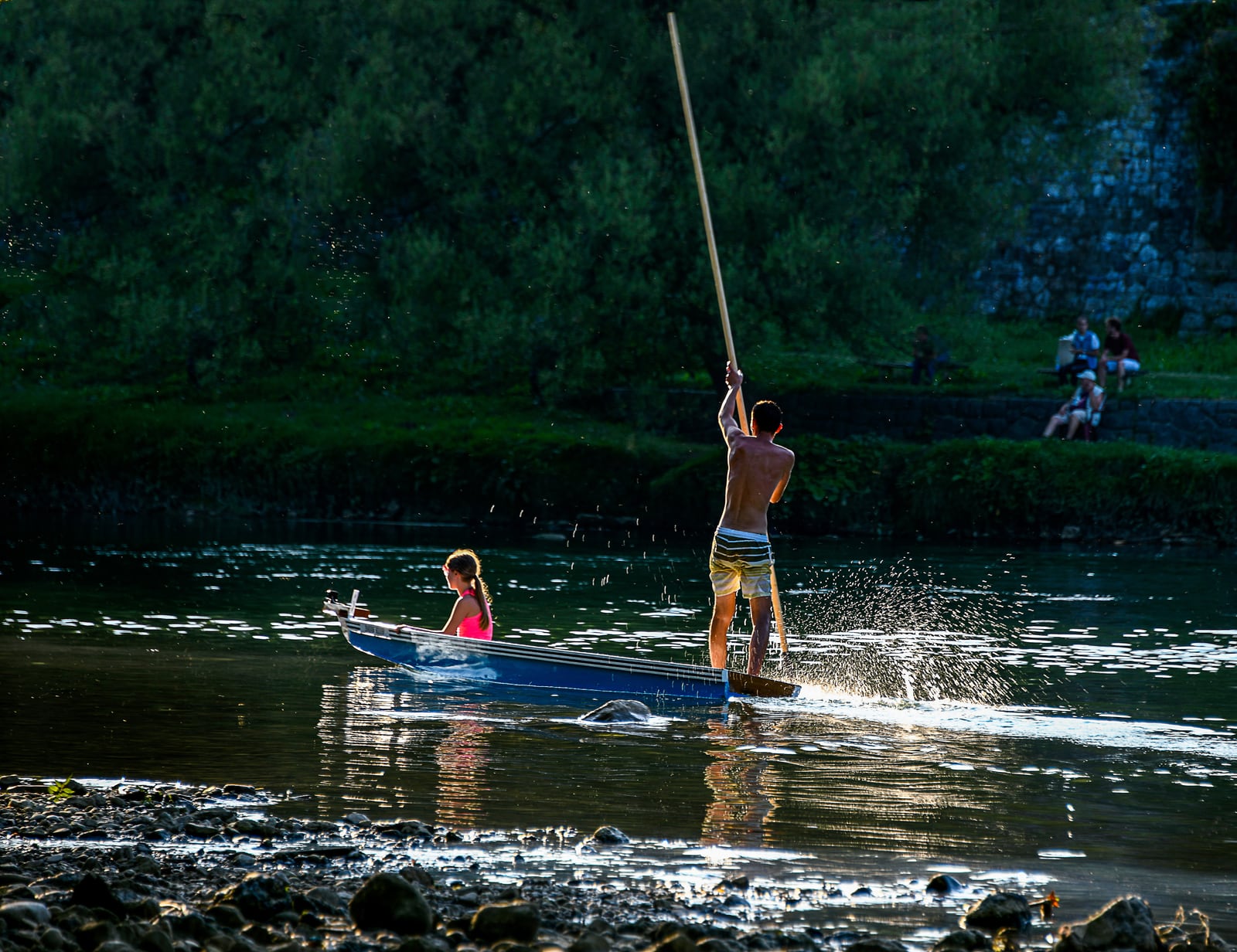
On the Vrbas, the engine disappears into the water. A boatman stands at the stern, reaches a long wooden pole ahead of him, finds the riverbed, and walks his hands down the shaft. The narrow hull slides upstream. The pole is the dajak; in Banja Luka, its name also belongs to the boat.
That submerged point of contact is the reason to take the ride. A dajak is not a generic sightseeing skiff with local paint, and it is not a canoe waiting for a passenger to paddle. It is a long, shallow Banja Luka craft shaped around one particular urban reach of the Vrbas, where a practiced dajakaš can use the bottom against the current [2][3]. Watch the pole plant, the brief flex through the boatman’s body, and the release. The city advances one push at a time.
Make this a single-anchor visit: book the direct one-hour daylight ride from Dajak Center, arrive at the landing below Klub 22, and let the object explain the river. The operator currently advertises the ride at €25 per person and lists three passengers per boat; treat those as the quoted tariff and capacity, then reconfirm the total, payment method, and full party composition before setting out [1][4]. In summer, request one of the final one to two daylight hours before local sunset—late enough for softer light, early enough to see the pole enter the water. That window is an editorial preference, not a published timetable; weather, river level, and the club’s live schedule win.
The pole is not an accessory
Official city tourism material describes a dajak as about seven metres long. Its working territory historically extended along roughly 15 kilometres of the urban Vrbas, where shallow edges and a usable bottom made pole propulsion possible. Before the leisure ride, the boat moved people and goods both with and against the water [2]. Its logic is less “cruise” than local infrastructure refined into craft.
The pole has its own physical heft. A Banja Luka boatbuilder interviewed about the craft described a typical dajak pole as roughly four metres long and three kilograms, with a metal point fitted to the end that searches for purchase below the surface [8]. Those figures turn the apparently simple push into something legible: the dajakaš is repeatedly placing and recovering a long tool while balancing on a moving stern.
The first local move is therefore linguistic: call the long shaft the dajak, and call the person handling it the dajakaš. Do not ask where the paddle is. The pole must meet something solid below the surface; its repeated placement is steering, propulsion, and a reading of depth at once [2][3]. A passenger sees only the upper half of that conversation.
Notice how little wasted motion there is. The dajakaš works from the raised stern, plants forward, pushes through, then lifts before the current can trap the pole. On the downstream portion, the same stance becomes control rather than a race with gravity. A July 2026 local race began at 17:00 from the Dajak landing and judged speed, precision, skill, and knowledge of the Vrbas together [5]. The list matters: strength alone does not choose the next safe patch of riverbed.
The second local move is to remain a passenger. In July 2026, a public “be a dajakaš for a day” session let beginners try the pole only with experienced boatmen; a young local participant singled out balance as the hard part [6]. A normal tour is not that lesson. Stay seated unless the captain explicitly offers a supervised attempt under the day’s conditions.
Book the boat before walking to the river
The third move happens several days before the ride. Use Dajak Center’s direct tour page or the Dajak Club contact linked there, choose daylight rather than a night or multi-activity package, and confirm four items in one message: date and time, number of adults and children, per-person price, and the exact meeting pin [1][4]. A recent Banja Luka guide recommends contacting the club a few days ahead because of demand; the direct operator page also functions as a booking page [1][4]. Reservation reality is not “join the next departure.” It is arrange a boat.
This prevents a common price mistake. The direct operator listing describes a one-hour, €25-per-person city ride, while a third-party listing describes a broader five-hour city package that includes a dajak segment and has different pricing [1][7]. Those are not competing quotes for the same product. If the boat is the point, ask for the one-hour Dajak Center ride by name.
The fourth move is to navigate to the operator, not merely to “Vrbas River” or “Green Bridge.” The current direct listing pins Dajak Center at 44.7687604, 17.2052625; recent local guidance describes the starting point as the landing below Klub 22 [1][4]. Save both the pin and the words. A local directory names the place Plaža Abacija / Dajak pristanište, on Braće Čubrilovića by Club 22, 950 metres from the city centre, and lists no parking [9]. Walk or take a taxi when practical, and do not substitute the club’s business-contact address for the confirmed boarding pin. At river level, look for the club landing and the long narrow hulls rather than choosing whichever staircase happens to reach the water.
Arrive 10 minutes early. That is enough to find the descent, identify your captain, and hear the boarding instruction without turning a quiet landing into a half-hour wait. If nobody is present, message the booking contact; do not climb into a moored boat or ask an unrelated riverside business to improvise the reservation.
Let the boatman compose the seats
A dajak is long, but it is not spacious. The fifth move is to wait for the dajakaš’s exact boarding instruction, then take the seat assigned. Local reporting notes a traditional visual arrangement in which one passenger sits nearer the boatman and another nearer the decorated tip, but balance should outrank reenacting a photograph [4]. Tell the captain about every adult and child, limited mobility, or unease before stepping aboard. The current direct listing says three passengers per boat, while one recent family review describes two adults and two children riding together; disclose children’s ages and let the operator allocate the boat rather than assuming headcount alone decides it [1][7].
Keep your center of gravity low and follow the captain’s instructions rather than changing seats for a better background. The official tour includes safety equipment, insurance, waterproof bags, and water or a soft drink; ask where each item should go rather than spreading loose phones, bottles, and straps through the hull [1]. The sixth move is to put the phone away during boarding and use the waterproof bag for everything you would hate to drop.
Once settled, leave the dajakaš a clear working lane rather than turning around every few seconds with a camera. If you want the classic photograph of the full boat and upright pole, ask when the captain can safely pause or let someone make it from the bank.
The seventh move is to let one full propulsion cycle pass before taking any picture: reach, plant, push, release. After that, you will know what belongs in the frame. The image above freezes the planted pole, spray, low passenger, raised stern, and carved bow in one instant [10]. On the ride, those parts separate and recombine slowly enough to read.
Read the carved end before the fortress
The dajak has a recognition cue even when it is tied up. City tourism material calls its pointed, decorated end the špic and notes that the stern and tip are made from single pieces of wood. Individual tips can resemble restrained or aggressive animals, depending on the maker’s design [2]. The ornament is not a logo pasted onto a standard rental hull; it is where a functional boat becomes a personal object.
The eighth move is to look at the špic from the landing before boarding, when you can see its profile without twisting in your seat. Ask which boat you will take and whether its decoration has a name or story. Banja Luka’s official tourism writing places the dajak among the city’s symbols and frames a ride as a summer experience [3]. The specificity survives because the boats are handled as working craft, not props.
From the water, Kastel Fortress and the bridges supply the city recognition. The tourism office describes a circuit linking Green Bridge, the First Mill, Kastel, and the return to Green Bridge, while the direct operator promises a one-hour city view that includes Kastel [1][2]. Treat those names as the route’s vocabulary, not a guaranteed checklist. The ninth move is to ask before departure, “Which section can we do today?” River conditions and the assigned tour should decide the turning point.
Four visitor mistakes, and the better move
Mistake one: walking to a generic river pin and expecting a boat queue. The club uses reservations, and current local guidance directs riders to the landing below Klub 22 [1][4]. Better: book a few days ahead, save the Dajak Center pin, and arrive 10 minutes before the confirmed slot.
Mistake two: treating the dajak as a canoe lesson. The pole works through balance and knowledge of the bottom; even a public beginner session used experienced supervision [5][6]. Better: stay seated, watch the propulsion cycle, and try the pole only in a session explicitly designed for instruction.
Mistake three: comparing unlike prices. A direct one-hour ride and a five-hour city package are different products [1][7]. Better: ask for the named direct ride, start from its advertised €25 per-person tariff, and verify the live total, inclusions, and payment before leaving your accommodation.
Mistake four: booking “a dajak” without choosing day or night. In 2026, local coverage distinguished calm daylight rides from illuminated evening packages and advised advance contact; current night packages can add drinks, decorations, and a different price [4]. Better: choose daylight for reading the riverbed technique, or deliberately book night for atmosphere—do not discover the distinction at the landing.
The compact go plan
- Anchor: one direct Dajak Center ride; no second attraction is needed.
- Season: target fair-weather summer; June–July 2026 local coverage confirms the current season and public events, but weather and river conditions control departures [4][5][6].
- Best time: request one of the final one to two daylight hours before local sunset; treat this as a preference, not a published departure.
- Reservation: contact the club several days ahead, then reconfirm on the day if weather or river conditions look unsettled [1][4].
- Meeting cue: Dajak Center pin 44.7687604, 17.2052625, at the landing below Klub 22 [1][4].
- Time: arrive 10 minutes early; the direct listed ride lasts one hour [1].
- Spend: the direct page advertises €25 per person, with child discounts described separately; reconfirm the current total and payment method [1].
- Capacity: the direct page lists three passengers per boat; disclose every adult and child because a recent family review records a different arrangement [1][7].
- Seat: board when invited, accept the captain’s placement, stay low, and keep the stern working area clear.
- Carry: compact clothing and footwear, sun protection, and only essentials; use the provided waterproof bag and safety equipment [1].
The dajak changes the scale of Banja Luka. From the bank, the Vrbas is scenery running through the city. From the low seat, it becomes a surface with a hidden floor, and every metre upstream has to be found before it can be crossed. Watch the boatman reach forward. The next piece of Banja Luka is wherever the pole lands.
Sources
- Dajak Center Banja Luka, “Discover Banja Luka on the Dajak Boat” — primary operator listing for the one-hour ride, €25 per-person price, three-passenger boat capacity, meeting pin, booking, safety equipment, waterproof bags, drink, and child terms.
- Tourism Organization of the City of Banja Luka, “Dayakcentre s.p.” — official description of the seven-metre craft, 15-kilometre urban operating reach, former transport role, pole-derived name, carved tip, and Green Bridge–First Mill–Kastel route.
- Tourism Organization of the City of Banja Luka, “Adventure—another name for Banja Luka” — official local account of upstream pole propulsion, decorated boats, summer rides, and the dajak as a city symbol.
- Ultra Magazin, “Ljeto u Banjaluci službeno može početi: Otvorena je sezona dajak vožnji” (June 11, 2026) — recent local guidance on daylight versus night rides, booking several days ahead, the landing below Klub 22, passenger placement, and an experienced dajakaš at the stern.
- Željka Šobot, “U sklopu ‘Ljeta na Vrbasu’: Trka dajak čamaca,” Banjaluka.com (July 25, 2026) — recent local confirmation of the 17:00 race at Dajak landing and the role of precision, skill, and river knowledge.
- Klix.ba, “Dajak nije samo čamac, već dio identiteta grada” (July 5, 2026) — recent account of the supervised public learning event, participant experience of balance, and the club’s heritage work.
- NowThingsToDo, “Banja Luka City Tour & A Magical Journey on Dayak Boat” — five-hour third-party package listing and user-review feed, used to distinguish the package from the direct one-hour ride and to qualify party-size assumptions.
- Banjaluka.com, “Evo kako se izrađuju dajak čamci” (August 25, 2017) — local interview with a dajak builder on the pole’s approximate four-metre length, three-kilogram weight, and metal point.
- Banja Luka City, “Plaža Abacija | Dajak pristanište” — local directory entry for the pier by Club 22 on Braće Čubrilovića, its 950-metre distance from the centre, and the absence of on-site parking.
- Cikajoca, “Dajak.jpg,” Wikimedia Commons — catalogue page for the real photograph made during a dajak race on the Vrbas in Banja Luka on August 4, 2019 (CC BY-SA 4.0).