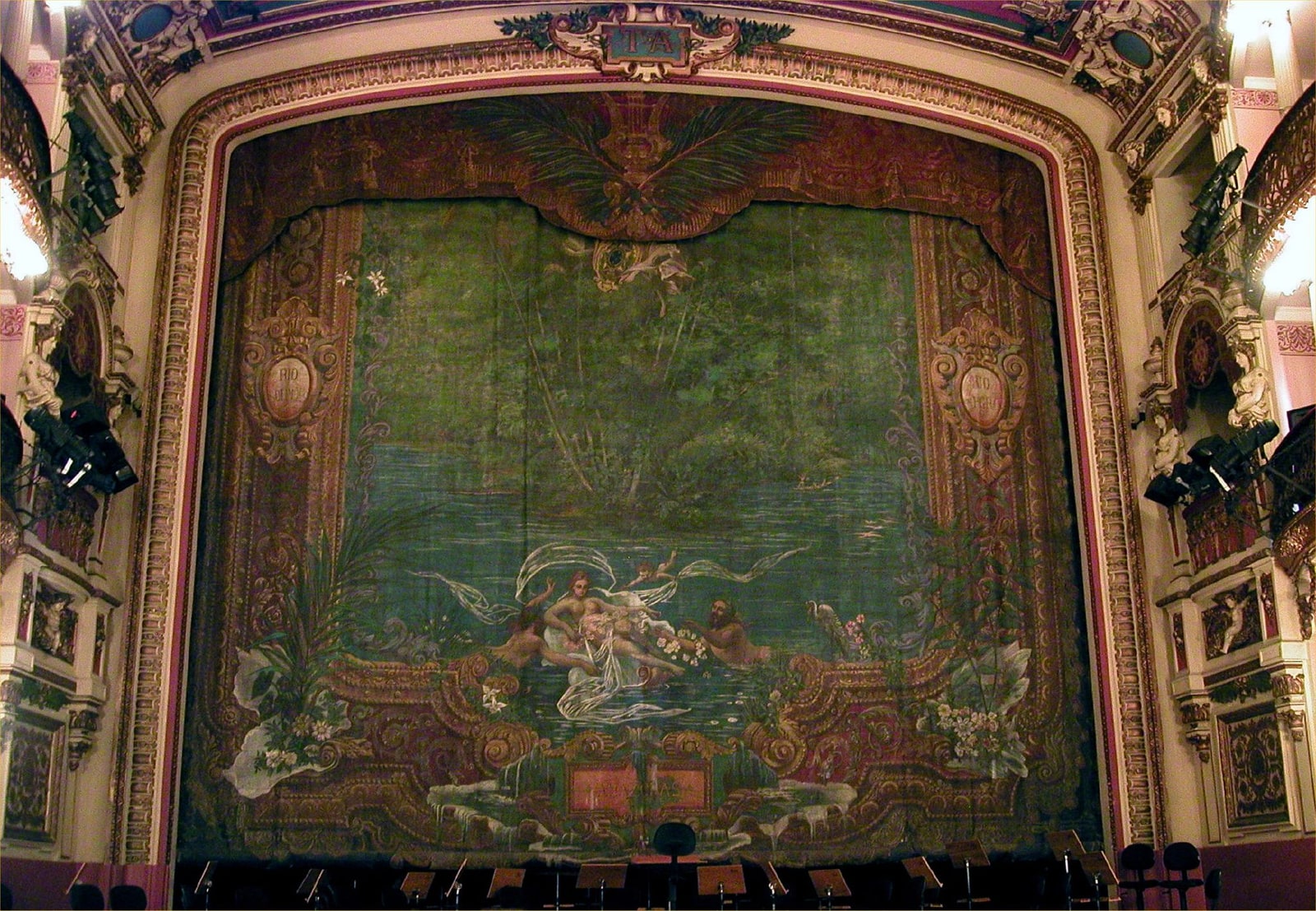
The first thing most visitors see at Teatro Amazonas is the dome. The more revealing thing is a river.
Inside the auditorium, the theatre's 1894 pano de boca—the painted house curtain—shows the meeting of the dark Rio Negro and the pale Solimões. Crispim do Amaral put that Amazonian confluence where a European opera house would normally place a ceremonial image between audience and stage.[1] Read it before the gilding. The curtain turns a famous monument from an imported Belle Époque trophy into a more complicated Manaus room: European forms, Amazonian imagery, rubber wealth, civic ambition and a theatre that still performs.
That order has become newly useful. On 27 July 2026, UNESCO inscribed “Amazonia Theaters” on the World Heritage List. The serial property joins Teatro Amazonas and Largo de São Sebastião in Manaus with Theatro da Paz and Praça da República in Belém; it does not crown one isolated building floating above its city.[2][3] UNESCO's own description emphasizes both sides of the ensemble—French and European architectural influence, and decoration that evokes the Amazon.[2]
So keep this visit deliberately small. The theatre is the sole anchor; the Largo is its threshold, not the start of a second sightseeing circuit. Allow 75–90 minutes, budget R$0–20 for admission, and make the guided interior—not a facade photograph—the point.
The visit begins before the 09:00 door
The first local move is to check the official theatre page on the morning you go. Its current service box lists guided visits Tuesday–Saturday, 09:00–17:00, and Sundays and public holidays, 09:00–13:00. It lists full admission at R$20, half admission at R$10, and free entry for people born in Amazonas who show proof of naturality, people with disabilities and children through age 10; other concession categories require proof.[1] Bring the relevant document rather than trying to resolve eligibility at the counter.
Those hours are an operating range, not a promise that every minute is available. Teatro Amazonas remains an active performance house, and special programming can alter visits. Local newspaper A Crítica documented a 09:00–13:00 holiday schedule in May 2026 and repeated the state culture department's advice to verify before travelling.[6] The official page itself publishes the box-office telephone, (92) 3622-1880, but no advance-tour reservation link.[1]
The second move is therefore an editorial best bet, not a guarantee: choose Wednesday or Thursday, reach Largo de São Sebastião around 08:40, and ask for the first available guided slot when the box office opens. A February 2026 r/Manaus thread explains why the 20-minute buffer matters. One recent visitor reported easy same-day entry; another found the early sessions sold out, returned the next morning, and received an 11:30 place after earlier times had filled.[8] Community evidence conflicts because real days differ. The honest conclusion is not “there is never a queue” or “you must book online.” It is: confirm the live system, arrive early, and keep one later slot free.
The third move happens at the counter. Ask three short questions before paying: What is the next departure? In which language? Is today's full circuit open? The official listing promises a guided visit but does not publish a language timetable or guarantee every room on every day.[1] A visitor who needs English, step-free access or a fixed departure should call ahead; the venue lists accessibility for physical, visual and hearing disabilities, but individual needs still deserve confirmation.[1]
For navigation, use Avenida Eduardo Ribeiro 659 as the address and the multicoloured dome above Largo de São Sebastião as the recognition cue.[1] The current Google Maps surface is useful for the live entrance pin and recent arrival photographs, not as authority over official hours.[9] Stand across the Largo long enough to see the whole facade, then go to the staffed entrance. Do not spend your first half-hour circling decorative doors in search of a self-guided route.
Let the guide establish the building
The fourth move is to accept the guided circuit as the form of the visit. This is not a museum in which speed produces value. Portal Amazônia's local account identifies the principal sequence as the auditorium, Salão Nobre and theatre museum, including rooms that hold photographs, performance history and dancers' objects.[5] Stay with the group, keep stair and balcony edges clear, and ask before making a photograph when the guide is speaking or a room is in use.
That restraint prevents the standard guided-tour failure: racing ahead to claim an empty frame, then missing why one room follows another. Teatro Amazonas opened on 31 December 1896 after a long, interrupted construction process. Brasiliana Fotográfica's archival history traces the project from an 1881 proposal through the 1884 cornerstone, suspended works and the final opening; its early photographs record a building made to announce that Manaus had entered an international urban and cultural circuit.[7] The guide is not delaying the “real” sight. The sequence is the sight.
The fifth move comes when the auditorium opens: resist looking up for a moment. The official venue description counts 684 seats across the stalls and three tiers of boxes, then directs attention to the concave ceiling, Paris-painted panels, bronze chandelier and masks of composers and playwrights.[1] All of that is worth seeing. But first face the stage.
If the house curtain is lowered, find the two bodies of water before studying the proscenium. If it is raised for rehearsal or stage work, ask the guide about Crispim do Amaral's image instead of treating its absence as a failed visit. The curtain was painted in 1894, before the theatre opened, and its subject is the meeting of the Negro and Solimões.[1] It gives the room a geographic center that imported marble, chandeliers and metalwork cannot supply.
This is not a tidy claim that local imagery cancels the economics of the building. IPHAN places Teatro Amazonas inside a historic center transformed by the rubber boom, when latex exports connected Manaus to industrial demand abroad and financed an ambitious European-profile urban program.[4] UNESCO similarly reads the theatre and its public square as expressions of wealth and political ambition during the rubber cycle.[2] The river curtain does something more interesting than absolution: it shows a city trying to picture itself inside the cosmopolitan machine it had purchased.
Carry the river into the Salão Nobre
The sixth move is to keep that tension alive upstairs. In the Salão Nobre, the official account identifies Domenico de Angelis's 1899 ceiling painting, The Glorification of the Fine Arts of the Amazon.[1] Brasiliana adds Amazonian fauna and flora in the wall hangings and four kinds of wood in the geometric floor, alongside Murano glass and the room's European decorative grammar.[7] The useful question is not “Which parts are local?” as though the room were a parts inventory. Ask how a late nineteenth-century elite staged Amazonian place through materials, allegory and imported prestige.
The seventh move is to notice that the building did not freeze in 1896. The theatre museum holds evidence of later performance life, including Festival Amazonas de Ópera stage models and objects connected to dancers who appeared here.[1][5] The July 2026 World Heritage decision recognizes historical significance; it does not turn the house into a mausoleum. Current event programming is precisely why a tourist circuit may shift.[1][3][6]
Once the guide releases the group, do not immediately bolt for another named attraction. Take 10 minutes back in the Largo and look at the dome again. The official description says its skin contains 36,000 pieces in the Brazilian flag's colours, imported from Alsace.[1] After the interior, that number should no longer read as a simple luxury statistic. The dome announces long-distance supply; the curtain answers with two rivers meeting locally; the theatre holds both statements at once.
That is the eighth move and the end of the portrait. Leave while this one building is still coherent.
Four visitor mistakes, corrected
Mistake one: arriving on Monday or near the final listed hour. The current official schedule begins on Tuesday, and performances or holidays can compress the circuit.[1][6] Better: recheck the official page, use a morning weekday and preserve a later slot as backup.
Mistake two: assuming “buy on arrival” means “walk straight in.” Recent local reports include both smooth entry and sold-out early departures.[8] Better: arrive before opening, ask for the next allocated tour, and call the official box office if a fixed time or access need is non-negotiable.[1]
Mistake three: collecting only the facade and dome. That produces the least specific version of Teatro Amazonas: ornate opera house in an unexpected latitude. Better: take the guided circuit and let the 1894 river curtain establish the auditorium before the ceiling and gold take over.[1][5]
Mistake four: calling the 2026 designation an award for one building. UNESCO lists a serial property across Manaus and Belém, and includes each theatre's public-space setting.[2][3] Better: keep this visit tight while remembering that the heritage argument is urban and regional, not a solitary-monument superlative.
The go details
- Anchor: Teatro Amazonas; Largo de São Sebastião functions only as its arrival and exit room.
- Best window: Wednesday or Thursday, 08:40–10:30, subject to the theatre's live program. Official visits begin at 09:00.[1]
- Time needed: 75–90 minutes, including same-day ticket allocation, the guided circuit and a 10-minute exterior reread. This is a planning budget, not a guaranteed tour duration.[1][5][8]
- Expected spend: R$20 full, R$10 concession, or R$0 for the official free-entry categories with proof; verify before arrival.[1]
- Queue and reservation reality: the official page gives a box-office contact but no tour-booking link; recent community accounts disagree on immediate availability, so treat same-day entry time as uncertain.[1][8]
- Navigation cue: Avenida Eduardo Ribeiro 659 → multicoloured dome at Largo de São Sebastião → staffed entrance / box office. Use the live map pin only to finish the approach.[1][9]
- Where to stand: begin across the Largo for the full facade; inside, let the guide place the group and keep balcony rails, aisles and doorways clear.
- What to ask: next departure, tour language, rooms open today, photography rule and any access accommodation you require.
- What to read first: the Meeting of the Waters curtain when visible; if it is raised, ask about it before moving your attention to the ceiling.[1][10]
- Live check: performances, rehearsals and holiday operations can change the circuit. The building's active cultural life outranks this itinerary.[1][6]
Teatro Amazonas is often introduced as proof that rubber money could import Europe into the forest. The guided rooms complicate that sentence. Europe is in the structure, ornament and ambition; Manaus is in the river image, the public square, the later performers and the continuing argument over what this house represents.
Read the river first. The gold becomes more legible afterward.
Sources
- Secretaria de Cultura e Economia Criativa do Amazonas, “Teatro Amazonas” — current official visiting hours, guided format, admission, concessions, address, accessibility, auditorium data and interior-art descriptions.
- UNESCO World Heritage Centre, “Amazonia Theaters” — 2026 serial-property listing, component parts, criteria and interpretation of the theatres' European and Amazonian attributes.
- Brazilian Ministry of Foreign Affairs, Ministry of Culture and IPHAN, “Inscrição dos Teatros da Amazônia na Lista do Patrimônio Mundial da UNESCO” (27 July 2026) — official decision date and scope of the recent inscription.
- IPHAN, “Manaus (AM)” — institutional history of the rubber-boom city, historic center, Teatro Amazonas's 1896 opening and 1966 federal listing.
- Portal Amazônia, “Visitas ao Teatro Amazonas revelam história, arte e arquitetura do principal cartão-postal de Manaus” (16 August 2025) — local reporting on the guided room sequence, museum and visitor service.
- A Crítica, “Espaços culturais de Manaus terão horário de funcionamento especial no feriado do Dia do Trabalhador” (30 April 2026) — recent local confirmation that holiday programming can alter visit hours.
- Brasiliana Fotográfica / Fundação Biblioteca Nacional, “Série ‘Teatros e cinemas do Brasil’ VII — O Teatro Amazonas” — archival photographs and sourced construction, opening, decoration and performance history, updated for the 2026 inscription.
- Reddit / r/Manaus, “Dúvida sobre visitar o Teatro Amazonas” (10 February 2026) — recent community reports on same-day ticket allocation, early-slot sellouts and the need to check event closures.
- Google Maps, “Teatro Amazonas, Manaus” — current community mapping, entrance-orientation and recent visitor-photo surface.
- Wikimedia Commons, “File: ‘Meeting of the Waters’ by Crispim do Amaral” — source page for Brian Snelson's real 2003 auditorium photograph used as the article image.