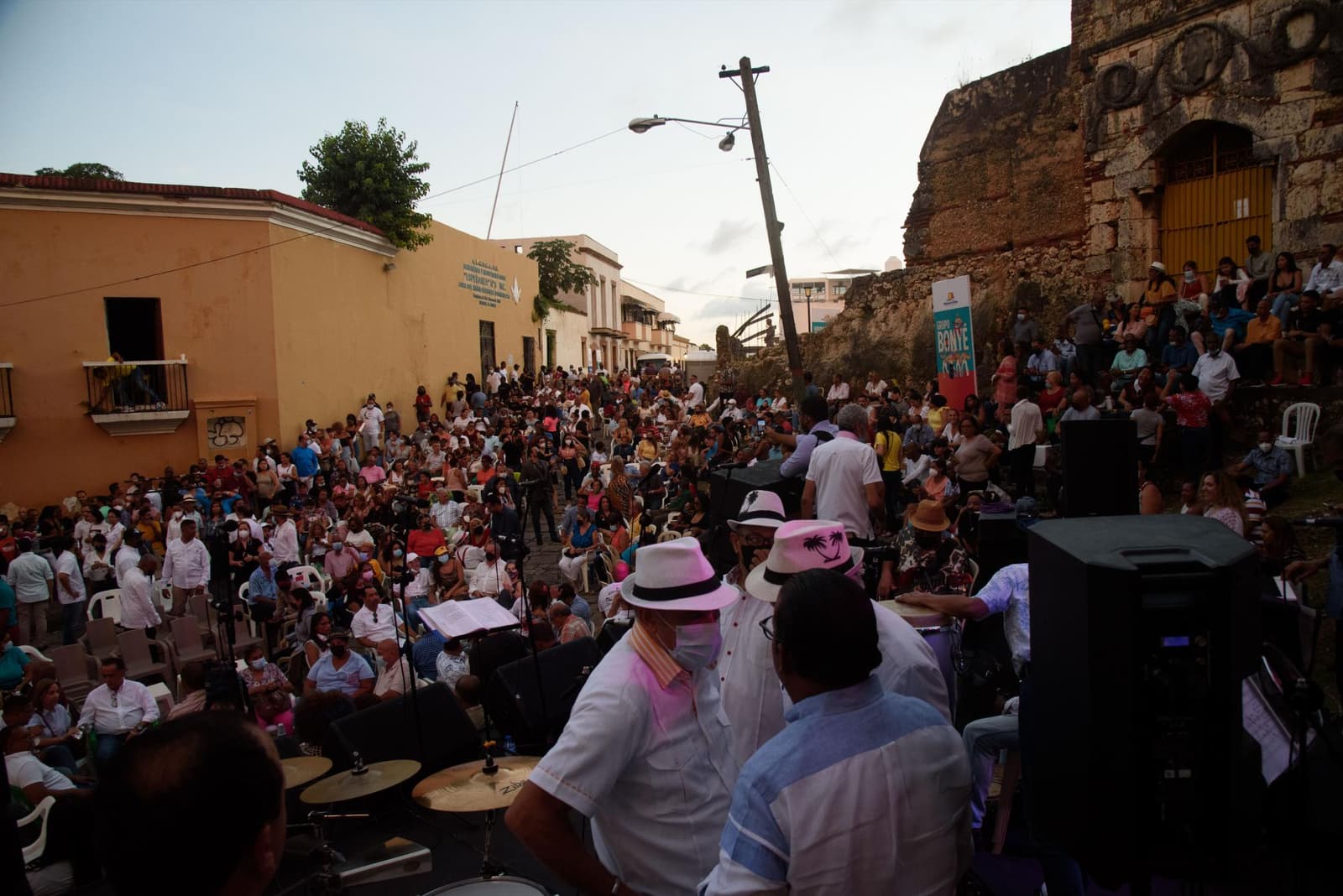
At 18:00 on Sunday, the Ruinas de San Francisco are easiest to misunderstand. The monastery does not reopen. Santo Domingo opens a dance floor beside it.
Grupo Bonyé makes the distinction audible. Son, merengue and salsa travel across a block where a sixteenth-century religious complex now stands under protection and reinforcement. People arrive to listen, greet, dance and occupy the public edge; the old stone is a wall to read, not a grandstand to climb. A good visit therefore depends on two kinds of attention at once: follow the living rhythm, and respect the boundary holding the ruin in place.
This Sunday gathering has the reputation of a permanent appointment, but permanence is precisely what a visitor should not assume. The Ministry of Tourism's live Turizoneando 2026 agenda schedules “Bonyé Pone el Son” at the Ruinas de San Francisco for Sunday, August 30 at 18:00, and identifies the program's activities as free [5]. A local agenda published on August 13 also placed Bonyé at the ruins at 18:00, while a live dance calendar lists 18:00–22:00; yet an August 9 notice called that night's performance the last encounter of a season [2][3][4]. The official Bonyé feed—not an old screenshot—is the final check [1].
Keep the experience tight: one gathering, one ruin-side block, about three hours. Arrive between 17:15 and 17:30, stay through at least two musical phases, and leave while the surrounding streets still carry the event's outward flow. Admission is listed as free [3][5]. The scarce things are shade, chairs, sightlines and room to dance.
Make the live check part of Sunday
The first local move happens before lunch. Open Bonyé's official account and confirm three items for that date: the performance is on, the start time, and the precise stage edge [1]. Then compare the live pin or current event post with the generic label “Ruinas de San Francisco.” A weekly tradition can still pause for weather, production, a special program or conservation work; the August listings' different wording is enough reason not to build a night around memory [2][3][4].
Do not outsource this check to a hotel desk's recollection or a search snippet. Save the newest post, not the prettiest one. If the official channel has not confirmed the date, treat Bonyé as unconfirmed and choose another evening plan. That boundary is more useful than the false confidence of “every Sunday.”
The second move is to navigate to the gathering, not to a notional monastery door. The current community map surface places Grupo Bonyé at F4G7+H96 on Calle Emiliano Tejera, on the Ruinas block [9]. A March 2026 local report describes the gathering at Hostos and Emiliano Tejera, while a recent Couchsurfing listing directs visitors behind the ruins at Duarte and Juan Isidro Pérez [8][10]. These are useful field descriptions of different exterior edges, not a permanent site plan. Let the latest official post and the visible event setup overrule them [1].
From Parque Colón, allow an editorial 8–12 minutes on foot for the roughly northward approach, plus extra time if pedestrian works redirect the final block [9]. Keep the route simple. Walk toward the live pin; on arrival, look for event chairs, sound equipment, staff and the Bonyé sign. Do not hunt through fencing for a hidden entrance.
Arrive before a free event becomes a full room
The third move is to arrive before the advertised start without behaving as if early arrival purchases territory. A 2021 Diario Libre gallery shows how quickly the sloped street edge, chairs and standing space can fill; its photographs also show people arriving well before the performance [12]. For an 18:00 listing, 17:15–17:30 is a useful planning window. It gives enough time to read that day's layout and too little time to turn the block into another monument stop.
If organizers have placed chairs, use an unclaimed one only if the seating area is plainly open. Do not move chairs into an aisle, reserve a row with bags or treat the first clear patch in front of a loudspeaker as premium space. If you are comfortable standing, the outer side of the dance area is often the more flexible position: you can see the crowd organize itself, step forward when invited and step back without cutting through seated listeners.
The fourth move is to read the protection line before reading the stage. In June 2026, local reporting described a temporary armature of steel, treated timber and other reinforcement surrounding the Ruinas del Convento de San Francisco [7]. Fencing and closed masonry are not visual clutter to evade. They are the current condition of the place.
Never sit on a ruin wall, climb a ledge for a photograph, lean equipment against the stone or cross a barrier because other people appear to have done so. Choose a street edge, event chair or open standing lane. The concert's civic magic comes from public space working next to vulnerable fabric, not from using that fabric as furniture.
Let son explain the room before you dance
The fifth move is to spend the first 15 minutes listening without trying to classify the whole night as “a salsa show.” Current local coverage names son, merengue, salsa and other Dominican and Caribbean rhythms; another 2026 event listing also includes jazz and bachata [2][3]. The repertoire can move. Do not arrive demanding one genre, one famous song or one photogenic dance style.
That openness is built into the group's history. Bonyé formed from friends who gathered around Afro-Caribbean music, and its name honors José María Guerrero, “Bonyé,” remembered as an important dancer of son [11]. In 2023, Listín Diario described the gathering after more than 16 years at the ruins and cited a doctoral ethnographic study presented at PUCMM that treated it as a cultural practice in public space, not merely a recurring gig [6]. The most Santo Domingo detail is architectural and social at once: the same ruin-side ground described as parking during the week became a Sunday place for leisure, encounter and dance [6].
Listen for that change of use. Before the crowd is fully loose, the chairs make the block resemble an outdoor concert. As couples begin to turn and standing listeners open small pockets, it becomes a social floor. The ruin has not changed function; the street has.
The sixth move is to join at the crowd's scale. Watch one complete song from the edge. Notice where couples enter, where they finish, and which strip remains a circulation lane. If someone invites you and you want to dance, a smile, eye contact and a clear yes are enough. If you initiate, ask rather than pulling. One song is a complete exchange; thank your partner afterward instead of assuming the next one.
Beginners do not need to perform expertise. Keep steps compact, protect other people's feet and leave aerial moves to a controlled stage. Spectators should keep phones at chest height and avoid holding a lens over a dancer's shoulder. Make one short record if you need it, then return the space to the people producing the atmosphere.
Leave by the same living edge
The seventh move is to let the live event shorten your plan. If rain, a security instruction, construction access or a denser-than-comfortable crowd redraws the block, move back or leave. Do not use “I came for Bonyé” as a reason to press through a working lane. A free public gathering has no obligation to reproduce the photograph or timetable you saw online [1][7][9].
This also means accepting a shifted stage without calling the night inauthentic. Recent sources place the gathering on different exterior edges of the same Ruinas block [8][10]. The stable anchor is the programmed gathering beside San Francisco; the exact speaker stack is operational detail.
The eighth move is to reverse the approach while the event is still legible around you. For a first visit, 20:30–21:00 is a sensible exit window: long enough to hear the room change, early enough to retrace the short walk toward Parque Colón before the listed 22:00 finish [3][9]. If you stay to the end, recheck your onward transport rather than assuming every quiet cross-street is an equally useful pickup point.
Carry out what you brought in. Buy nothing unless you want it; admission remains the experience. If you do purchase a drink or snack, read the posted price before ordering and keep cups out of the dance lane and off the masonry.
Four visitor mistakes, corrected
Mistake one: treating “every Sunday” as a confirmed ticket. August 2026 pages disagree about whether one date closed a season even while later listings continued to advertise the ritual [2][3][4]. Better: check Bonyé's official feed on the same Sunday and confirm date, time and stage edge [1].
Mistake two: arriving at 18:00 and expecting a front-row chair because entry is free. Photographic evidence shows a large crowd and early arrivals, while current listings show no paid reservation mechanism [3][5][12]. Better: reach the block 30–45 minutes early, take only clearly open seating and plan to stand.
Mistake three: using the ruin as a seat, shortcut or camera platform. The monument remains under active protection and reinforcement [7]. Better: stay on the event surface, obey every barrier and let the old stone frame the gathering without bearing your weight.
Mistake four: filming the first song and leaving with a generic “Latin music” clip. Bonyé's specific lineage runs through son, a named dancer and a long public-space practice [6][11]. Better: listen for 15 minutes, watch how the room turns from concert to social floor, and join only at the crowd's compact scale.
The go details
- Anchor: Grupo Bonyé's Sunday gathering on the public edge of the Ruinas de San Francisco. The protected monastery is context and boundary, not a second attraction to enter.
- Best window: Sunday, 17:15–20:30, only after same-day confirmation. Current listings commonly place the music at 18:00–22:00, but seasonal and production language varies [1][2][3][4].
- Time needed: 2.5–3 hours: 30–45 minutes to arrive and read the setup, at least two musical phases, then the return walk.
- Expected spend: RD$0 admission [3][5]. An optional RD$500–1,000 personal buffer for a simple refreshment or short local transport leg is a planning envelope, not a quoted Bonyé tariff.
- Queue and reservation reality: current pages list free entry and no advance ticket link. Space and sightline—not admission—are the practical constraints, so early arrival matters [3][5][12].
- Navigation cue: Grupo Bonyé, F4G7+H96 on Calle Emiliano Tejera → Ruinas de San Francisco block → visible event setup. Hostos at Emiliano Tejera and Duarte at Juan Isidro Pérez are useful recent approaches, not guaranteed permanent entrances [8][9][10].
- Where to stand or sit: use only event-set chairs or an open outer edge of the dance area. Keep speaker fronts, circulation lanes, restoration fencing and every stone ledge clear.
- What to do first: hear one full song and spend 15 minutes learning the floor before dancing or filming.
- What to wear: compact, comfortable shoes for paving and dancing; carry water and a light rain layer for an open-air evening. Avoid loose bags that widen your footprint in the crowd.
- Live check: the official Bonyé account outranks weekly aggregators, old photographs and this article whenever date, weather, stage position or access changes [1].
Bonyé does not rescue the Ruinas de San Francisco from being ruins. It does something more careful. For a few Sunday hours, people make a civic room along the protected edge: music in front, old stone behind, chairs becoming a dance floor one small opening at a time.
Check where the stage is. Keep the masonry clear. Then let the street teach you when to step in.
Sources
- Grupo Bonyé, official Instagram profile — primary channel to confirm the live Sunday date, start time, weather notice and current stage position.
- Acento, “ACENTO CULTURAL: Agenda cultural del 13 al 19 de agosto de 2026” — recent local confirmation of an 18:00 Bonyé gathering at the Ruinas de San Francisco and its Dominican and Caribbean repertoire.
- SalsaVida, “Bonyé en las Ruinas de San Francisco” — current dance-community listing for the August 30, 2026 event, 18:00–22:00 schedule, free entry, venue and organizer contact.
- Sinergya, “Disfruta el último encuentro de Bonyé esta temporada en las Ruinas de San Francisco” (9 August 2026) — recent local notice documenting the 18:00–22:00 free gathering and the conflicting “last of the season” boundary.
- Ministry of Tourism of the Dominican Republic, “Turizoneando” — official live agenda listing “Bonyé Pone el Son” at the Ruinas de San Francisco on 30 August 2026 at 18:00, within the free June 20–August 30 program.
- Listín Diario, “Bonyé, expresión cultural dominicana que busca ser patrimonio intangible de la humanidad” (27 October 2023) — local reporting on the gathering's 16-year continuity, weekday-to-Sunday change of use and a doctoral ethnographic study presented at PUCMM.
- 7 Segundos, “El primer monasterio de América lucha contra el deterioro en la Ciudad Colonial” (3 June 2026) — recent local reporting on the temporary steel, treated-timber and reinforcement structure protecting the Ruinas de San Francisco.
- El Nacional, “Zoom turístico: Grupo Bonyé, la sensación” (16 March 2026) — recent local account of the gathering's 2008 origins, son-centered identity and practical Hostos–Emiliano Tejera location.
- Google Maps, “Grupo Bonyé, Santo Domingo” — live community mapping, recent photographs and final-block orientation.
- Couchsurfing, “Free Live Music with Grupo Bonyé” (1 March 2026) — recent community event listing with the practical Duarte–Juan Isidro Pérez approach, free-entry note and 17:00–22:00 planning window.
- Visitantes, “Grupo Bonyé regresa a la Zona Colonial” — local account of the group's formation, repertoire and namesake, son dancer José María Guerrero “Bonyé.”
- Diario Libre, “Bonyé devolvió la alegría a la Zona Colonial” — source gallery for Francisco Arias's real November 2021 photograph, plus visual evidence of early arrivals, crowd density and the ruin-side event layout.