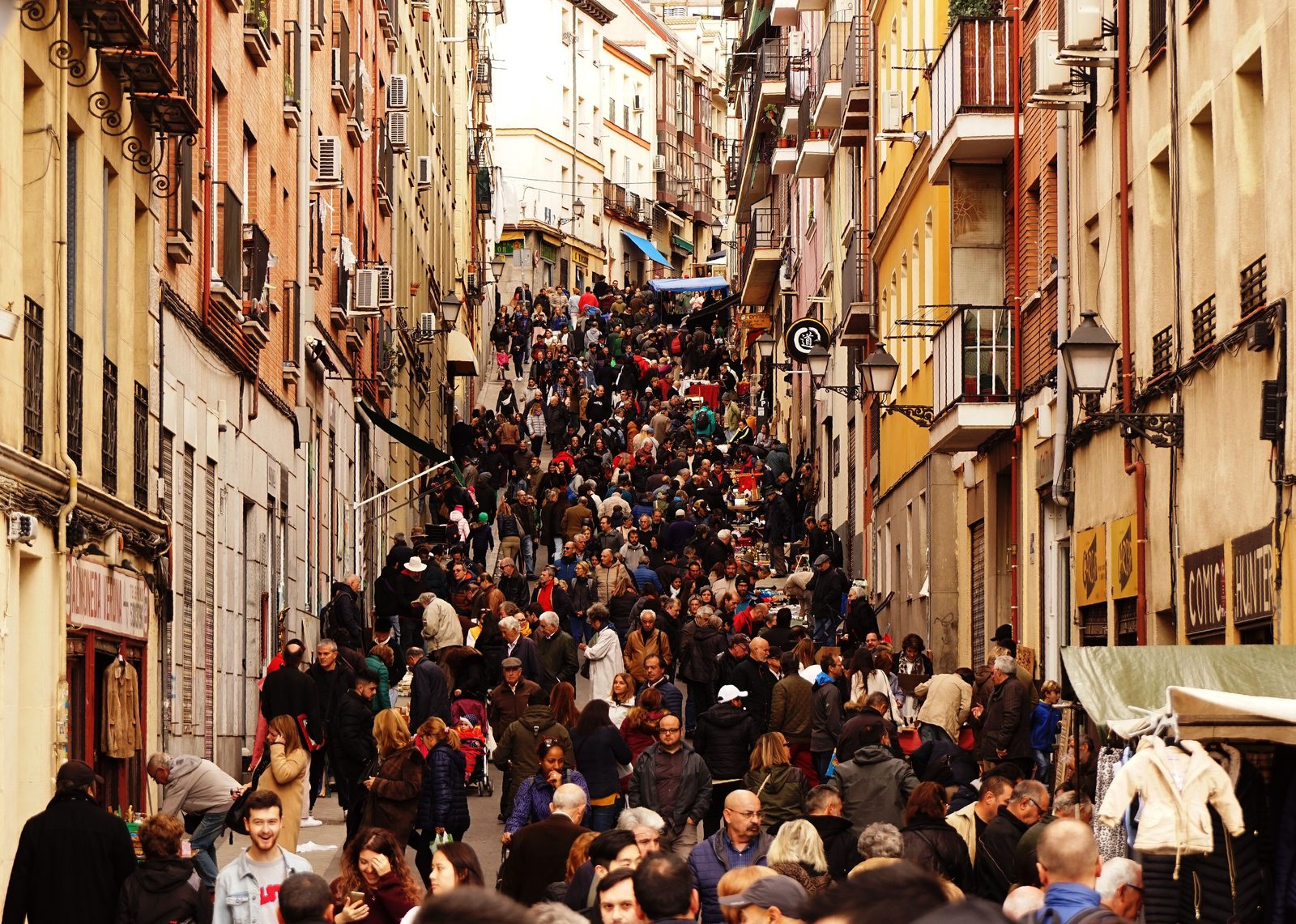
Madrid has a very specific Sunday physics. The city does not really wake by marching into a checklist; it wakes by loosening. That is why the useful local version of Sunday is not “do the sights early.” It is to let one crowded social machine carry you downhill, then step out of it before your energy gets flattened.
For that, two anchors are enough:
- El Rastro for the active part of the day — browsing, bargaining, crowd-reading, and deciding when to leave.
- Las Vistillas for the release valve — shade, terraces, skyline, and the small satisfaction of watching Madrid slow itself down.
This is a tight non-food route, and it works because both places belong to a recognizably madrileño Sunday rhythm. El Rastro has been running in this zone for more than 250 years, from 9:00 to 15:00 on Sundays and bank holidays. Tourism Madrid describes the broader Sunday spread as having more than 3,000 stalls, while a separate city page describes the core market triangle as hosting 1,000+ merchants.[1][2] The city’s own explanation of the name still carries the old abattoir memory: rastro, the trail left by carcasses moving down toward the tanneries.[1][2] Madrid Secreto frames the broader Sunday mood with another useful word: dominguero — the local habit of taking the day back into the streets, bars, antique lanes, and long late-morning drift.[5]
Image context: the cover image shows El Rastro’s dense street texture, which matters here because this article is really about how to use the market’s slope, crowd pressure, and side streets rather than treating it like a generic flea market stop.
Why the handoff matters
A lot of visitors treat El Rastro as a heroic endurance test and then wonder why Sunday in Madrid feels clogged by noon. The better local read is simpler: do the market while it still has shape, then get out before the main artery becomes the whole experience.
The Making of Madrid gives the key operational detail. The market sits between 4 metro stations — La Latina, Tirso de Molina, Puerta de Toledo, and Embajadores — but the top-of-hill start is the winning move, because Plaza de Cascorro lets you work with the slope rather than against it.[4] The same guide also gives the most useful reality check for shoppers: if you want genuine finds, 10:30 is already late; after that, the market is still worth doing, but more for atmosphere and social scanning than for first-pick antiques.[4]
That is why this route works best as a controlled 2.5–4 hour Sunday lane rather than an open-ended sprawl.
Anchor 1: El Rastro is not one street, and that changes the day
If you only grind down Ribera de Curtidores and call it done, you miss the part locals actually use. Tourism Madrid’s own route guide is explicit that the market is more than the main slope: San Cayetano, Carlos Arniches, Mira el Río, Plaza del General Vara del Rey, and Plaza del Campillo del Mundo Nuevo all change what kind of objects, pace, and people you get.[1][2]
So the practical sequence is this.
Start at La Latina or Tirso de Molina and enter near Plaza de Cascorro.[1][4] Give the main slope one clean first pass so you understand crowd density, then start peeling sideways. If you want painters’ stalls and a more specific visual identity, move through Calle de San Cayetano.[1] If you want old books, head toward Carlos Arniches and Carnero.[1] If you want the market to feel less souvenir-heavy and more like an old Madrid rummage field, drift toward Plaza del General Vara del Rey and Campillo del Mundo Nuevo.[1][4][5]
The Making of Madrid describes Vara del Rey as one of the best corners for the mix of quality antiques and true rummage energy, while Madrid Secreto adds the detail that the square still holds ungentrified bars and antique sellers with more bite than polish.[4][5] That is the right mood cue for the whole article: this is a Sunday you should steer, not complete.
The second anchor is a pressure release, not an afterthought
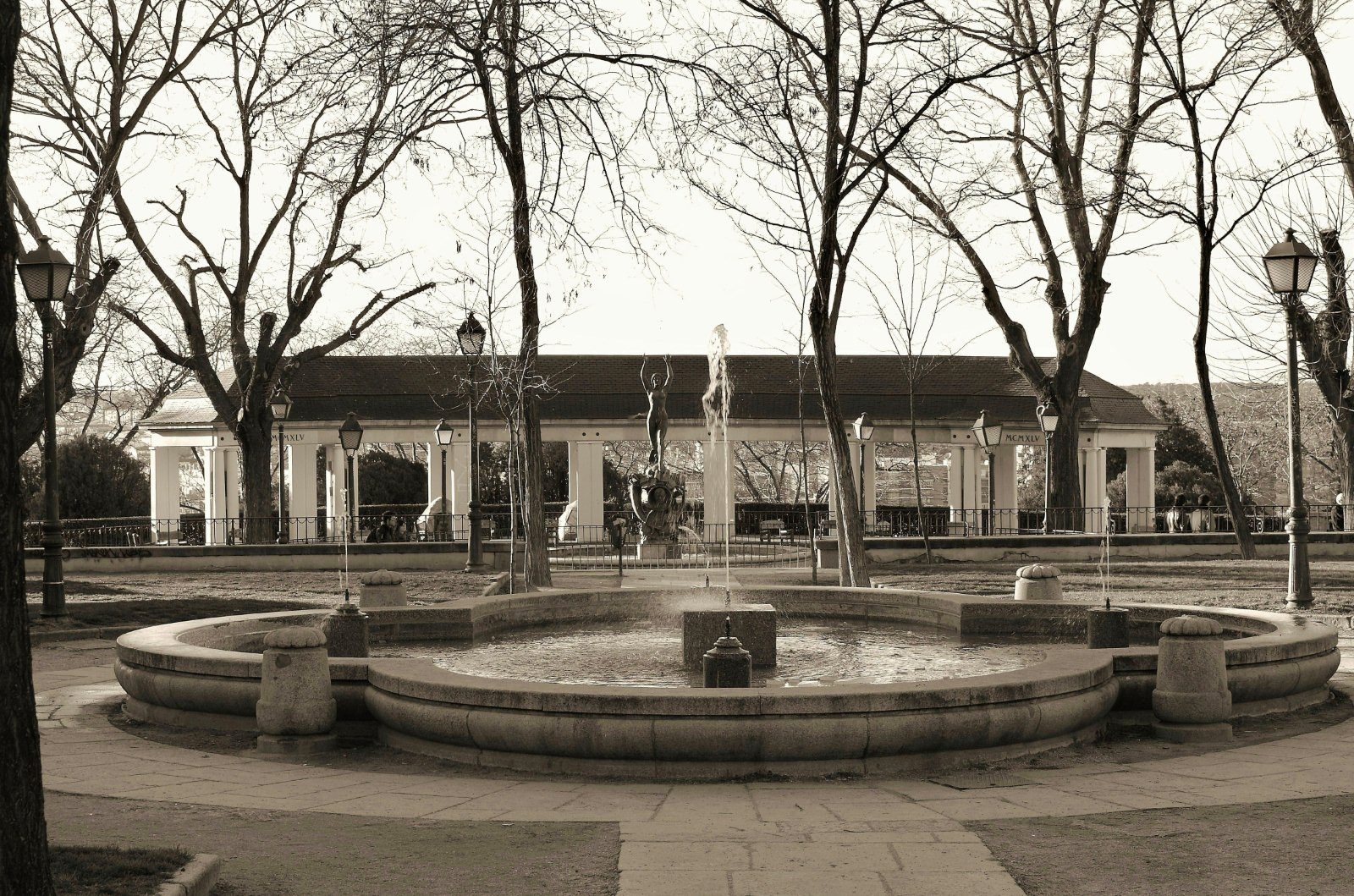
Las Vistillas works because it is close enough to feel like a continuation of the same Sunday, but different enough to reset your body. Tourism Madrid describes the gardens as 1.74 hectares, designed in 1932 and 1945, and still used in good weather as a terrace-and-sunset park with views over the Manzanares and Casa de Campo.[3]
That matters more than it sounds. After El Rastro, what most people need is not another attraction. They need air, shade, and a place where sitting down does not feel like queue management. Las Vistillas gives you that. If the market is the city’s Sunday inhale, this is the exhale.
It also gives you the cleanest decision point for a drink. Madrid’s Sunday logic absolutely allows the classic vermouth or beer handoff, but the better move is to let the market noise fall first and only then decide whether you want a terrace seat, a short bar stop, or just the view.[1][3][5]
The move is especially good once the market stops giving you signal. If by late morning you have already made one or two worthwhile detours, a west-facing terrace or edge bench at Las Vistillas does more for the day than another 45 minutes of shoulder-checking on Ribera de Curtidores.[3][7]
Eight local moves that actually change outcomes
- Start high, not low. Use La Latina or Tirso de Molina, not Embajadores or Puerta de Toledo, unless you specifically want to climb into the crowd.[1][4]
- Separate “buying time” from “atmosphere time.” If you care about objects, arrive around 9:15–10:00; after 10:30, treat the market as a street ritual first and a shopping mission second.[4]
- Do one main-street pass, then escape sideways fast. Ribera de Curtidores gives orientation; the side streets give character.[1][2]
- Use Vara del Rey as your calibration square. If the market still feels good there, keep going. If even that corner feels overcompressed, your exit window has arrived.[4][5]
- Carry cash, but keep it zipped and close. Local guidance is blunt: many stallholders still prefer cash, and crowded Sundays remain pickpocket territory.[4]
- Haggle only where the setup invites it. The Making of Madrid notes that bargaining is part of the pleasure when prices are not posted; forcing it on every stand just slows you down.[4]
- Let aperitivo be optional, not compulsory. Local Sunday culture around El Rastro often rolls into vermouth or beer in La Latina, but the smarter move is to do it only after you have left the market’s choke points.[1][5]
- Finish at Las Vistillas, not back at Cascorro. The route feels complete when the sound level drops and the view opens. That handoff is the whole point.[3][7]
Non-local traplines
Trap 1: entering from the bottom because it looks geographically closer
Better move: start near Plaza de Cascorro from the top and work downhill. Madrid’s slope is not decorative here; it determines whether the crowd feels legible or punishing.[1][4]
Trap 2: arriving at noon and expecting serious antique luck
Better move: if you want objects, be there before 10:30. If you arrive later, shift your goal to street texture, people-watching, side lanes, and one clean exit.[4]
Trap 3: staying on Ribera de Curtidores the entire time
Better move: use San Cayetano, Carlos Arniches, Vara del Rey, or Campillo del Mundo Nuevo to change the market’s texture and recover decision-making space.[1][2][4]
Trap 4: treating aperitivo as the next queue to conquer
Better move: leave the densest market zone first, then decide whether you want a vermouth, a beer, or just a seat with a view. Sunday in Madrid is supposed to loosen, not stack.[1][3][5]
Two clean Sunday versions, depending on what you want
If you want the route to feel even more controlled, split it in advance.
- Object-first Sunday: arrive around 09:15–09:45, enter high near Cascorro, do one fast slope read, then peel early toward San Cayetano, Carlos Arniches, and Vara del Rey while the market still has buying signal.[1][4] Once the object energy flattens, walk out to Las Vistillas and let the park finish the day.
- Atmosphere-first Sunday: arrive around 10:45–11:30, accept that you are shopping the social field more than the stalls, use Ribera de Curtidores only as orientation, then spend your real time budget on one or two side-street turns plus a slower landing at Las Vistillas.[1][4][5]
That way the day stops being a vague “Sunday plan” and becomes a route with a chosen payoff.
One-screen execution card
- Country / city: Spain, Madrid
- Anchors: El Rastro → Las Vistillas
- Best time window: 09:15–12:45 if you want shopping signal; 10:30–14:00 if you mainly want atmosphere and a terrace finish
- Expected spend range: €0–€15 if you browse without buying and finish with one drink; €20+ only if the market catches you with a small object or antiques impulse. A local guide’s city-centre rule of thumb is that even a simple glass can run above €4 once you stay central.[4]
- Queue / crowd reality: Plaza de Cascorro and the first stretch of Ribera de Curtidores compress early and stay dense; the market is fun when you redirect, tiring when you insist.
- Where to stand or sit: in El Rastro, keep moving until a side street or square changes the rhythm; at Las Vistillas, take a west-facing edge or terrace if you want the view to do the final work.[3]
- Navigation cue: if you can still hear the market but you can already see the skyline opening, you are moving correctly toward the finish.
Sources
- Tourism Madrid — A morning at the Rastro (hours, 250+ year continuity, 3,000 stalls across the broader Sunday spread, side-street structure, metro-start guidance, bar/vermouth context)
- Tourism Madrid — The Rastro (1740 documentary mention, core market triangle, 1,000+ merchants, street-by-street spread)
- Tourism Madrid — Vistillas Gardens (1.74-hectare park, 1932/1945 design, terraces, sunset/view context)
- The Making of Madrid — A Guide to El Rastro: Madrid’s Legendary Flea Market (2026 local guide with start-point advice, 10:30 antiques cutoff, 3-hour pacing, cash/pickpocket warning, Vara del Rey / Campillo read)
- Madrid Secreto — 10 planes de un domingo en Madrid para terminar la semana bien (Sunday dominguero framing, Rastro-to-aperitivo pattern, Vara del Rey local flavor)
- Google Maps community listing — El Rastro, Madrid (recent crowd, route, and street-level visitor/community signal)
- Google Maps community listing — Jardines de Las Vistillas, Madrid (recent community signal on park pacing, sitting, and viewpoint use)
- Wikimedia Commons image source (hero)
- Wikimedia Commons image source (in-article)