Luang Prabang's morning alms can be ruined by the exact instinct that brings visitors there: the need to possess the moment. The better dawn move is smaller. Decide before you leave the guesthouse whether you are an observer or a participant, reach the street early enough to settle down, and let the monks pass without making yourself part of the procession.
The ceremony, usually called Tak Bat or Sai Bat, is not a show that starts when tourists arrive. Luang Prabang's official tourism page describes it as a long-standing Lao Buddhist practice in which devotees offer food to monks every morning, with the main public window roughly 05:30-06:30 from March to October and 06:00-07:00 from November to February.[1] The same page names the old-city procession points that draw visitors, including the areas around Wat Xieng Thong, Luang Prabang Primary School, and the National Museum, while also warning that Sakkaline Road can crowd with tourists.[1]
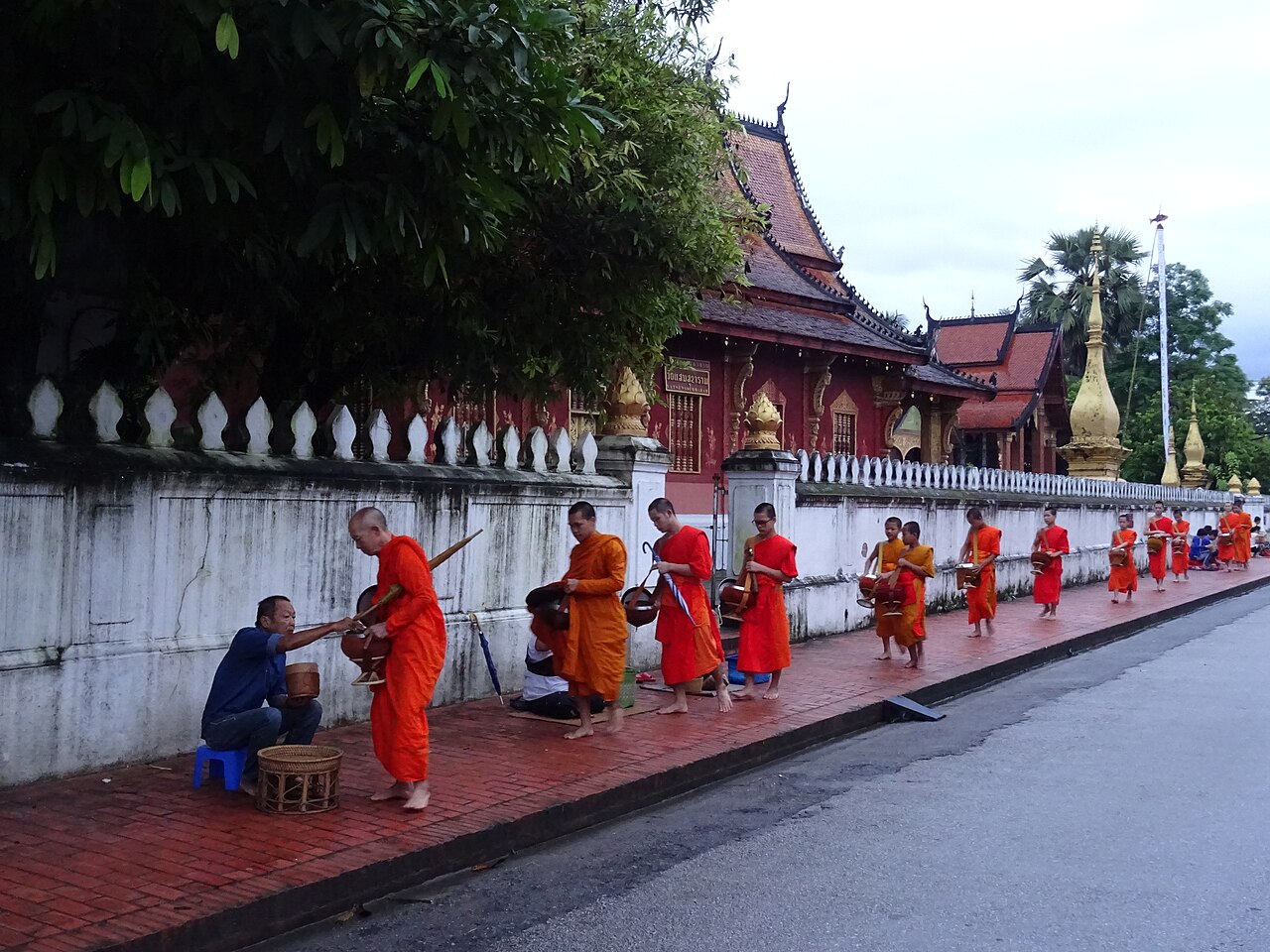
That distinction matters because Luang Prabang is a living religious city before it is a preserved travel image. UNESCO's World Heritage page frames the town as an unusually intact fusion of Lao urban structure, Buddhist temples, traditional houses, colonial buildings, rivers, and mountain landscape; it also notes that Buddhist rites and ceremonies remain active parts of local life, even as tourism pressure affects the historic town.[3] The dawn ritual belongs to that living layer. Your job is to keep it readable without adding friction.
Local move one: build the morning around waiting, not arrival. In the warmer-season window, be in place by 05:10-05:20; in the cooler-season window, use 05:40-05:50 as the equivalent buffer. You are not trying to beat a ticket queue. You are giving your eyes time to adjust, your phone time to disappear, and local almsgivers time to settle before the first line of robes appears.[1]
Local move two: choose your role before anyone sells you anything. If you are observing, the expected spend is 0 kip. Stand back, stay silent, and let the almsgivers do the giving. If you are participating, do it only because the offering means something to you, not because a chair and a basket have appeared. Both the official tourism page and a local Luang Prabang etiquette page tell visitors to buy sticky rice at the morning market rather than from vendors on the monks' path, and to offer only with respect.[1][2]
Local move three: start one degree quieter than the famous view. Discover Laos says Wat Mai on Sisavangvong Road is a popular place to see the procession, but that popularity is exactly the problem; it recommends side roads for a quieter, less tourist-heavy read.[4] Recent Tripadvisor reviews make the same practical point in messier real-time language: Sakkaline Road can be useful for temple background, but Kounxoau Street and less obvious lanes can feel calmer and more locally attended.[5] The better rule is not "find the secret spot." It is "do not add yourself to the worst bottleneck."
Local move four: stand across the road and stay lower than the monks. Luang Prabang's official guidance asks observers to keep at least 5 metres away, avoid blocking the procession, avoid physical contact, and never follow the route by bus.[1] The local etiquette page goes further: do not stand on walls or steps where you are physically above the monks, and do not trail the procession in a vehicle.[2] If you cannot see without crowding, you are in the wrong place.
Local move five: treat clothing as part of the ritual, not as a travel-photo problem. Shoulders, chest, and legs should be covered, especially if you are giving.[1][2] If you participate, remove your shoes and follow the local posture rather than improvising for comfort.[2] If you observe, you still dress for a sacred public morning, not for a riverside cafe after breakfast.
Local move six: if you take a photograph, pre-compose it and then stop. Discover Laos gives the cleanest camera rule: shoot from across the road, turn off flash, keep the phone silent, and do not follow the monks for a better angle.[4] Tripadvisor's recent review stream is full of the same lesson from the other side, with visitors repeatedly complaining about people stepping into the path, talking loudly, or treating the line as a moving photo set.[5] One quiet frame is enough. The phone should not become the main participant.
Local move seven: let the whole sequence finish. A common visitor error is leaving after the first short line because the "event" seems done. Current review accounts describe a route that can unfold in waves through the old quarter and along adjacent streets.[5] If you are standing still, the best part may be the second or third passing: fewer raised phones, more ordinary street sound, more sense that this is a routine crossing the town rather than a staged reveal.
Local move eight: end at the morning market, not in another chase. AP's November 2025 Luang Prabang photo essay is useful because it keeps the ritual inside a wider dawn routine: monks walk before dawn, locals and tourists wait along the street, and after daybreak the morning market fills with produce, herbs, meat, fish, and everyday shopping.[7] That is the better exit. If you participated, you may already have bought rice there. If you only observed, walk through after the ceremony as a market morning, not as a souvenir hunt.
The non-local trapline is short. Mistake one is buying a last-second chair-and-rice setup because someone has made it easy. Better alternative: observe for free, or buy rice earlier at the market if participation has real meaning for you.[1][2][5] Mistake two is choosing the most famous Sakkaline stretch because you want the gold-temple backdrop. Better alternative: ask your lodging which nearby lane locals use and accept a quieter background.[4][5][6] Mistake three is trying to photograph the procession into intimacy. Better alternative: stay across the road, no flash, no following, no stepping backward into anyone's path.[1][4] Mistake four is treating restraint as a lesser experience. Better alternative: understand that restraint is the experience.
The go details are simple. Best window: 20 minutes before the official seasonal start, then stay through the main 40-60 minute movement. Expected spend: 0 kip for observation; optional market-bought rice only if you participate seriously. Reservation reality: none for the public ritual, although hotels and tours may sell guided setups. Where to stand: across the road, off the monks' path, not on steps, not above anyone, and preferably away from the densest vendor chair rows. Navigation cue: guesthouse -> morning market if participating -> quiet old-quarter lane or across-road Sakkaline edge -> hold still -> morning market breakfast.
Luang Prabang rewards the visitor who can accept being peripheral. The monks do not need you to complete the morning. The city does not need another close-up. What it offers, if you arrive early and stay small, is a dawn rhythm in which temple walls, bare feet, bowls, sticky rice, street lamps, and the first market sounds remain connected. That is enough.
Sources
- Official Website for Tourism Luang Prabang, "Morning Alms (Sai Bat)" - official timing, route, 5-metre distance, dress, offering, bus, and Sakkaline Road guidance.
- Luangprabang-laos.com, "Rules to respect during the morning alms" - local etiquette page on silence, market-bought rice, shoes, covered clothing, no flash, no contact, and not standing above monks.
- UNESCO World Heritage Centre, "Town of Luang Prabang" - World Heritage context for the town's Lao, Buddhist, colonial, river, and tourism-pressure layers.
- Discover Laos Today, "Alms Giving Ceremony in Luang Prabang (Tak Bat)" - Laos tourism-supported guide on the ritual, popular Wat Mai/Sisavangvong route, side-road advice, and respectful photo behavior.
- Tripadvisor, "Alms Giving Ceremony - Luang Prabang" - current community review surface with 2025-2026 reports on hours, Sakkaline Road, Kounxoau Street, crowding, vendor chair setups, and etiquette friction.
- Reddit r/travel, "Utterly horrified by the almsgiving ceremony in Luang Prabang" - community discussion on the overtourism trap, quieter streets, and the need to ask locally rather than defaulting to the main tourist line.
- Eugene Hoshiko, Associated Press, "Photos of Buddhist monks in Laos praying in region littered with unexploded bombs" - November 2025 photo essay confirming the dawn alms line, morning market rhythm, and broader Luang Prabang context.
- Wikimedia Commons, "File:Alms giving ceremony in Luang Prabang 2.jpg" - real photographic source for the article image, showing the procession along a temple wall.