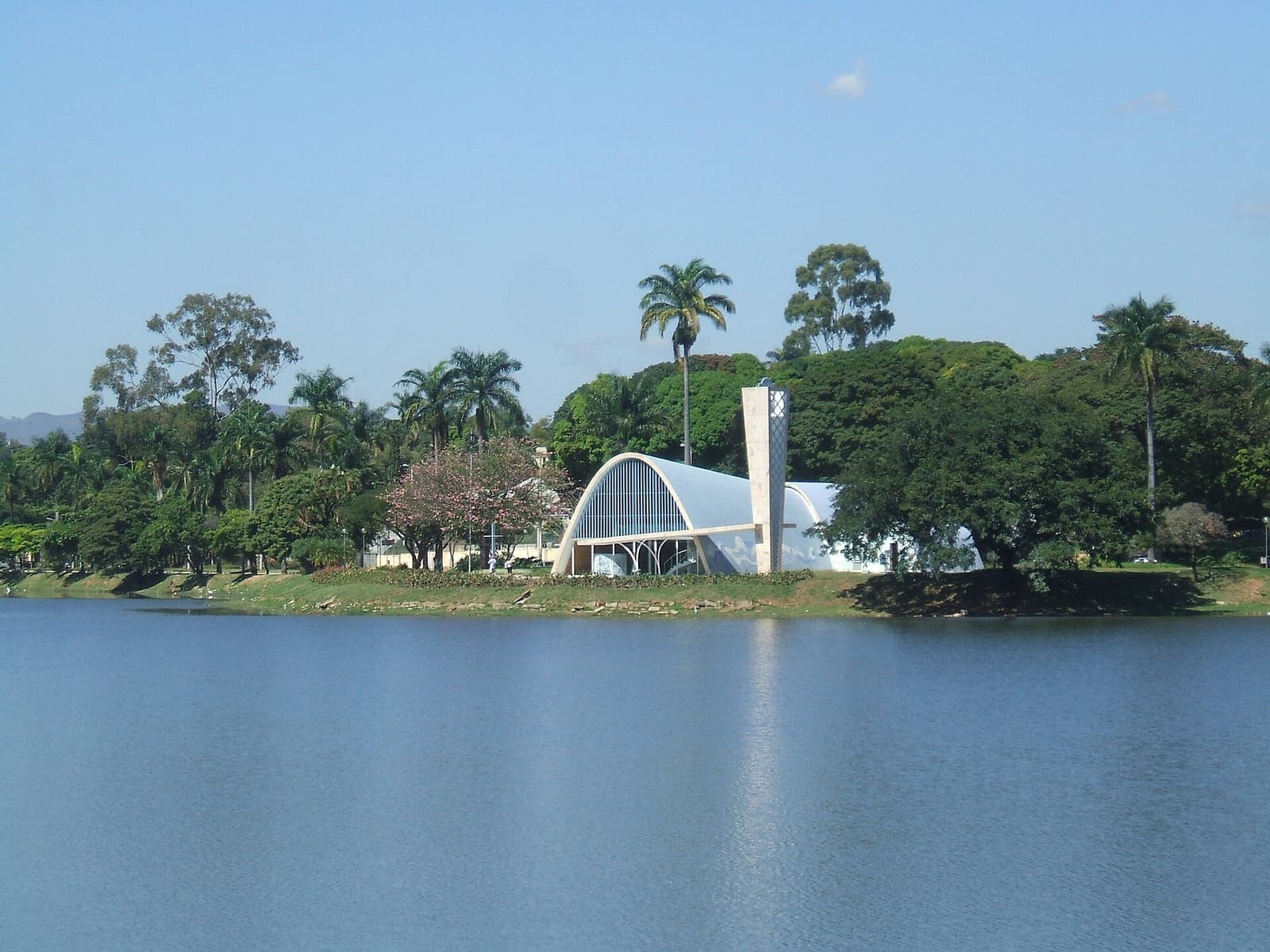
Pampulha is where Belo Horizonte becomes easiest to misunderstand. The church is famous enough to pull every camera toward its blue-white arch, but the better visit does not treat it as an isolated icon. Use Lagoa da Pampulha as the room, the Santuário São Francisco de Assis as the anchor, and the soft-hour walk as the method. That sequence turns a postcard stop into a short lesson in how BH built leisure, modernism, worship, traffic, and weekend exercise around one artificial lake.
Keep the scope tight. This is not the full Pampulha circuit and not a citywide Niemeyer hunt. The working plan is one lake edge, one church, and about 60-90 minutes of looking. The sanctuary's own site currently frames São Francisco de Assis as an active parish as well as a heritage place, with Sunday masses listed at 07:00, 10:00, and 16:00, plus a tourist-visit path that visitors can schedule through the church site.[1] A January 2026 SouBH local guide adds the practical layer: tourist visitation is generally Tuesday to Sunday, commonly around 09:00-17:00 with a lunch closure, entry is usually a small paid fee in the R$3-R$6 range, and the church does not have its own parking.[2]
That last point is the first local move. Do not arrive as if the church were a museum with a clean parking lot and a blank schedule. Put Igrejinha da Pampulha or Santuário São Francisco de Assis - Pampulha into the map, not just Pampulha, and assume the final approach will be a little urban: Avenida Otacílio Negrão de Lima, street parking pressure, cyclists, walkers, lake glare, and people using the edge for ordinary exercise. If you are coming from central or south-zone BH, ride-hail or taxi is often simpler than turning the visit into a parking errand.[2][5]
Local move two: choose the light window before choosing the route. A 2025 local Pampulha guide recommends early morning, roughly 05:30-08:00, and late afternoon, roughly 16:30-18:30, for walking and cycling because the temperature, flow, and light are kinder.[3] For most visitors, late afternoon is the cleaner first read. The church profile is readable across the water, the lake has enough motion to feel local rather than abandoned, and you can leave before the edge becomes a dark, car-dependent guess. Morning works if you are already staying near the lake or if heat is your main constraint.
Local move three: do not promise yourself the whole lagoon on foot. The same local guide gives the orla as about 18 kilometers.[3] That number is the difference between a place portrait and a bad itinerary. If you try to "walk Pampulha" casually, you will spend the visit managing sun, distance, and crossings instead of reading the place. The better move is a short segment: arrive at the church side, cross the road carefully, find the opposite-water view, then give yourself a slow out-and-back rather than a heroic loop. If the full circuit matters, make it a bike outing with water, sun protection, and a separate half-day mindset.[3][6]
The cultural texture is not decorative. UNESCO lists the Pampulha Modern Ensemble as a 1940s project around an artificial lake, joining architecture, landscape, art, and leisure in a planned modern setting associated with Oscar Niemeyer, Roberto Burle Marx, Cândido Portinari, and Belo Horizonte's mid-century civic ambition.[4] That is why the church works best from across the water first. Up close, it becomes a building with panels, arches, doors, religious use, and tour logistics. From the lake edge, it becomes part of a larger experiment: a Brazilian city trying to make modernism feel like Sunday space.
Local move four: photograph the church once from the lake side before you cross into the sanctuary zone. The temptation is to rush to the entrance, but the profile across the water explains why Pampulha became a visual shorthand. Stand low enough that the water stays in the frame. Let the roofline sit against the trees. Do not zoom until the lake disappears. The image source for this article shows the useful composition: the church is not floating as a postcard object; it is held by water, palms, roadway, and everyday lakeside texture.[7]
Local move five: treat the sanctuary as active, not as architectural access. If your visit lands near a Sunday mass window, either attend respectfully or stay outside and wait. If you want the interior as a tourist visit, check the official scheduling path and same-day conditions rather than assuming every hour is equally open.[1] SouBH's 2026 guide is careful on this point too: hours and values can change with maintenance, celebrations, or special events, so the small fee and standard window are planning anchors, not a guarantee.[2]
Local move six: carry the small-spend logic correctly. The core lake-edge visit can cost R$0 if you stay outside, walk, and use the public edge. Budget R$3-R$6 for a tourist visit inside the church when available, plus transport. Bring a card, but keep a little cash buffer because small cultural-site payment practice in Brazil can be uneven even when official guidance points you one way. The amount is not the point; avoiding a wasted arrival is.
Local move seven: use review platforms as a weather vane, not as authority. The TripAdvisor surfaces for both the sanctuary and Lagoa da Pampulha are useful before you go because they surface current visitor friction: closure surprises, parking complaints, heat, crowding, and whether people are treating the lake as a quick photo stop or a longer outing.[5][6] But do not let review noise outrank the sanctuary's own page for worship and visit access, or the local Pampulha guide for walking timing.[1][3]
Local move eight: leave with the lake still doing some work. If you finish at the doorway, the visit collapses back into "I saw the church." Instead, step back toward the water for five minutes after the close-up. Watch how the traffic, cyclists, runners, and photo-takers move around the same curve. Pampulha's city-specific detail is this coexistence: modernist monument, active parish, exercise path, and road edge all sharing one frame. It is not the frictionless lake of a resort. It is a BH public edge, and that is the point.
The non-local trapline is short. Mistake one is trying to complete the full 18-kilometer orla on foot because it looks manageable on a map. Better: hold the church-side segment unless this is a planned bike circuit.[3] Mistake two is arriving at noon for the cleanest photo. Better: use 05:30-08:00 or 16:30-18:30, with late afternoon as the easiest visitor window.[3] Mistake three is treating the church as a permanently open architecture object. Better: check the sanctuary schedule, respect mass, and build in a fallback exterior view.[1][2] Mistake four is driving to the door and expecting parking to solve itself. Better: arrive by ride-hail, taxi, or a deliberate drop-off plan, then spend your attention on the lake edge.[2][5]
Concrete go details: best window is 16:30-18:30 on a dry weekday or quieter weekend afternoon. Expected spend is R$0-R$6 before transport, depending on whether you enter the church as a tourist visitor. Queue reality is light compared with major museums, but access can be constrained by worship, lunch closure, maintenance, or special events, so check the sanctuary page before leaving.[1][2] Where to stand: first across the water with the church profile and lake in one frame, then near the sanctuary entrance only after you have understood the wider edge. Navigation cue: Igrejinha da Pampulha / Santuário São Francisco de Assis -> opposite-water photo angle -> short lake-edge walk -> sanctuary exterior or scheduled visit -> return to the water before leaving.
Pampulha rewards restraint. The right visit is not the longest loop, the closest photograph, or the most complete modernist checklist. It is a controlled hour where the lake remains visible enough to explain the church. Keep that order, and Belo Horizonte stops looking like a city with one famous chapel on the side. It starts looking like a city that once tried to make modernism useful as public weather, weekend habit, and worship space at the same time.
Sources
- Santuário Arquidiocesano São Francisco de Assis, official site - current sanctuary reference for Sunday mass times, tourist-visit scheduling, worship context, and location.
- Maria Clara Landim, "Igrejinha da Pampulha: o que saber antes de visitar em BH." SouBH, 2026-01-11 - recent local guide to hours, visit fees, mass/visit caveats, parking, and access basics.
- Lagoa da Pampulha, "Caminhada e Ciclismo na Lagoa da Pampulha: Roteiro, Dicas e Segurança," 2025-05-19 - local guide to the 18-kilometer orla, walking/cycling windows, safety, and lake-edge use.
- UNESCO World Heritage Centre, "Pampulha Modern Ensemble" - heritage context for the 1940s artificial-lake ensemble, modern architecture, landscape, art, and civic planning.
- Tripadvisor, "Santuário Arquidiocesano São Francisco de Assis" - current visitor-review surface for on-the-ground access, closure, parking, and visit-friction checks.
- Tripadvisor, "Lagoa da Pampulha" - current visitor-review surface for lake-edge timing, walking/cycling impressions, heat, and circuit expectations.
- Wikimedia Commons, "File:Igreja de São Francisco de Assis - Lagoa da Pampulha.jpg" - real photographic source for the article image, showing the church across the lake.