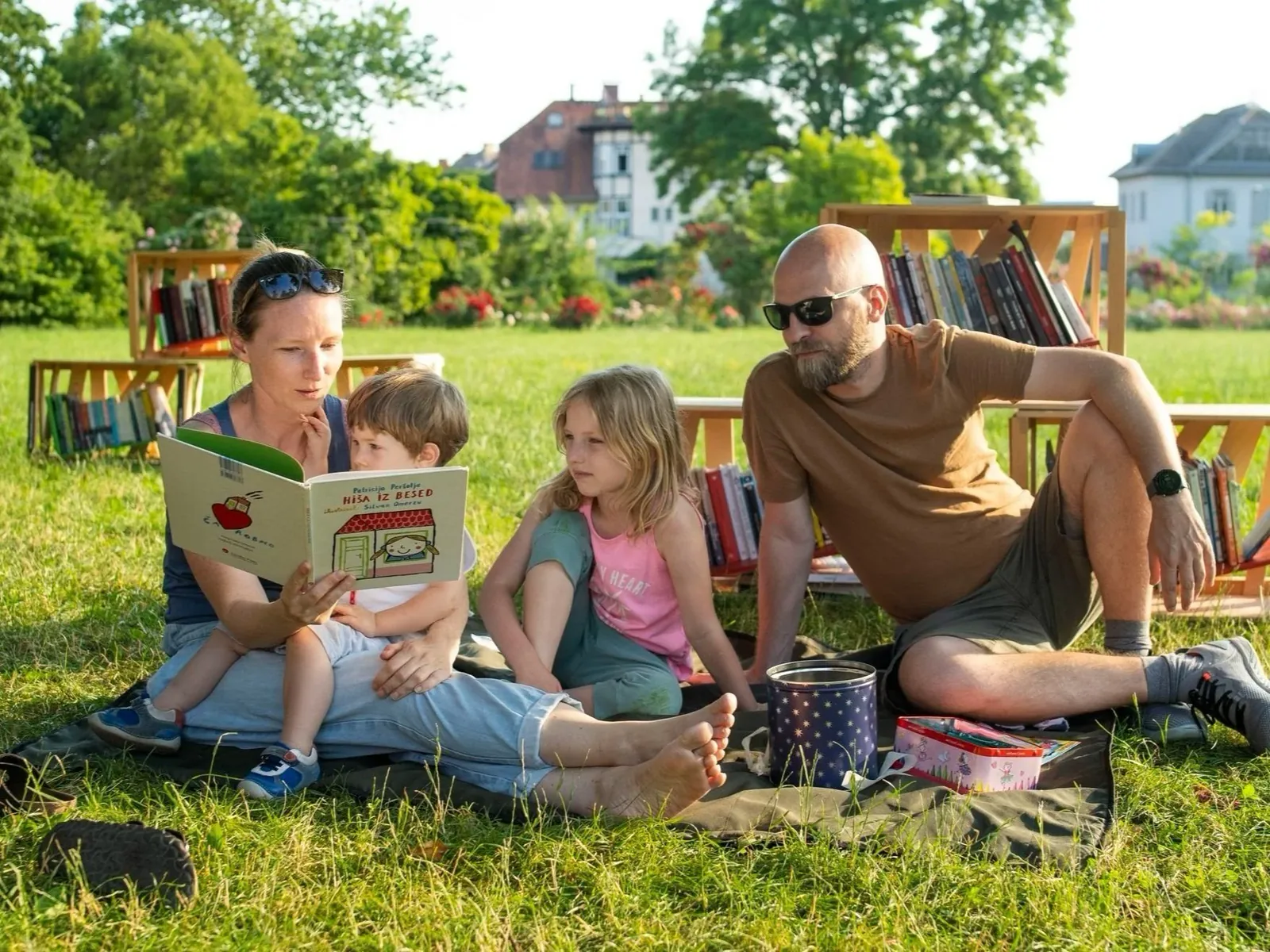
At 10:00 on a dry Friday, a library appears on the grass beside Tivoli’s pond. There is no door to unlock. Low wooden crates hold the books; chairs, cushions, and tree shade make the reading room. An attendant is the only fixed point [9]. By evening, the useful parts can disappear again.
This is Knjižnica pod krošnjami—Library Under the Treetops—and its Tivoli unit is a Ljubljana summer habit worth treating as a destination rather than a lucky park sighting. In 2026 it runs through September 13, on Thursday from 15:00 to 20:00 and Friday through Sunday from 10:00 to 20:00, but only in dry weather [1][3]. The best version of the visit is small: find the right lawn, choose one book, read for 30–45 minutes, return it, and leave the library exactly as temporary as you found it.
The books stay put. This library gives you a place to read, but it does not lend its curated collection to carry away. Entry costs €0, there is no membership step, and the books remain on site [2][3]. What you borrow is a patch of afternoon and permission to stop treating Tivoli as scenery between attractions.
Let the forecast choose the hour
The first local move happens before you leave your room: check the organizer’s current location page and then check the sky. “Open” here is a compact agreement among attendants, books, furniture, and weather. Visit Ljubljana states plainly that the reading islands are cancelled in bad weather [3]. Because the notice does not define how much rain counts as “bad,” a passing shower should trigger a same-day recheck rather than a confident trip to a library whose walls are made of leaves.
For the cleanest attempt, use Friday from 10:00 to noon. The community-review synthesis favors early morning or late afternoon for park comfort; 10:00 is the earliest hour the reading island offers, and Friday is its first full opening day of the week [1][5]. This is still a planning recommendation, not a promised quiet period. Thursday from 15:00 to 17:30 is the useful alternative if you want later light. Sunday can be lovely, but Tivoli is also the city’s threshold to the Rožnik and Šiška hills, part of a familiar weekend walking landscape rather than an empty visitor park [7].
Do not let a “Tivoli Park—open 24 hours” listing replace the library timetable. A current review surface describes a large, always-accessible park used for walking, running, cycling, picnics, and family time [5]. The reading island occupies only one small part of that landscape and keeps only four weekly opening days [1]. The park can be open while every library crate is in storage.
Give the approach from Prešeren Square roughly 15–20 minutes on foot [4]. The practical navigation cue is:
city centre → Jakopič Promenade → Tivoli pond → Čolnarna → lawn beside the greenhouse
Save the organizer’s direct Tivoli coordinate—46.051835, 14.494304—before setting out [4][8]. “Tivoli” alone is too broad. The island sits in the shade by Čolnarna, beside the pond and greenhouse; the organizer identifies it as Ljubljana’s largest Library Under the Treetops unit [1]. If you reach a grand promenade and start climbing toward the castle without seeing pond water, a greenhouse, and low book crates together, stop adding distance and recheck the coordinate.
Read the shelves before claiming a chair
Arrive as a reader, not as someone hunting free park furniture. Greet the attendant and spend two minutes with the crates before sitting. The Tivoli unit carries fiction and children’s picture books, with a particularly strong selection in the social sciences and art [1]. The organizer says most locations, rather than every unit, have a shelf of books in English and other languages, so ask what multilingual stock Tivoli has out that day [8]. That is faster and kinder to the books than lifting half a crate in search of one English spine.
Choose one volume first. A short story, essay, slim art book, or children’s book suits a finite park hour better than a novel selected out of ambition. The program has no borrowing system: books are for on-site reading and should go back in their place [2]. This is not a take-one-leave-one box, and the fact that the shelves stand outdoors does not make them abandoned.
The organizer’s FAQ adds one nuance: some locations also have a separate green exchange box where books may be left or taken, but not every unit has one and Tivoli’s current page does not promise one [9]. Do not add to or remove from the curated thematic crates. If a distinct green box is present, ask the attendant to confirm how it works.
Then take an unoccupied chair or a place on the grass within the reading island. Keep paths open, do not reserve a second chair with a bag, and let families stay near the children’s shelves. If you have food, finish it away from the open books; if you carry a drink, keep it closed while browsing. Those are not complicated house rules so much as the mechanics of sharing an outdoor collection with no floor, roof, or cleaning buffer.
Now give the book a real interval. Thirty minutes is enough to change the visit; three minutes is usually only enough to prove that you found it. Put the phone away for the first ten. Read until the park’s sound separates into layers: pages, bicycles on the path, conversation near the pond, a child negotiating the next book. A Ljubljana-based first-person account remembers the project through its colored chairs, wooden shelves, public readings, and even the occasional guitar under the trees [6]. The point was never silent-room discipline transplanted outdoors. It was reading made porous to city life.
Make photographs after you understand what the place is doing. One wide frame can hold the crates, trees, and lawn without turning an individual reader—especially a child—into your subject. Ask before making a close portrait. Then sit down. The recognizable image of this library is not an empty display of books; it is people using shade together [1].
Finally, return the book to the correct place and bring the chair back into the cluster if you moved it. Thank the attendant. This last move is part of the visit, not housekeeping after it. A temporary reading place survives because each reader closes a tiny loop that an ordinary building would hide inside staff corridors and automated returns.
Ljubljana’s library is seasonal equipment
Library Under the Treetops began in Ljubljana in 2004. The 2026 program is its 22nd season, now spread across a network of reading islands supported by publishers, local partners, and volunteers [2][3]. That history keeps the Tivoli setup from feeling like a promotional pop-up. The crates are recurring civic equipment: brought out when the trees can supply a ceiling, removed when rain makes the arrangement untenable, and rebuilt often enough to become a resident expectation.
Tivoli gives that idea an unusually precise setting. The park links the centre to the protected Rožnik–Šiška landscape, a place Ljubljana Tourism describes through the local habit of walking out toward Šiška Hill with one foot in the city and the other in the forest [7]. The reading island sits near that handoff. It does not require visitors to enter an institution, buy a drink, or surrender the day to a major sight. It asks them to interrupt a walk.
That interruption is the place-specific texture. In many cities, summer culture means a stage, a ticket line, or a temporary bar. Here, one of the recurring seasonal gestures is to put contemporary books under mature trees and trust passers-by to become readers. Publishers contribute new releases; local organizations help each island operate; the books stay public precisely because they do not leave [2][3]. Ljubljana turns shade into a service.
Three ways to miss the library while standing in the park
The first mistake is using the generic park pin. Tivoli is broad enough for current reviewers to mention both its variety and imperfect wayfinding [5]. The better alternative is the exact pond-side sequence: Jakopič Promenade, Tivoli pond, Čolnarna, greenhouse lawn [1][4].
The second is copying the park’s always-open clock onto the reading island. Current community listings mark Tivoli accessible around the clock [5], while the outdoor library begins its week on Thursday afternoon and runs through Sunday [1]. Treat the organizer’s page as the clock and the park listing as geography.
The third is assuming a large park makes every hour equally comfortable. The current review synthesis recommends the early or late edges to avoid crowds [5]. The better alternative for this four-day library clock is the Friday 10:00 opening; if weather or time will not allow a simple 10 + 30 rhythm—ten minutes to arrive and settle, thirty with one book—save the visit for another opening rather than reducing it to a five-minute inventory of crates.
The compact go plan
- Best window: Friday, 10:00–12:00; Thursday, 15:00–17:30, is the second choice [1][5].
- Season and weather: through September 13, 2026, in dry conditions only; recheck on the day [1][3].
- Total time: allow 60–90 minutes from the centre, including the walk and a 30–45-minute reading interval.
- Expected spend: €0 required. There is no ticket, membership, or compulsory order; any refreshment elsewhere in the park is a separate choice [2][3].
- Reservation and queue reality: no ticket or reservation step is published. Chairs are finite, so browse first, take one only when you are ready to use it, and be willing to sit on the grass [1][2].
- What to choose: fiction, picture books, social science, or art; ask the attendant whether the day’s Tivoli stock includes English-language options [1][8].
- Where to sit: inside the shaded reading cluster near the pond, without blocking a path or using a spare chair as storage.
- Navigation cue: aim for Čolnarna and the greenhouse lawn beside Tivoli pond, not merely “Tivoli Park” [1][4].
- Exit move: replace the book where it belongs, return the chair, and let the rest of the park become a different visit.
The Library Under the Treetops is modest enough to disappear from an itinerary and specific enough to improve one. Its lesson is not that books become more picturesque outdoors. It is that a city can make reading civic without making it monumental. For one dry hour in Tivoli, the trees supply the building and the readers supply its reason to exist.
Sources
- Knjižnica pod krošnjami, “Ljubljana / Design” — organizer’s current 2026 Tivoli location, pond-and-greenhouse cue, weekly hours, collection focus, storage provider, and source page for the real Tivoli photograph used as the article image.
- Knjižnica pod krošnjami, “Library Under the Treetops” — organizer’s English overview of the project’s 2004 origin, free access, publisher support, on-site-only reading, and return practice.
- Visit Ljubljana, “Library Under the Treetops” — current 2026 confirmation of the 22nd season, Ljubljana locations, free entry, partner model, and bad-weather cancellation boundary.
- Google Maps, “Prešeren Square to Library Under the Treetops — Tivoli” — walking directions to the organizer-linked reading-island coordinate, used to avoid the park’s overly broad generic pin.
- Wanderlog, “Tivoli Park” — current community-review aggregation covering shade, paths, family use, central-city access, wayfinding limits, and early/late timing to avoid crowds.
- Nature with Marusa, “Library Under the Treetops in Ljubljana” — Ljubljana-based first-person account and photographs of the project’s chairs, wooden shelves, shade, reading, music, and public literary events.
- Visit Ljubljana, “Landscape park: Tivoli, Rožnik, Šiška Hill” — local context for Tivoli’s connection to the protected hills and the resident weekend-walking habit.
- Knjižnica pod krošnjami, “Locations” — organizer’s English-language 2026 location list, Tivoli schedule, dry-weather condition, and multilingual-shelf note.
- Knjižnica pod krošnjami, “Pogosta vprašanja” — organizer’s FAQ on on-site reading, optional green exchange boxes, and the different kinds of attendants who staff reading islands.