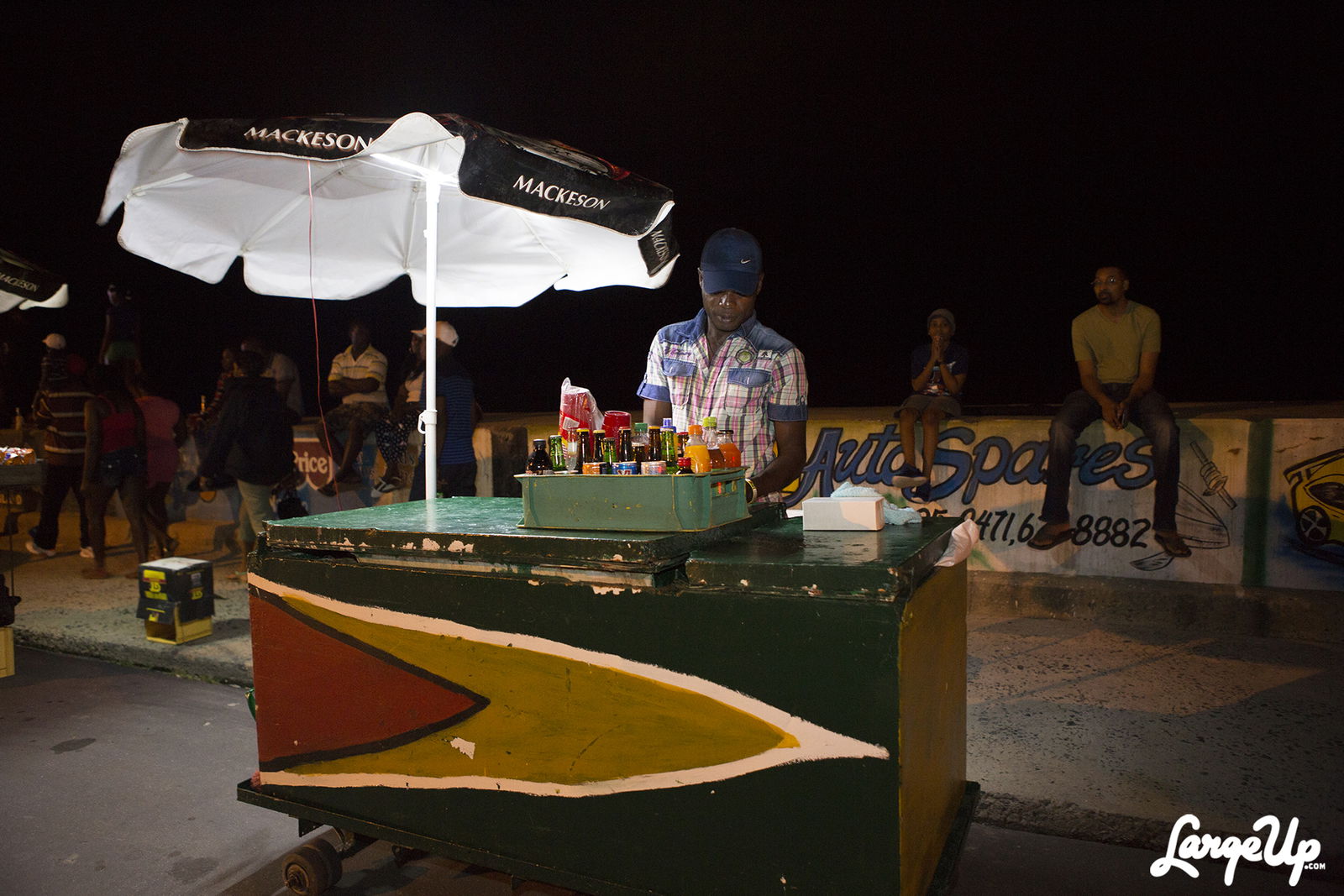
Seventy-five minutes before sunset on a Sunday, Georgetown’s Sea Wall is between uses. The Atlantic breeze is already there. Cars begin to take positions; coolers, grills, and speakers are still becoming a streetscape; small groups settle into the long public edge. The weekly lime is assembling, but it has not yet become the open-air night party described in local accounts.
That handover is the right moment for a first visit. Guyana’s current Where & What guide calls the stretch between Camp Road and Vlissengen Road a “big open-air party” every Sunday evening; a News Room cultural feature traces the same weekly ritual from Camp Street toward Kitty Roundabout through car sound systems, improvised carts, food, drink, and conversation [1][2]. A lime is not a scheduled performance with a curtain time. It is social time made public.
The full night is also the wrong promise to make to an unfamiliar visitor. Canada’s current travel advice identifies the Sea Wall among Georgetown sites where criminals often target visitors, advises against walking alone after dark, and recommends reputable, hotel-connected taxis [9]. Australia’s current advice is blunter: avoid the Georgetown Sea Wall after dark [10]. The useful version therefore accepts a tradeoff. Go with a companion, arrive by a pre-booked car 75 minutes before local sunset, observe the western edge for 45–60 minutes, and be back in that car before darkness.
Keep the geography equally disciplined: begin at the northern end of Camp Road, walk no more than about 300 metres east toward Vlissengen Road, then reverse to the same pickup point [11]. This is one public-space ritual, not a waterfront hike. Access itself has no posted ticket in the official and local sources reviewed, so the required spend is GYD 0. Book the ride, not a place.
Save Camp Road, not “the seawall”
The first local move happens before leaving the hotel: save the exact coordinate 6.8248023, -58.1566027 and send it to the driver [11]. Ask for Camp Road at Seawall Road, then show the pin. “The seawall” is too broad to function as an address.
This matters because three nearby names are easy to collapse into one. The historic Kingston Seawall Bandstand and Esplanade sit west of Camp Road. The Sunday party corridor begins at Camp and runs east toward Vlissengen and Kitty. Farther east, community-review listings use still other Sea Wall pins around Queen Street [1][7][11]. They belong to the same coastal system, but not to one compact visitor stop.
The distinction carries a safety boundary. The 2026 local guide reports a round-the-clock police outpost at the Esplanade near the historic Bandstand, then separately identifies the younger Sunday crowd on the Vlissengen–Camp stretch [1]. Do not transplant the outpost’s reported coverage onto the whole lime. If you want the cast-iron Bandstand, make it a different daylight visit. For this ritual, let the Camp Road pin be both door and exit.
Arrange the return before arrival. Use a taxi company recommended by the hotel or a known local contact, agree on a pickup time, and ask the driver to meet at the same coordinate. Canada’s advisory says taxis are the safest way to get around Georgetown but warns that roadside taxis can also present risk; the practical answer is a reputable, pre-arranged service rather than a hailed car [9]. A July 2026 r/Guyana itinerary independently makes the same local move for the Sea Wall: watch sunset, use the vendors if desired, and get there by cab [5].
Set pickup for 10 minutes before published sunset, not “when we are ready.” That fixed edge leaves roughly an hour on site while keeping the official after-dark warning operative. If the driver is delayed, remain with your companion in an active, visible area and call the dispatcher. Do not start walking inland while staring at a map.
Watch the room build itself
At Camp Road, put the phone away for the first five minutes. The second local move is to understand the direction of travel before recording it: ocean on the left as you move east, roadway and city on the right, return pin behind you. Stay on the established public walking surface, keep clear of moving vehicles, and follow any same-day police, traffic, or access direction over this article.
Then walk slowly. The visit is not a hunt for one famous stall. It is a close reading of setup: which groups face the water and which face one another; how a parked car becomes seating; how a cart carries cold drinks without becoming a permanent shop; how competing music sources divide a linear space into small rooms. News Room’s portrait of the lime describes repurposed refrigerators on wheels, grills made from halved oil drums, and temporary bars assembled from shipping containers, tarpaulins, and plywood [2]. The objects are practical, but together they are also a local language of making do in public.
The third move is to let residents choose your distance. Do not step between a group and its car, sit on someone’s cooler, or treat a family gathering as street theatre staged for a lens. Make the wide photograph first. Ask before photographing an identifiable person, a vendor at close range, or a child. Martei Korley’s 2016 image works because the cart, people, painted wall, and night economy remain in one social frame; it does not pretend the lime is an empty landscape [2].
The fourth move is counterintuitive: bring no speaker. In May 2026, Guyana’s Environmental Protection Agency began testing a permanent noise-monitoring and public-warning system at the Sea Wall after years of complaints. The pilot continuously compares sound against configured thresholds, displays exceedances, and can alert the EPA and police [4]. This is not a silent promenade, but neither is every visitor invited to add another sound system. Listen to how the existing rooms overlap.
Cap the outbound walk at about 300 metres, even if the liveliest cluster seems to begin just beyond it. That is the fifth move. The full Camp-to-Vlissengen corridor is the local party’s scale; 300 metres out and 300 back is the visitor’s risk and attention boundary. It supplies enough change in sound, seating, and vendor density to reveal the mechanism without turning the evening into a long linear exposure.
On the return, pause once with the sea in view and the gathering behind you. Georgetown’s water is not a blue-tourism backdrop. The wall exists because the city occupies a low coastal plain. Just west of this route, the National Trust dates the Kingston concrete sea defence to 1860, after an 1855 flood left areas from Kingston to Ogle under at least 1.5 metres of water [3]. Sunday leisure happens on working protective infrastructure.
The social job survived; the equipment changed
The Sea Wall’s public life is older than the current lime. The National Trust records the nearby Bandstand, built around 1903, as one of Georgetown’s three cast-iron bandstands and a social hub for orchestras, theatrical groups, and the police band [3]. The 2026 guide still notes occasional entertainment there, but gives the younger Sunday party its own geography east of Camp Road [1].
The compelling continuity is not musical genre. It is the wall’s second job. A piece of civil infrastructure has repeatedly doubled as a room where the city sees itself. The older room concentrated attention on a decorated platform. The contemporary lime distributes it among cars, carts, grills, speakers, couples, children, and groups of friends. Georgetown did not stop using the Sea Wall socially; it changed the furniture and multiplied the stages.
That is why the sixth move is to sit or stand without demanding a view. Use an open public spot that does not obstruct a step, vendor, path, or parked vehicle. Give the scene 15 uninterrupted minutes. Do not spend the whole interval facing the ocean. The ritual’s subject is the shifting arrangement of people along a defence line, not sunset alone.
Food remains optional texture, not the primary anchor. A current Georgetown street-food guide places the Sea Wall’s roadside grills in the weekend circuit and gives GYD 500–1,500 as an indicative range for barbecue, depending on portion [8]. If you order, the seventh move is to ask the price before committing, pay in Guyanese dollars with small notes, choose something cooked in front of you, and eat near the stall without blocking service. Prices and vendors can change; the range is a planning buffer, not a tariff.
The eighth move is to close your own loop. Carry the container to a bin or take it away. A May 2026 Sea Wall outreach under the EPA’s “Nah Dutty De Place” campaign reminded visitors that littering is an offence and used street theatre to connect the rule to public behaviour [12]. A defence structure that keeps water out cannot be treated as a drain for whatever Sunday leaves behind.
Then leave on time. The crowd may be becoming more interesting just as the pickup arrives. That is not a planning failure. The pre-sunset threshold delivers the mechanics of the lime while respecting an evidence-based boundary. Authenticity does not require ignoring advice written specifically for this place.
Four ways visitors misread Sunday
Mistake one: using a generic Sea Wall pin. The Bandstand, Camp Road party edge, Kitty, and Queen Street review pin are distinct [1][7][11]. Better: save the Camp Road coordinate, send it to the driver, and return to it.
Mistake two: copying the local peak without the local support system. Current sources agree that Sunday comes alive around sunset and after it [1][2][7]. Official advice nevertheless tells visitors not to walk alone after dark and, in one case, to avoid the Sea Wall after dark altogether [9][10]. Better: go with a companion, observe the buildup, and leave before the peak.
Mistake three: turning the whole corridor into a walk. The party’s length is not an itinerary requirement. Better: use the first 300 metres, reverse, and keep the total on-foot distance around 600 metres. If the atmosphere is thin that day, do not expand the route in search of a guaranteed scene.
Mistake four: treating vendors as a fixed market. The lime is assembled weekly, and community accounts describe mobile, improvised setups rather than a stable roster [2][5][6]. Better: arrive willing to spend GYD 0. If one busy, clean stall appeals, order one freshly cooked item; otherwise let the social choreography be the visit.
The compact go plan
- Anchor: Camp Road’s northern terminus at Seawall Road, 6.8248023, -58.1566027 [11].
- Best window: Sunday, arrive 75 minutes before local sunset and schedule pickup 10 minutes before sunset.
- Company and transport: go with at least one companion; use a reputable taxi booked through a hotel or trusted local contact for both directions [9][10].
- Time and distance: 45–60 minutes on site; walk up to 300 metres east, then return, for roughly 600 metres total.
- Expected spend: GYD 0 required; allow GYD 500–1,500 for one optional roadside barbecue portion, with price confirmed before ordering [8].
- Queue and reservation reality: no admission queue or place reservation is published. Crowd density, roadside stopping, and taxi coordination are the constraints; pre-book the car.
- What to notice: the shift from defence line to social room—cars as furniture, carts as mobile bars, overlapping sound zones, and groups facing one another rather than a central stage [2][3].
- Etiquette: keep out of the vehicle lane, leave groups their space, ask before close photographs, add no speaker, and remove your litter [4][12].
- Abort conditions: heavy rain, unusual sea conditions, access restrictions, an absent companion, or an unconfirmed return car. Same-day official direction outranks the plan.
- Exit: return to the Camp Road pin and leave before dark, even if the larger lime is only beginning [9][10].
The Sea Wall lime is not diminished by seeing its first hour. In that threshold, the logic is unusually clear: protective concrete becomes seating; private cars become public rooms; small vendors turn movement into a temporary neighborhood. The night version is fuller, louder, and more locally supported. A responsible first visit stops one beat earlier—and still hears Georgetown assemble.
Sources
- Gem Madhoo-Nascimento, Guyana — Where & What 2026, pp. 118–119 — current local guide to the Sea Wall, the Esplanade police-outpost boundary, and the separate Vlissengen Road–Camp Road Sunday party stretch.
- Danielle Swain, “Between slackness and sovereignty: Dancehall’s controversial rise at Mashramani.” News Room Guyana, March 2, 2025 — local cultural account of the Camp-to-Kitty Sunday lime, its carts and sound systems, and source page for Martei Korley’s real 2016 photograph used as the article image.
- National Trust of Guyana, “Kingston Seawall” — official history of the 1860 sea defence, the 1855 flood, and the nearby 1903 Bandstand’s musical and civic use.
- Sharda Bacchus, “EPA testing noise monitoring system at seawall; rollout planned for hotspots countrywide.” News Room Guyana, May 19, 2026 — recent local confirmation of the Sea Wall noise-monitoring pilot and enforcement design.
- r/Guyana, “24 hours in Georgetown, Guyana” (July 2026) — current community advice to use a cab for the Sea Wall, aim for sunset, and treat food vendors as an optional finish.
- r/Guyana, “New here in Guyana, would love some advice and recs” (April 2026) — current local/community discussion of the Bandstand, Sea Wall food spots, vigilance, and trusted local transport context.
- Wanderlog, “Seawall, Georgetown” — community-review aggregation distinguishing late-afternoon calm from the busier weekend evening and showing how broad Sea Wall pins can refer to different sections.
- 592Hub, “Georgetown Street Food Guide 2026” — current local guide used only for the indicative GYD 500–1,500 weekend Sea Wall barbecue range and freshly cooked-food boundary.
- Government of Canada, “Travel advice and advisories for Guyana” — current official warning naming the Sea Wall among targeted Georgetown sites, advising against walking alone after dark, and recommending reputable taxis.
- Australian Government Smartraveller, “Guyana Travel Advice & Safety” — current official advice to avoid the Georgetown Sea Wall after dark, avoid walking alone, and arrange official transport.
- OpenStreetMap, “Camp Road at Seawall Road, Georgetown” — exact west-edge coordinate used for the fixed drop-off and return point.
- Guyana Times, “EPA expands ‘Nah Dutty De Place’ campaign with seawall outreach” (May 4, 2026) — recent local confirmation of the Sea Wall anti-litter campaign and public-space etiquette message.