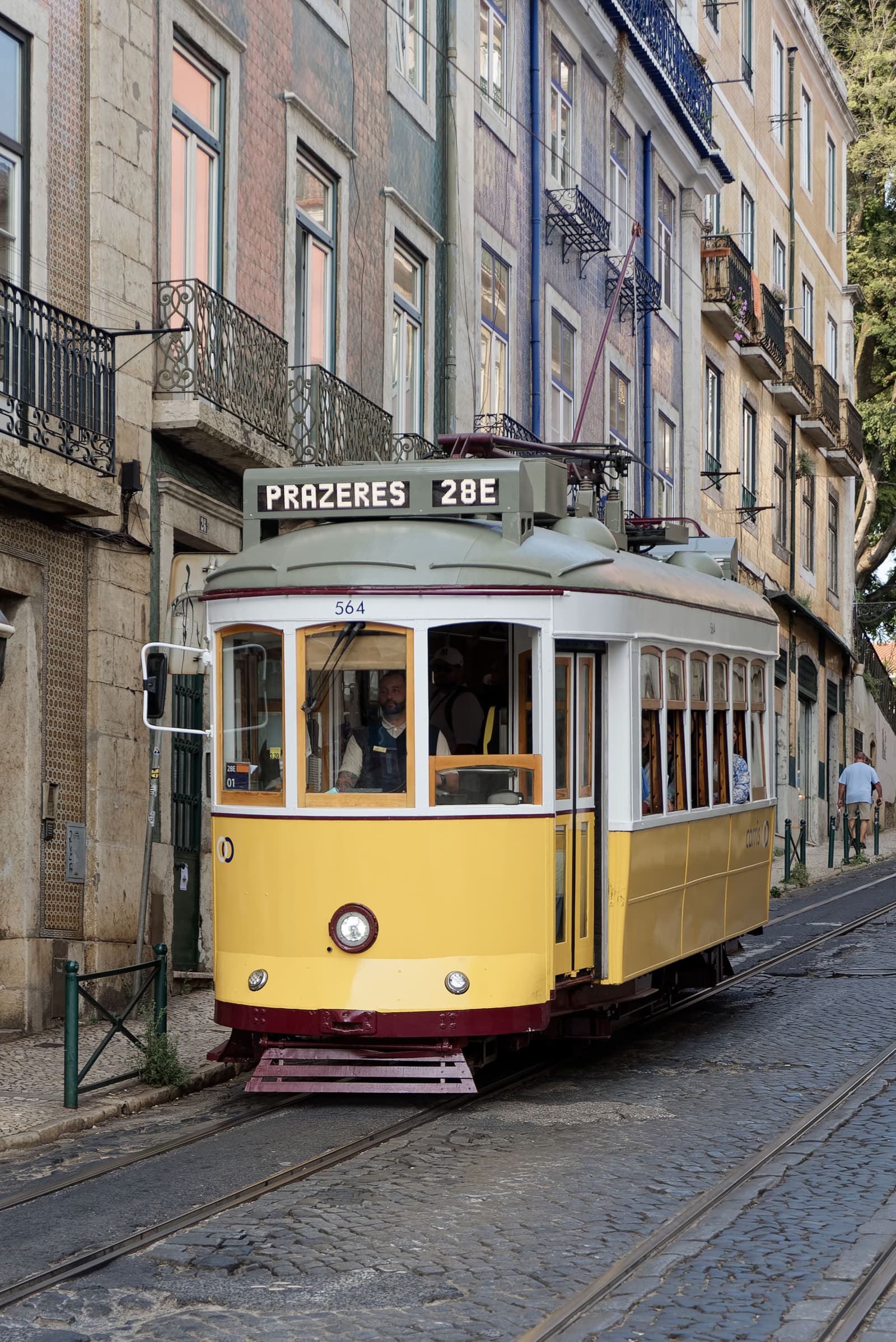
Lisbon makes more sense when you stop chasing neighborhoods and read one hillside seam as a living system. This route keeps scope tight to two adjacent Alfama anchors that Tram 28E already stitches together: Portas do Sol and Miradouro de Santa Luzia.[1]
Both anchors are non-food, both are city-specific, and both reward micro-timing. The practical point is to arrive when the tram still functions as mobility, not as a moving queue.
- Portas do Sol stop / terrace edge
- Miradouro de Santa Luzia stop / terrace garden
Image context: the cover image is a Lisbon Tram 28E scene in the historic center, matching the exact mobility layer used to access this Alfama seam.
Anchor logic: two stops, one ridge, one clear sequence
Carris publishes both Lg. Portas Sol and Miradouro Sta. Luzia as consecutive 28E stops in the same directional chain.[1] That single detail is the route’s core edge: you are not planning two distant attractions, you are working one continuous urban balcony with two entry points.
Use the current Carris timetable PDF (in force 09-03-2026) as your hard timing frame.[2] For weekday departures from Martim Moniz, the schedule starts at 04:40 and runs into the late-night band around 01:30; weekend/holiday runs begin around 04:45 and extend to roughly 01:30 as well.[2] That wide service span gives you two usable visitor windows:
- Early shoulder: roughly 07:00–09:00 for cleaner platform flow and easier orientation on arrival.
- Late shoulder: roughly 20:30–22:30 for lower photo congestion and calmer terrace pacing.
The PDF also shows segmented “tempo aproximado” blocks for the line (e.g., 12 / 13 / 13 / 12 / 4 / 3 minutes in the published structure), which is enough to treat this as a layered hillside traversal rather than a single stop-hop.[2]
8 local moves that materially improve outcomes
First, board with a stop-level intention: if your main goal is Santa Luzia framing and azulejo wall context, stay on until Miradouro Sta. Luzia; if your goal is wider Tagus-axis orientation first, step off at Portas do Sol and backtrack uphill in minutes.[1]
Second, pick one shoulder window and commit; mid-day drift is where this micro-route turns into crowd management.
Third, use the navegante occasional card when you plan repeated short urban transfers: card cost is €0.50, validity is 1 year, and it supports Carris/Metro 24h products plus zapping credit.[3]
Fourth, keep your first terrace pass short (15–25 minutes) and come back later if needed. Long static stays at first arrival usually produce the worst crowd friction.
Fifth, use the route adjacency to your advantage: because the two anchors are consecutive on the same line, you can re-enter the tram after one terrace and avoid rebuilding your route from scratch.[1]
Sixth, preserve one historical texture detail while you move: Alfama remained legible as a narrow-street maze partly because it was less damaged in the 1755 earthquake than other central areas, and that street grain is exactly what makes these miradouro approaches feel different from Baixa geometry.[5]
Seventh, treat Santa Luzia as a wayfinding node, not just a photo stop. Visit Lisboa’s own copy frames it as a compass point for reading nearby domes and Alfama orientation cues.[4]
Eighth, keep one micro-buffer of 20–30 minutes in your day plan; 28E is a surface line with real street variability, and rigid minute-perfect chaining is the main failure mode.[2]
Non-local trapline: 3 common misses and cleaner alternatives
Mistake 1: treating Portas do Sol and Santa Luzia as separate half-day attractions
Better alternative: run them as one ridge sequence in a single pass, because the tram line itself already links them stop-to-stop.[1]
Mistake 2: arriving at peak noon and trying to “wait out” congestion
Better alternative: shift to early or late shoulder windows and make your first stay intentionally short.
Mistake 3: buying tickets ad hoc at the point of stress
Better alternative: preload a navegante occasional card and decide transfer logic before boarding; the friction reduction is disproportionate to the setup effort.[3]
Portable takeaway artifact: shoulder-window execution card
| Condition | Entry stop | Stay length | Re-entry rule | Why it works |
|---|---|---|---|---|
| Morning shoulder (07:00–09:00) | Portas do Sol first | 15–20 min | Continue to Santa Luzia on same movement chain | Better orientation before terraces saturate[1][2] |
| Late shoulder (20:30–22:30) | Santa Luzia first | 20–25 min | Reverse to Portas do Sol only if platform flow is clean | Lower visual congestion, easier pacing[1][2] |
The route payoff is portability: two anchors, one line, one repeatable rhythm. Lisbon usually rewards people who run sequences, not checklists.
Sources
- Carris official 28E route page (stop chain showing Portas do Sol + Miradouro Sta. Luzia adjacency)
- Carris official 28E timetable PDF (entry in force 09-03-2026, first/late service bands, approximate segment timing blocks)
- Metropolitano de Lisboa, navegante occasional card (card cost €0.50, one-year validity, usable products)
- Visit Lisboa, Miradouro de Santa Luzia (viewpoint features and orientation cues in Alfama)
- Wikipedia, Alfama (historical neighborhood texture and 1755-earthquake survival context)
- Google Maps place listing — Portas do Sol (community review stream and recent visitor flow notes)
- Google Maps place listing — Miradouro de Santa Luzia (community review stream and congestion timing signal)