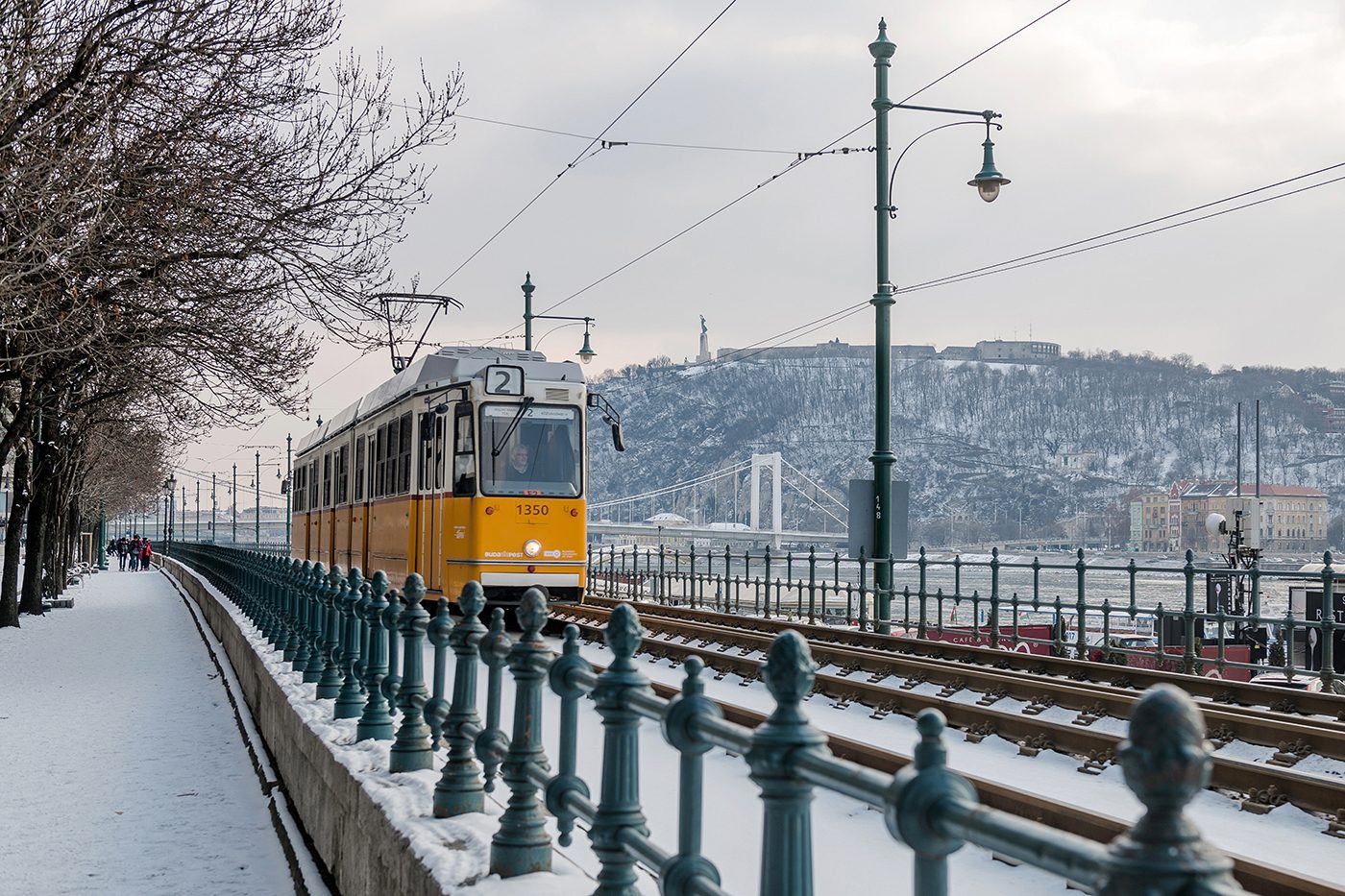
Budapest sells itself with big-ticket night options, yet one of the best city habits is cheaper and cleaner: treat Tram 2 as a timed ritual at blue hour, when the river edge turns reflective and the opposite Buda hillside starts glowing. This is a one-anchor city-travel plan, not a checklist marathon, and the anchor is fully non-food: ride the Jászai Mari tér → Fővám tér section with deliberate stop choices and timing discipline.
The value is local mechanics. You are using ordinary transit, ordinary fare products, ordinary platform behavior, and one unusually strong river corridor. That combination gives a better outcome than most first-visit “sightseeing transport” scripts.
Why this one corridor works
BKK’s own timetable network confirms line 2 as the Danube-side tram spine between Jászai Mari tér and Közvágóhíd.[2] Budapest tourism’s route explainer maps the same corridor as a continuous sequence of Parliament, Vigadó zone, Fővám tér and the market-hall edge, which is exactly why this line behaves like an everyday scenic artery, not a special-event product.[3]
Moovit’s current line summary gives the operational numbers that matter for execution: first services around 05:02, service running to around 04:42, weekday headways often in the 4–10 minute band, and weekend headways often 10–15 minutes.[4] Whether every minute is exact on your day, the planning implication is stable: you can iterate this ride without expensive waiting penalties.
The ritual window: blue-hour boarding, one short hop-off, one reboard
Use this pattern.
- Board at Jászai Mari tér 35–20 minutes before local sunset. You want mixed daylight and early city lights in the same ride segment.
- Stay on until roughly Vigadó tér / Eötvös tér zone, then do a short river-edge hop-off for photos and orientation.
- Reboard southbound toward Fővám tér before full darkness hardens reflections and platform crowding.
- End near Fővám tér and decide whether to cross Liberty Bridge on foot or continue by tram.
This sequence keeps walking transfers short while giving two light conditions in one pass.
Fare math and spend reality
BKK’s current public price sheet gives a clean baseline for this ritual:
- Single ticket: 500 Ft
- Single ticket bought on the spot: 700 Ft
- 30-minute ticket: 600 Ft
- 90-minute ticket: 850 Ft
- 24-hour travelcard: 2,750 Ft[1]
If you do one ride with no hop-off, single ticket pricing is enough. If you follow the ritual correctly (ride + short stop + reboard), a 90-minute ticket (850 Ft) usually protects the sequence better than paying two on-the-spot singles (1,400 Ft total). Even against two standard singles (1,000 Ft), 90-minute flexibility is often worth the small premium.
A realistic transit-only spend range for this plan is 850–2,750 Ft depending on whether this is your only ride block or part of a full-day transit plan.[1]
7 local moves that materially improve the outcome
First, ride in the window-side seat facing the river when possible; you are optimizing sightline continuity, not just transport.
Second, avoid treating the line as one uninterrupted “must do from terminal to terminal” task. The line is strongest when used as modular segments with one controlled stop-off.
Third, load ticket logic before you board. The local forum pattern is consistent: people who arrive with fare ambiguity lose more time than people who miss one tram.[5]
Fourth, use timetable rhythm, not panic timing. With 4–10 minute weekday frequency, missing one train is usually a low-cost error.[4]
Fifth, keep your camera/phone setup simple before boarding; blue hour shifts quickly, and platform fumbling wastes the best 10-minute interval.
Sixth, run your walk in short bursts: 5–12 minute embankment segments work better than a long uninterrupted walk if your goal is one transport ritual, not endurance sightseeing.
Seventh, if weather turns windy on the Danube edge, shorten the hop-off and keep the ride continuous; the anchor is the corridor, not any single stop.
Non-local traplines (and better alternatives)
Trap 1: Buying on-board logic in your head, then discovering friction at the stop
Better move: commit to either a single-ticket run or a 90-minute run before arriving on platform.[1]
Trap 2: Riding only once at full dark because “night views are enough”
Better move: board during the blue-hour transition so you get both daylight contour and city-light reflection in one cycle.
Trap 3: Treating this like a tourist cruise and ignoring commuter flow
Better move: board, stand, and alight like normal city users; this line is routine transport first, scenic bonus second.[5]
Trap 4: Overplanning too many landmarks in one pass
Better move: keep one anchor and one optional hop-off; depth beats checklist drift.
Why this still qualifies as high-value city travel
This route has a portable logic you can reuse in other cities: identify one high-frequency public corridor, enter during a light transition, do one purposeful stop-off, then reboard before crowding or darkness flattens the experience. Budapest just gives this method unusually good scenery-to-friction ratio.
The result is not only cheaper than most curated evening products; it is also closer to how the city is actually lived.
Sources
- BKK official fare list (tickets, time-based fares, travelcards)
- BKK official timetables index (line 2 corridor listed in network)
- BudapestInfo local guide for Tram 2 corridor context and stop-by-stop orientation
- Moovit line 2 service window/headway summary (operational planning reference)
- Reddit / r/budapest local rider discussion on tram reliability, safety, and BudapestGO planning behavior
- DailyNewsHungary 2026 tram guide (recent confirmation of tourist-use corridor patterns)
- Info-Budapest practical write-up for Tram 2 stop sequence and ride duration context