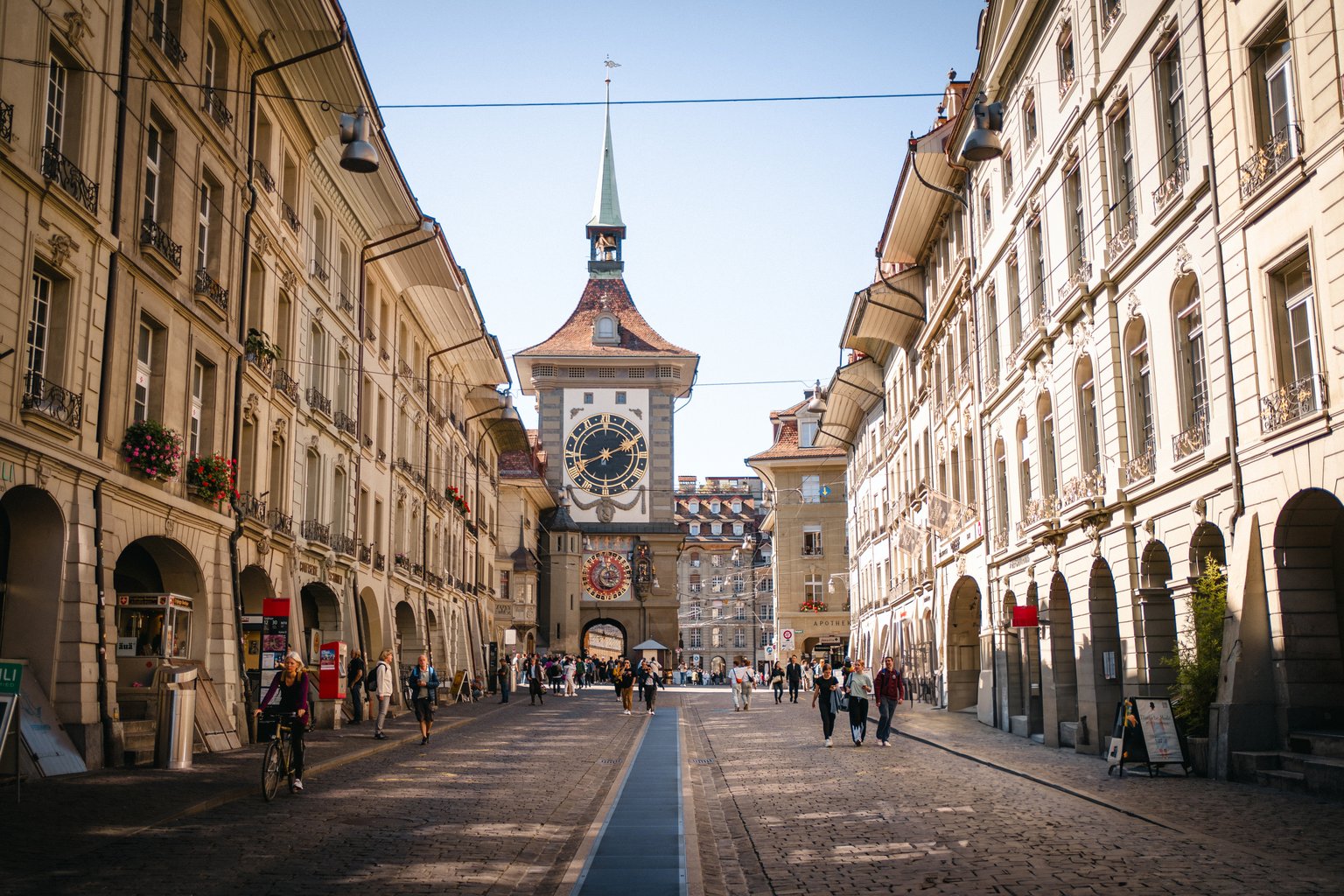
Being on time is a small mistake at Bern’s Zytglogge. The clock tower’s figures start moving about four minutes before the hour, so an arrival timed to the first full-hour chime misses the opening. German-language visitor accounts on Mappsch mention the rooster’s early announcement; Bern’s local guide G26 places the beginning at the same moment. Set your appointment with the tower a little earlier than the tower’s appointment with the hour.[1][2]
There is another appointment you probably will not see. In a September 2026 report for the local newspaper BärnerBär, Andrea Bauer follows timekeeper Mario Marti into the tower. Each day, someone from his team climbs up, checks the clock and winds its weights back into position. Marti inherited the work after his father’s death in 2023; his own son has begun helping. The figures outside are public, but their dependable return rests on this quieter family routine.[5]
That is a good reason to give the performance your attention. Something has been prepared for you before you arrive.
Find the figures before they move
Approach the Kramgasse side, east of the tower, where the astronomical clock and figure group face the street. G26 identifies this as the viewing side. If you have reached the tower from Marktgasse, continue around to find that decorated face before settling into a position. The address used by Bern Welcome is Bim Zytglogge 3.[1][3]
For a first visit, I would choose 11:50–12:05, a fifteen-minute appointment built around noon. This is a suggested viewing window, not a promise of a quiet street. Bauer’s report describes people already waiting and notes that the noon sequence gives them a particularly long round of sights and sounds. Aim to have found your position by 11:53, leaving a little slack before the first movement.[5]
There is no admission queue for watching from the street, and no reservation is needed. There may still be people between you and the figures. The useful distinction is between finding a clear view and finding a front row: the latter is not always better. Switzerland Tourism specifically recommends standing back enough to see the gilded bell-striker high on the tower.[1][4]
Choose your spot before raising a phone. Check that both the lower figures and the upper bell area are visible, and keep the passage through the tower clear. A tightly framed photograph of the dial can wait; the pleasure of this visit is following movement between different parts of the building.
Let the hour travel up the tower
The rooster announces the change. Bears circle, the jester rings his bells prematurely, and Chronos turns his hourglass. At the hour, the gilded figure called Hans von Thann strikes the bell above, keeping time with Chronos’s sceptre. Bern Welcome’s account makes the connection between the lower figure and the upper striker explicit. Watch for that correspondence: an apparently scattered collection of ornaments becomes a coordinated performance.[3]
Try watching one relationship rather than recording everything. Follow the sceptre for a moment, then lift your eyes towards the bell. The smallness of the figures rewards concentration. You do not need to identify every character to notice that the hour is being handed from one part of the tower to another.
After the striking ends, return your attention to the astronomical dial. It works on a different scale of time, displaying information including the zodiac, lunar phase and date. Its moving parts will not provide another burst of theatre while you wait. Switzerland Tourism points visitors to the Bärner Zytfänschter display in the gateway for an explanation. Save that closer reading for after the brief action, when you can look without wondering whether you are missing the rooster.[4]
The tower’s position also rewards a second look. It began as a defensive gate and became more central as Bern expanded. After the 1405 fire it took on its public timekeeping role. Bern Welcome notes that distances expressed as hours of travel were measured from here, while length standards at the gate helped regulate measurement.[3] The building once gave people several ways to agree about the world outside their own door.
Decide whether to go behind the face
For one full-price adult, the visit costs CHF 0–25: nothing for the outdoor performance, or CHF 25 for the public tower tour, excluding transport. G26 clearly separates free street viewing from paid interior access. Treating the crowd outside as a queue for an open tower door is the second avoidable mistake.[1][6]
The official tour lasts 60 minutes, takes at most 19 people, and meets on the Kramgasse side. Book a dated departure and check its language before shaping the rest of your day around it. The booking page, checked on 10 November 2026, still displayed an August–October schedule in its descriptive text; that is not a reliable November timetable. Use the dated booking calendar or ask Bern Welcome to confirm the departure.[6]
Think about the climb, too. A Mappsch reviewer praises the tour while describing cramped stretches and narrow stairs where a firm hold is useful. Bern Welcome specifies approximately 130 steps to the upper viewpoint. Expecting a casual, spacious ascent is the third mistake; ask the operator about suitability before booking if tight stairs are a concern.[2][6]
Going inside adds the machinery to your memory of the moving figures. Staying outside leaves you with something complete as well: the rooster, the turn of the bears, the answering bell. After the last strike, lower the phone and look once more at the now-still group. You have seen a few minutes of its day. Somewhere behind that face, the weights continue their slow descent.[5]
Sources
- Redaktion G26 Bern, “Zytglogge: Berns Zeitglockenturm und sein Figurenspiel,” published 20 February 2026, updated 16 July 2026 — local guide to the eastern viewing side, early start and free outdoor access.
- Mappsch, “Zytglogge – Bern,” German-language visitor reviews — undated accounts of the early rooster call and narrow interior stairs; used for visitor experience, not current opening hours or prices.
- Bern Welcome, “Zytglogge (Clock Tower)” — official account of the figures, former city gate, public measurements and address; source of the accompanying photograph. Checked 10 November 2026.
- Switzerland Tourism, “Clock Tower (Zytglogge)” — four-minute lead, upper bell-striker sightline, astronomical display and Bärner Zytfänschter. Checked 10 November 2026.
- Andrea Bauer, “«Stück Berner Geschichte»: BärnerBär begleitet Zytglogge-Zeitrichter,” BärnerBär, 27 September 2026 — local reporting on Mario Marti, daily winding, family continuity and the noon performance.
- Bern Welcome, “Tour of the Clock Tower (Zytglogge)” — public-tour price, duration, group size, steps, meeting point and booking arrangements. Checked 10 November 2026; consult the dated calendar for departures.