The first thing to look for on the way to Leiden’s Burcht is a lion changing colour. Above the gateway from Nieuwstraat, the animal is being returned to red. Local broadcaster Sleutelstad reported on September 17, 2026 that scaffolding remained and work would take several more weeks. An older photograph’s sandy lion may be less historically faithful than the bright one arriving now.[2]
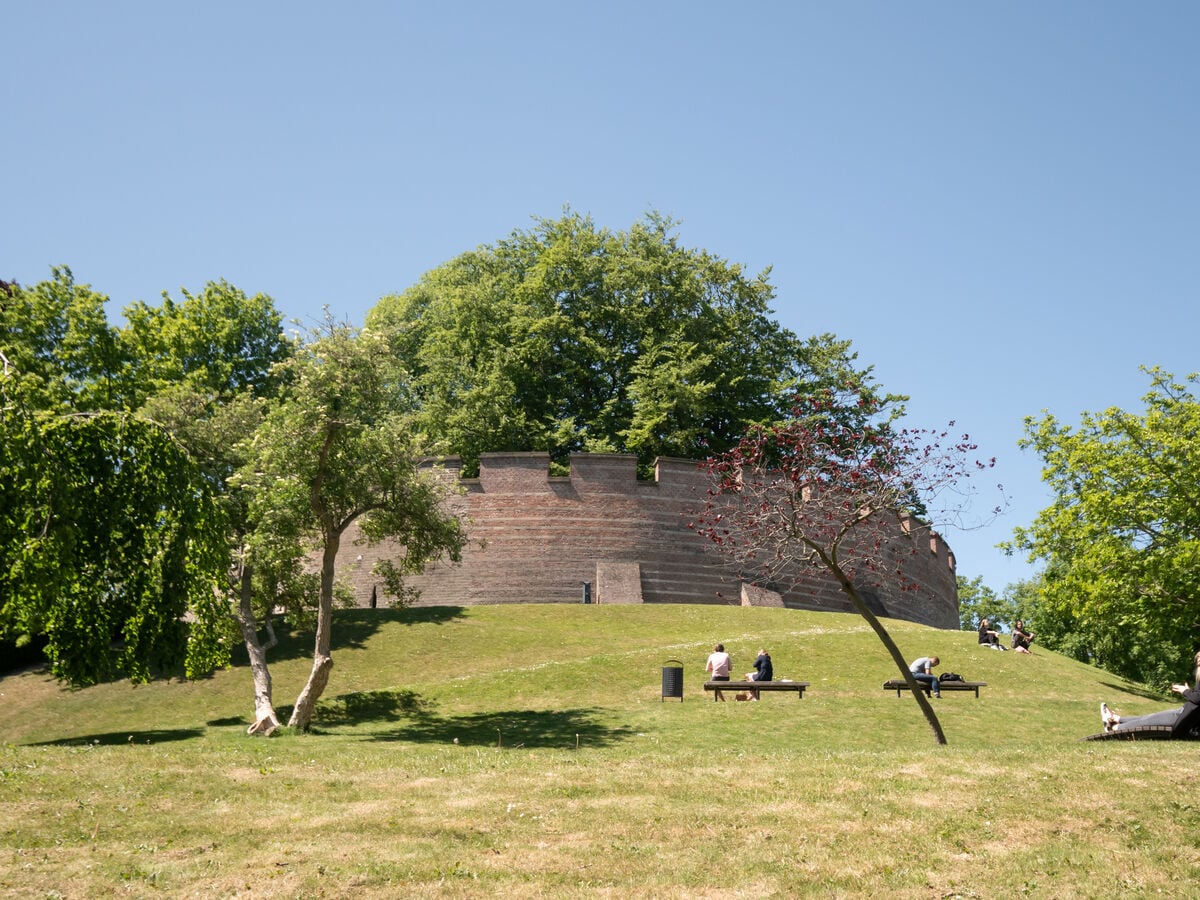
Beyond that street entrance, the route rises to a ring of masonry on a man-made hill, roughly 10 metres above its surroundings.[1] The walk is short enough to fit between other plans, but it deserves to be taken as a whole. Street, gateway, slope and wall explain how Leiden has made an old defensive position available for an ordinary morning out.
Look up before going through
Use Burgsteeg and the gateway on Nieuwstraat as your approach, rather than navigating only to a pin at the centre of the hill. Burgsteeg is the address used by the city’s visitor office; the heritage organisation’s account identifies the Nieuwstraat entrance as part of the complex’s conversion into a public attraction.[1][5] If arriving on foot from Leiden Centraal, I would budget 20–25 minutes to reach this entrance at an unhurried pace. That is a planning allowance, not a timed route measurement.
Pause beside the gateway, clear of the passage, and look up. Red pigment survived in the lion’s mane; laboratory analysis and archival research supported restoring its colour. The gate is also getting masonry repairs and a stone-grey finish.[2] Looking for those details gives the scaffolding a purpose beyond spoiling a photograph.
It would be easy to see the works and assume the whole Burcht is closed. The municipality’s restoration notice says the passage beneath the street gate remains open to pedestrians and cyclists during the work.[3] Follow the arrangements posted on site, and leave room for people using it as a route. The latest report checked for this article describes work in progress; it does not justify promising an unobstructed view of the finished lion.[2]
The other way up matters
The obvious ascent is the high staircase beside the café terrace. For someone who cannot manage those steps, the useful local detail is behind the building: a sloping path starts on Van der Sterrepad. Sleutelstad explained the distinction in February 2024 after reporting that this second entrance was regularly locked.[4]
The reason was surprisingly mundane. The security contractor opened the gate at the stairs each day but had not known that another gate also needed opening. After questions to the municipality, the second gate was added to its rounds.[4] A public monument had a route intended to widen access, yet the daily instructions failed to include it.
So do not let the prominent staircase make the decision for you. Look for the slope if that better suits your party. Equally, a path up the hill should not be read as a promise that every part of the fortification is accessible: the local Open Monumentendagen listing marks its Burcht visit as unsuitable for wheelchair access.[5] If step-free access is essential, confirm the particular route and areas you want to reach with the visitor office before setting out. The distinction is between reaching the hill and using everything on it.
A circle that lets the city in
At the top, take the wall walk if the steps suit you. Let the curve determine the pace: move around it, pause where you can stand without blocking others, and watch the relationship between roofs, trees and masonry change. A single photograph can flatten this into a viewpoint. Walking the circumference makes it a sequence of views.[1]
The ring has been repaired repeatedly. The local heritage account dates its tuffstone wall to the late twelfth century and describes conservation in 2010 to protect the battlements from rain.[5] What looks like a continuous medieval object contains many decisions about how to keep it standing.
Its purpose changed too. The expanding city had enclosed the Burcht by the fourteenth century, weakening its defensive role. After Leiden acquired it in 1651, gardens, a maze and a deer park made it a public attraction.[5] Those amenities belong to its history. They explain why a place organised around defence began inviting people uphill for pleasure.
That is the most satisfying thing to carry back to the street. The height remains, but the reason for climbing has changed.
Give it a morning
An April 2026 discussion on r/Leiden recommends Sunday morning, describing a calm circuit accompanied by church bells.[6] Treat that as one contributor’s experience, not a guarantee of silence. My suggested window is 10:00–12:00, with 30–45 minutes for the gateway, ascent and a slow look around once you arrive. These are visit-planning estimates, not official hours or a required duration.
Ordinary admission is free; there is no ticket reservation to arrange for this self-guided stop.[1] A practical budget is €0–10 per person, excluding transport: zero covers the Burcht itself, while the upper end is merely an optional refreshment allowance. A café purchase is not part of the admission arrangement. As a public visit, it has no timed-entry queue to plan around, although groups and the narrow approaches can still slow movement.
The last visitor mistake is turning “free” into “always open.” In a local discussion about evening access, one person reported walking there after a listed closing time, while a former security worker described a daily locking routine.[7] Those accounts do not establish today’s exact schedule. They do establish why a sunset visit should not depend on an old map listing. Read the posted gate hours when you arrive and keep the return comfortably within them.
Come down before the visit becomes a race against a lock. At Nieuwstraat, glance back toward the lion. You have travelled only a small distance, but passed through several versions of a city: a stronghold, a public garden, a maintained monument and a passage that someone still has to remember to open.
Sources
- Visit Leiden, “De Burcht” — official visitor information on the Burgsteeg address, artificial hill, wall walk and free access; also the source of the photograph reproduced above. Checked September 27, 2026.
- Jan Frensen, Sleutelstad, “Groot onderhoud voor Leidse Burchtpoort vordert: chemische analyse bewees rode leeuw,” September 17, 2026 — written local reporting on scaffolding, pigment analysis, restoration details and the remaining work.
- Municipality of Leiden, “Restauratie Burchtpoort van start,” March 26, 2026 — restoration scope and the stated provision for pedestrian and cycle passage during works; its original completion estimate is superseded by source 2.
- Chris de Waard, Sleutelstad, “Hek hellingpad Burcht voortaan dagelijks open,” February 3, 2024 — location of the sloping entrance and the municipality’s response to its gate being left locked.
- Open Monumentendagen Leiden, “23 De Burcht” — local heritage account of the fortification, public ownership and restoration, with the organiser’s accessibility warning; event-specific visiting hours are not used as ordinary opening hours here.
- r/Leiden, “Stunning views over Leiden from De Burcht,” April 3, 2026 — community recommendation for a Sunday-morning visit and the experience of hearing church bells.
- r/Leiden, “Openingstijden Burcht van Leiden,” May 2024 — conflicting visitor recollections and a former security worker’s account of daily gate closure; used to explain uncertainty, not to assert current opening hours.