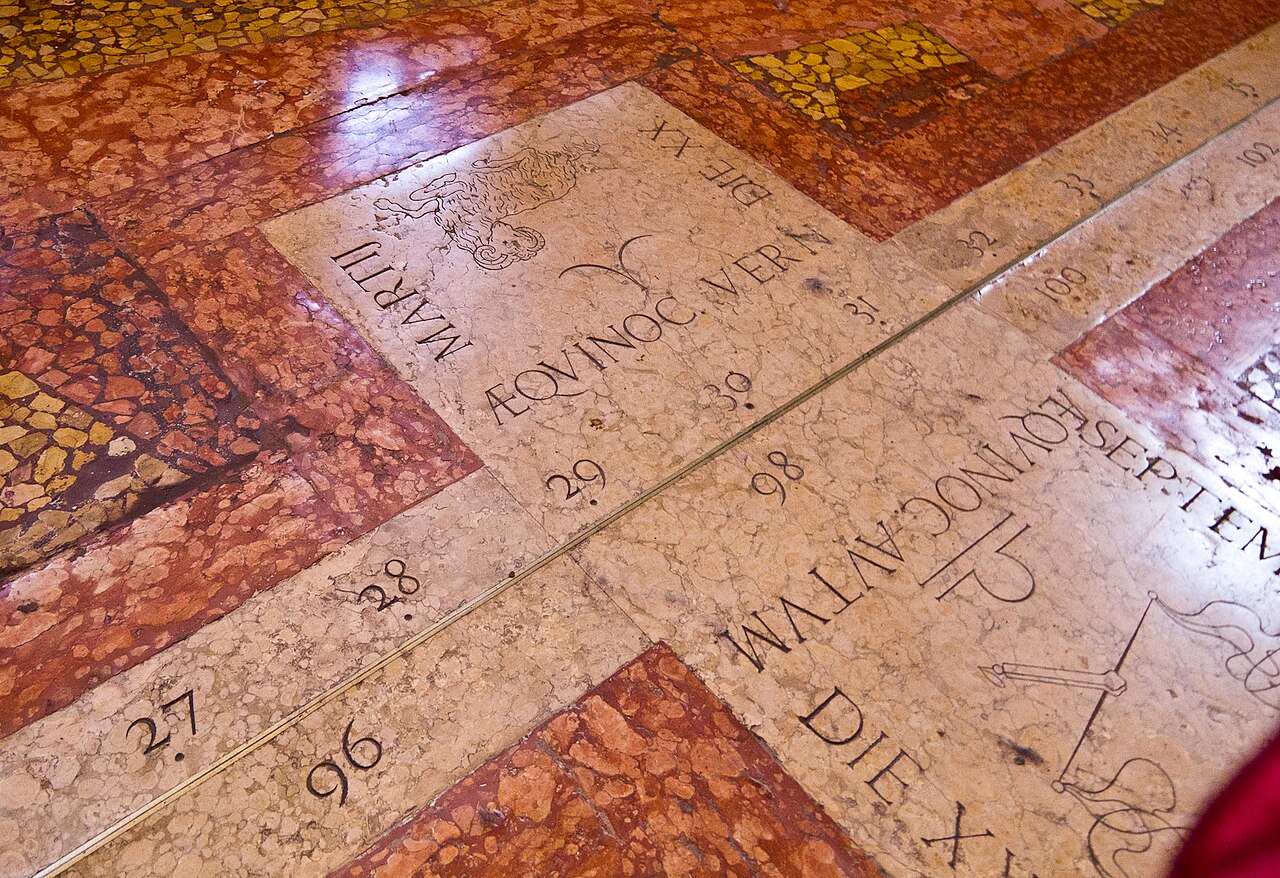
Inside Bologna’s Basilica of San Petronio, the detail worth waiting for is small enough to be lost against the floor: an image of the Sun, admitted through a hole in the vault. As it crosses a line in the paving, the building registers local noon. The church’s height and darkness become parts of an instrument; your task is to arrive while the sky can operate it.[1][2]
The meridian cuts obliquely across the left aisle. Local cultural association Succede solo a Bologna describes its roughly 67 metres of marble and the golden sun painted around the aperture above. These are useful recognition cues. Looking down finds the scale; looking up finds the source. The distance between them makes a tiny opening capable of an observation on the scale of a room.[1]
Cassini built the instrument in 1655. Its purpose extended beyond telling people when to eat lunch: INAF astronomer Francesco Poppi explains that observations compared changes in the projected Sun’s diameter with changes in its apparent motion, helping test Kepler’s account of planetary motion. The meridian also served investigations into the accuracy of the Gregorian calendar.[2] That history changes the pleasure of the visit. You are looking at a church floor arranged to make a question answerable.
Arrive for the Sun’s appointment
The first visitor mistake is treating 12:00 on a phone as the appointment. In the Italian horology community AISOR, Bologna-based gnomonist Giovanni Paltrinieri describes a visit that culminates in watching the solar image cross the line. A participant’s photograph records the December 14, 2019 crossing at 12:09 Central European Time. That is evidence of one day’s observation, not a reusable timetable: local solar noon and civil clock time are different measures.[6]
Ask at the basilica for the day’s expected passage, making clear that you mean the meridiana. My suggested viewing window begins 20–30 minutes before that passage, with 45–60 minutes allowed for the visit overall. Those are planning allowances, not measured queue times. They give you room to find the instrument and watch the light approach, instead of arriving at the door when the interesting moment is already happening.
The second mistake is assuming that an open church guarantees a visible solar image. Paltrinieri’s invitation expressly makes the observation dependent on the sky.[6] Choose a day with direct sunshine if seeing the crossing matters most. Under cloud, the marble and aperture still explain the arrangement, but patience cannot summon a beam. Keep that distinction when deciding whether to wait or return.
Find the line without buying the wrong visit
San Petronio faces Piazza Maggiore. Once inside and facing the main altar, look to the left aisle, then follow the pale strip across the paving.[1][4] Find the painted golden sun around the hole in the fourth vault before searching the floor for its moving image.[1]
When the image is visible, choose a position beside its path and leave other people a view. Watch from within the permitted visitor area; the quiet pause is part of being in a working church. A photograph can record where the light was. Staying beside it lets you notice that its position changes.
The third mistake is treating every interior visit as a paid chapel tour. In a November 19, 2025 Italian-language Tripadvisor review, visitor roberto p distinguishes free basilica admission from the paid three-chapel circuit. The basilica’s current booking page confirms that the meridian itself is free.[5][4] For an ordinary individual visit, budget €0. If you independently choose the three-chapel circuit, its standard adult price is €5, making €0–5 a useful admission budget. The paid circuit is an optional extension within the same building.[4]
Individuals and ordinary adult groups below 15 people do not need to reserve basilica entry; groups of 15 or more must book, and school and youth groups have separate rules.[4] Free admission does not establish how long any entrance queue will take. Preserve your arrival margin instead of assuming that no ticket means immediate access.
The building has another calendar
Access checked September 28, 2026: the basilica lists daily opening from 10:00 to 18:00, with last entry at 17:50.[3] Before leaving for the square, check its homepage notice as well: on September 29, some areas may be inaccessible during a religious celebration; on October 4, guided visits finish at 13:30, with their last admission at 13:15. The notice does not identify a guaranteed viewing position for the meridian during these events.[7]
Arrive with shoulders and knees covered, and leave suitcases in storage before coming: the official rules exclude luggage. Visitors needing the ramp should use the side entrance on Via de’ Pignattari.[3] Settling these details beforehand keeps the brief solar event from becoming something you miss while solving a problem at the door.
There is a particularly Bolognese continuity here. The university’s account of the meridian’s anniversary records that townspeople were invited to Cassini’s first observations on September 22, 1655.[9] Today’s visitor can still perform the essential change of attention: stop looking through the nave toward a distant destination, look down, and give a small moving light enough time to become an event.
Sources
- Succede solo a Bologna APS, “I record di Bologna” — local cultural association’s account of the meridian, its floor setting and painted aperture.
- Maura Sandri, Media INAF, “Al via le celebrazioni per l’Anno cassiniano,” February 27, 2025 — interview with Bologna astronomer Francesco Poppi on the instrument’s scientific purposes.
- Basilica di San Petronio, “Info e orari” — current opening hours, dress and luggage rules, and accessible entrance; checked September 28, 2026.
- Basilica di San Petronio, “Visite” — free meridian access, individual and group booking rules, and optional chapel prices; checked September 28, 2026.
- roberto p, “Il Santo Petronio,” Tripadvisor Italia, November 19, 2025 — individual visitor report distinguishing free basilica entry from the paid chapel circuit.
- AISOR community forum, “Visita alla meridiana di San Petronio,” December 2019 — Bologna gnomonist Giovanni Paltrinieri’s invitation and participants’ report, including weather dependence and an observed local-noon crossing.
- Basilica di San Petronio, official homepage — September–October 2026 access and guided-tour notices; checked September 28, 2026.
- CEphoto, Uwe Aranas, “Bologna SanPetronio MeridianGiandomenicoCassini,” December 28, 2011 — original photograph and CC BY-SA 3.0 attribution record, Wikimedia Commons.
- Università di Bologna, “Giò Domenico Cassini dai suoi tempi ai giorni nostri,” 2005 — account of the public observations inaugurating the meridian in September 1655.