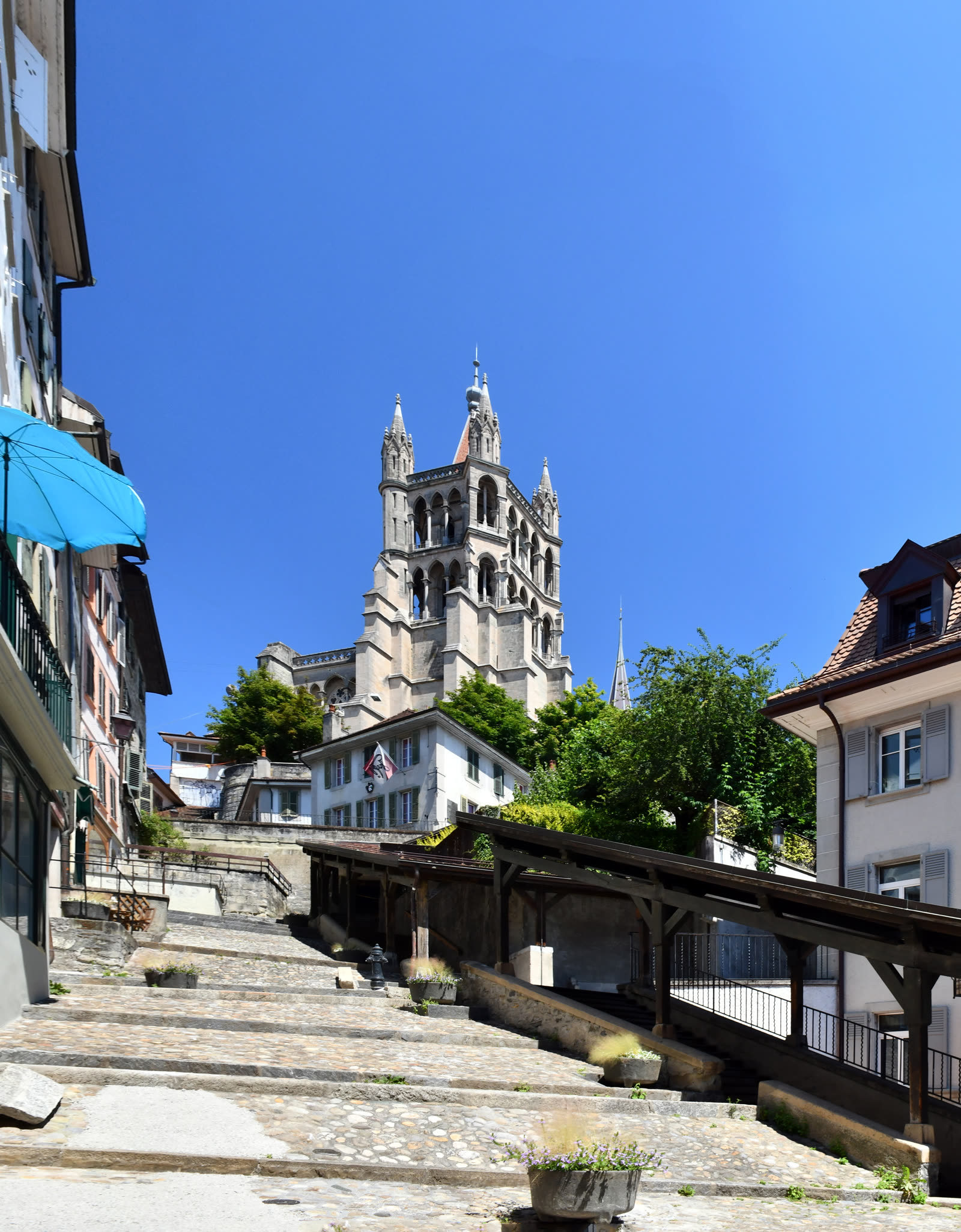
Lausanne is easy to misread as a slope problem. Visitors come out of the station, feel the grades immediately, and start solving the city in fragments: one museum by the lake, one shopping street on the way back up, one cathedral look, then done. The cleaner local correction is much tighter. Use the Escaliers du Marché as your way into the Cité, take the cathedral tower before last entry if you want the long view, then stay put until the watch begins calling the night hours from above.[1][2][3][4]
That sequence works because the two anchors do different jobs. Escaliers du Marché is not generic old-town atmosphere but a direct vertical edit between Place de la Palud and the cathedral hill. Lausanne Tourisme dates the staircase's first recorded existence to the 13th century and its current wooden, roofed form to 1717-1719.[1] The same page explains why the place is called "du Marché": until the 14th century the city market stood beside it, and traces of that older market ground still survive below Rue Pierre-Viret.[1] Lausanne Cités adds the mechanical facts that make the climb feel specific rather than symbolic: the stair has 177 steps, it was cut in two by the opening of Rue Pierre-Viret in 1911, and continuity was restored by an under-road passage in 1975.[7]
The cathedral then changes the hill from a climb into a room. The official cathedral page gives the current 2026 visitor logic clearly: from 01 April 2026 to 30 September 2026, the site is open 09:00-19:00 daily; from 01 October 2026 to 31 March 2027, it shifts to 09:00-17:30.[2] The cathedral itself is free, while the tower currently costs 6 CHF for adults 26+, 4 CHF for concessions, 3 CHF with the Lausanne Transport Card, and is free for visitors up to 25 or with the City Pass.[2] Last tower entry is 30 minutes before closing.[2] After that public visiting window ends, the place keeps a second life. Every night between 10 pm and 2 am, the cathedral watch calls the hours from the belfry, carrying on a tradition that Lausanne Tourisme describes as more than 600 years old.[2][3]
Image context: the cover uses a real Wikimedia Commons photograph looking up the Escaliers du Marché toward the cathedral. That is the right recognition cue because this article is about one physical sentence in Lausanne: roofed stairs first, church tower second, night voice last.[10]
Why this night room works after the market starts to drain away
The staircase is strongest when the lower city has begun to quiet down but the old market logic is still faintly present. Officially, Place de la Palud hosts the country market on Wednesday and Saturday mornings, with a craft market every first Friday of the month.[1] Das Genève makes the same geography legible from a local-guide angle, describing the stairs as the central-city link between the animated Palud square and the cathedral above, with market energy still defining the place on Wednesdays and Saturdays.[6]
That is why this piece works as a night room instead of a market walk. You do not need the produce stalls themselves. You need the knowledge that this wooden climb still belongs to the mercantile heart of Lausanne, so that when the square empties and the stairs begin echoing, the quiet feels earned rather than museum-like.[1][6]
The cathedral watch sharpens that evening logic. Lausanne Tourisme's interview with Renato Häusler says he climbs 153 stairs to reach the top and values the moment of stopping to take in the city each time he arrives.[3] A newer Lausanne Tourisme profile introduces Alexandre Schmid as a main watchman in the role since January 1, 2024, calling the hour every night on the hour from 10 pm to 2 am.[4] Together those two profiles make an important practical point. The public tower visit and the night watch are not the same experience. One belongs to opening hours and ticketing; the other belongs to a later civic ritual. The best visitor move is therefore not to chase special access after dark but to let the square and the stairs become your listening room.[2][3][4]
A recent Lausanne Tourisme panorama leaflet still tells visitors to listen to the Watch calling out the hours at the cathedral, which is a useful current signal that this is not dead heritage copy but active visitor guidance right now.[8]
There is also a current constraint worth respecting. The official cathedral page says the rose and its stained glass remain inaccessible until spring 2027 because of renovation work in the south transept.[2] That pushes the emphasis back where it belongs for this route: onto the climb, the forecourt, the city roofs, and the voice overhead.
8 local moves that make this night room land
- If you go on Wednesday or Saturday, separate market time from night-room time. See the square in the morning if you want, but come back in the evening for the cleaner version of the route.[1][6]
- Start from Place de la Palud rather than dropping in from behind the cathedral. The stairs matter because they pull you out of the lower city in one continuous motion.[1][7]
- Do not rush the lower flights. The covered section is the real mood-setter; halfway up, Lausanne already starts sounding different.[1][10]
- Treat the Pierre-Viret underpass as part of the old route, not as an interruption. Lausanne Cités is useful here: the stair was broken in 1911 and stitched back together in 1975, so the passage is part of the stair's story now.[7]
- Decide on the tower early. In the current season, the last public visit is 30 minutes before close, so if you want the panorama you need to commit before the evening drifts away.[2]
- If you do climb the tower, come back down before full dark and stay outside for the watch. Public tower visiting is a daytime layer; the 10 pm call belongs to the square below.[2][3][4]
- For the first night call, stand on the cathedral forecourt or a little way down the upper flights. The westward opening over the roofs makes the voice feel placed inside the city rather than detached from it.[2][5]
- After the call, linger in the Cité instead of sprinting downhill. Lausanne Tourisme's Cité piece is right that the neighborhood still has small corners and pauses built into it, which is exactly what you want after the hour has been announced.[5]
Non-local trapline: 4 common mistakes and the better alternative
Mistake 1: doing the Escaliers du Marché only as a daytime postcard climb
Better alternative: use the stairs late enough that the old market quarter has started to empty, then let the cathedral watch finish the sequence at 10 pm.[1][2][8]
Mistake 2: assuming "cathedral at night" means the tower stays open until the watch calls
Better alternative: separate the two layers. Public tower access ends with the standard schedule and its 30-minute last-entry rule; the watch is something you hear after that, from outside.[2][3][4]
Mistake 3: giving up when Rue Pierre-Viret cuts the stair in two
Better alternative: keep going through the underpass. The break and repair are part of the stair's real history, not evidence that the route has stopped making sense.[7]
Mistake 4: scheduling the route for peak market bustle when what you actually want is the quiet night room
Better alternative: if Wednesday or Saturday is your only chance, note the market character in the morning and return in the evening once the central square has thinned out.[1][6]
Concrete go details
- Best window: for the full version, aim for roughly 18:15-22:10 in the 01.04.2026-30.09.2026 season so you can take the tower before the 18:30 last entry and still stay for the 10 pm watch call; for the shorter version, just arrive around 21:15-21:45 and use the stairs plus the forecourt as your listening room.[2]
- Expected spend: 0-6 CHF, depending on whether you only do the outdoor route or add the tower; the main night-room version is free.[2]
- Queue and reservation reality: no serious queue pattern for the stairs or forecourt; the only hard public constraint is the tower's closing rule. Lausanne Tourisme notes that a special meeting with the watch is possible by appointment, but the normal public version does not depend on booking.[2][5]
- Where to stand: first midway up the covered stairs, then on the cathedral forecourt or just down the upper flights where the roofs open westward.[1][5][10]
- Navigation cue:
Place de la Palud -> lower Escaliers du Marché -> Pierre-Viret passage -> upper flights -> Place de la Cathédrale 1; the stair itself is easy to surface on the current map layer if you search it directly from lower town.[1][2][7][9] - Numeric anchors worth keeping: 13th century, 14th century, 1717-1719, 177 steps, 1911, 1975, 09:00-19:00, 09:00-17:30, 30 minutes, 6/4/3 CHF, 10 pm-2 am, 153 stairs.[1][2][3][7]
Lausanne does not need a giant night itinerary to explain itself. One wooden climb, one forecourt above the roofs, one voice repeating the hour from the belfry: that is enough to make the city stop feeling like a set of gradients and start feeling composed.
Sources
- Lausanne Tourisme, "Escaliers du Marché" (official page covering the direct stair link between Place de la Palud and the cathedral, the staircase's first record in the
13th century, its1717-1719form, the market history, and Palud's current market schedule). - Lausanne Tourisme, "Lausanne Cathedral" (official page covering current
2026opening hours, tower prices, the30-minutelast-entry rule, the nightly10 pm-2 amwatch calls, and the rose-window renovation throughspring 2027). - Lausanne Tourisme, "The voice of the Cathedral" (official interview covering the watch's
600-yeartradition, Renato Häusler's role, and the153stairs he climbs to the belfry). - Lausanne Tourisme, "Meet Alexandre Schmid, watchman of the Cathedral" (official profile noting that Alexandre has held the role since
January 1, 2024and calls the hour every night from10 pm to 2 am). - Lausanne Tourisme, "The Cité Quarter" (official neighborhood article covering the watch call from
10 pm to 2 am, the possibility of arranging an appointment with the watch, the oldest privately owned house near the foot of the stairs, and the small pauses built into the Cité). - Das Genève, "Escaliers du marché de Lausanne" (local guide describing the stairs as the city-center link between the cathedral and Place de la Palud, and noting the market life on Wednesdays and Saturdays).
- Lausanne Cités, "A Lausanne, les Escaliers du Marché sont des marches vers le ciel" (local press feature from 2024-11-25 counting
177steps and explaining the1911cut and1975reconnection of the staircase). - Lausanne Tourisme, "Panorama Walks" leaflet (recent official visitor PDF that still tells readers to listen to the cathedral Watch calling out the hours, confirming the ritual as live visitor guidance).
- Google Maps search, "Escaliers du Marché Lausanne" (current community and navigation surface useful for same-day orientation from the lower city).
- Wikimedia Commons, "File:Cathédrale escaliers du Marché (1).jpg" (documentary photographic source for the lead image).
Editor’s Pick Review
This article takes today’s merged standard/add-on editor-pick slot because it is the strongest 24-hour candidate under the current quality bar: it turns one small Lausanne route into a complete city-reading mechanism, keeps the advice practical without flattening the atmosphere, and passes the stricter image policy with an immersive documentary visual that is physically central to the piece rather than analytical decoration. The English article is unusually precise about sequence, timing, costs, access limits, and local ritual, while the Chinese edition keeps the same spatial logic in natural prose with stable terminology, clean transitions, and low translationese. The result feels useful before arrival and still textured enough to reward slow reading.