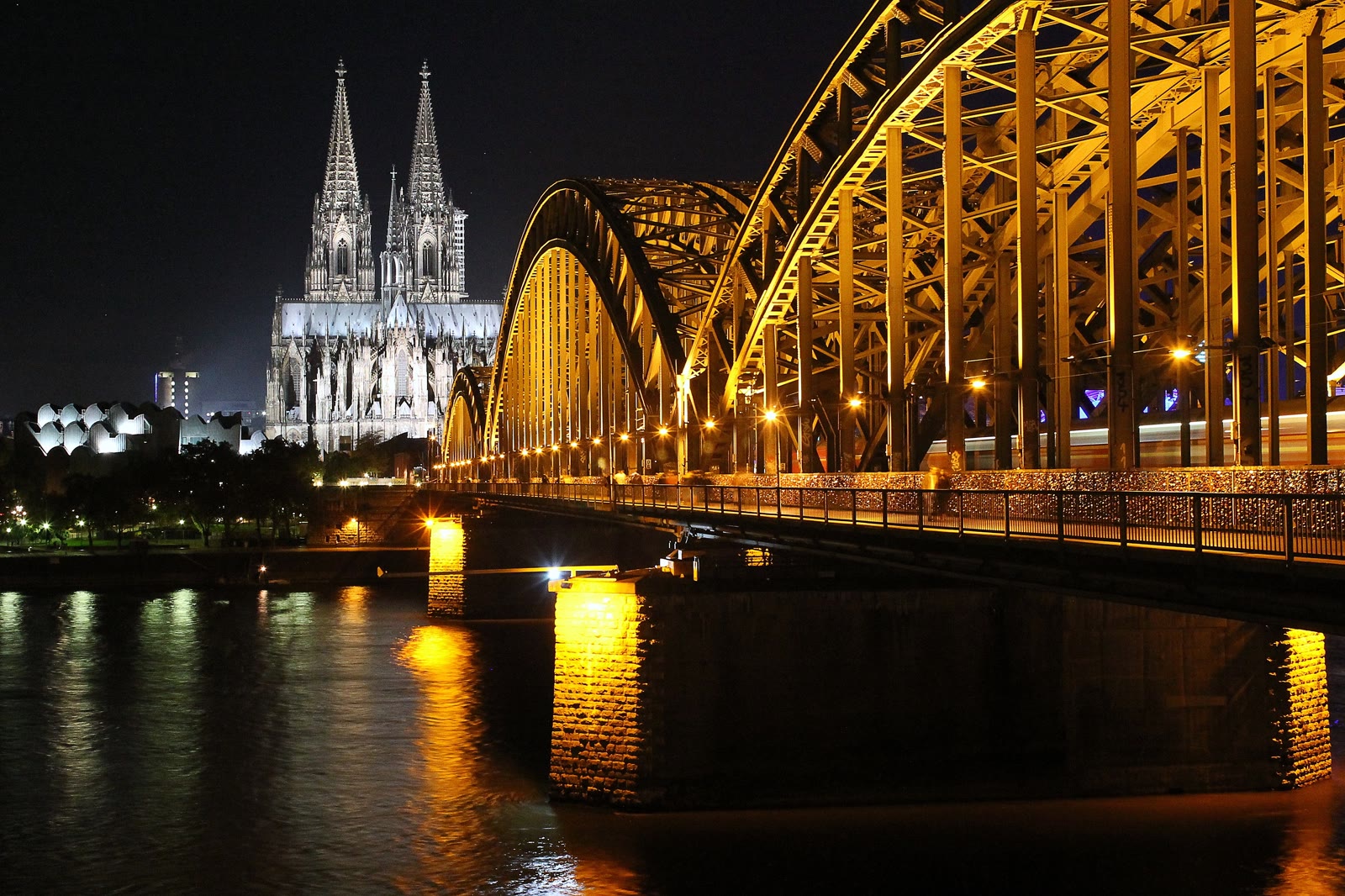
Cologne is easy to flatten into left-bank behavior. People orbit the Dom, walk a few minutes along the old town edge, take the bridge as a postcard backdrop, and then drift back inland before the evening has actually settled. The cleaner local move is shorter and more structural. Cross the Hohenzollern Bridge while the sky is still changing, stay moving until you reach Deutz, then let the Rheinboulevard take the longer pause once the cathedral, bridge, and river have all fallen into one frame.[1][2][3][4][6]
The two anchors solve opposite problems. The Hohenzollern Bridge gives Cologne its pressure: trains, steel, vibration, and the sense that the Rhine is still a working seam rather than decorative water. KölnTourismus describes the bridge as more than 400 metres long, one of Germany's most important railway bridges, and a span that now takes around 1,500 train crossings per day.[1] The official page also fixes the approach. The footpath begins behind Museum Ludwig, and the walk from Cologne Central Station takes about 3 minutes.[1] The Rheinboulevard gives you the release. KölnTourismus places its staircase between Hohenzollern Bridge and Deutzer Bridge, dates the built form to 2016, and notes that the stepped river edge runs for 500 metres along Deutz with one of the city's strongest old-town views, especially in the evening.[2]
The city-specific texture is that the better cathedral view belongs to the bank Cologne spent years treating as secondary. KölnTourismus's Die Schäl Sick route explains that the right-bank side of the Rhine acquired the name Schäl Sick because it was long considered the "crooked," "wrong," or simply non-preferred side in relation to Cologne proper.[5] That makes this evening route more than a skyline trick. You cross away from the canonical image of Cologne in order to get the most convincing version of it back. The Dom is not diminished by that move. It becomes legible.
Image context: the cover uses a real Wikimedia Commons night photograph taken from the right bank of the Rhine. It is the right documentary image here because the article is not about the bridge in isolation or the cathedral in isolation. It is about the Deutz-side relationship that appears only after the crossing has already happened.[7]
Why the bridge has to come first
The common visitor mistake is to go straight to the Rheinboulevard and treat the bridge as background scenery. That flattens the room too early. The boulevard is excellent at holding an evening, but it is not what gives the evening its scale.
The bridge should come first because it adds resistance before the landing. On the official bridge page, KölnTourismus describes the almost sublime feeling of walking beside locomotives and heavy rail traffic, then stresses that the panoramic city-center view opens from the Deutz side rather than from the cathedral approach.[1] The sequence matters. You leave Cologne's ceremonial center, pass the lock-covered fencing and the rail noise, feel the structure doing actual transport work, and only then descend into the broad stair room that turns all of that pressure into a still image.[1][2]
The local-use signal points the same way. koeln.de says the Rheinboulevard has been one of the city's hot spots for more than ten years, especially in summer, and recommends exactly the approach this article is built around: go past the cathedral, walk over the Hohenzollern Bridge, then drop onto the Deutz-side promenade; if you come by rail instead, it is roughly a 500-metre walk from Deutz station.[3] Mit Vergnügen Köln describes the same place less formally but more revealingly: this is where countless people gather in summer to catch the sunset with Dom, Rhine, and bridge all in the same line, and if the steps feel too crowded the riverside just beyond them still works.[4] A recent r/cologne thread adds one more small evening cue from ordinary use: locals recommend the river promenade near the bridges around sunset, noting that the green parrots roosting in the trees on the Rhine edge are part of the charm rather than a planned attraction.[6]
8 local moves that make this night room actually land
- Start from the cathedral side, not from Deutz. The route needs one active crossing before it becomes a room.[1][2]
- Use the bridge as soon as you reach the station area. The official walk from Cologne Central Station is only about 3 minutes, which makes detouring elsewhere before the crossing feel unnecessary.[1]
- Do not let the love locks become the outing. They are part of the bridge texture, not the reason to turn around early.[1][3]
- Keep moving until the Deutz landing, then drop immediately to the steps. The boulevard works best as the second room, not as a later add-on.[2][3]
- Aim for the last 45 minutes of daylight and the first 20 to 30 minutes after sunset. You want enough sky left for the bridge silhouette and enough darkness for the old town lights to start carrying weight.[1][2][4]
- Hold the northern stretch of the steps first. Closest to the bridge, the relationship between arch, cathedral, and river is cleanest before you drift south for space.[2][4]
- If the broad steps are packed, keep the route but change level. Mit Vergnügen's fallback is sound: the river edge just beyond the main staircase still preserves the same skyline logic with less crowd friction.[4]
- Let Deutz be the end of the route, not a transit inconvenience.
koeln.dealready frames the boulevard as easy on foot from the bridge and only about 500 metres from Deutz station if you want the rail exit afterward.[3]
Non-local trapline: 4 common mistakes and the better alternative
Mistake 1: staying on the left bank because that feels like the "real" Cologne
Better move: cross into Deutz on purpose. The whole point of the Schäl Sick idea is that Cologne often becomes more readable from the side once treated as the wrong bank.[5]
Mistake 2: treating the Hohenzollern Bridge as a static photo platform
Better move: keep walking until the structure has done its job. The bridge is useful because it vibrates with rail traffic and shifts the city's scale before you stop.[1]
Mistake 3: arriving only after the sky has gone completely black
Better move: use blue hour instead. The route is strongest when the bridge still cuts a silhouette and the boulevard is just beginning to glow.[1][2][4]
Mistake 4: seeing the Rheinboulevard as a quick stop before returning immediately to the old town
Better move: sit on the right bank long enough to let the frame settle. Local coverage treats the steps and river edge as the evening destination, not as overflow space for the Dom.[3][4][6]
Concrete go details
- Best window: the final 45 minutes of daylight into the first 20-30 minutes after sunset, with the bridge taken first and the boulevard used for the deeper blue after that.[1][2][4]
- Expected spend: EUR 0 if you start at Cologne Central Station and do the route on foot. If you choose to exit from Deutz by rail or tram, budget one local ticket rather than building the route around taxis.[1][3]
- Queue and reservation reality: none. The variables are crowd density on warm evenings and your own tolerance for bridge wind and train noise.[1][4]
- Where to stand or sit: keep moving on the bridge, then take the first longer pause on the northern part of the Rheinboulevard steps nearest the bridge before drifting south for more room.[2][4]
- Navigation cue:
Cologne Central Station -> back edge of Museum Ludwig -> Hohenzollern Bridge footpath -> Deutz landing -> immediate drop to Rheinboulevard -> southward drift only if you need space.[1][2][3] - Numeric anchors worth keeping: 3 minutes, 400+ metres, 1,500 train crossings, 2016, 500 metres, 500-metre walk from Deutz station, and the "more than 10 years" hot-spot reality of the steps.[1][2][3]
Cologne has louder riverfront evenings than this and more obvious ones. It has very few that explain the city so efficiently. One working bridge, one supposedly wrong bank, one long staircase, and one cathedral seen from the side are enough.
Sources
- KölnTourismus, "The Hohenzollern Bridge: The most important railway bridge and photo motif" (official page covering the bridge's 400+ metre length, about 1,500 train crossings per day, the Museum Ludwig footpath start, the Deutz-side panorama, and the 3-minute walk from Cologne Central Station).
- KölnTourismus, "Rhine Boulevard" (official page covering the 2016 staircase, the 500-metre stepped river edge between Hohenzollern Bridge and Deutzer Bridge, and the evening-view logic from Deutz).
- koeln.de, "Rheinboulevard in Köln-Deutz" (local city guide, modified April 22, 2026, used here for the "more than ten years" hot-spot framing, the cathedral-to-bridge walking approach, the roughly 500-metre walk from Deutz station, and the practical tram/S-Bahn access notes).
- Mit Vergnügen Köln, "11 wunderbare Plätze in Köln für den perfekten Sonnenuntergang" (local lifestyle guide used for the summer sunset-crowd signal and the fallback advice to use the riverside edge if the main steps are too crowded).
- KölnTourismus, "Die Schäl Sick" (official local-context route page used for the meaning of Schäl Sick as the right-bank side historically treated as the "wrong" or non-preferred side of Cologne).
- Reddit,
r/cologne, "Visiting Cologne" (published December 2025; local/community discussion used here for the sunset-promenade behavior near the bridges and the small right-bank parrot detail). - Wikimedia Commons, "File:Köln bei Nacht, Blick vom rechten Rheinufer auf das Museum Ludwig, den Kölner Dom und die Hohenzollernbrücke.jpg" (documentary photographic source for the lead image).