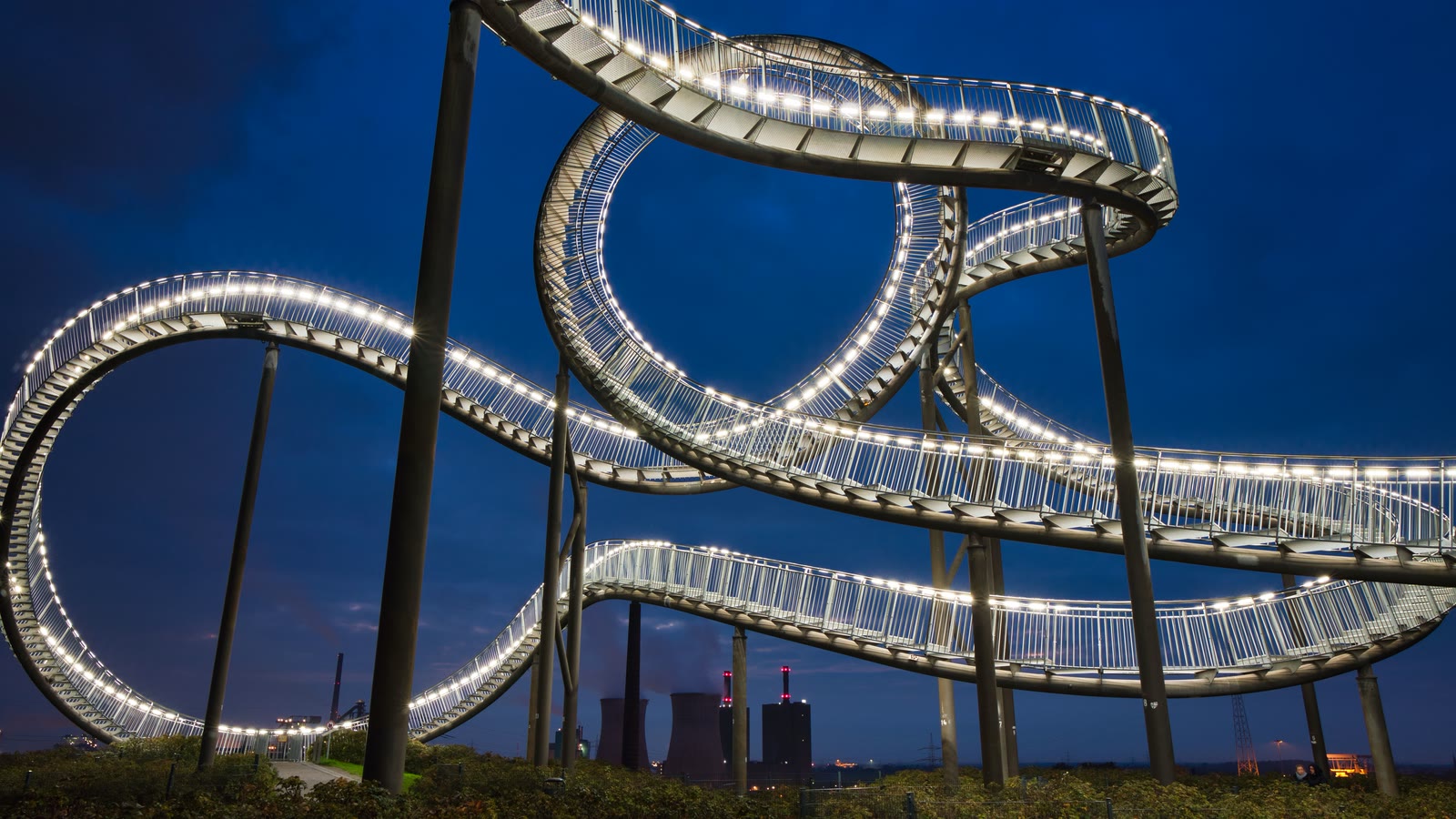
Do not save Tiger & Turtle for after dark. The useful hour begins 40 minutes before sunset, at the tram stop that carries the artwork's name. There is still enough light to read the paved rise through Angerpark, enough sky to separate a zinc-work spoil heap from the factories beyond it, and enough time to climb before 880 LEDs turn the handrails into a white line.
That change is the visit. Tiger & Turtle looks like a roller coaster engineered for speed, but it moves only at the pace of feet on galvanized-steel grating. Its loop cannot be crossed. Each stair arm eventually sends you back the way you came. At blue hour, the object does not start running; your understanding of it does.
Duisburg's own visitor page says the sculpture is free and open day and night, weather permitting, and identifies tram 903 as the clean public-transport approach [1]. Give the place 75–90 minutes rather than making it a late-night photo errand. Climb once while the structure is still silver, watch the lights take over, then descend far enough to see the whole impossible track become a drawing against the sky.
Let sunset set the appointment
The first local move is to look up sunset for the date, then count backward 40 minutes. Do not copy a fixed arrival time from somebody else's summer itinerary. The city's 2026 evening-tour schedule quietly demonstrates the seasonal logic: starts move from 21:30 in late June to 21:00 in late July, 20:00 in mid-August, 19:30 in late September, and 19:00 in late October [2]. The sculpture keeps the same address; darkness does not.
Aim to step off tram 903 about 40 minutes before sunset and reach the mound's upper paths 20–25 minutes before it. That buffer is not about beating a ticket queue—self-guided admission costs €0, with no reservation or entrance gate [1]. It is about seeing where you are putting your feet and letting the night arrive as a sequence.
Recent visitor reports repeatedly converge on sunset, but they add a useful warning: the staircase is more satisfying before the peak photo crowd, and people moving on its metal structure can be felt underfoot [6]. So the second move is to give the first climb to the remaining daylight. Take in the horizon from one arm, return to the central low point, and save the other arm for the LEDs. This produces two readings of one object instead of two nearly identical phone pictures.
The paid guided tour is optional, not an admission requirement. For the remaining 2026 dates listed in the city guide, an approximately one-hour evening tour costs €14 for adults and €6 for children aged 8–13, requires advance purchase, and calls for a flashlight and sturdy shoes [2]. A self-guided visit needs no ticket. The realistic spend range at the anchor is therefore €0–€14 per adult, before transport.
Tram 903 is the front door
From Duisburg Hauptbahnhof, the official instruction is tram 903 toward Mannesmann Tor 2, alighting at Tiger & Turtle [1]. The third move is to save both the destination pin and a return departure before boarding. Use the DVG live planner on the day rather than trusting a screenshot or an old timetable [9].
That same-day check matters more than usual in 2026. Since June 1, the VRR has made Duisburg a single fare zone; journeys within it use price level A, while the network continues to offer the distance-based eezy.nrw option [10]. Let the planner recommend the current ticket for your actual origin. It is cleaner than preserving a fare in an article after the tariff structure has changed.
Driving creates avoidable ambiguity. Angerpark has no dedicated visitor car park; the city points motorists toward Ehinger Straße or Kaiserswerther Straße and says parking is generally found in surrounding residential streets [1]. That is not the same thing as a guaranteed attraction lot. Tram 903 gives the night a legible threshold and removes the need to hunt through a neighborhood while the best light drains away.
The fourth move happens before the ride: use a toilet at the station or in the center, and carry what you need for the hill. An April 2026 report by the Greens in Duisburg's southern district, based on repeated site visits, described obscured or missing approach signs from Ehinger Straße, too few bins, and no nearby toilets; the district representation unanimously approved its improvement motion [8]. Treat that as a current field report, not a reason to skip the place. Save the pin, bring water, and do not expect visitor-center infrastructure at the mound.
From the stop, choose the paved ascent, even if a map or worn footpath suggests a shortcut. Community reports describe the paved road as the route that is hardest to lose, while the wooded cuts are less obvious to a newcomer [6]. In daylight they merely complicate the approach. After sunset they erase exactly the orientation this visit is designed to preserve.
The Halde is not scenery under the sculpture
On the way up, keep the fifth move deliberately slow: look down before looking out. In Ruhr vocabulary, a Halde is a spoil heap, a made hill built from industrial residue. Heinrich-Hildebrand-Höhe covers roughly six hectares and contains slag from the former MHD Sudamin zinc works [4]. Baukunst NRW records the plant's closure in 2005 and places the heap about 35 meters above street level [5].
The material connection is unusually exact. Heike Mutter and Ulrich Genth did not put an unrelated amusement-park shape on a green hill. They made a zinc-plated steel sculpture on the residue of zinc production. The artists' project record gives the track a length of 220 meters, the sculpture a height of 20.6 meters, and the public opening date of November 13, 2011 [3]. Industrial material has changed roles without pretending it came from nowhere.
That is the place-specific texture a quick photo loses. The Ruhr's structural change is often narrated with a neat before-and-after: factory closes, culture arrives. Tiger & Turtle keeps the two conditions in the same frame. From the steps, active steelworks, freight and storage landscapes, the Rhine corridor, woods, and residential Duisburg remain visible. The artwork is not a victory platform above an extinct industrial city. It is a slow device for seeing a region where production, remediation, recreation, and image-making overlap [4][5].
A local Komoot user made the mound the closing highlight of a 16.1-kilometer walk through southern Duisburg in July 2025, approaching it through river, lake, wooded, residential, and park-like terrain [7]. You do not need to reproduce that long route at night. The useful local lesson is smaller: Tiger & Turtle is not an isolated roadside object. It can function as the final punctuation in a lived southern-Duisburg landscape.
The loop is a stop, not a dare
At the steelwork, the sixth move is to choose one stair arm and accept its return. The structure is walkable only to about 13 meters above its base; the central loop is closed off [4][5]. This is not a defect to outsmart. The interruption is what converts the fantasy of continuous acceleration into a bodily fact: you climb, meet a gate, turn, and pass your own view again.
Wear shoes that grip. The surface is open metal grating, the slopes become proper stairs, and wind is more noticeable once you clear the mound. Recent community accounts also warn that the grating changes what is comfortable to wear and that the structure can feel active when several people are moving on it [6]. Keep one hand available for the rail, do not set a tripod across the steps, and let faster walkers pass at a landing rather than on a narrow pitch.
The seventh move is to use the loop gate as punctuation, not as the photograph. Pause below it only long enough to look through the geometry toward the industrial horizon. Then reverse. Back at the low center, take the other arm until the light has shifted. The two out-and-back climbs reveal different edges of the same panorama, while the impossible loop stays visibly impossible.
As dusk settles, LEDs integrated into the handrails begin to dominate the metal. The city counts 880 of them [1]; the artists describe the lighting as part of the stair system, not a floodlight aimed at a monument [3]. That distinction changes the atmosphere. The route itself glows. Curves that were spatially confusing in daylight flatten into a continuous bright contour, while the people walking them become small interruptions in the line.
Now make the eighth move: descend to see what you just walked. Choose an open patch at the base or a bench where you are off the circulation path. Give the complete silhouette five quiet minutes. Jonas Windmann's blue-hour photograph captures the recognition cue precisely: white handrail light, the blocked loop held near the center, and enough cobalt sky to keep the steel from disappearing [11]. The photograph is not an instruction to find the identical tripod mark. It is a reminder that the best view arrives after you stop climbing.
Four ways to lose the night
Mistake one: arriving only when the sky is black. Recent reviews describe the dark approach as less comfortable, while the city itself asks guided visitors to carry a flashlight [2][6]. Better: reach the stop 40 minutes before sunset, use the paved rise, and let full darkness arrive after you know the ground.
Mistake two: treating “roller coaster” as a promise of a completed circuit. The loop is gated and both sides are out-and-back [4][6]. Better: walk one arm in residual daylight and the other as the LEDs take over. Never climb or reach around a closure.
Mistake three: driving to a presumed attraction car park and trusting the first path you see. There is no dedicated Angerpark lot, and a 2026 local site report says the Ehinger Straße approach has suffered from poor signage [1][8]. Better: use tram 903, save the pin, empty your bladder before arrival, and stay on the paved ascent.
Mistake four: reading “open day and night” as unconditional access. The city closes the structure for severe weather, strong wind, snow, or ice; official tours are also cancelled for thunderstorms and severe storms [1][2]. Better: check the forecast and the official status before leaving. If the stairs are closed, do not turn a weather boundary into a challenge.
The visit in one glance
- Best window: a dry, calm weekday; arrive at the
Tiger & Turtletram stop 40 minutes before local sunset and allow 75–90 minutes through the return to the stop. - Expected spend: €0 for a self-guided visit; optional official evening tours are €14 adult / €6 ages 8–13 on the listed 2026 dates. Transit is separate [1][2].
- Queue and reservation: no booking for self-guided access. Paid tours require advance tickets. At sunset, manage crowding by walking rather than holding a narrow landing for photographs [2][6].
- Navigation cue:
Duisburg Hbf -> tram 903 toward Mannesmann Tor 2 -> Tiger & Turtle stop -> saved map pin -> paved Angerpark ascent[1][9]. - Where to stand: climb both open stair arms, turning at the loop closures; for the complete illuminated view, stand off the path at the base rather than stopping traffic on the grating.
- Carry: grippy shoes, water, and a charged phone; add a small flashlight for the descent. Use a toilet before the final tram leg [2][8].
- Before leaving: check weather closure, a live 903 return, and the current VRR ticket suggestion [1][9][10].
Tiger & Turtle earns its night by refusing the thing its shape advertises. Nothing races. The loop goes nowhere. A 220-meter track asks to be covered twice, slowly, above the slag of a zinc works. Then the handrails light up and Duisburg's old materials become legible in a new grammar—not erased industry, not theme-park nostalgia, but a public line that can be walked until it tells you to turn around.
Sources
- City of Duisburg, “Tiger & Turtle – Magic Mountain” — official access, free-entry, lighting, weather-closure, parking, tram 903, and route guidance.
- Duisburg Tourism, Guided Tours 2026 — official evening-tour dates, start times, duration, prices, booking, footwear, flashlight, and storm-cancellation guidance.
- Heike Mutter and Ulrich Genth, “Tiger & Turtle – Magic Mountain” — artists’ project record for dimensions, track length, material, public opening, elevation, and integrated handrail lighting.
- Route Industriekultur, “Tiger & Turtle – Magic Mountain” — official industrial-heritage account of the MHD Sudamin slag heap, sculpture dimensions, walkable height, night lighting, and surrounding industry.
- Baukunst NRW, “Tiger and Turtle – Magic Mountain” — architecture register on the zinc-works site, galvanized steel, heap height, closed loop, views, and the artists’ speed-versus-stillness concept.
- Wanderlog, “Tiger & Turtle, Duisburg” — Google and Tripadvisor community-review aggregation, including 2025 reports on sunset timing, paved approach, grating, wind, crowd movement, the loop closures, and return-tram planning.
- Komoot, “Wanderbares Duisburg – Tiger und Turtle” (July 13, 2025) — local community route report placing the mound at the end of a southern-Duisburg walk through mixed green and residential terrain.
- Greens Duisburg, “Mehr Schilder und weniger Müll für Tiger & Turtle” (April 17, 2026) — recent local site-visit report on Ehinger Straße wayfinding, bins, toilets, and the unanimously approved district motion.
- Duisburger Verkehrsgesellschaft, VRR journey planner — official live departure and connection check for tram 903.
- Verkehrsverbund Rhein-Ruhr, “The second phase of the tariff reform in the VRR” — official June 1, 2026 change making Duisburg one fare zone and defining current A/B/C ticket logic.
- Wikimedia Commons, “File:Tiger and Turtle in der Blauen Stunde.jpg” — Jonas Windmann’s real blue-hour photograph, made October 17, 2020 and licensed CC BY-SA 4.0.