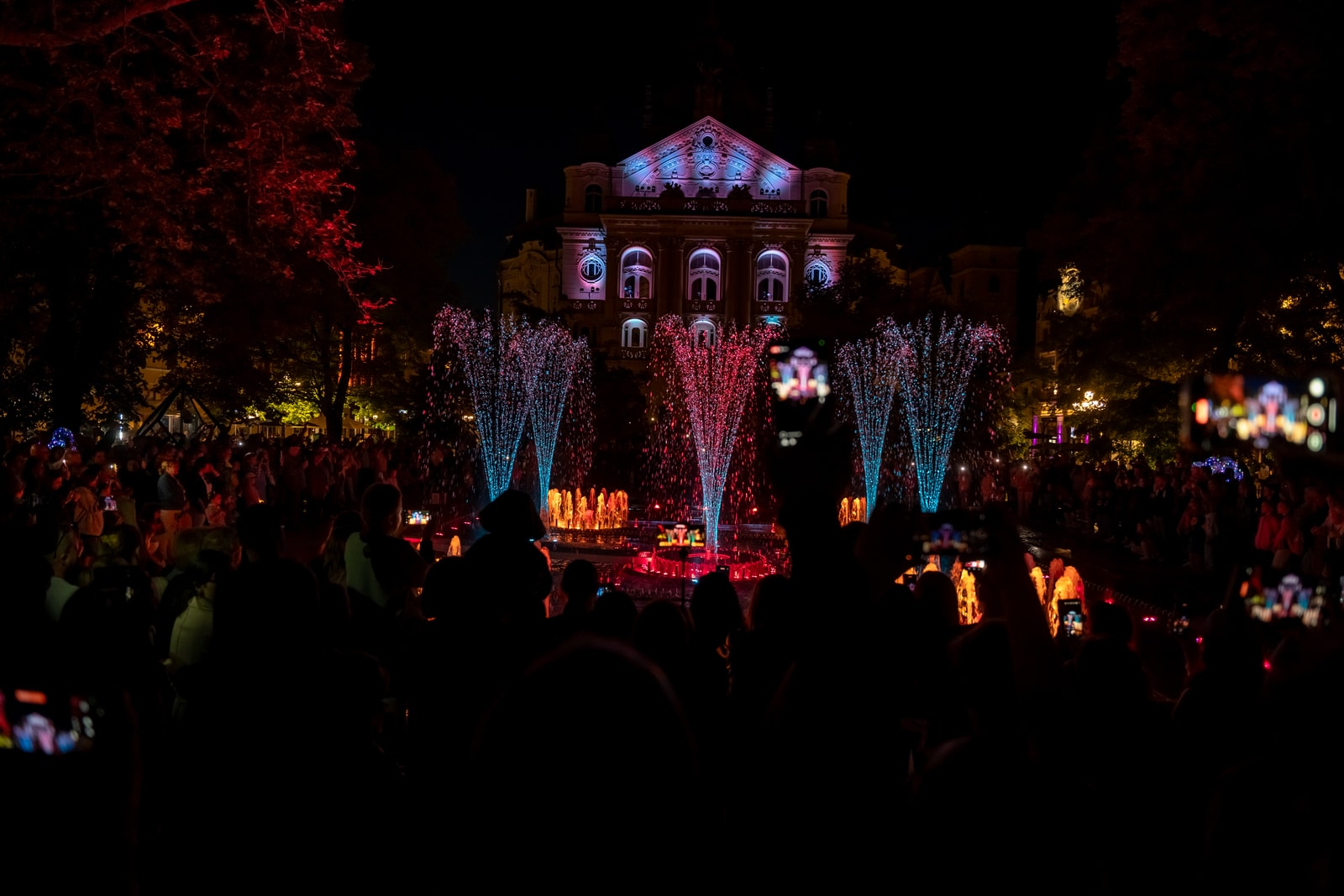
At 20:40, the Singing Fountain is still only one part of Hlavná. Children lean toward the water. Couples inherit benches from older couples. The National Theatre waits at the north end of the pool like a stage set that has wandered outdoors. Then the top of the hour approaches, attention turns inward, and a piece of public landscaping becomes a room.
That change—not the highest jet, the longest cable, or the cleverest software—is the reason to come. Košice reopened the fountain for its 40th anniversary on May 1, 2026, after bringing it out of its winter pause. The city staged a large birthday show, but the more revealing version is an ordinary evening when nobody has bought a ticket and the audience assembles by sitting down [1][3].
Keep the visit to one anchor: Spievajúca fontána, Hlavná 51, in the narrow park between St. Elisabeth Cathedral and the National Theatre [2]. In late summer, arrive 15–20 minutes before a confirmed evening cycle, allow 45–60 minutes, and budget €0 for the fountain itself. There is no reservation line or admission gate; benches are simply first come, while special programs can turn the same space into a dense event crowd [1][8][10].
The timing word that matters is confirmed. Published hours have changed between seasons, weather can stop the effects, and nearby events can replace the normal playlist [2][4][5]. Check the City of Košice or municipal-greenery channel on the day. If 21:00 is running, 20:40–21:20 is the cleanest late-summer window: enough time to orient while there is still residual light, then one full turn after the lamps become legible. If only 20:00 is confirmed, take that cycle rather than waiting for a darker show that has not been promised.
Find the room before the spectacle
The first local move is to save the Slovak name, not merely “musical fountain.” Košice has another multimedia work, the Plávajúca fontána—the Floating Fountain—in City Park. The one in this article is the Singing Fountain beside the National Theatre on Hlavná [2][7]. A live Google Maps pin is useful, but the visual cue is better: approach northward from the cathedral and stop when the theatre, a shallow oval of water, trees and two lines of benches share one axis [8].
The second move is to arrive before the hour without standing at the basin’s edge. Choose an outer bench or a place behind the seated row, ideally where the theatre remains visible above the water. That wider frame is the point. Local review streams repeatedly describe the fountain as a place to sit among the trees, listen and watch rather than a sight to photograph and leave; one Košice reviewer even gives the approach from the station through Mlynská and past Urban’s Tower [6][7]. Locals do not need to turn the fountain into a destination with a velvet rope. Sitting is the ritual.
Keep the central walking line open. Hlavná continues to function while the water plays: prams pass, people cross between benches, and someone who has no interest in the next song still needs a route through. Do not build a tripod gate or stand directly in front of a seated viewer. If the nearest bench is full, take the second row rather than converting the rim into a seat.
The third move is to wait through the top of the hour. Visit Košice describes the music as an hourly turn, while a local operating guide places illumination and the last song on a separate daily clock [2][5]. Those are reasons to arrive early, not reasons to count down as if every ordinary night were the May 1 gala. If the water is running quietly at 20:52, the visit has not failed. If the expected cycle does not begin, give it several minutes, check the current notice, and accept the operating decision.
Twenty-two bells make a city-specific clock
Košice opened the original fountain in 1986. The municipal history says the idea followed then-mayor Rudolf Schuster’s encounter with a fountain in the Soviet Union, while specialists from the former East Slovak steelworks, VSŽ Košice, helped solve its design and engineering [4]. That origin is more revealing than a generic “communist-era attraction” label. The work joined city government, heavy-industry skill, music and a pedestrian main street; it made civic theater out of the same technical culture that shaped modern Košice.
The nearby carillon localizes the machine further. Its 22 bells represent Košice’s 22 boroughs, and Visit Košice identifies the work as the oldest singing fountain in the former Czechoslovakia [2]. The bells are therefore not just an audio accessory. They let a fragmented city announce itself as one sound in the historic center.
The fourth move is to listen for that relationship before chasing the water’s maximum height. Face the theatre, let one melody establish its rhythm, then notice whether the jets answer in sheets, low arcs or vertical bursts. Afterward, turn once toward the cathedral. The same shallow basin is held between two kinds of ceremony: a Gothic church to the south and a nineteenth-century theater to the north. The fountain does not compete with either building; it supplies the interval where people can occupy the axis without entering an institution.
That interval nearly lost its machine. Before the 2023–2024 modernization, a municipal inspection found that only 6 of 25 pumps and 109 of 160 reflectors were working. The roughly €1.79 million rebuild replaced the failing system with 43 pumps, 750 nozzles and 260 LED lights; the central jet can reach 24 metres [4]. Those figures explain why old photographs and memories may show a thinner performance. They should not become a specification sheet that crowds the actual night.
The fifth move is therefore restraint: make one photograph with the theatre in it, then lower the phone for one song. The official image above is honest about the temptation—screens rise as soon as the fountain does [1]. But a phone crops out the small civic mechanics that make the place distinctive: strangers shifting along a bench, children reacting before adults do, and through-walkers briefly slowing without joining the audience.
The program is a live condition, not a monument label
The fountain’s hardware is stable; its behavior is not. During the 2025 season, operators reported roughly 120,000 minutes of music and a library of about 30,000 tracks, with classical music in the morning, orchestral selections later and a modern evening playlist. Separate modes served the Peace Marathon, the Košice Night Run and city celebrations [3]. In June 2026, the Art Film festival overrode the ordinary sequence with a daily 19:00–21:00 block of film music [10].
That variability is the night room’s strength, but it makes stale instructions dangerous. One official 2024 notice advertised operation from 12:00 to 22:00; a Visit Košice guide recorded 09:00 to 21:00 for summer 2025; another local guide currently lists lighting from 20:05 and a final song at 21:50 [2][4][5]. These clocks document different operating contexts, not one eternal timetable.
The sixth move is to treat a same-day notice as more authoritative than any of them, including this article. The recent community record is useful precisely because it is inconsistent: 2025 reviewers agree that the benches and evening light make the place, but report activity beginning at different times [6][7]. Local review evidence can describe how a place feels; the operator decides what runs tonight.
Weather has the same authority. The upgraded system is linked to its own weather station and can shut down when rain or strong wind makes operation unsuitable [5]. If a storm is building, do not wait beside the basin for software to prove that it noticed. Use the covered edges of Hlavná, and let the fountain be absent. A no-show caused by a safety pause is not a service failure to negotiate.
The seventh move is physical: stay out of the basin. After the 2024 reopening, visitors damaged nozzles by entering despite prohibition pictograms placed around the fountain. Municipal staff also warned that the falling weight of water from the 24-metre central jet could injure someone; police may treat entry as a public-order offense [9]. This is not an interactive splash pad, however inviting the low side jets look. Watch children from the dry side and follow the signs that are present that evening.
Four ways visitors flatten the hour
Mistake one: searching for “the Košice fountain” and accepting the first result. The Floating Fountain is a separate work in City Park. Better: use Spievajúca fontána, Hlavná 51, and the National Theatre as the recognition cue [2][8].
Mistake two: arriving at 20:17, seeing ordinary water and declaring the show over. The musical turn is organized around the hour, while lighting and special programs keep their own clocks [2][5][10]. Better: verify a cycle, arrive 15–20 minutes before it, and stay through the transition.
Mistake three: stepping into the basin for a low-angle photograph or to cool off. Entry is prohibited, has already damaged equipment and can put a person beneath a powerful falling jet [9]. Better: use the bench line, keep the theatre in the frame and let the water supply the foreground.
Mistake four: expecting the official crowd photograph every night. That image records a programmed public event, not a queue forecast [1]. Better: prefer an ordinary evening. If a festival has taken over the fountain, either arrive 30–40 minutes early and accept the crowd or return for the quieter hourly room.
One bench, one hour
The practical sequence is deliberately small. Save the Slovak pin. Check the live program and weather. Walk north from the cathedral until the National Theatre closes the view. Arrive before the hour. Choose a bench without blocking Hlavná. Keep out of the basin. Watch one cycle with the phone down for at least one song. When it ends, remain seated for two minutes while the most hurried viewers leave.
There is no second attraction to race toward. The fountain has already shown what is specific about Košice: a 1986 civic machine rebuilt for its 40th birthday, steelworks expertise translated into choreography, 22 boroughs counted in bells, and a public that knows the correct verb is not see but sit [1][2][4][6][7]. At the top of the hour, the water performs. The city makes the room.
Sources
- City of Košice, “Spievajúca fontána poteší Košičanov od 1. mája” (April 30, updated June 12, 2026) — official confirmation of the May 1 opening, 40th birthday program, modernization cost, seasonal operation and the municipal photograph used above.
- Visit Košice, “Refresh yourself at the fountains of Košice — Part 1” — local destination-office account of the Hlavná 51 location, hourly musical turn, 2025 operating window, 22-bell carillon and separate Floating Fountain.
- Košice Online, “Zazimovanie Spievajúcej fontány trvá niekoľko dní” (October 28, 2025) — local reporting on winterization, the season’s music volume, playlist modes and planned spring restart.
- City of Košice, “Obnovená Spievajúca fontána strieka vyššie ako Herliansky gejzír” (April 27, 2024) — official history and technical account of the 1986 origin, failing old equipment, €1.79 million rebuild, pumps, nozzles, lights and that season’s hours.
- Košice Guide, “Spievajúca fontána” — local operating guide for current weather automation, event overrides, summer lighting and last-song timing; used as a planning aid rather than an immutable timetable.
- Wanderlog, “The Singing Fountain, Košice” — current Google and Tripadvisor review aggregation, including 2025 reports on evening timing, seating, the theater backdrop and the fountain’s role as a local social place.
- SlovenskObčan, “Recenzie na Spievajúca fontána” — Slovak community-review collection used for the station-to-Mlynská approach, Urban’s Tower cue, bench culture, hourly carillon and preference for the night lights.
- Google Maps, “Spievajúca fontána, Hlavná 51, Košice” — live navigation, community-photo and review surface used to verify the pin and immediate spatial cues.
- STVR, “Do opravenej fontány vchádzajú aj napriek zákazu” (May 28, 2024) — Slovak public-broadcaster report on entry-prohibition signs, damaged nozzles, falling-water risk and enforcement.
- City of Košice, “Spievajúca fontána zahrá filmovú hudbu, štartuje Art Film Košice” (June 15, updated July 15, 2026) — recent primary example of an event-specific 19:00–21:00 program overriding the ordinary repertoire.