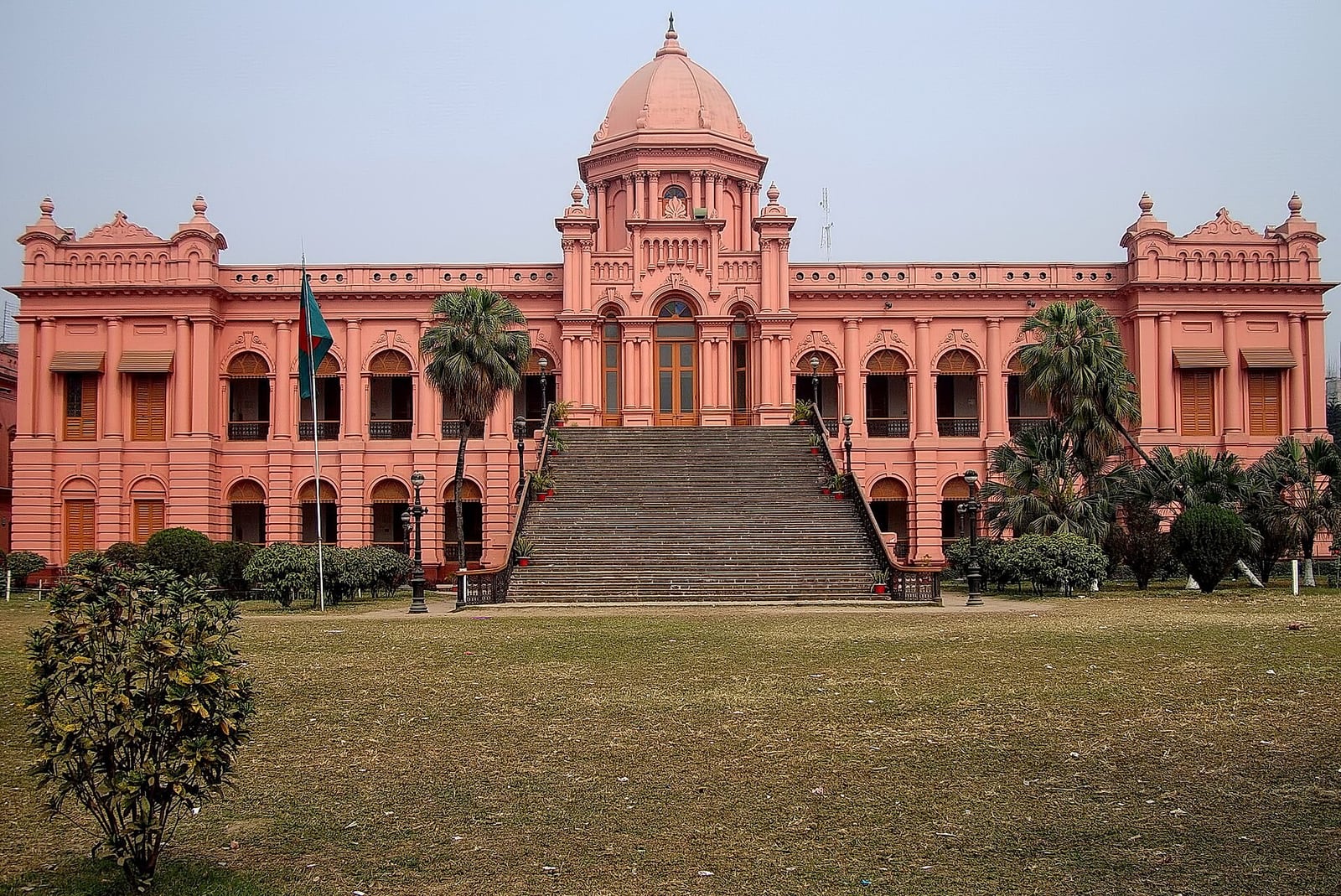
Ahsan Manzil’s obvious fact is its color. The more useful fact is its orientation. The pink palace presents a broad stair and domed facade toward the Buriganga River, but an ordinary museum visit reaches it from Islampur Road, through an Old Dhaka district still organized around wholesale cloth, rickshaws, pedestrians and deliveries. The building looks ceremonial from the lawn. The approach feels commercial right up to the gate.
Keep both faces in the same visit. Come through Islampur, read the museum rooms, then finish outside where the palace turns south toward the river. That sequence prevents the “Pink Palace” from floating free as a postcard. It restores the city around it: a nineteenth-century seat of household and political power placed between a trading street and the water route that once supplied its grandest arrival [1][5][6].
The cleanest operating window is Sunday through Wednesday, 10:20–11:50. The official general schedule opens Ahsan Manzil and the National Museum’s other branch museums from 10:30 to 16:30 Saturday through Wednesday; ticket sales stop at 16:00. Friday is a different day, 15:00–18:30, with sales ending at 18:00, and Thursday is the weekly closure [2]. Recent local reviews repeatedly describe Friday and weekend afternoons as the crowded version, so a weekday opening gives the rooms and front lawn their best chance to remain legible [7][9].
Let Islampur be the first gallery
The first local move is linguistic. Save আহসান মঞ্জিল as well as “Ahsan Manzil,” and pair it with Islampur, not merely “Old Dhaka.” VromonGuide’s Bangla directions use Bahadur Shah Park / Victoria Park and Jagannath University as the practical approach landmarks, then recommend completing the last stretch on foot or by rickshaw according to street conditions [6]. The destination address is commonly listed as 2/3 Islampur Road. A driver who knows Sadarghat but not your museum pin is more likely to recognize that local chain than an English nickname.
Do not turn the final approach into a test of a map’s arrival estimate. Islampur is one of the city’s major cloth-trading areas; the narrow working streets do not become a museum forecourt because a visitor is late. Leave a 30-minute buffer beyond the app’s estimate, step out where the lane is no longer helping the vehicle, and keep shop thresholds and handcarts clear. The buffer is planning advice, not a published journey time. Dhaka’s local guide gives several possible approaches precisely because the last useful route depends on where the city releases you that morning [6].
The second move is to notice the transition instead of resenting it. A recent r/Dhaka thread from someone asking what to combine with Ahsan Manzil drew an answer from a resident with family roots in the area: Islampur itself is the place, with its cloth market and nearby streets, while Ahsan Manzil is the formal anchor [8]. That is a better reading than calling the market “chaos” and the palace “relief.” One is a working commercial district; the other was the residence and administrative seat of a family whose power depended on the city around it.
Keep the scope tight, however. This is not permission to collect five more Old Dhaka sights before lunch. The third move is to give the palace 75–90 minutes and let the cloth-market approach supply context rather than become a second attraction to conquer. If you want Shankhari Bazar, Sadarghat or a Buriganga boat ride, make that a separately researched outing. The local thread is candid that the river experience and surrounding streets require their own judgment [8].
Buy time before you buy a ticket
The official admission ladder is unusually clear: BDT 40 for a Bangladeshi adult, BDT 20 for a child aged 3–12, BDT 300 for a citizen of a SAARC country and BDT 500 for other foreign visitors. Children under 3 and visitors with physical disabilities do not need a ticket [2]. These are admission prices, not a total Old Dhaka budget; transport remains variable.
The fourth move is to settle the ticket method before entering Islampur. Ahsan Manzil’s official e-ticket instructions require registration, a visit date, ticket quantity and online payment; the resulting printout, downloaded copy or ticket number can be shown at entry [4]. If you intend to use that route, complete it earlier on a stable connection and save the ticket offline. Do not stand at the gate creating an account while the opening crowd passes you. If the online process does not complete, keep a payment fallback and use the staffed ticket process that is operating that day rather than buying from an unofficial intermediary.
There is no published timed-reservation ritual for an ordinary individual visit. The practical queue is crowd-driven. Current community reports confirm both sides of it: visitors in March and May 2026 found the museum open and the BDT 40 local ticket current, but warned that weekend and especially Friday afternoons can make movement through the rooms unpleasant [7]. A July 2026 Tripadvisor report likewise found the palace operating and well maintained while describing the surrounding area as busy [9]. Arriving at 10:20, ten minutes before the weekday opening, is a queue buffer—not a guarantee of first entry.
The palace turns south
Once inside the grounds, the city changes axis. The long facade, central dome and open stair face the Buriganga. Banglapedia describes the building on a one-metre raised platform, about 125.4 metres long by 28.75 metres deep, with an open southern staircase extending through the front garden toward the river [5]. Those numbers explain the view better than the nickname does. Ahsan Manzil is not a compact villa painted pink; it is a long river-facing institution designed to make arrival visible.
The fifth move is to postpone the full facade photograph until you can stand squarely on the lawn without blocking the stair or another group’s path. Make one wide frame that includes the dome and both wings. The photograph above does exactly that [10]. Then put the phone away before entering the galleries. Current visitor summaries do not describe interior photography rules consistently, so ask the guard at the present checkpoint and obey the room signs. Another visitor raising a phone is not permission [7].
The river face also carries the palace’s repair history. Khwaja Abdul Ghani began the Rangmahal in 1859, completed it in 1872, and named Ahsan Manzil for his son Khwaja Ahsanullah. A tornado on April 7, 1888 badly damaged the complex; reconstruction introduced the dome that now dominates the silhouette. An earthquake on June 12, 1897 required another round of repair [1][5]. The sixth move is therefore to treat the dome as evidence of survival and redesign, not as a timeless crown.
That city-specific detail changes the portrait. The building that looks most fixed in Old Dhaka is partly the result of disaster, family rebuilding, state acquisition and museum reconstruction. Its pink surface is not a shortcut around those layers. It is where they have been made to appear continuous.
Read the museum as an argument about what could be saved
The official National Museum account says Ahsan Manzil was named in 1872, remained a major political center in Bengal for nearly a century, and reopened as a museum in 1992 with 23 galleries [1]. The dedicated museum history adds a harder boundary. When the government acquired the property in 1985, the museum project covered 5.65 acres, while much of the Nawab estate and roughly two-thirds of the Andarmahal remained outside the acquisition. Reconstruction began in 1986, and the museum was inaugurated on September 20, 1992 [3].
The seventh move is to read the period rooms with that boundary in mind. Some objects are original; other interiors were reconstructed from documentary photographs and surviving material. The result is not fraudulent, and it is not an untouched household. It is a museum’s argument about how to make a dispersed palace history visible. Start with the family and building chronology, then choose three rooms rather than racing all 23: one room of public ceremony, one domestic room and one gallery about the Nawabs’ civic or political role [1][3].
This slower method also handles an interpretation gap raised by recent reviewers. Visitors praise the furniture, portraits and everyday objects but differ on how much context is available in English [7][9]. If you do not read Bangla, preview the official museum history before arrival, save the relevant page on your phone, and ask one precise question inside. “Which parts of this room are original?” will usually teach you more than asking a busy attendant to summarize the whole dynasty.
The eighth move is to finish outdoors. Return to the southern lawn and look past the broad stair toward the river. Do not pretend the present Buriganga is the courtly approach preserved in amber. Boats, terminal activity, pollution and dense riverbank work belong to the modern view. The productive contrast is not “beautiful palace, ugly city.” It is that the palace still announces a river orientation even though most museum visitors now arrive through the landward market.
Four ways visitors flatten the portrait
Mistake one: choosing Friday afternoon because it sounds leisurely. Officially, Friday entry begins only at 15:00, and recent community accounts describe that session as the most crowded [2][7][9]. Better: use a Sunday–Wednesday opening if the rooms matter more than the social scene.
Mistake two: navigating only to “Sadarghat.” That gets you into the correct part of Dhaka without necessarily giving you the cleanest final approach. Better: carry the full chain—Bahadur Shah Park / Jagannath University → Islampur → Ahsan Manzil—and switch to walking or a rickshaw when the lane makes that sensible [6].
Mistake three: treating every staged room as an intact survival. The museum was assembled through acquisition, conservation and reconstruction, and part of the former complex remained outside the project [3]. Better: ask what is original, what was remade from photographs and what the display is trying to recover.
Mistake four: attaching a spontaneous river ride because the palace faces the Buriganga. Local discussion treats the river and adjacent streets as a separate, condition-dependent experience, not a frictionless museum add-on [8]. Better: complete the palace portrait at the lawn. Research any boat plan, operator, daylight route and return point independently.
The go details
- Anchor: Ahsan Manzil Museum only; Islampur is the approach context, not a second checklist.
- Best window: Sunday–Wednesday, arrive 10:20, enter from 10:30, and allow 75–90 minutes. Saturday is officially open but belongs to the local weekend; Friday opens at 15:00 and is the crowd-heavy fallback [2][7][9].
- Closure and cutoff: Thursday closed; ordinary Saturday–Wednesday ticket sales end at 16:00, while Friday sales end at 18:00 [2].
- Expected spend: admission BDT 40 / 20 / 300 / 500 by visitor category; transport is additional and variable [2].
- Reservation reality: no timed slot is published for an ordinary individual visit. The official e-ticket is date-based and should be completed before arrival if used [4].
- Queue reality: allow 10–15 minutes at a weekday opening; avoid Friday and public-holiday sessions if a slow interior read is the priority [7][9].
- Navigation cue:
Bahadur Shah Park / Jagannath University → Islampur Road → আহসান মঞ্জিল; use the last stretch on foot or by rickshaw according to live street conditions [6]. - Where to pause: stand off the circulation line on the southern lawn, far enough back to hold both wings, the dome and the broad stair in one frame [5][10].
- Interior etiquette: ask before photographing, follow the signed route, keep doorways clear and do not turn period furniture into a portrait set [7].
- What to retain: market-side arrival, river-facing ceremony, disaster-shaped dome, and museum reconstruction. Those four layers are the portrait.
Ahsan Manzil becomes more interesting when its famous view comes last. Islampur gives you the working city first. The galleries show how much of the palace had to be collected, interpreted and rebuilt. Only then does the southern stair recover its force: it turns a long pink building toward the Buriganga and remembers an arrival system the modern visitor no longer uses.
Do not choose between the market and the river. The palace needs both orientations. Dhaka delivers you through one and lets the architecture face the other.
Sources
- Bangladesh National Museum, “Ahsan Manzil Museum” — official branch-museum account of the 1872 naming, nearly century-long political role, 23-gallery plan and 1992 public opening.
- Bangladesh National Museum, “Museum visiting schedule and admission fees” — official page updated May 16, 2026, with general and Friday hours, Thursday closure, ticket-sale cutoffs and current Ahsan Manzil admission categories.
- Ahsan Manzil Museum, “Establishment of Ahsan Manzil Museum” — official account of the cancelled 1974 auction, 1985 acquisition, 5.65-acre museum boundary, reconstruction and September 20, 1992 inauguration.
- Ahsan Manzil Museum, “How To Buy Ticket” — official e-ticket workflow for registration, dated visit selection, payment and presenting a printed copy, downloaded ticket or ticket number.
- Banglapedia, “Ahsan Manzil” — Bangladesh’s national encyclopedia entry for the palace’s dimensions, river-facing staircase, 1859–1872 construction and repairs after the 1888 tornado and 1897 earthquake.
- VromonGuide, “Ahsan Manzil, Puran Dhaka” — Bangla local guide used for Islampur wayfinding, the Bahadur Shah Park / Jagannath University approach, last-leg transport logic and a local cross-check of hours and prices.
- Wanderlog, “Ahsan Manzil Museum” — current Google and Tripadvisor community-review digest, including March–May 2026 reports on live admission, Friday/weekend crowding, interior movement, interpretation and photography uncertainty.
- Reddit / r/Dhaka, “Place to visit nearby Ahsan Manzil” (January 2026) — recent local-community discussion used for the Islampur cloth-market context and the boundary between a palace visit and separate river or neighborhood outings.
- Tripadvisor, “Ahsan Manzil” — live visitor listing and July 2026 review confirmation of the operating museum, busy Old Dhaka setting, collection and river-facing exterior.
- Mahbub Hossain Shaheed, “Ahsan Manzil—Front View,” Wikimedia Commons — source page for the real December 2012 photograph of the palace exterior, resized for the article from the 2,512 × 1,678 original.