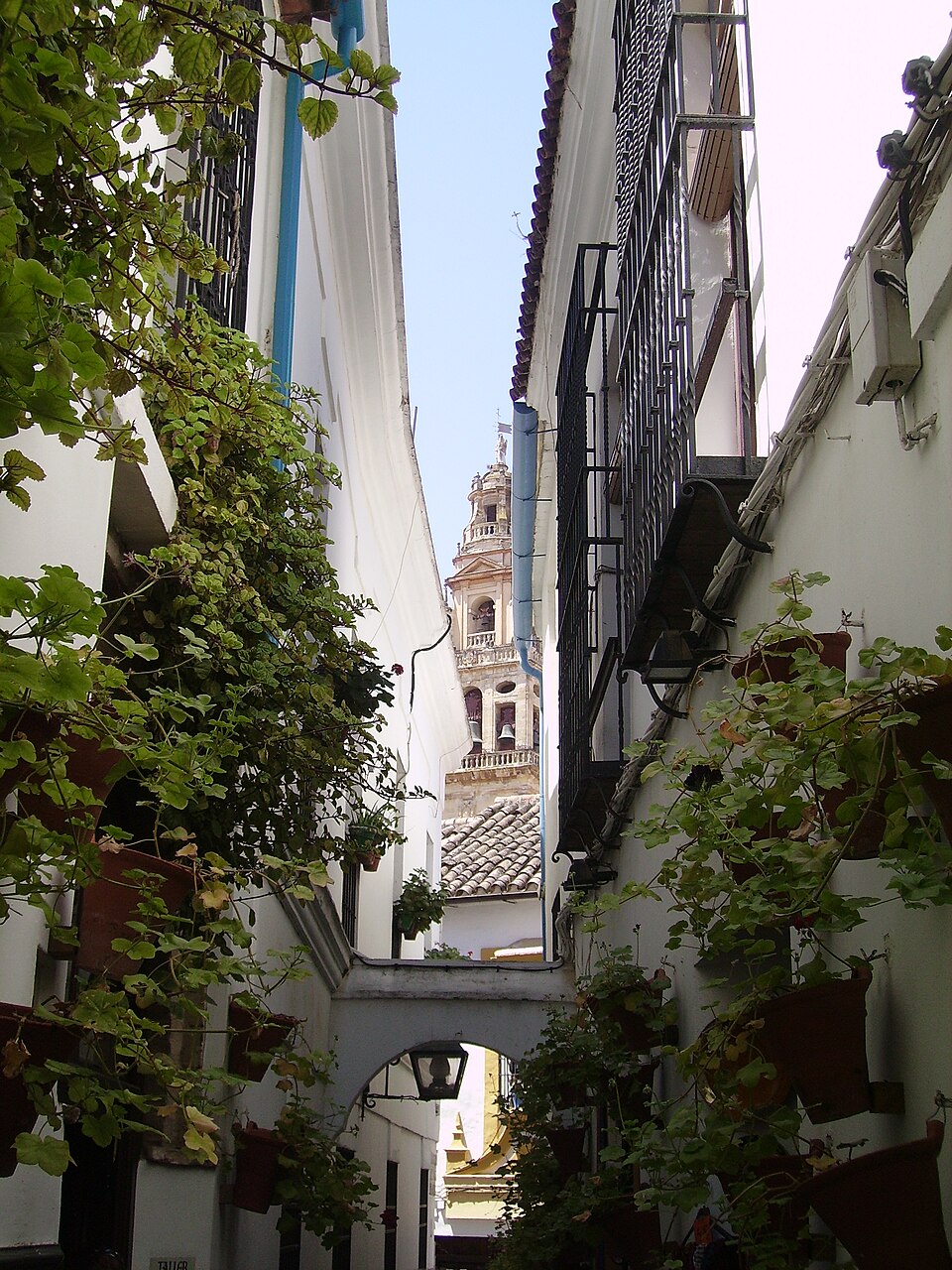
Calleja de las Flores is famous enough to punish lazy timing. The official tourism page describes the lane as a narrow, gently rising alley in the heart of the Juderia, close to the Mosque-Cathedral, ending in a small square with a fountain and a view back toward the bell tower.[1] That is exactly why it jams. The place is built like a camera: white walls, flower pots, a short throat of paving, and the tower framed at the far end. Arrive at the wrong hour and the street stops being a street. It becomes a slow contest over the same photograph.
The better Cordoba move is to accept the photograph and then refuse to make it the whole visit. Treat the alley as a street microcosm: a tiny public room where patio culture, tourist pressure, mid-century restoration, cathedral gravity, and local walking etiquette all meet in under five minutes. As of May 26, 2026, the nearby Mosque-Cathedral's own visitor page lists the main monument at 10:00-19:00, the bell tower in half-hour slots from 9:30 to 18:30, and a Monday-Saturday free visit from 8:30 to 9:30, with access prevented at 9:20.[2] Those times matter because Calleja de las Flores works best in the margins around the big monument's clock.
The first move is to make the alley your hinge, not your destination. If you are doing the free early Mosque-Cathedral window, enter at 8:30, accept that the official page begins the exit process before 9:30, and then step into the Juderia before the day's escorted groups thicken.[2] If you are not doing the monument, aim even simpler: before 9:00 or after 18:00 in warm months, when the walls still hold light but the lane is less likely to be shoulder-to-shoulder. Wanderlog's aggregated review surface gives the same practical direction in plain visitor language: go early or late, because the view and the narrowness are real but crowd pressure changes the experience.[5]
The second move is physical. Do not stop in the throat of the lane. Walk through, let the small square take the pressure, and then turn back for the tower frame. The official tourism description is precise on this geometry: the alley rises to a small square, and that square is where the fountain and view settle.[1] If you pause halfway, everyone behind you has to negotiate your photo. If you reach the square first, the street can keep working.
The third move is to read the objects instead of only the backdrop. Puerta de los Patios describes the lane as an azucaque, a narrow dead-end passage with Hispano-Muslim urban logic, but it also notes that its current appearance owes much to a mid-20th-century reform: paving was replaced with typical cobblestone, small arches were added between facades, and the fountain was built with archaeological remains.[4] That detail is the place-specific texture. Calleja de las Flores is not an untouched medieval relic. It is a managed Cordoban image, assembled from older street form, restoration choices, plant care, and the visual pull of the Mosque-Cathedral tower.
That makes the flower pots more interesting, not less. Cordoba's official patios site frames patios as spaces of coexistence and family life where history, light, water, and vegetation meet.[3] Calleja de las Flores is not a private patio, and treating it as one is a visitor mistake. But it borrows the city's patio grammar and turns it outward: white wall, shade, hanging pots, cooling stone, and a small water point. The useful way to look is to notice how domestic devices have been made public. The lane gives visitors a legible version of a Cordoban habit without giving them license to behave as if every nearby doorway is a stage.
The fourth move is etiquette. Take the photograph, then clear the sightline. Wanderlog's aggregated review surface and the current Google Maps place layer both show why this stop behaves like a compressed community bottleneck, not a spacious monument visit.[5][6] The consensus is not mysterious. People like the lane because it is pretty, and people complain because everyone is trying to occupy the same narrow view. The better alternative is a two-step rhythm: frame the tower, move to the side, then look at the walls, grilles, pots, and paving without blocking the central flow.
The fifth move is to keep the spend honest. Calleja de las Flores itself should cost EUR0 and take only a few concentrated minutes; local visitor guidance also treats it as a free, 24-hour street rather than a ticketed attraction.[7] The adjacent decisions are separate: EUR15 for the Mosque-Cathedral, EUR4 for the bell tower, or EUR25 for the night visit according to the official ticket page on May 26, 2026.[2] Do not let the free alley become a vague excuse to drift into unplanned ticket windows. If the tower is your priority, buy that slot as its own small plan. If the alley is the priority, keep it public and light.
The sixth move is navigation. Pin "Calleja de las Flores, 14003 Cordoba" only until you reach the old center, then stop staring at the phone. The official page places the lane at that address and "not far" from the Mosque-Cathedral; the Mosque-Cathedral page gives the practical transit cue of the Puerta del Puente bus stop, urban lines 3 and 12.[1][2] Once you are near the monument, the useful path is visual: find the tower, keep to the narrow lanes, and let the bend reveal the alley rather than charging through the Juderia as if it were a station concourse.
The seventh move is to avoid the May trap. Cordoba's patio season is real, and the official municipal material treats the festival as a major civic tradition, not as decoration pasted onto one tourist lane.[3] If you come in May, do not assume Calleja de las Flores is "the patios." Use it as a threshold, then consult the official patio routes for actual open houses and neighborhood distribution.[3] The better version is slower and more respectful: one famous public alley, then a deliberate patio route, not a hunt for private doors.
The eighth move is weather-aware. In summer, the same whitewashed beauty that makes the lane photogenic can make the old center feel hard and reflective by mid-afternoon. Use the alley before the heat builds, or after the Mosque-Cathedral's late-afternoon wave starts to loosen. In winter, the problem flips: the lane can be calmer, but the light may be flatter, so the tower frame matters more than the flowers. Either way, the rule is the same. Go when the street can still breathe.
The common visitor mistakes are all versions of treating the place as flatter than it is. Mistake one: arriving at midmorning because the map says it is only a short stop. Better: attach it to an early monument exit or an evening walk. Mistake two: standing in the alley mouth for multiple photos. Better: move to the square, turn back, shoot once, and clear the lane. Mistake three: describing the scene as purely ancient. Better: notice the reform-era paving, arches, and fountain as part of the modern public image.[4] Mistake four: treating the flowers as a prop detached from Cordoba's patio culture. Better: understand the lane as a public echo of a private domestic tradition.[3]
What makes Calleja de las Flores worth keeping in a Cordoba plan is not that it is hidden. It is not hidden at all. Its value is that a very small street teaches the old center's operating rule quickly: beauty here is often a matter of compression. The tower is close, the walls are close, the flower pots are close, and so are the other people who came to see them. Use that pressure well and the lane becomes more than a postcard. It becomes a short lesson in how to move through Cordoba without mistaking recognition for arrival.
Sources
- Turismo de Cordoba, "Calleja de las Flores (Alley of the Flowers)" - official visitor description of the lane, Juderia location, small square, fountain, flowers, and Mosque-Cathedral bell-tower view.
- Mezquita-Catedral de Cordoba, "Tickets and opening hours" - official visitor prices, May 26, 2026 schedule, free early visit rule, last-entry rule, address, and Puerta del Puente transit cue.
- Patios de Cordoba, official municipal festival site - context on Cordoba's patios as spaces of coexistence, light, water, vegetation, and visitor-route planning.
- Puerta de los Patios, "Calleja de las flores" - local heritage note on the lane as an azucaque, its mid-20th-century reform, cobbled paving, facade arches, fountain, and daily tourist photo use.
- Wanderlog, "Calleja de las Flores" - community-review surface with Google-derived ratings, highlighted recent visitor comments, and early/late timing advice.
- Google Maps search, "Calleja de las Flores Cordoba" - current place-status and community-review surface used as a navigation and crowd-expectation check.
- Explore Cordoba, "Calleja de las Flores Cordoba" - local guide note on the lane as free, open 24 hours, and crowded by mid-morning.
- Wikimedia Commons, "File:Calleja de las Flores.JPG" - source page for the real 2008 photograph by Américo Toledano used as the article image.