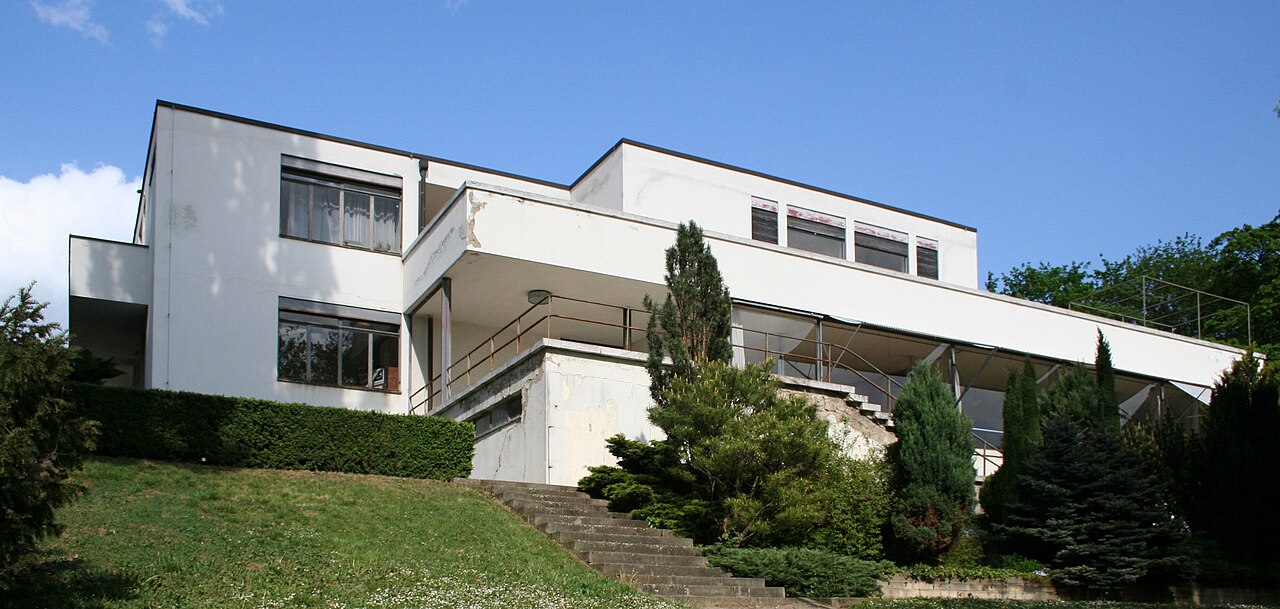
Villa Tugendhat is the Brno attraction most likely to punish spontaneity. That is not because the house is unfriendly. It is because the best part of the visit is inside a very small operating system: guided tours, limited groups, language slots, weather-dependent garden access, and a residential neighborhood that was never designed to absorb casual drive-up sightseeing.
Treat it as a place portrait, not a trophy stop. The anchor is one house in Cerna Pole, plus the garden approach that links it to Villa Low-Beer and the edge of Luzanky Park. The useful version starts before the ticket scan. Book the interior first, shape the day around that fixed point, then let the hillside and neighborhood explain why Mies van der Rohe's glass room belongs in Brno rather than in an abstract architecture textbook.
The hard gate is capacity. Villa Tugendhat's official tours page lists a 60-minute basic tour and a 90-minute extended tour, both capped at 16 people per group, while the "Villa from the Outside" tour runs 40 minutes with a 25-person cap.[1] The Brno iD ticket page adds the current 2026 price frame: from January 1, 2026, the basic tour is 450 CZK, the extended tour is 500 CZK, and the outside tour remains 200 CZK.[2] Those numbers are modest; the scarce resource is not money. It is a slot.
Local move one: do not start the Brno plan with the villa unless you already have the ticket. Go To Brno, the city's own visitor office, recommends booking 3-4 months ahead because of high interest in tours, and even the BRNOPAS route does not guarantee an entrance ticket automatically.[3] Recent traveler and community signals say the same thing less politely: Tripadvisor reviewers stress advance booking and describe tours filling quickly, while r/Brno commenters keep warning visitors that without months-ahead tickets they may only reach the gardens.[7][8]
Local move two: choose the tour by what you actually need. If this is your one Mies pilgrimage, the extended tour is the better default because it includes the technical floor: air-conditioning machinery, boiler room, electric-window machinery, laundry, photo chamber, and the fur-coat safe.[1] That is not nerd garnish. The house's drama is partly mechanical. UNESCO emphasizes that the villa's modernity came from spatial and aesthetic concepts made possible by industrial production, including reinforced concrete slabs, steel beams, mechanical systems, and large electrically operated windows.[4] If you skip the technical layer, you risk seeing only the elegance and missing the machinery that made the elegance work.
Local move three: if you fail to get the interior, do not fake an interior visit. Use the garden and outside tour deliberately. The official page says the garden and exhibition can be visited free during opening hours, without a guide, though the garden closes in adverse weather such as snow, ice, or wind.[1] The outside tour is not a consolation prize if you know what it is for: terraces, the urban development around Luzanky Park, the villa colony above the park, and the view from the upper and garden levels.[1] Mapy.com review traffic reinforces that the linked gardens of Tugendhat, Low-Beer, and Arnold can still make an unplanned visit worthwhile when the interior is unavailable.[6]
Local move four: approach from below or through the park when time allows. The official directions give several public-transport options: tram 3, 5, or 9 to Detska nemocnice, then about 600 meters or 10 minutes along Cernopolni Street; tram 7 or 9 to Tomanova, then about 400 meters or 7 minutes; or bus 67 to Schodova, then about 500 meters and a staircase section.[1] For most visitors, the tram approach beats a car. The same official page says there is no reserved visitor parking immediately around the villa and that a resident parking system is active nearby.[1]
Local move five: keep the neighborhood in the frame. Go To Brno places the house in Cerna Pole, describes it as a functionalist villa with unique technologies, and connects it to a broader Brno architecture route that includes Low-Beer, Cafe Era, Stiassni, Arnold, and other villas.[3] That matters because Tugendhat is often treated as a single UNESCO pin. The better reading is more local: a wealthy interwar family, a hillside above a public park, a modernist villa colony, and a city whose architecture still moves between industrial wealth, Jewish family histories, public museums, and everyday tram stops.
Local move six: do not rush the first view from the garden. UNESCO's account makes the garden relationship central, not decorative: the living area opens directly to the terrace, and the wide stairway leads down into the garden.[4] The famous glass room is not simply a room with a view. It is a controlled handoff between interior, terrace, slope, and city. Stand too close to the house and the composition flattens. Step down into the garden and the white volumes, windows, and retaining lines start to explain themselves.
Local move seven: use 2026 as a reason to plan, not as a reason to improvise. Brno Daily reported in April 2026 that the city and region were marking 25 years since Villa Tugendhat was added to the UNESCO World Heritage List and 140 years since Mies van der Rohe's birth, with cultural and professional events throughout the year and an August program linking the Tugendhat, Arnold, and Low-Beer villa gardens.[5] That makes the house newly visible this season. It also means the casual "we will see if tickets are around" strategy is weaker than usual.
The visitor mistakes are predictable. Mistake one is assuming the UNESCO label means museum-style walk-up access. Better: treat the tour slot like a train departure, fixed before the rest of the day.[1][3][7][8] Mistake two is driving straight to Cernopolni and then discovering that parking is the wrong problem. Better: use the tram, walk the last 7-10 minutes, and spend the attention on the approach rather than on resident-zone rules.[1] Mistake three is booking the shortest available option without asking what you want from the house. Better: choose basic if time is tight, extended if the technical systems are the point, outside if the interior is gone but the hillside is still useful.[1][2]
Mistake four is treating the garden as filler after the main event. Better: make it the spatial key. The house was built in 1929-1930 for Grete and Fritz Tugendhat, and UNESCO describes it as one of the most original projects completed by Mies, with the house and garden still present inside the property boundary.[4] Go To Brno adds the material detail that onyx from Northern Morocco, Italian travertine, and veneers including rosewood, zebrawood, and Makassar ebony shaped the interior, while the 2010-2012 restoration returned the house and garden toward their original appearance.[3] The garden is where those high-design facts stop sounding expensive and start becoming readable as a lived slope.
Here is the compact version. Best window: take a late-morning or early-afternoon tour, then leave 30-45 minutes for the garden and linked-villa slope so the visit does not end at the guide's final sentence. Expected spend: 0 CZK for a garden-only stop when open, 200 CZK for the outside tour, 450 CZK for the basic tour, or 500 CZK for the extended tour before transit and coffee.[1][2] Queue and reservation reality: interior tours are the bottleneck, not the cash desk, and practical advice from official and community sources points toward booking months ahead.[3][7][8] Navigation cue: city centre -> tram to Detska nemocnice or Tomanova -> walk uphill to Cernopolni 45 -> tour -> garden descent -> Villa Low-Beer / Luzanky edge -> tram or center walk back.[1][3]
Where to stand or sit: do not crowd the street entrance as if it were the whole facade. On arrival, hold the entrance terrace long enough to understand the upper level, then save your slowest pause for the garden side, where the house opens toward Brno. If the tour is full, do not hover at the gate hoping the building will become simpler. Take the outside or garden route honestly, then let Cerna Pole and Luzanky do the rest.
That is the quiet trick of Villa Tugendhat. The more famous it becomes, the more useful it is to visit it with restraint. A slot, a tram, a slope, a garden, a few minutes of looking back from below: those are the mechanics that keep the house from becoming only a white modernist icon. Brno is not asking you to collect the villa. It is asking you to arrive at the right scale.
Sources
- Villa Tugendhat, "Tours and tickets" - official tour lengths, group capacities, garden/exhibition access, weather closures, address, public-transport approaches, and parking guidance.
- Brno iD, "Tickets to Villa Tugendhat" - official 2026 ticket prices for basic, extended, and outside tours.
- Go To Brno, "Tugendhat Villa" - local tourism page covering the Cerna Pole location, 3-4 month booking advice, BRNOPAS caveat, materials, technologies, 2010-2012 restoration, and nearby architecture context.
- UNESCO World Heritage Centre, "Tugendhat Villa in Brno" - World Heritage description and Outstanding Universal Value statement on Mies van der Rohe, 1929-1930 construction, spatial innovation, garden relationship, technical systems, integrity, and authenticity.
- Brno Daily, "Tourist Season Opens In Brno and South Moravia, With Gastronomy, Festivals and Culture" (April 2, 2026) - recent local report on Brno's 2026 tourism season, including Villa Tugendhat's UNESCO and Mies anniversaries and linked villa-garden programming.
- Mapy.com, "Villa Tugendhat (UNESCO site)" - local mapping/review page used for visitor signal on the garden and linked-villa approach.
- Tripadvisor, "Villa Tugendhat" - traveler review stream used for current visitor signals about advance booking, English tours, neighborhood parking, and garden-only fallback expectations.
- Reddit r/Brno, "What to visit in Brno?" - community thread noting that Villa Tugendhat is a common recommendation but interior access usually requires months-ahead tickets, with gardens as the fallback.
- Daniel Fiser, "Villa Tugendhat-20070429.jpeg," Wikimedia Commons - real photographic source used for the article image, showing Villa Tugendhat from the garden in Brno.