Kigali is often sold through altitude, cleanliness, memorial gravity, and big city views. Imbuga City Walk is smaller than that story, and more useful for a first read of the capital. It is a short car-free corridor in the central business district where the city's public-space ambitions become physical: paving underfoot, benches at the edge, small stalls, coffee stops, security presence, office workers, visitors, and enough room to walk without negotiating motorcycles or cars.
Keep the scope tight. This is a place portrait of one anchor, not a full Kigali itinerary. The move is to enter Imbuga City Walk / CarfreeZone as a working pedestrian room, spend 30 to 60 minutes there, and let the corridor explain how Kigali wants downtown public life to feel. Kigali City's own guide names Imbuga City Walk as a popular center that relies primarily on walking or cycling for transport [1]. UrbanShift's C40 case study gives the hard scale: a 520-meter corridor, developed by the city government and managed through a public-private model [3]. That is compact enough that the common visitor mistake is not getting lost. It is moving too quickly.
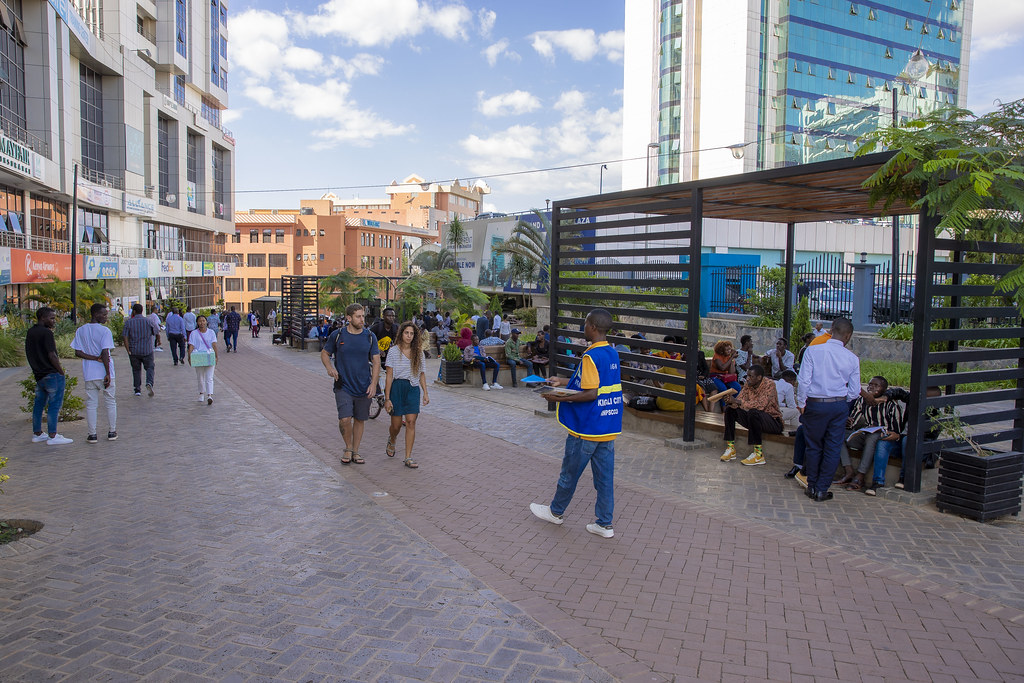
Start from the downtown side, preferably when the office day is loosening rather than at dead midday. The best window is 16:30 to 18:30 on a normal day, or earlier if you know an event is scheduled. The City of Kigali homepage recently listed an Indatirwabahizi Cultural Concert at Imbuga City Walk for 29 May 2026 from 5:00 p.m. onward, with free entrance [2]. Do not treat that one event as a permanent calendar promise; treat it as proof of how the space is used. Imbuga is not only a sidewalk improvement. It is a downtown stage that can turn from lunch pause to evening room.
The first local move is to walk the full length before choosing a seat. The corridor is short enough that you can scan it once without fatigue, and the first bench is rarely the best bench. UrbanShift's description matters here because it frames the project as more than paving: pedestrian and cycling-friendly space, green landscaping, kiosks, exhibition use, benches, free Wi-Fi, lighting, and public toilets are all part of the public-room idea [3]. On site, that means you should look for the working edges, not the center line. The benches, shade patches, kiosks, and shopfront transitions tell you more than a straight walk through the middle.
The second move is to sit before buying. A March 2026 local travelogue by George Baguma describes the same rhythm from inside the place: a slow stroll, then coffee, then a bench, then small craft browsing, then the Kigali city sign as a social photo point rather than a solitary trophy [4]. That is the order to copy. If you buy immediately, the visit collapses into a souvenir stop. If you sit first, the place begins to show its mix: office shirts, tourists, photographers, people waiting for friends, and residents using the car-free space as an ordinary pause.
The third move is to carry small cash even if you do not plan to shop. The walk itself is effectively a RWF 0 activity, but the realistic spend range is RWF 3,000 to 20,000 if you add coffee, a simple snack, or a small craft item. Do not arrive with only a card and a plan to "just browse." The stalls and informal photo interactions are part of the social fabric, and being able to make one small purchase keeps the stop flexible. Baguma's account is not a price guide, but it captures the correct behavior: coffee, bench, craft stall, photo help, then evening atmosphere [4].
The fourth move is to use the Kigali sign with patience. Wanderlog's aggregated review page, drawing on user reviews, repeatedly describes Imbuga as a clean, friendly, central place to meet locals, drink coffee, buy craft items, and take photos with the Kigali sign [5]. The trap is turning that sign into the whole route. Better: let other people finish their photos, take one or two of your own, then leave the sign behind. The corridor is stronger when the sign is punctuation, not destination.
The fifth move is to treat "open" as two different ideas. Evendo's Imbuga City Walk page frames the place around scenic strolling, local culture, unique mementos, and practical tips such as checking craft kiosks and looking out for events or performances [6]. That does not mean every stall, cafe, toilet, or event setup will operate with the same rhythm all day. The better assumption is simple: the public corridor may be physically accessible, while its useful social life is strongest in late afternoon and evening.
The sixth move is to keep the visit non-heroic. Imbuga City Walk is only 520 meters, and that modest scale is the point [3]. Do not add it as a rushed connector between every major Kigali sight. Give it one bounded pause: walk, sit, coffee or craft, sign, second pass. If you have only 20 minutes, do one loop and sit for five. If you have 60 minutes, do the slower version and wait for the lights or event setup to change the mood.
The seventh move is to use the space as a weather and hill break. Kigali's center can be bright, sloped, and businesslike; Imbuga gives you an easier surface and more predictable pedestrian behavior. Tripadvisor's February 2024 review snippet even notices the breeze and trees at the higher point of the hill [6]. That is a small detail, but it changes outcomes: if the day is hot or you are between meetings, Imbuga is better as a decompression stop than as a checklist item.
Three visitor mistakes keep repeating. The first is arriving at noon, taking the Kigali sign photo, and deciding the place is empty. Better: use the late-afternoon window or check whether an event is scheduled [2][4]. The second is treating the corridor as a shopping strip. Better: sit first, then buy only if something actually fits the moment [4][5][6]. The third is expecting a giant pedestrian district. Better: respect the 520-meter size and read the details: car-free movement, shade, seating, kiosks, public toilets, lighting, and the way pedestrians occupy the middle without constantly checking over a shoulder [3].
There is a deeper reason this small stop belongs in a Kigali route. The city has spent years making cleanliness, order, safety, and planned public life part of its international image. Those claims can feel abstract from a hotel lobby or car window. Imbuga City Walk puts the claim at foot level. A downtown road segment becomes a corridor where strangers can linger, take photographs, drink coffee, browse, wait, and move without vehicle pressure. It is not the whole city, and it should not be mistaken for every Kigali street. But it is a precise sample of one civic idea: public space as managed calm.
The practical version is clean. Go between 16:30 and 18:30. Enter from the CBD side and walk the whole corridor once. Sit before buying. Keep 30 to 60 minutes free. Carry small cash. Use the Kigali sign quickly and politely. If an event is being set up, stay on the edge until you understand the flow. If nothing is happening, do not force spectacle. Let the corridor be what it is: a short, controlled, social room in the middle of a capital that often works best when you stop trying to see everything at once.
Sources
- City of Kigali, "What to visit in Kigali" - official city guide entry identifying Imbuga City Walk / CarfreeZone as a walking- and cycling-oriented center.
- City of Kigali homepage - official recent city update listing a 29 May 2026 Imbuga City Walk cultural concert from 5:00 p.m. onward.
- UrbanShift / C40 Cities, "Kigali, Rwanda: Imbuga City Walk Car-Free Zone" - case study noting the 520-meter corridor, city-government development, and public-private management model.
- George Baguma, "Imbuga City Walk: Kigali's Quiet Escape Within the City," Afrika Nzuri, 17 Mar 2026 - recent local travelogue on the coffee, bench, craft-stall, photo, and evening rhythm.
- Wanderlog, "Imbuga City Walk" - review-aggregation page with user signals on meeting locals, coffee spaces, craft shopping, cleanliness, and the Kigali sign.
- Evendo, "Discover the Vibrant Charm of Imbuga City Walk" - visitor-facing local attraction page noting scenic strolling, local culture, unique mementos, craft kiosks, and events or performances.
- Rwanda Government Flickr album, "Imbuga City Walk | Kigali, 17 October 2023" - photographic source for the article image, showing the car-free zone as a public space for sitting, walking, events, and exhibitions.