Gamcheon Culture Village is easiest to spoil by treating it as one painted backdrop. The better move is to let the hill control the visit. Start at the upper village road, take the map seriously, step off the main photo line when the lane allows, and keep your pace quiet enough that the place still feels like a neighborhood rather than a queue.
That distinction matters here more than in most postcard districts. Visit Busan gives the address as 203, Gamnae 2-ro, Saha-gu, lists the visitor window as 09:00-18:00 from March through October and 09:00-17:00 from November through February, and explicitly reminds visitors to observe silence and cleanliness because the village is residential.[1] The Korean tourism office is even blunter about the shape of the place: Korean War refugees built homes in staircase fashion on the foothills of a coastal mountain, and the alleys later filled with murals and sculpture made by residents.[5]
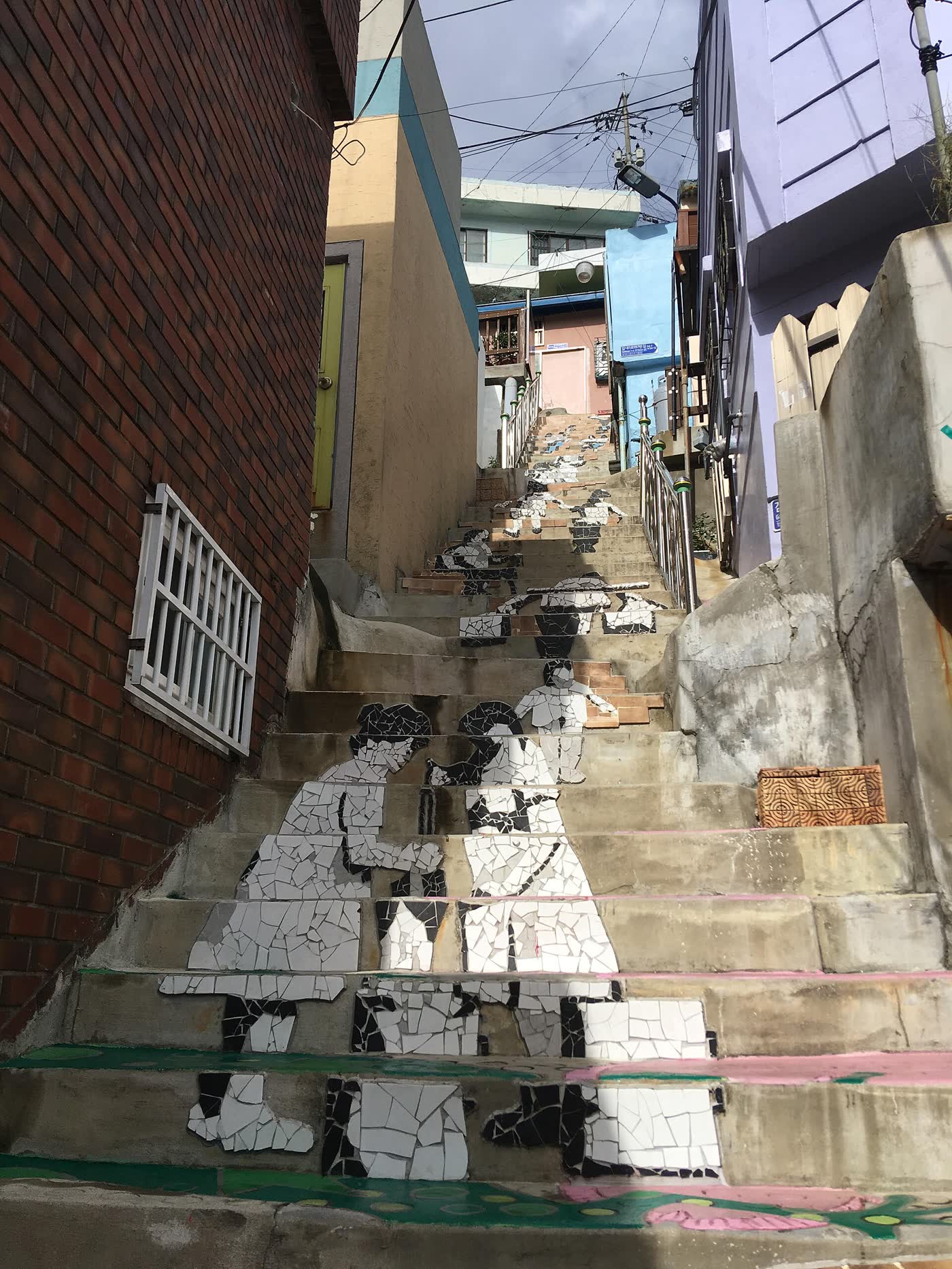
The local move is to arrive for either the first clean hour or the soft late-afternoon window. 09:00-11:00 gives you open light, shop shutters starting to lift, and fewer tour groups pressing against the same murals. 16:00-18:00 is better for color and shadows in warm months, but it has a closing-clock problem: tourist-facing shops, the information center, and some route help start thinning out around the posted hours.[1][2] A recent Reddit travel thread captures the boundary well: people ask whether they can enter before 9 because the village has no gate, and the useful answer is that this is more neighborhood than attraction, so early walking is possible only if you behave like a guest rather than a photographer looking for empty streets.[6]
Do not start by climbing from the bottom unless the climb itself is the point. The official route advice from Visit Busan puts visitors on Busan Metro Line 1, then a village bus from Toseong Station Exit 6 or Goejeong Station Exit 6, getting off at Gamjeong Elementary School and walking about 5 minutes.[1] A community travel thread adds a small but useful correction: mapping apps can funnel everyone to the same stop, so stepping one stop earlier or thinking about the bus queue can be the difference between standing in a packed mini-bus and sitting for the short hill ride.[7] Tripadvisor reviewers converge on the same practical logic from another angle: get transport to the top, then walk down through the village instead of exhausting yourself before the route has even started.[4]
At the top, pause at the information-center area before chasing the first view. The tourist information center lists the same 203 Gamnae 2-ro address, the 051-204-1444 contact number, and the same seasonal hours; the Saha-gu page lays out three route shapes, including a 40-minute main-road return, a 1 hour 20 minute compact course, and a 1 hour 20 minute stamp course.[2][3] That is the first visitor trapline: the shortest route is not necessarily the poorest one. If you have one hour, the main road plus one controlled stair descent is better than pretending you will complete every stamp and then rushing through residents' lanes with a camera raised.
Buy or borrow the map if you are the kind of traveler who drifts badly on slopes. Recent community reviews still mention the 2,000 KRW map, and the reason is not souvenir value.[4] Gamcheon is legible from a distance but confusing up close: alleys fold behind houses, stairways reverse direction, and the prettiest wall is not always the right path. The map also slows the visit down. Instead of hunting every mural, choose a small loop: information center, Little Prince area if the queue is light, one viewpoint, one stair lane, then a lower road exit. That is enough to understand the village without turning it into a scavenger hunt.
The second mistake is treating the main road as the whole place. It is useful, but it is also where the crowd thickens: souvenir shops, snack counters, tour leaders, and photo lines all compress at the top. The article-worthy part of Gamcheon begins when you angle into a stair lane and notice how close the walls are. Some doors open directly onto the route. Laundry, scooters, utility boxes, painted fish markers, cafe signs, and resident notices all share the same narrow band of public attention. That is why the official etiquette matters: keep voices down, do not use drones, and do not treat a doorstep as a prop.[1][4]
The third mistake is arriving after the posted visitor window and expecting the village to behave like an open-air theme park. The Korea Tourism Organization says the broader village is open 24 hours, but Visit Busan and the information-center pages give real operating windows for visitor services.[1][2][5] Both can be true. The streets do not lock, but the visit becomes thinner and more intrusive after the shops and staffed points close. If you want quiet photographs, go early and stay disciplined. If you want help, snacks, maps, and toilets, stay inside the official daytime rhythm.
The fourth mistake is underestimating the surfaces. Gamcheon is not a flat mural district. It is stairs, grades, short reversals, and narrow turns. Local and traveler accounts repeatedly warn that comfortable shoes matter, and that a wet day changes the whole feel of the slopes.[4] If rain is forecast, shrink the route. If you are with a stroller, a tired parent, or anyone with knee trouble, keep to the upper road, the information-center area, and one viewpoint rather than forcing the stair descent.
The best compact route is simple. Reach the upper entrance by village bus or taxi. Use the information center as the reset point. Spend 10 minutes reading the first view instead of photographing it immediately. Walk the main road only until the crowd starts to pull you forward, then step into one stair lane and slow down. If a passage feels residential, lower your voice and keep moving. If a photo queue forms, skip it. Finish by returning to the main road for a bus, or continue downhill only if you have enough daylight and a map route you can actually explain.
What Gamcheon gives back is not the fantasy nickname often attached to it. It is not just a Korean version of some other hillside city. Its specificity is harsher and more interesting: a refugee and religious settlement on a steep Busan slope, later remade through public art, tourism, resident labor, and the constant friction of people visiting a place where other people still live.[3][5] The right visit keeps that friction visible. You come for color, but the stairs teach the etiquette.
Sources
- Visit Busan, "Gamcheon Culture Village: When in Busan" - official visitor hours, address, transit directions, fees, and residential-area etiquette.
- Visit Busan, "Gamcheon Culture Village Tourist Information Center" - information-center address, phone number, seasonal hours, guides, and baggage-storage note.
- Saha-gu Office, "Gamcheon Culture Village" - local district history, address, contact point, recommended route lengths, and latest page update note.
- Tripadvisor, "Busan Gamcheon Culture Village" - recent traveler reviews on the 2,000 KRW map, top-down routing, crowds, stairs, and privacy etiquette.
- Korea Tourism Organization, "Busan Gamcheon Culture Village" - national tourism listing on refugee origins, staircase homes, murals, 24-hour access, address, and free admission.
- Reddit r/koreatravel, "Entering Gamcheon Culture Village before 9 AM" - recent community discussion on early access, quiet walking, and the residential-neighborhood boundary.
- Reddit r/koreatravel, "Help with Busan itinerary" - community route advice on Gamcheon bus stops, Naver routing, walking onward, and crowd avoidance.
- Christophe95, "Stairs in the Gamcheon Culture Village 2.jpg," Wikimedia Commons - real photographic image source used for the article cover and figure.