At 10:20, leave Kaunas Old Town by the Vytautas the Great Bridge and cross the Nemunas. The river opens behind you; the hill rises in front. At its foot, look for the lower station at Amerikos Lietuvių g. 6. A wooden car will take a short, steep line through the trees and set you beside one of the cleanest panoramas of the old city.
The address matters because “the Kaunas funicular” is no longer a safe instruction. Kaunas has two historic lines. Žaliakalnis, north of the centre by the Resurrection Basilica, stopped operating in May 2025 and remained closed during this July 2026 check. Aleksotas, south of the river, is the working one: its operator currently publishes daily service from 07:00 to 19:00, departures every 10 minutes, and a fixed lunch pause from 12:00 to 13:00 [1][5][7].
That distinction is the whole ritual. Do not use the funicular as a generic box to tick. Cross the river deliberately, ride the surviving public machine uphill, give the observation deck one attentive pause, then walk back down if the steps suit you. Allow 50–70 minutes. The required spend is €1.50 one way, or €3 if you ride both directions [1][2].
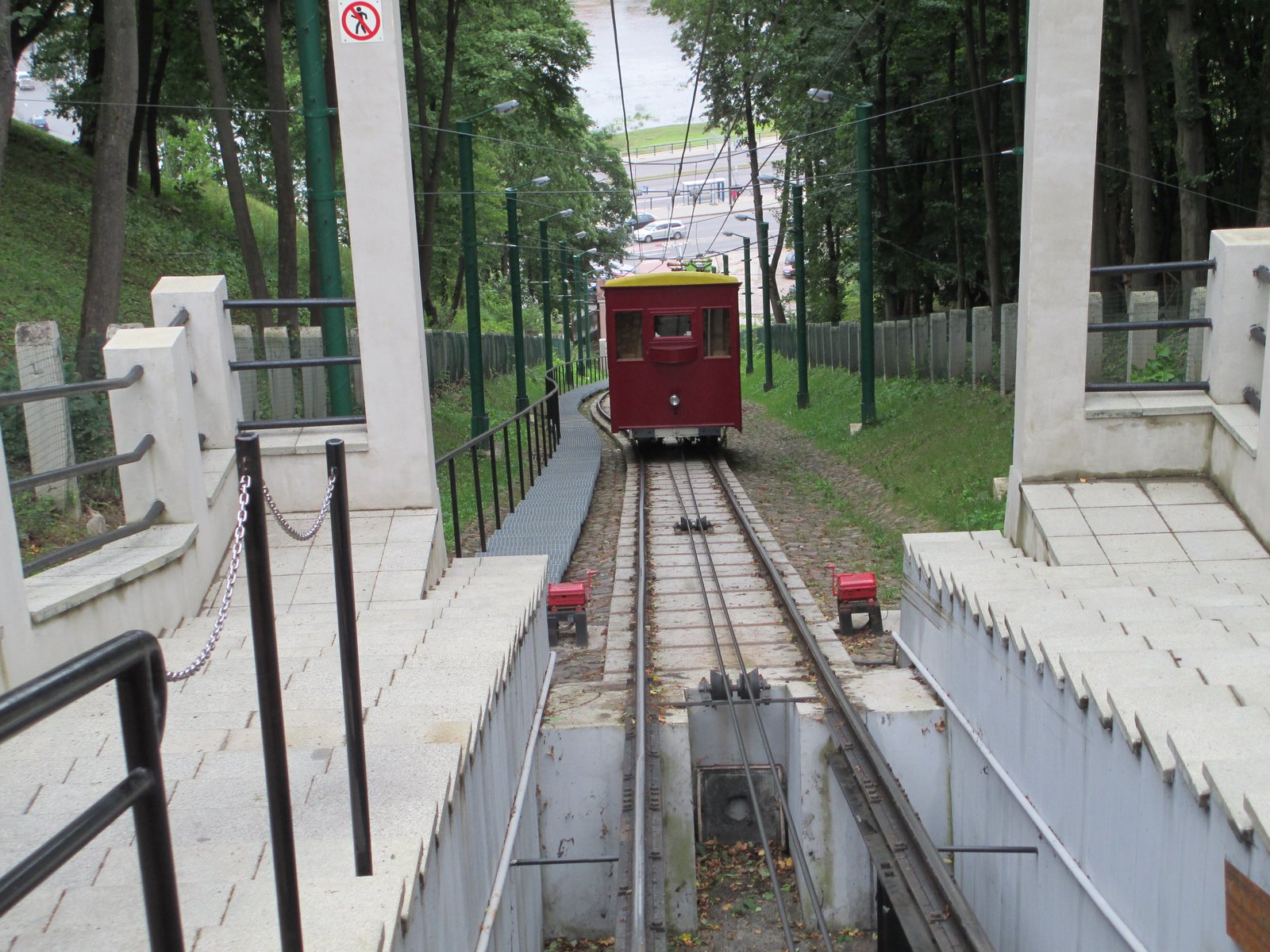
Image context: the cover is Avi1111's real photograph from July 2013, not a generated travel visual. It looks from the upper station down the wooded incline, with one red car descending toward the river. The image is older than the current fare and payment system, but the operator's service page confirms that authentic wooden prewar cars, track, stations, and traction equipment remain part of the working line [1][8].
Cross the river before you climb
Move one: navigate to the line by bank and address, not by attraction name. From Town Hall Square, reach the north end of the Vytautas the Great Bridge, cross south, then angle toward Amerikos Lietuvių g. 6 [1]. If a map sends you toward Aušros Street and the Resurrection Basilica, it has selected Žaliakalnis. Stop and correct it before climbing the wrong hill [5][7].
The bridge supplies a piece of Kaunas texture before the machinery does. Kaunas IN describes the funicular as infrastructure for a rapidly growing city: municipal planners wanted a practical connection between the centre and a hill district whose development was constrained by poor access [3]. Walking the river crossing first makes that old planning problem legible. The machine is short because the obstacle is steep, not because the ride was conceived as a miniature attraction.
Move two: arrive on the ten-minute rhythm, but keep clear of noon. The published departures run at :00, :10, :20, :30, :40, and :50 through each operating hour, except for the 12:00–13:00 break [1]. A useful first window is 10:10–11:20. A second is 13:10–14:20. Do not arrive at 11:58 and treat the locked pause as a breakdown.
Schedules are still not guarantees. A Tripadvisor contributor reported riding in spring 2026 and paying by card, while the same community surface preserves reports of maintenance closures and disrupted returns [6]. Check the operator page on the same morning and avoid building the route around the final departure; if the car is unexpectedly still, use the adjacent steps only if the climb works for your body.
Move three: trust the new payment notice over old cash-only reviews. Since March 1, 2026, the standard one-way fare has been €1.50. The operator says riders may pay with a Žiogas card or app, a bank card, or an NFC device [2]. Several otherwise useful older reviews still say “cash only” and quote €1 [6]. They accurately describe the wooden car and lunch break, but not the current transaction. Bring a small cash backup if that lowers your travel friction; do not present it as the only accepted method.
Move four: board like this is transport, because it is. Let descending passengers clear, take a wooden seat, and keep the doorway free. The car holds up to 25 passengers, and the operator permits one bicycle [1]. Those details are a reminder that this is not a static museum ride. Locals, students, workers, bicycles, and visitors share a very small vehicle.
During the ascent, put the phone down long enough to feel the counterweight logic. The line is a 132.9-metre single track at an 18-degree incline. Its two cars separate at the midpoint, pass, then return to one rail [1]. The best visual moment is not a sweeping city view through the trees. It is the other car appearing where one line briefly becomes two.
Give the panorama one job
Move five: leave the upper station before choosing the photograph. The observation deck is beside the top of the line, but do not stop in the exit stream. Move onto the open terrace first. Visit Kaunas identifies the deck as the place to read the centre and Old Town from Aleksotas Hill [5]. Use the river as the baseline: the Nemunas below, the bridge you just crossed, the old roofs beyond it, then the larger city rising behind.
The deck works because the ride has already simplified the geography. Kaunas is often introduced through a list—castle, cathedral, modernism, museums, two rivers. From Aleksotas, those pieces become banks, slopes, towers, and crossings. Spend 15–25 minutes, not an hour hunting for a secret angle. The view is the reward for understanding the transfer, not a second attraction that needs to be conquered.
Move six: orient before you zoom. The official city and national tourism pages both define this as a panorama of Kaunas Centre and Old Town [3][4]. Find the river, bridge, and old roofs with your eyes before opening a camera. That sequence turns the deck into a reading position rather than a generic high-place photograph. It also keeps the outing from expanding into another viewpoint chase.
Move seven: return on foot only if the descent suits you. Recent community reports repeatedly recommend the asymmetric version: ride up, walk down the stepped path beside the line [6]. It is a satisfying release because the rails stay beside you and the bridge slowly returns to eye level. It is not the right choice for every knee, stroller, wheelchair, wet day, or icy surface. If steps are a barrier, pay the second €1.50, remain at the signed boarding point, and ride down [1][2][6].
At the bottom, do not immediately summon a car. Cross the bridge back on foot. The uphill car gave the city to you as a panorama; the return crossing puts traffic, water, stone, and distance back into it.
A machine built for an expanding city
Move eight: read the age through what still moves. Aleksotas dates to 1935, after Kaunas had already built the Žaliakalnis line. Kaunas IN describes a project made with Swiss and German partners, with automatic-brake wagons built by the local Amlit company; it frames the funicular as a sign of the city's rapid interwar infrastructure modernization [3].
That context protects the visit from nostalgia. The wooden benches and brass details are charming, but the line was not built as a theme-park antique. It solved an incline. Its original logic—move residents between the river level and the hill—still appears whenever a bicycle, student, or neighbour boards with a visitor [1][3].
The contrast between the two Kaunas lines now makes that civic value unusually visible. A January 2026 local report said Žaliakalnis had ceased service in May 2025, while Aleksotas remained municipally operated despite annual costs far above ticket revenue [5]. The inference is not that one ride “saves” a funicular. It is that paying for ordinary public access keeps heritage meaningful in the only way a transport machine fully can: by moving people.
The visitor trapline
Mistake one: following any result labelled “Kaunas Funicular.” Many guides were written when both lines operated [5][7]. Better: verify Aleksotas, Amerikos Lietuvių g. 6, on the south bank before walking.
Mistake two: planning a noon ride. The current daily timetable has a hard 12:00–13:00 lunch pause [1]. Better: use a :10 or :20 departure with enough margin to look at the deck before the break.
Mistake three: repeating the €1, cash-only advice. Those details survive in older reviews, but the operator changed the standard fare to €1.50 and added bank-card, app, and NFC payment from March 1, 2026 [2][6]. Better: treat the operator as the current authority and reviews as evidence about lived friction.
Mistake four: waiting for sunset on the platform. The published service ends at 19:00, well before midsummer darkness [1]. Better: use daylight, make the old city legible, and choose another public viewpoint if your main requirement is late-night colour.
A compact go plan
- Best window: 10:10–11:20 or 13:10–14:20, after checking the live operator page [1][6].
- Expected spend: €1.50 for the ride-up/walk-down version; €3 for a round trip [1][2]. The observation deck is an open public-space stop, not a ticketed second anchor [4].
- Queue and reservation reality: the operator publishes ten-minute departures and onboard fares rather than a visitor reservation system. With a 25-person car, wait for the next run instead of crowding the doors [1].
- Where to stand and sit: clear the lower doorway, take any open wooden seat, then move fully onto the upper terrace before stopping for the view.
- Navigation cue:
Kaunas Town Hall Square -> Vytautas the Great Bridge southbound -> Amerikos Lietuvių g. 6 -> Aleksotas Funicular -> upper observation deck -> adjacent steps or return car -> bridge back to Old Town[1][3]. - Time budget: 50–70 minutes total, including 15–25 minutes at the deck. Add margin for the next ten-minute departure or a slow stair descent.
- Same-day check: service notice, planned maintenance, weather, step condition, and the current payment reader. Official notices outrank this route [1][2][6].
Kaunas does not need both funiculars blurred into one nostalgic attraction. The useful city knowledge is more exact: one line is closed; the other still carries people. Cross the river, arrive outside lunch, ride the working machine, and walk back into the old city with the hill's logic in your legs.
Sources
- UAB Kauno autobusai, “Aleksoto funikulierius” — current official address, daily hours, ten-minute departures, €1.50 fare, capacity, bicycle rule, track dimensions, and surviving equipment.
- Kauno viešasis transportas, “Aleksoto funikulieriuje patogesnis atsiskaitymas ir naujos kainos” (February 25, 2026) — official March 2026 fare and card, app, bank-card, and NFC payment update.
- Kaunas IN, “Aleksotas Funicular” — current official city-tourism page on the line's development purpose, 1935 infrastructure, address, schedule, and upper-station panorama.
- Lithuania Travel, “Aleksotas Observation Deck” — national tourism listing for the free, funicular-linked public panorama over central Kaunas and the Old Town.
- Kas vyksta Kaune, “Kauno miesto savivaldybės tarybos narė V. Pranarauskaitė: funikulierius ar apžvalgos ratas?” (January 11, 2026) — local reporting on the Žaliakalnis shutdown, ownership, heritage status, and Aleksotas operating economics.
- Tripadvisor, “Aleksotas Funicular” — current community-review surface, including a spring 2026 ride and card payment report plus earlier reports on maintenance, the stepped descent, views, and stale cash-only guidance.
- Reddit r/kaunas_lithuania, “Žaliakalnis Funicular” (May–June 2026) — recent local-community confirmation that Žaliakalnis is out of operation and Aleksotas is the line visitors should use instead.
- Wikimedia Commons, “Funicular to Aleksotas Hill, Kaunas.JPG” — Avi1111's real July 23, 2013 photograph of the operating railway used as the article image.