Near midnight, flowers start moving the wrong way through Bangkok. Not out of hotels, shrines, shops, and homes, but toward them. Trucks edge into Chak Phet Road. Bundles disappear between shoulders. Orchids, lotus buds, roses, marigolds, and jasmine enter the old city under fluorescent light, hours before most of the people who will see them wake.
Pak Khlong Talat is often called a 24-hour attraction. That is accurate and not very useful. The market has different nights inside it. At 21:45, a visitor can arrive and leave by MRT while the retail edge is still easy to read. Around 03:00, the same streets belong to wholesale arrivals, handcarts, sorting, and buyers. Time Out Bangkok's November 2025 field note calls 3 a.m. the peak of the crush; Thailand's official 2026 visitor page recommends 05:00–08:00 and describes 04:00–08:00 as the busiest period [1][2]. Those are not conflicting tips. They describe a supply chain gathering speed.
The good visit is therefore not “go late.” It is: choose one shift, make the return plan first, then enter a market that happens to be beautiful without asking it to perform for you. Allow 45–75 minutes. Pak Khlong Talat is the only anchor.
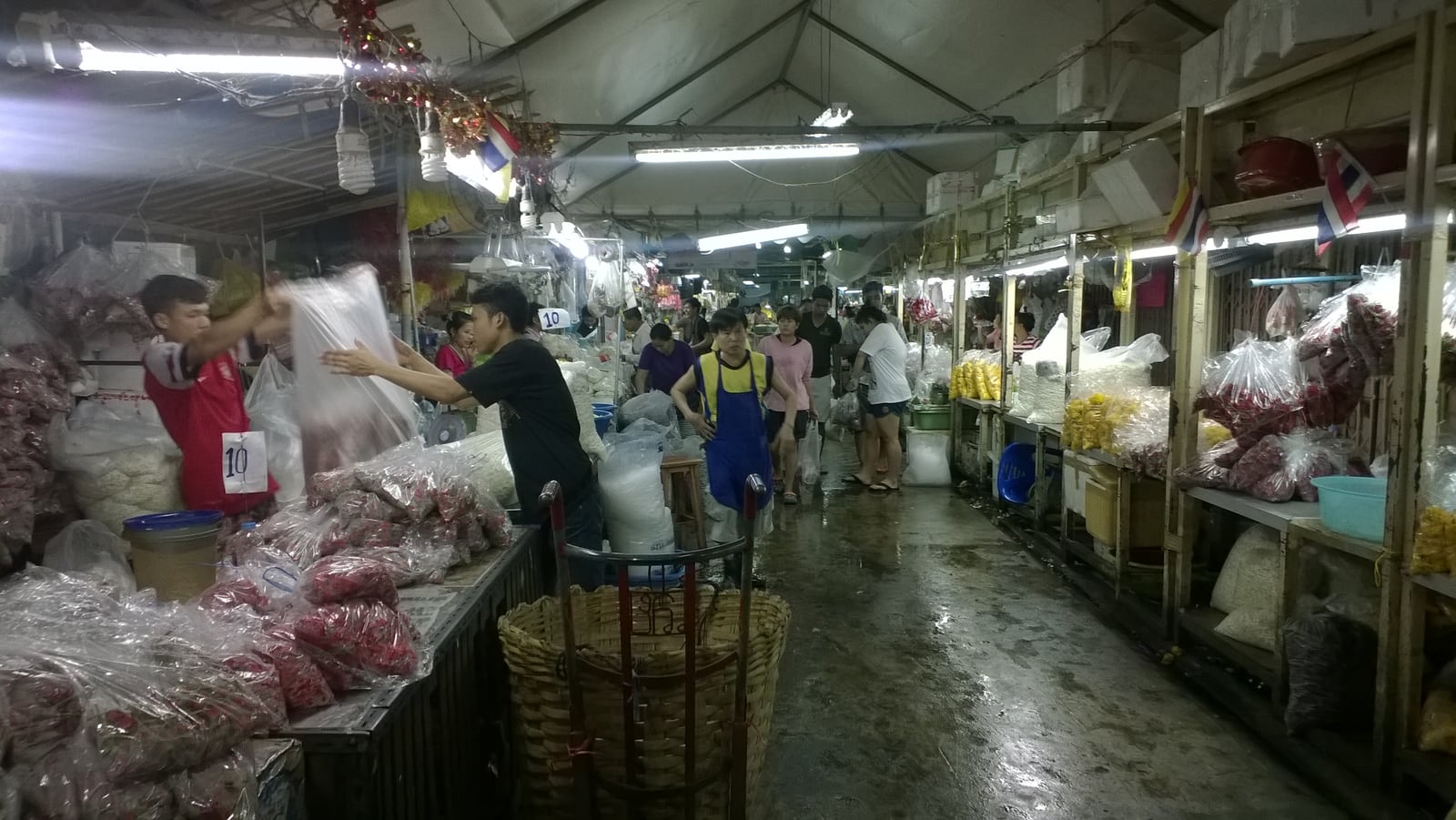
Image context: the cover is Ovedc's real photograph made at 19:14 on February 18, 2015. Workers pass bagged petals beside a handcart while customers thread through a wet, fluorescent-lit aisle. It is documentary evidence of the market's after-dark texture, not a generated travel scene. The stalls have changed since 2015, so current hours and transport come from current sources, not from the photograph [1][3][8].
Pick the night you actually have
First local move: choose between the late shift and the wholesale shift. If you want flowers, human scale, and a straightforward rail return, use roughly 21:45–23:00. The market is operating, but you are ahead of its most compressed freight hour. If you want to watch the wholesale machine, use roughly 00:30–03:30 and accept that a car will be part of the plan. Midnight is not a magic opening time—the market is already open—but recent local reporting says that is when deliveries become the story [1][2].
Do not combine those versions into a five-hour vigil. The point is to notice a change of urban function, not to exhaust every aisle. Wongnai's Bangkok community-review surface shows visits ranging from under an hour to about two hours, with both wholesale and retail flower buying described [5]. A focused circuit is enough: arrive from Sanam Chai, follow the flower-facing edge of Chak Phet Road, make one pass through a covered market aisle, buy or observe, then return by the same known route.
Second local move: decide how you are leaving before you decide what you are seeing. BEM's live first-and-last-train table is direction-specific. On this article's July 2026 check, it showed last Blue Line trains from Sanam Chai at 23:24 in one direction and 00:16 in the other, with a request to reach the station at least five minutes early [3]. Those times are not permission to improvise until 00:10. Check your destination in BEM's current table on the day. Your personal cutoff must leave time for the 250–400-metre approach, station entry, and BEM's five-minute margin.
For the wholesale shift, assume the MRT is unavailable. Arrange the return car in the app you already use, wait at a bright mapped pickup point away from active loading, and share the vehicle details if that is your normal practice. Do not make the river boat your midnight fallback: the official Chao Phraya Express Boat timetable is daytime and evening service, not an overnight route [10].
Third local move: approach by the canal side, not by a vague “flower market” pin. At Sanam Chai, follow Exit 4, which BEM signs for Pak Khlong Talat, then take Rachini Road and turn left onto Chak Phet Road. BEM describes an approach of about 250 metres, while the official visitor page gives about 400 metres; allow roughly 250–400 metres depending on the entrance and route [1][7][9]. The useful recognition cues are not a grand gate. They are the Pak Khlong Talat name, flower shops thickening along the road, handcarts, and the rise of Memorial Bridge beyond the market. If your map places you in a silent mall corridor, return to street level instead of hunting for a ceremonial entrance.
If you need step-free access, ask station staff before following Exit 4. BEM lists lifts or ramps at exits 1 and 3, not at the market-signed exit [7].
Let the freight draw the floor plan
At first, look for empty space. Then notice that almost none of it is truly empty. A strip of wet pavement may be a trolley line. A gap before a stall may be where the next bundle lands. The curb may need to take a van, a motorcycle, and a person carrying flowers wider than their shoulders in the same minute.
Fourth local move: give every working load right of way. Walk single file where the aisle narrows, keep bag straps close, and step fully aside before stopping. Between 02:00 and 07:00, the official visitor guidance specifically warns that heavy flower movement can leave floors wet and slippery [1]. Closed shoes with grip are more useful than an outfit designed around the photograph. At the 3 a.m. peak, do not stand at the mouth of a lane to “capture the chaos.” The chaos has a destination [2].
Fifth local move: make the first pass without a camera. Read the market by work. Whole bundles arrive. Sellers strip, grade, group, wrap, and display. Garland makers turn loose jasmine and marigold into dense, portable objects. Retail bouquets sit beside quantities meant for florists, hotels, ceremonies, and shrine vendors. The night becomes legible when you can distinguish a selling face from a loading face and a viewing edge from a route.
This is the place-specific fact that changes the room: Pak Khlong Talat did not begin as a purpose-built flower attraction. Thai public-history sources trace a progression from fish landing and produce exchange to fruit, vegetables, and, by the later twentieth century, the flower trade [1][6]. Its name and position still belong to the mouth of a canal beside the Chao Phraya. The visual abundance is the surface of an old distribution habit: bring perishable things into the city by the cool hours, divide them, and send them onward.
That history is why the market feels more convincing at night than as an item on an old-town checklist. It is not preserved commerce. It is commerce keeping its own clock.
Buy by the seller's unit
Sixth local move: ask what the quoted number buys. Point to the exact item, greet the seller, and establish whether the price is for one stem, one garland, one bunch, one wrapped bouquet, or a wholesale quantity before money changes hands. Pak Khlong Talat serves retail buyers as well as trade customers, but that does not make every display a pick-your-own bin [4][5]. Do not separate a bundle or handle petals unless invited.
Carry small baht notes even if you normally pay by phone. The official visitor guidance recommends small cash; it does not promise that every independent stall accepts a foreign card [1]. Entry costs ฿0. Interviews reported in the 2025 study recorded small ready-made bouquets at ฿50–60 in January 2024, an observed example rather than a current tariff [4]. A visitor allowance of ฿100–300 is therefore a conservative personal ceiling for one modest, easy-to-carry purchase, not a quoted market price. Flower type, grade, quantity, holy days, ceremonies, and seasonal demand all move the actual price.
Seventh local move: buy something with a destination. A small bouquet that can stand in a hotel glass, or a garland you understand how you will carry and use, is better than an armful acquired for ten minutes of pictures. A 2025 Kasetsart University study based on interviews with flower sellers and customers found that the market's newer visitor economy had encouraged small ready-made bouquets alongside its traditional wholesale role [4]. That adaptation makes a modest purchase easy. It does not turn the worker who wrapped it into a photo prop.
If you only want to look, look. There is no admission fee and no obligation to invent a transaction. Stand where standing does not cost someone else a sale or a clear aisle.
Photograph the market after you have read it
The most revealing recent change is not a new building. It is a new audience. The 2025 study describes Instagram and TikTok check-ins helping recast Pak Khlong Talat as both a physical market and an online cultural space; sellers responded with bouquets, cafés, workshops, and other visitor-facing businesses [4]. Time Out Bangkok noticed the street version of that shift in late 2025: young people taking a single flower onto Memorial Bridge for photographs [2].
Eighth local move: take the photograph from the edge of work. Ask before making a close portrait. Avoid flash in a worker's face. Frame the flowers with buckets, wrapping paper, price cards, hands, shop signs, or a moving cart—the things that explain why they are here. If someone needs the patch of floor you chose, move before finishing the shot. One attentive image is better local conduct than a burst that blocks a sale.
The cover photograph gets this right. It does not pretend the market is an empty tunnel of colour. People occupy it. Containers and light fixtures remain visible. Beauty and logistics share the frame [8].
Memorial Bridge is useful as orientation, but it is not the second half of this route. If you step toward it, use the market's glow and the bridge structure to confirm where you are, then return to the exit plan you already made. Do not let a “quick bridge shot” carry you past the last train.
The visitor trapline
Mistake one: treating “open 24 hours” as “equally alive for 24 hours.” The official visitor page confirms round-the-clock operation, while local reporting identifies midnight deliveries and a 3 a.m. wholesale peak [1][2]. Better: choose the gentler rail window or the working wholesale window, and accept the tradeoff.
Mistake two: arriving by MRT at 02:30. The market keeps a different clock from the railway [2][3]. Better: use rail for the late shift; for the wholesale shift, set both inbound and outbound car plans before arrival.
Mistake three: posing in the brightest gap. At this hour, a photogenic gap may be loading space, and the wet floor may be carrying flowers rather than rain [1][2]. Better: watch the movement once, find a true edge, ask before portraits, and yield immediately.
Mistake four: assuming a 24-hour market keeps every neighbouring café, food hall, and shop awake. Wongnai's local review surface explicitly notes late closures around a market that itself continues [5]. Better: bring water, use a restroom before the deep-night shift, and treat any open side business as a bonus rather than support infrastructure.
A compact go plan
- Anchor: Pak Khlong Talat's flower-trading lanes along Chak Phet Road; Memorial Bridge is a recognition cue, not a second stop.
- Best windows: 21:45–23:00 for a rail-compatible look, or 00:30–03:30 for the wholesale night with car transport [1][2][3].
- Time budget: 45–75 minutes for one slow circuit; no reservation and no admission queue, but freight congestion is real [1][5].
- Expected spend: ฿0 to observe; carry small notes and set ฿100–300 as your own ceiling for one compact purchase rather than expecting a fixed attraction price [1][4].
- What to buy: ask whether the unit is a stem, bunch, garland, bouquet, or wholesale pack; choose something you can carry without crushing it or blocking the aisle [4][5].
- Where to walk: Exit 4 toward Rachini and Chak Phet Road, flower-facing edge, one covered aisle, then the same route back. Give carts, bundles, and wet working patches priority [1][7][9].
- Navigation cue:
MRT Sanam Chai -> Exit 4 -> Rachini Road -> left on Chak Phet Road -> Pak Khlong Talat lanes -> same route back[1][3][7][9]. - Same-night check: current BEM last train for your direction, rain, footwear, pickup point, battery, and the market pin. Live operator information outranks the times printed here [3][7].
Pak Khlong Talat is most memorable when the flowers stop looking decorative. Each bundle is cold-hour freight; each garland is skilled work; each trolley is the beginning of a morning elsewhere in Bangkok. Choose the shift, keep the lane open, and the market will show you a city preparing its day while almost everyone else still calls it night.
Sources
- Thailand 2026 Annual Meetings Team, “Pak Khlong Talad” (August 15, 2025) — recent official Thai visitor guidance on the 24-hour market, pre-dawn rhythm, flower origins, wet-floor window, MRT approach, cash, and trading history.
- Tita Honghirunkham, “Pak Khlong Talat.” Time Out Bangkok (November 7, 2025) — recent local reporting on midnight deliveries, the 3 a.m. wholesale peak, working congestion, and the single-flower photography habit near Memorial Bridge.
- Bangkok Expressway and Metro, “First–Last Train of Blue Line” — live official BEM table for direction-specific Sanam Chai service and the five-minute arrival warning, checked July 23, 2026.
- Thattita Chumkhun and Sowatree Nathalang, “Pak Khlong Talat: From a Fish Market to a Popular Flower Market through the Role of Media.” Journal of Social Sciences and Humanities 51, no. 1 (2025), pp. 33–48 — local interview study on the market's history, visitor economy, online image, and seller adaptation.
- Wongnai, “Pak Khlong Talat” — Thai community-review surface documenting wholesale and retail browsing, typical visit lengths, flower buying, and the boundary between the 24-hour market and late-closing side businesses.
- Designated Areas for Sustainable Tourism Administration, “Pak Khlong Talat Night Market” — Thai public-history account of the fish-to-produce-to-flower transition, the linked market spaces, and nighttime wholesale role.
- Bangkok Expressway and Metro, “Sanam Chai” — official BEM station page identifying Exit 4 for Pak Khlong Talat and the exits with lifts, ramps, and escalators.
- Wikimedia Commons, “Thailand Bangkok Pak Khlong Talat – flower market ovedc 01.jpg” — Ovedc's real February 18, 2015 evening photograph of workers, bagged petals, a handcart, stalls, and a wet market aisle, used as the article image.
- Bangkok Expressway and Metro, “Pak Khlong Talat” — official BEM walking directions from Sanam Chai Exit 4 via Rachini and Chak Phet roads, with an approximate 250-metre distance.
- Chao Phraya Express Boat, “Timetable” — current official route schedule, effective June 24, 2026, showing daytime and evening rather than overnight river service.