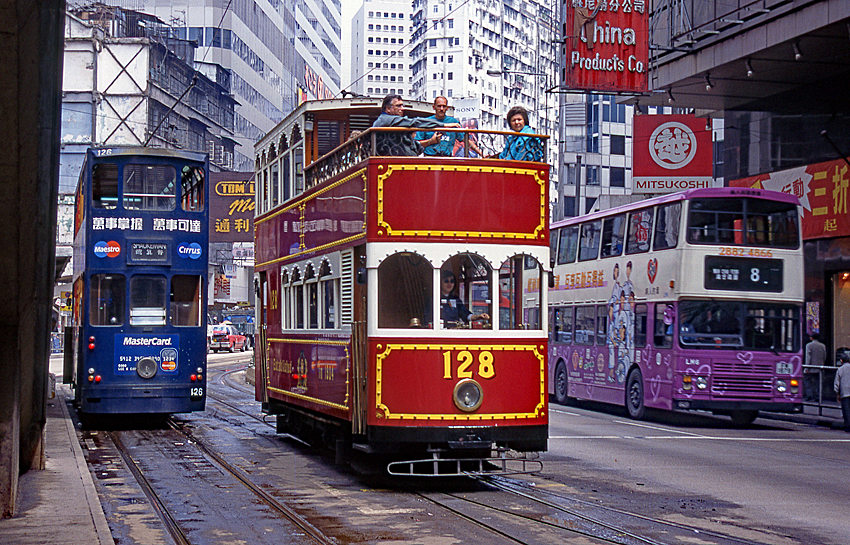
North Point gives you a version of Hong Kong that feels mechanically simple and socially dense at the same time: a tram bell, a wet-market lane, minibus pressure at intersections, and a double-decker moving at a speed that lets you actually read storefront life. If your city day has only one anchor, this one is high-yield because it works as transport, observation deck, and neighborhood decoder in a single corridor.
The working move is to treat the North Point–Chun Yeung Street stretch as a timed place portrait, not a random scenic ride. You are optimizing for one thing: catching the market-and-tram overlap without getting trapped in peak-hour crush or choosing the wrong branch car.
Why this anchor is worth your one-slot day
Hong Kong Tramways still runs a flat-fare, high-stop-density system on Hong Kong Island, and the North Point branch is one of the few places where the tram passes directly through a market street texture that stays legible from the upper deck. The city changed around it, but this corridor kept its mixed cadence: old produce stalls, school traffic, office commuters, and tramcars threading through at street-human scale.
Two details define the experience quality:
- Cadence: official frequencies for major lines stay in the 5–12 minute band depending on line/time window, so you can recover from a missed car without blowing up your afternoon.
- Geometry: Eastbound and westbound stop names differ, and branch destinations can look similar at a glance; your decision quality at the platform matters more than most first-time riders expect.
The practical timing window that performs best
If you want atmosphere plus manageable boarding, run this window:
- Best arrival at North Point stop area: 16:30–17:30
- Best ride segment through Chun Yeung Street: 17:00–18:15
- Avoid if possible: 08:00–09:30 and 18:15–19:15 weekday commuter peaks
Why this works: market life is still active, light is better for upper-deck visibility, and platform crowding is usually less punishing than the sharp commuter spikes.
Local-knowledge moves that change outcomes (8 moves)
- Board from the rear, pay at front on exit, and prep payment before your stop. It sounds trivial, but front-door payment hesitation causes the most avoidable bottleneck at busy stops.
- Take upper deck front-left for westbound visual read, front-right for eastbound harbor-side peeks where available. Window orientation changes what you can actually see.
- Do not trust tram body color for route decisions. Ads dominate livery now; read destination text first.
- At shared stops, choose by terminal direction, not by route-number habit from other cities. The destination name is the stable signal.
- If your car is visibly full at stairwell, skip and take the next one. A 5–12 minute recovery beats riding blind from the lower deck aisle.
- For Chun Yeung Street texture, commit to a slow segment and stay seated through at least 3–4 stops. Frequent hopping kills the street-reading value.
- Use tram + short walk rather than forcing MTR for micro-distances in this corridor. The tram gives better neighborhood signal per minute when distances are short.
- Exit one stop early near your intended transfer if crowd pressure is rising. You gain platform space and cleaner crossing angles.
Four non-local traplines and the better alternative
Trap 1: “I’ll just jump on any colorful tram and figure it out later.”
Better move: confirm destination on the front display before boarding; route colors are not reliable wayfinding.
Trap 2: “I can decide where to sit after departure.”
Better move: commit immediately to upper deck or quick lower-deck exit strategy. Stair choke points make late repositioning costly.
Trap 3: “Peak hour equals best city vibe.”
Better move: target late afternoon shoulder (around 17:00) for a stronger street scene with fewer boarding frictions.
Trap 4: “MTR is always faster so tram is only nostalgia.”
Better move: for short-to-medium island hops with high surface curiosity, tram can outperform in cognitive value even when absolute speed is lower.
Concrete go-details (so you can execute without improvising)
- Cost floor: HK$3.30 adult flat fare (HK$1.60 child, HK$1.50 senior).
- If you run two legs: budget HK$6.60 per person for tram-only movement.
- Monthly local benchmark: HK$260 monthly ticket (useful reference for heavy tram days).
- Service span anchor: key routes begin around 05:xx and run to around 00:xx; North Point branch service windows are narrower, so check branch endpoint before committing late.
- Expected wait target: typically 5–12 minutes on core lines.
- One hard branch signal: Shau Kei Wan ↔ Kennedy Town direct pattern is limited to 2 departures/hour in the stated schedule window.
- Where to stand: rear-door queue line, one body-width clear from curb edge so exiting passengers can clear front flow downstream.
- Where to sit: upper deck first row if available; if unavailable, second row aisle-side for faster alight.
Portable takeaway artifact: rainy vs dry run through the same anchor
| Condition | Start point | Ride strategy | Walk strategy | Total tram spends |
|---|---|---|---|---|
| Dry (visibility priority) | North Point | Upper deck, stay on for 4–6 stops through market corridor | Add 12–20 minute post-ride walk for lane texture | HK$3.30–HK$6.60 |
| Rainy (friction control) | North Point | Take first non-crowded car, lower deck near exit for fast alight | Keep walks under 8 minutes per segment, use covered links when possible | HK$3.30–HK$6.60 |
The high-value logic is simple: North Point rewards timing and micro-decisions more than brute itinerary volume. You get better urban signal by moving slower, choosing the right car, and committing to one corridor long enough for patterns to appear.
Sources
- Hong Kong Tramways — Schedules & Fares (routes, first/last departures, fare table, payment methods)
- Hong Kong Transport Department — Tram Service Details (frequency bands, service remarks)
- Discover Hong Kong — Everything to Know About the Beloved Ding Ding (network context, operating characteristics, route ideas)
- 3HK local post (2025-05-19) — platform-direction confusion patterns and rider errors in Chinese travel community discussion
- Mimi韓 travel note (updated 2025-11-11) — repeated practical rider heuristics observed in Chinese-speaking visitor community
- Google Maps place reference — North Point Tram Terminus (recent rider review stream)
- Google Maps place reference — Chun Yeung Street corridor (recent area review stream)