At 9pm, a cannon at Havana’s Fortaleza de San Carlos de la Cabaña gives the city an audible time signal. The sound once announced the closing of gates in the wall around the colonial city; Cuba’s official tourism portal dates the wall’s demolition to 1863. The boundary has largely disappeared, but the appointment survives.[1] A visitor can build an evening around the few seconds in which the fortress addresses the city across the water.
The local meaning reaches beyond the spectacle. CiberCuba records an expression used by older Habaneros to declare themselves still vigorous and dependable: “Estoy como el cañonazo de las nueve”—roughly, “I’m as reliable as the nine o’clock cannon.”[2] That is a useful thought to take to the ramparts. For somebody watching from outside Cuba, this is a historic ceremony; in the city’s own vocabulary, it is also a way of saying that a person is still going strong.
Give the fortress an hour
Put the full destination—Fortaleza de San Carlos de la Cabaña, ceremonia del cañonazo—in the conversation with your driver. The official city guide places La Cabaña on the eastern bank of the harbour entrance. The neighbouring Morro has the conspicuous lighthouse; La Cabaña is the destination for the ceremony.[4][5] Naming the event as well as the fortress helps make the intended drop-off clear.
For an independent visit, I would aim to arrive around 7:30pm, with a place to watch chosen by 8pm. That half-hour is a suggested allowance for entry and finding your bearings, not a measured queue time. In a review published in March 2025, Tripadvisor contributor luznatalia_villa recommends arriving by eight, especially at weekends, and warns that the wait involves standing.[3] Choose comfortable shoes and settle any need for a seat with your guide before committing to that plan.
Arriving at nine is the easiest way to hear everything and see little. A June 2025 visitor recommends coming before darkness to explore; the afternoon light and the ceremony require different arrival decisions.[3] If the view across the harbour matters to you, move your visit earlier according to that day’s sunset. An eight o’clock arrival should never be treated as a promise of daylight.
A guided booking does not automatically solve the sightline problem. One Civitatis reviewer, writing in August 2023, describes a crowded ceremony that remained difficult to see despite the guide’s efforts.[7] On arrival, ask where spectators may stand and which way the participants approach. Choose a clear view of their working space, then keep the route open. A photograph taken over somebody’s shoulder cannot recover the part of the procession you missed.
Watch the people keeping the appointment
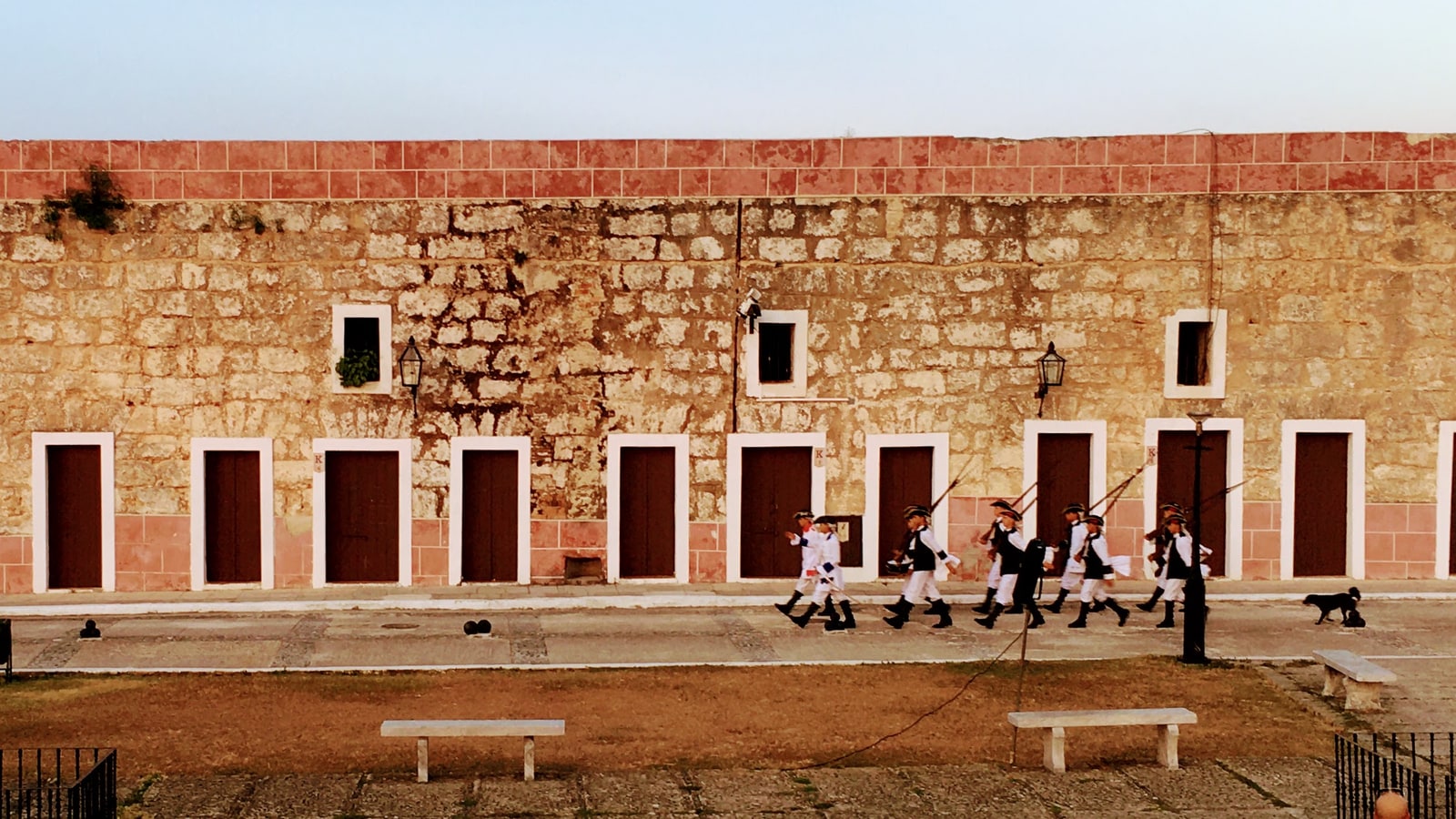
Ernesto Gonzalez Diaz’s Havana Times photo feature describes the fortress as a place used by Cubans as well as foreign visitors, with cultural gatherings and craft stalls along its cobbled routes. His account of the ceremony follows soldiers in historical uniforms using period artillery.[4] That gives the wait something to look at: how a functioning group of people occupies an old military space.
CiberCuba identifies the performers as young members of military service dressed in uniforms recalling the reign of Carlos III.[2] Watch the coordination—the group’s spacing, its approach, the attention directed towards the gun. The photograph above preserves one such moment from 2022; it is an archival view of the ritual, not a record of tonight’s attendance or arrangements.[9]
Keep the harbour in the scene. Across that water is the city whose inhabitants once had to reckon with closing gates.[1] The ceremony becomes more legible when you can connect the people beside the cannon with the streets beyond it. The anticipation does much of the work: everyone has come knowing what will happen, and still has to wait for it.
Arrange the whole evening
For a concrete organised-trip budget, Taino Tours lists US$34 per adult without dinner, or US$54 with dinner, including transport and a guide. Those are package prices, not the fortress’s walk-up admission tariff. The operator lists an 18:45 departure and durations of 4 hours and 5 hours respectively; its tariff was issued on 5 November 2025, with validity through 31 October 2026.[6] The US$34–54 range therefore describes two versions of the same excursion, before tips and unspecified extras.
Taino requests bookings 48 hours ahead, subject to availability, and quotes in US dollars while taking payment in Mexican pesos. Confirm the total and collection point before paying.[6] Civitatis separately lists hotel pickup, return transport and fortress admission; a customer review dated 10 January 2026 reports a punctual guide and taxi.[7] These provide recent confirmation of the excursion’s operation, rather than a guarantee that every advertised departure will run.
If you go independently, ask your accommodation to confirm that evening’s access and admission price, then agree the return fare and meeting point with the driver before setting off. A detailed 2017 report on Tripadvisor’s Cuba forum describes arriving close to firing time, finding little opportunity to explore afterwards, and asking a taxi to wait as other cars departed.[8] Its old prices are not a current budget, but the sequencing lesson remains useful: give the fortress time before the shot and give the journey home a plan.
Check the linked operators again for your date; the practical details here were checked on 10 October 2026. Once those arrangements are settled, the evening can have a little space in it. Look across the water, let the crowd settle, and watch the people whose task is to make a familiar sound arrive on time.
Sources
- Cuba Travel, “Tradiciones y Costumbres: El Cañonazo de las 9” — official account of the nightly time signal and the city walls.
- CiberCuba, “El cañonazo de las nueve” (28 March 2007) — Cuban account of the local expression, military participants and historical ceremony.
- Tripadvisor, “Fortaleza de San Carlos de la Cabaña” — individual visitor accounts, including March and June 2025 reviews on arrival time, standing and daylight; reviews are anecdotal.
- Ernesto Gonzalez Diaz, “Havana’s Nightly Cannon Fire Ritual,” Havana Times (25 April 2014) — local photo reportage on the ceremony and the fortress’s public life.
- Cuba Travel, “Ciudad Habana, lugares de interés” — official location and description of the Fortaleza de San Carlos de la Cabaña.
- Taino Tours, “Excursiones nocturnas con origen en La Habana” (edition dated 5 November 2025; tariffs valid through 31 October 2026) — operator’s prices, inclusions, departure times, booking notice and payment terms.
- Civitatis, “Ceremonia del cañonazo en La Habana” — booking inclusions and customer reviews dated 18 August 2023 and 10 January 2026; checked 10 October 2026.
- Noelius, “Estuve en Cuba Junio 2017 (Cayo-Varadero A.I.+Habana),” Tripadvisor Cuba forum — firsthand account of a late arrival and arranging a waiting taxi; historical prices are not used.
- Zomatho, “Cannon Shot Ceremony in Havana” (26 August 2022), Wikimedia Commons — original photograph and attribution, licensed CC BY-SA 4.0.