A good seat at Deichman Bjørvika puts Oslo’s waterfront on the other side of the glass. Architect and Oslo resident Eva Taucar recommends the top-floor lounge for its view across the Opera House toward the fjord. Her more revealing endorsement is domestic: this is somewhere her family goes when the weather turns bad.[1] The spectacular building has become useful enough to enter without an occasion.
That is the pleasure of visiting Oslo’s main public library. You can arrive as a sightseer and stay as a reader. You do not need a borrowing card simply to sit, browse or read inside, a point regular users explain to uncertain visitors in the city’s Reddit forum.[2] The practical question comes after the door: which part of this very public building suits the hour you want to spend?
Come in before choosing a seat
Aim for Anne-Cath. Vestlys plass 1, between Oslo Central Station and the Opera House.[1][3] The opera’s white slopes are a useful orientation cue; the library is the separate glass building across the road. Allow 5–10 minutes from the station, a planning allowance for finding your exit and crossing rather than a timed walking claim. You can leave the rest of the waterfront for later. This visit has one address.
For a first look with time to settle, I would choose 08:30–10:00 on a weekday and allow 60–90 minutes inside. The local guide, updated August 7, 2026, lists weekday opening as 08:00–22:00, with 10:00–18:00 on Saturdays and Sundays.[1] Check the library’s own page for that day’s hours before leaving; on the October 10 check for this article, it showed the Saturday window.[3] The suggested morning visit follows community advice to come early for a seat, not a promise that the building will be empty.[2]
Budget NOK 0–100 per person, excluding transport. Admission costs nothing; the upper figure is simply an optional refreshment allowance, not a quoted café price. Bringing your own reading material and buying nothing is a complete visit.[1][2] Nor is there an admission reservation to secure. Ordinary seats and bookable rooms are different propositions: community contributors distinguish seats available on arrival from private study spaces that require advance booking.[2]
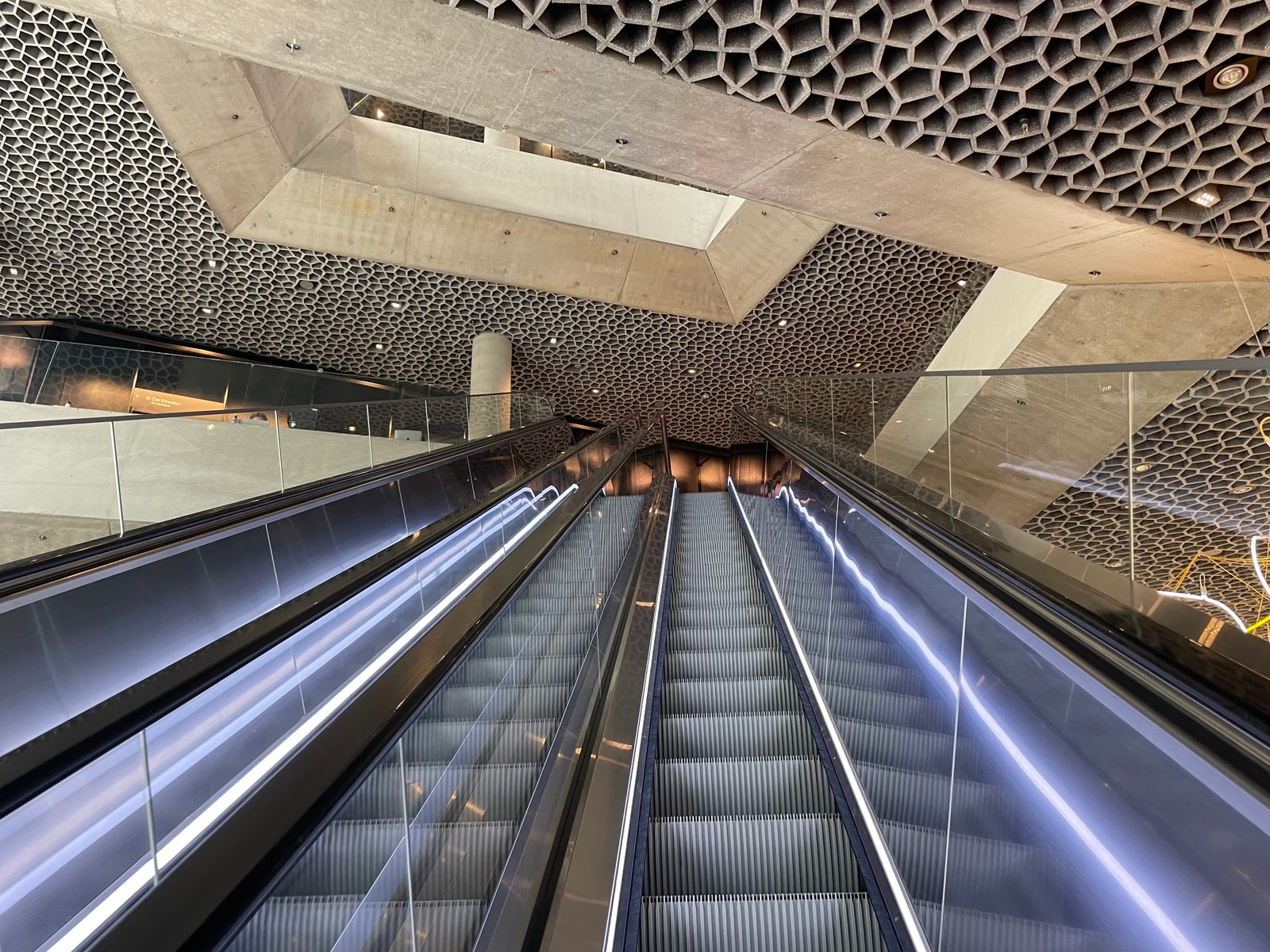
One visitor mistake is hovering near the entrance because a library seems to require membership. Another is taking the entrance floor as the whole experience. Taucar’s recommendation is to continue upward.[1] Follow the signs toward the upper reading areas before deciding where to stop. The escalator ride is part of the encounter. Look upward at the honeycomb-patterned concrete ceiling and the angular openings between floors; the photograph catches how much there is to see before reaching a shelf.[6]
Listen before you unpack
A library this open has several kinds of company. Deichman describes six floors containing reading places alongside workshops, games, a cinema and meeting rooms.[3] Its civic ambition is visible in that mixture. Someone arriving to repair an object and someone arriving to read quietly can both have a legitimate reason to be here.
They may not want the same seat. In the local discussion, one contributor enjoys the background hum, while others describe crowding and distracting conversations. A visitor who first asked about access later reported that the atmosphere did not suit exam preparation.[2] These are individual experiences rather than a noise survey, but they correct the third easy mistake: assuming that free library access guarantees silence.
Before taking out a laptop, pause and listen. If conversation would break your concentration, ask staff for the quiet reading area and use its current signs, rather than treating every sofa as a silent desk. Bring headphones if you intend to work; this is also a practical suggestion from the local thread.[2] If the aim is simply to rest, take an available lounge seat upstairs and let the view supply the occupation.[1]
Leave the neighbouring chair available, keep calls away from readers and frame architectural photographs without turning someone’s working space into your subject. These are courtesies for a shared room, not elaborate visitor rituals. The photograph that matters most may be the one you postpone because you have found a good page.
The books that belong to another century
On the top floor, the Future Library gives waiting an unexpectedly long horizon.[4] Katie Paterson’s project began in 2014 and invites one writer each year to contribute a text that will remain unpublished until 2114. A thousand trees planted in Nordmarka are intended to provide the paper for the eventual books. Inside Deichman, the manuscripts are held in a specially designed, wood-lined room.[5]
Look for the Future Library, or Framtidsbiblioteket, and follow the room’s posted instructions. Come to see the place where the texts are kept; they are not available to browse.[4][5] That boundary is the work’s central idea. Much of this building makes knowledge available immediately, while this small part asks a city to preserve something for readers it cannot yet know.
The project also changes how the waterfront view feels. From the lounge, Oslo is present tense: buildings, water, whatever the weather happens to be doing. A few steps away, a collection is being assembled for a different century. You do not need a long visit to notice that change of scale, but it rewards a little time without a screen.
Finish by returning to an ordinary shelf or an ordinary seat. Its daily life includes making things, meeting people and spending time among books.[3][4] The lasting impression can be modest: a place in the city where the view is good, the chair is usable and staying does not require another purchase.
Sources
- Eva Taucar, “Deichman Bjørvika Oslo,” Spotted by Locals, updated August 7, 2026 — an Oslo resident’s account of family use, the upper lounge, free admission and opening hours.
- r/oslo, “Deichman Bjørvika,” April 19, 2024, with subsequent visitor update — community advice on card-free access, early arrival, study-space booking and variable noise; individual reports, not guaranteed conditions.
- Deichman, “Bjørvika” — official branch page for the address, daily hours and facilities; checked October 10, 2026.
- VisitOSLO, “Deichman Bjørvika / Oslo Public Library, Main Branch” — official destination listing confirming the address, upper-floor fjord view, Future Library and public facilities; checked October 10, 2026.
- Future Library, “The Artwork” and “Silent Room” — the project’s account of Katie Paterson’s 2014–2114 work, the Nordmarka trees and the unread manuscripts.
- Ssu, “Deichman Bjørvika (interior),” photograph, May 18, 2022, Wikimedia Commons — original photograph and attribution; CC BY-SA 4.0.