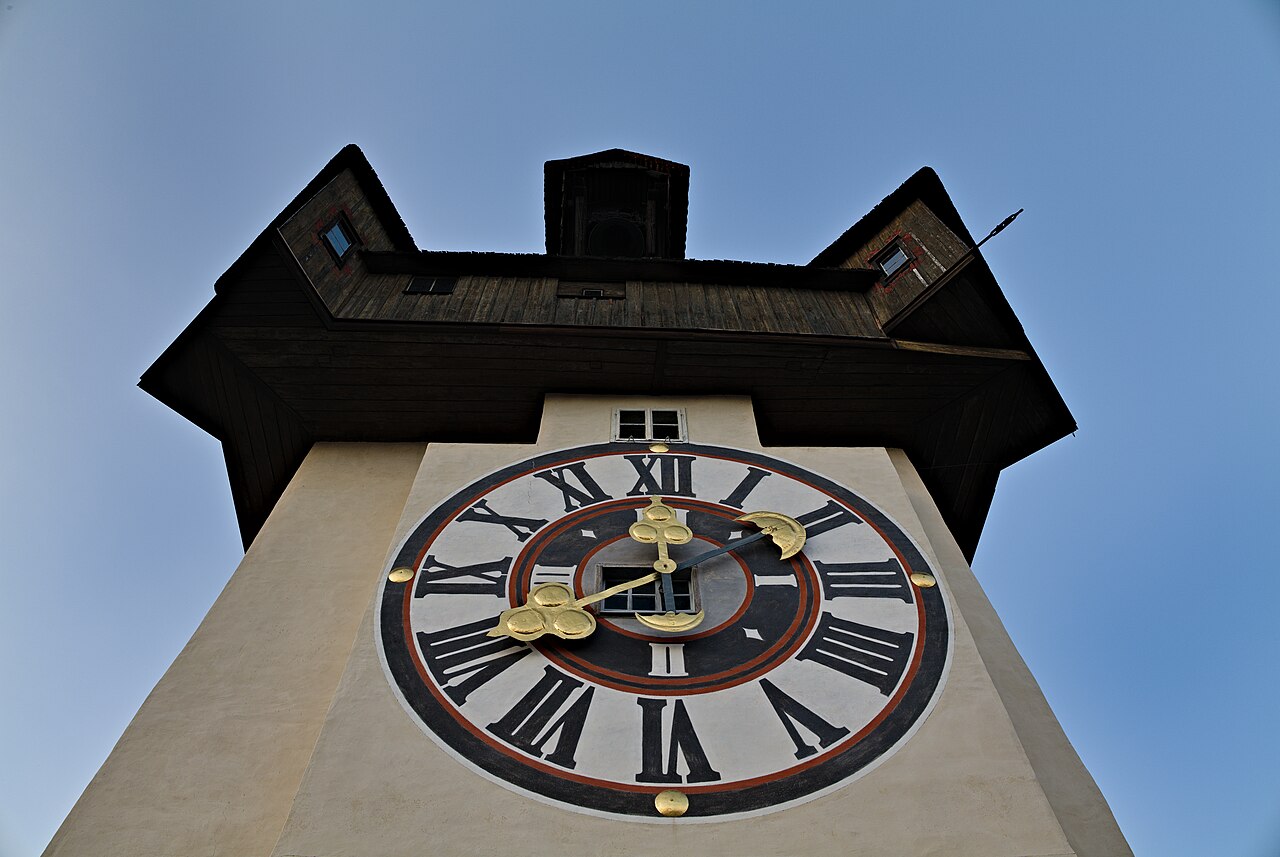
Graz is easiest to misread when the Schlossberg becomes only a viewpoint. The better version is a short evening ritual: start low in the old town, choose your ascent deliberately, stop at the Uhrturm before chasing the upper terraces, and let the clock tower turn the hill from scenery into city logic.
The hill is compact enough to reward restraint. Official regional tourism describes the Schlossberg as rising about 123 meters above the Hauptplatz, directly over the old town, with the Uhrturm as the landmark and three main approaches: on foot, by Schlossbergbahn funicular, or by Schlossberg lift [2]. That range of access is the whole trick. Graz gives you a climb, a rail line, and a vertical shaft, but the best visit does not use all three just because they exist.
Use the evening shoulder, roughly 90 minutes before sunset, as the default. If the steps are dry and your knees are fine, climb from the Schlossbergplatz side or through the old-town lanes toward the clock. Graz.net's local guide frames the walk up Schlossbergweg as a 15- to 20-minute approach to the Uhrturm, with the hill sitting right above the old center [3]. That is short enough to feel like a city habit rather than a hike, but long enough to make the first view earned.
The lift is not a failure; it is a different reading. Graz Tourism says the Schlossberg lift enters from Schlossbergplatz, runs daily 8:00 to 00:30, reaches the top in about one minute, and costs EUR 2.50 for adults, while normal Graz public-transport tickets are not valid on it [1]. Use it if rain, heat, luggage, or mobility makes the stairs annoying. The key is to treat the lift as a clean vertical reset, not as a way to skip the hill mentally.
The funicular has another job. The Schlossbergbahn runs every 15 minutes, climbs at up to a 60 percent gradient, accepts Graz Linien zone 1 tickets, and generally operates 9:00 to midnight Sunday to Thursday and 9:00 to 2:00 on Friday and Saturday, with winter mornings starting later [1]. That makes it the better choice when you want the ascent itself to become the view: glass roof, old-town roofs dropping away, and a slower arrival than the lift. Pick either lift or funicular on the way up, then walk the Uhrturm terrace before deciding how to go down.
Do not make the upper hill your first target. The Uhrturm is the hinge because it is both object and orientation tool. Graz.net gives the useful hard facts: the tower is 28 meters high, survived the Napoleonic demolition of the fortress because Graz residents bought it free, and carries the famous reversed visual logic of its hands: the larger hour hand came first, so the later minute hand had to be smaller [3]. That detail matters on site. It tells you to slow down and look at the clock as a working oddity, not just as the thing on postcards.
Stand below the Uhrturm first, facing back toward the old roofs. Keep the parapet clear if people are taking quick photos, then slide to the side wall or a bench for the longer look. The red-tile old town, the Mur corridor, Kunsthaus, church towers, and the softer hills beyond become legible only if you stop moving for a few minutes. This is the local texture of Graz: a city that feels ceremonial from above but still small enough that the route you just walked remains visible.
The first visitor mistake is riding straight to the top, taking the clock photo, then leaving. The better alternative is a two-stop rhythm: Uhrturm first, upper terrace second. A recent r/graz local-experience thread recommends picnicking on Schlossberg as an ordinary Graz move, grouped with city habits rather than bucket-list tourism [4]. Another r/graz viewpoint thread points people beyond the clock toward the Kasematten side for another angle over the city [5]. You do not need a full picnic or a whole evening up there, but you should give the hill one second pause after the landmark.
The second mistake is climbing at the hottest or busiest part of the day and blaming the city for feeling flat. Midday turns the stone, stairs, and exposed terraces into glare. Evening gives you shadow, restaurant spillover, students and after-work walkers, and enough light to keep the descent simple. In summer, start around 18:30-19:30 if you want a relaxed upper pause; in winter, move the whole sequence earlier and check the funicular's later morning start if you are planning a sunrise variant [1].
The third mistake is mixing up the machines. The lift is fast, direct, separately ticketed, and best for a practical up-or-down move. The funicular is public-transport-compatible, runs on a visible rail line, and is better when the ride is part of the point [1]. The 170-meter indoor slide that Graz Tourism mentions is a novelty descent with a height requirement, not the calmest way to finish a first city-reading route [1]. If you want the hill to stay coherent, descend by stairs, lift, or funicular and leave the slide for a separate mood.
Eight local moves keep the route clean. Start from Hauptplatz or Schlossbergplatz rather than appearing by taxi at the top. Choose one ascent method before you arrive. Put the Uhrturm before the Kasematten. Stand aside after the first photo. Sit where the wall widens instead of blocking the stair pinch points. Carry a light layer because the hilltop wind can feel different from the lanes below. Descend while the old town is still easy to navigate. If you are meeting someone afterward, choose a low-town landmark, not "somewhere on Schlossberg," because the paths split more than the map suggests [1][2][4][5].
The spend can be almost zero. Walking is free. The lift is EUR 2.50 for adults. The funicular can fit inside a valid zone 1 ticket. There is no reservation reality for the core route, only queue reality: on warm weekends and event nights, the machines and the Uhrturm terrace can bunch up, so add 10 to 15 minutes of slack if you are timing dinner or a train [1]. If the hill is crowded, do less, not more: clock, wall, second terrace, down.
That is why the Uhrturm should be the stop, not just the symbol. It gives Graz a readable sequence: compact old town, quick rise, strange clock, second view, controlled descent. The city does not need a grand panorama chase. It needs one measured climb that lets the hill explain why Graz feels both fortified and easygoing at the same time.
Sources
- Graz Tourism, "Schlossberg lift and Schlossbergbahn funicular" - official mobility page for lift and funicular routes, operating hours, frequency, ticket validity, lift fare, and slide note.
- Erlebnisregion Graz, "Grazer Schlossberg" - official regional tourism page on the Schlossberg's position, height above Hauptplatz, access options, Uhrturm role, and fortress history.
- Graz.net, "Uhrturm Graz" - local Graz guide covering the tower's 28-meter height, history, clock-hand oddity, and 15- to 20-minute walking approach.
- Reddit r/graz, "Living in Graz for 3 weeks and looking for local experiences?" - recent local/community thread mentioning Schlossberg picnicking and ordinary city habits around Graz.
- Reddit r/graz, "Von wo hat man die besten Aussichten uber die Stadt?" - local/community viewpoint discussion noting Schlossberg and the Kasematten-side outlook as useful city views.
- Wikimedia Commons, "File:Uhrenturm Schlossberg Graz 2022-08-03 01.jpg" - real photograph by Leonhard Lenz, taken August 3, 2022, used as the article image.