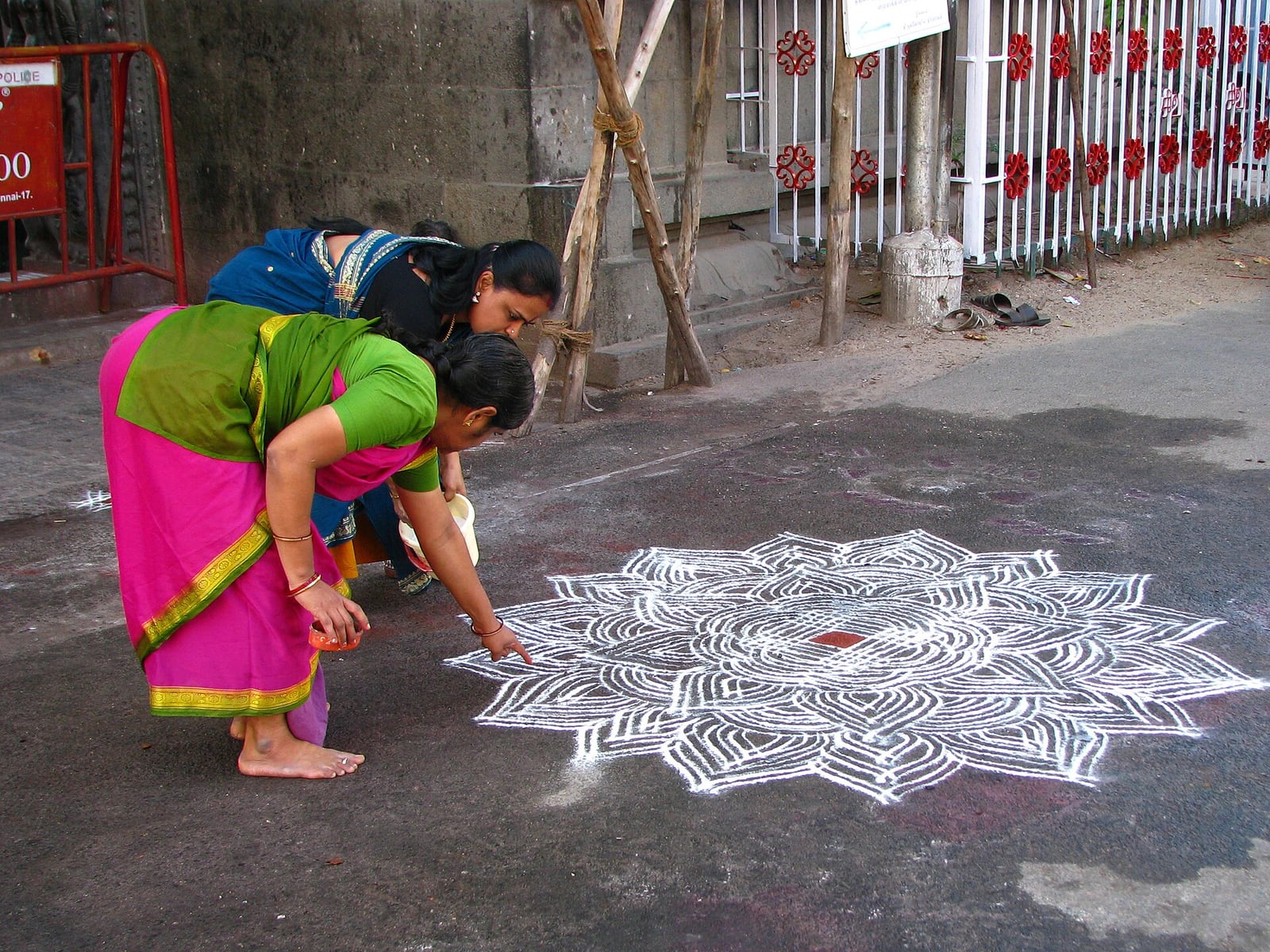
At 05:45, Mylapore is not empty. It is unfinished.
A threshold has been swept and dampened. White powder falls through practiced fingers: first dots, then a line that bends around them without losing its partner. A devotional song may be approaching along the next street. Somewhere beyond the temple tank, a shutter rises. The drawing will not be protected when the day begins. Feet, tyres, dust and weather will edit it.
That impermanence is the point of this visit. During Margazhi, the Tamil month that usually falls across December and January, kolams become especially visible in Chennai's morning life. Recent local reporting describes households starting before daybreak by sweeping and sprinkling their thresholds, then building patterns from grids, curves, dots, lines and loops [2]. In Mylapore, the practice shares the hour with temple-going, walkers and small groups making devotional rounds of the Mada Streets [3][4]. It is lived frontage, not an outdoor design museum.
Make this one 60–75-minute dawn circuit around the streets immediately adjoining Kapaleeshwarar Temple. Start from the official North Mada Street address, make one slow loop, and stop looking before the neighborhood's working day turns the same space into traffic. The route is free, requires no reservation and promises no particular drawing. A household may make a small kolam, a large one or none at all. Rain may erase the morning before you arrive. Good city reading begins by accepting that you are not owed a display.
Arrive on the household clock, not the festival clock
The first local move is to verify the season rather than assuming that “December” is precise enough. Margazhi follows the Tamil calendar, so check that year's dates close to travel. For the clearest balance, choose a weekday after the month has begun and before its final Bhogi/Pongal turn. In January 2026, Mylapore Times recorded four weeks of low-key devotional rounds ending on Bhogi morning; some larger groups appeared only on weekends or Sundays [3]. A weekday cannot guarantee more kolams, but it reduces the chance that a special program becomes the whole street.
The second move is to save Arulmigu Kapaleeshwarar Temple, 12/1 North Mada Street as the drop-off—not merely “Mylapore.” The Tamil Nadu government's temple page lists a morning opening from 05:30 to 12:30 [5]. That gives the district a dependable recognition cue at dawn even though this walk does not require entering the temple. Ask to be set down on North Mada Street, find the active temple edge, and keep your first few minutes on the broad, lit public route.
Arrange that ride before sleeping. A recent r/Chennai discussion recommending Mylapore's early-morning temple culture also contains practical warnings about ride cancellations, cash preferences and rough stroller conditions [7]. Confirm the pickup, fare method and exact pin with your hotel or driver the night before; carry small cash as a backup, not as permission to renegotiate a price at the curb. If step-free access matters, do not infer it from a map. Ask locally about the current surface and drop-off before committing to the loop.
The useful arrival window is 05:40–05:55. It is late enough for the temple-facing streets to have activity and early enough to watch the neighborhood assemble. In one local portrait of Margazhi, morning walkers were already circling the temple tank at 06:00 while kolams appeared on damp thresholds [4]. Treat that as atmosphere observed in one season, not a daily timetable.
Scout once before raising the camera
The third move is a camera-down first pass of 20–25 minutes. Keep Kapaleeshwarar Temple as the anchor and stay on the four Mada Streets or their immediate, active edges. Do not turn “finding authentic kolams” into a hunt through quiet residential lanes. The public loop is enough: it lets differences in scale, material and state emerge without making a private doorway your destination.
Read the ground before looking at façades. A fresh kolam often announces itself through the preparation around it: a darker damp patch, a clean threshold, a grid whose outer loops are still incomplete. The 2025 Chennai practitioners interviewed by The New Indian Express described symmetry beginning with correctly placed dots; once that grid shifts, the whole design shifts [2]. That gives you something better to watch for than size. A compact sikku or looped kolam can contain more control than a broad field of color.
The fourth move is to give every fresh drawing its full width. Walk around it even if other feet have already crossed an edge. Never test whether the powder is dry, repair a broken line, add a dot or place a bag on an undecorated center. A kolam sits at the meeting point of a home and a street. Its public visibility does not transfer authorship to the passerby.
If someone is still drawing, stop outside the working arc. The photograph above is useful because it shows the mechanics: one hand can release two parallel lines while the body turns around an expanding pattern [1]. Watch the wrist, pace and spacing without leaning over the shoulder. The fifth move is to ask before photographing the maker or the doorway, then take one frame without flash or direction. A finished design on public pavement is not the same consent as a close portrait of the person who made it.
Let sound keep its right of way
Margazhi does not isolate visual art from the rest of Mylapore. In the neighborhood's own seasonal record, the last 2026 dawn carried four devotional groups of roughly four to seven people around the Mada Streets; the report distinguishes those regular, low-profile rounds from larger weekend groups [3]. Another local account places walkers, concert listeners and threshold kolams in the same 06:00 soundscape [4]. The specific combination changes each morning, but the coexistence is characteristic.
The sixth move is to hear an approaching group before deciding where to stand. Move to the edge, lower your conversation and let the group pass without walking backward in front of it for video. Do not use a phone speaker to identify a song. Do not join a devotional round merely to obtain access or a better angle. If invited into conversation, follow the other person's pace; otherwise, observation is enough.
This is also where Mylapore's city-specific texture becomes visible. The four Mada Streets are not a decorative heritage route pasted onto Chennai. They wrap a working temple precinct whose tank steps, in a local heritage account, have been worn smooth by generations of feet [4]. The annual Mylapore Festival describes the neighborhood as older than the seventeenth-century city that grew around it [6]. At dawn, that long history is not presented as a monument. It arrives through repeated small uses: walking the tank, opening a shop, drawing at a threshold, carrying a song around the block.
Make one 5-minute pause near the temple tank only where standing does not narrow the path. Then continue. The tank is context, not a second attraction to complete.
Do not confuse the contest with the practice
The seventh move is to separate two legitimate but different scenes. The everyday Margazhi threshold is made on a household clock. The Sundaram Finance Mylapore Festival kolam contest is a scheduled public event. In 2026, the official program placed kolam and rangoli contests on the east side of North Mada Street on two January afternoons, with limited entrants and venue registration [6]. That is a public street gallery with organizers, boundaries and spectators. It is not evidence that the same block will become a contest at dawn—or on the same dates next year.
If your trip overlaps the next festival, check the organizer's current program instead of repeating the 2026 calendar. Decide which experience you want. For the contest, arrive on its published clock and use its spectator edges. For the quieter seasonal moment described here, choose a separate weekday dawn. Trying to combine both produces the classic visitor error: arriving at 06:00 for an afternoon event, or arriving at 15:30 expecting to watch a private morning ritual begin.
The distinction also improves how you look. Contest entries are meant to be compared in a concentrated field. Household kolams are distributed, variable and already entangled with doors, scooters, drains and errands. The latter should not be ranked. Recent Chennai reporting stresses that the form changes across makers and generations, while the daily threshold remains one of its roots [2]. Notice difference without turning every doorstep into a scorecard.
Leave before observation becomes pursuit
On the second half of the loop, the eighth move is to choose only three stops: one small dot-grid pattern, one work in progress if an invitation to watch is clear, and one threshold whose surrounding street explains how the design lives. Give each no more than a few minutes. That constraint prevents the camera from pulling you farther into residential space or making one household absorb a crowd of one.
Aim to finish by 07:00–07:15. That is editorial timing, not an official closing hour. It keeps the visit inside the dawn interval described by local sources while leaving the streets to commerce, school runs and ordinary traffic [3][4]. The ₹0–₹200 on-site budget is equally simple: the street circuit costs nothing; the upper end is only a planning allowance for water or tea. There is no ticket, guide, purchase or temple entry required for the anchor.
Carry water, a compact umbrella, quiet footwear and little else. Chennai's idea of winter is relative: the final Margazhi dawn reported in January 2026 was 24°C, while another local seasonal account uses 25°C to describe a gentle December day [3][4]. Humidity and rain can still matter. A tripod, large bag or elaborate photo kit is more likely to block a threshold than improve the visit.
Four mistakes that flatten the morning
Mistake one: arriving after breakfast for “better light.” By then, traffic and feet may have softened the lines, and the act of drawing is likely over. Better: reach North Mada Street at 05:40–05:55, make a camera-down scout, and leave by about 07:15 [3][4][5].
Mistake two: treating the festival contest as a daily schedule. The 2026 contest occupied a defined part of North Mada Street on two announced afternoons [6]. Better: verify the new program; choose either its public event or a separate Margazhi dawn rather than blending their clocks.
Mistake three: stepping close because the work is on the pavement. Recent reporting describes the kolam as an extension of household decoration and a practice rooted at the threshold [2]. Better: preserve the full drawing, ask before photographing a person or home, and let the maker control the working space.
Mistake four: searching deeper until the street performs. Local residents recommend early Mylapore because temple and street culture are already present; they do not promise a spectacular design at every door [7]. Better: hold the temple-edge loop, accept small or absent kolams, and let one real threshold be enough.
The go details
- Anchor: the immediate Mada Streets around Kapaleeshwarar Temple, with North Mada Street as the start. The temple tank supplies orientation, not a second itinerary.
- Season: Margazhi, usually across December and January. Verify the current Tamil-calendar dates and any festival program close to travel [4][6].
- Best window: a weekday 05:40–07:15, beginning after the temple's published 05:30 opening [5]. No quantity or size of kolam is guaranteed.
- Time needed: 60–75 minutes: a 20–25-minute camera-down scout, one short tank-edge pause, then three selective stops.
- Expected spend: ₹0–₹200 on site. The walk is free and unreserved; transport is separate and should be agreed before the dawn pickup.
- Queue and reservation reality: none for the street circuit. A festival contest has its own dated program and boundaries; the 2026 details are precedent, not the next edition's schedule [6].
- Navigation cue: 12/1 North Mada Street, the government-listed Kapaleeshwarar Temple address [5]. Ask for the North Mada Street side rather than a generic Mylapore pin.
- Where to stand: outside the maker's arm span and off the center of any moving group. Pause only where a threshold, shop opening or walking line remains clear.
- Etiquette: step around fresh powder, never alter a line, ask before photographing people or homes, lower your voice for devotional groups, and do not turn residential side lanes into a search grid.
- Carry: water, compact umbrella, quiet shoes, a small cash backup for transport and a phone with the return pickup saved. Leave the tripod behind.
Mylapore's Margazhi morning is easy to spoil by wanting it to become larger: a longer route, a brighter contest, a closer portrait, a perfect calendar of guaranteed scenes. The better visit stays small. Begin from one official address. Walk one old urban ring. Learn what the dots are doing. Leave a threshold exactly as you found it.
By the time the street is fully awake, the kolam has already started to disappear. Seeing that change—without accelerating it—is the whole seasonal moment.
Sources
- McKay Savage, “Women drawing an intricate kolam outside the Mylapore Temple” (February 17, 2008), Wikimedia Commons — documentary photograph, location, authorship and image record.
- The New Indian Express, “Kolam: Art rooted in ritual” (December 20, 2025) — recent Chennai reporting on pre-dawn threshold preparation, Margazhi practice, dot-grid geometry and contemporary makers.
- Mylapore Times, “On Mada Streets, margazhi bhajans season ends on a dawn of mist and smoke” (January 14, 2026) — neighborhood reporting on four weeks of devotional rounds, group scale, weekend variation and the final dawn's conditions.
- Nikitha Madhavan, “When Winter Whispers in Madras.” Madras Inherited, December 11, 2024 — local heritage account of Mylapore at 06:00, tank walkers, damp thresholds, kolams and the December–January Margazhi setting.
- Hindu Religious and Charitable Endowments Department, Government of Tamil Nadu, “Arulmigu Kapaleeshwarar Temple — Contact Us” — official North Mada Street address and current opening hours.
- Sundaram Finance Mylapore Festival, “Mylapore Festival 2026” — primary organizer record for the annual early-January festival, its neighborhood setting and the scheduled North Mada Street kolam contest.
- r/Chennai, “American family of 3 visiting Chennai” (December 2025) — recent community discussion recommending Mylapore's early-morning Margazhi culture and flagging cash, ride and stroller frictions.