Geneva is full of respectable lake walks that somehow miss the city. The easy visitor move is to circle the harbor on foot, photograph the Jet d'Eau, and keep treating the water as scenery. The more Genevan move is shorter and more useful: take Mouette M2 across the rade, get off at Pâquis, and let the Bains des Pâquis pier absorb the rest of the hour.[1][2][3] One anchor is a tiny yellow public-transport crossing. The other is a public bath complex that still behaves like ordinary city infrastructure instead of a curated waterfront attraction.
That sequence matters because the Bains are not an add-on to the promenade. Geneva Tourism still describes Les Pâquis as a working-class, down-to-earth, multi-ethnic district stretching from Cornavin to the lake, and it names the Bains des Pâquis as one of the neighborhood's quintessential local institutions, with sauna, beach, diving platform, and a bar on the water.[8] The place also carries a deeper local charge than many visitors realize. The baths have existed since 1872, were rebuilt in 1931-1932, and were later saved from demolition after Genevans mobilized and voted in 1988 to keep the spirit of the place intact.[6] That history explains why the Bains still feel habitual rather than ceremonial. People use them because they belong to the city, not because they were staged for a lakefront selfie.
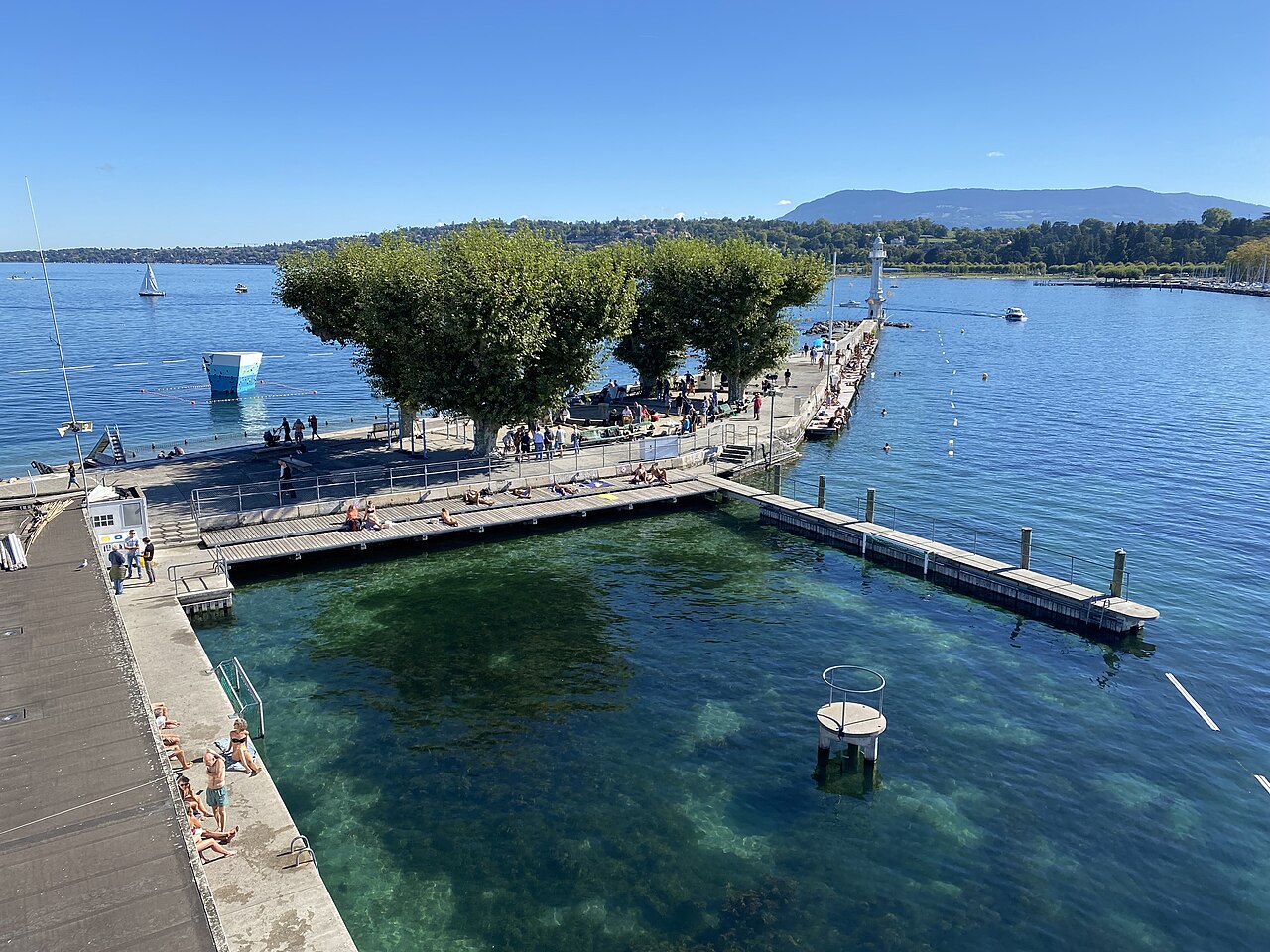
Image context: the cover uses a real Wikimedia Commons photograph of the Bains des Pâquis jetty. It is the right image for this piece because the route depends on a documentary view of the pier itself: pool in the foreground, jetty and lighthouse ahead, lake beyond, no fantasy skyline treatment.[11]
Why the boat-to-pier sequence works better than the bridge loop
The first reason is compression. The Mouettes Genevoises are not cruise boats in miniature. They are part of Geneva's public-transport fabric, and the official fare page keeps the logic simple: a short hop crossing costs CHF 2.00 for adults, while a 60-minute ticket costs CHF 3.00.[1] TPG's Geneva-only ticket page adds the crucial distinction: the short-hop ticket is valid for a one-way trip of 3 stops or one Mouette crossing, while the 60-minute ticket makes more sense if you plan to keep layering tram or bus travel onto the outing.[2] This is why the route is so effective. You are not buying a sightseeing product. You are making one precise city move.
The second reason is that the crossing keeps the harbor legible. TPG's Jet d'Eau access page says the shuttle boats cross the lake in just a few minutes and lists the active landing points as Molard, Eaux-Vives, Pâquis, Perle du Lac, and Genève Plage.[3] For this article's ritual-lens version, M2 from Eaux-Vives to Pâquis is the cleanest cut. It is long enough to reset your sense of shorelines and short enough that you do not start treating the ride as the main event.
The third reason is that the boat and the pier belong to the same city grammar. The Mouettes company describes the service as operating 365 days a year, connecting the lake edges as a normal part of Geneva life rather than as a seasonal curiosity.[1] The Bains' practical-information page then takes over the handoff exactly where you need it: the baths sit at Quai du Mont-Blanc 30, the Pâquis Mouette stop is one of the recommended access points, bus lines 1 and 25 stop at Mont-Blanc, and Cornavin is only a 10-minute walk away.[5] The result is unusually elegant. One small crossing gives you one direct pier.
Anchor 1: ride M2 like transport, not like a harbor attraction
The most useful attitude on the Mouette is restraint. Board with your ticket already sorted, keep your phone away for a minute, and do not treat the boat like a floating balcony that requires performance. The official useful-information page is plain about etiquette and constraints: smoking is not permitted on board, eating and drinking are forbidden, and on M1 and M2 pushchairs need to be folded before boarding.[4] These are not glamorous details, but they are exactly the sort of micro-rules that separate public transport from decorative water transport.
That public-transport feeling is the whole point. If you start from the left bank and board at Eaux-Vives, the crossing is less about panorama than about changing your relationship to the harbor. The old-town and Jet d'Eau side stays behind you, the right bank begins to gather, and Pâquis stops feeling like an extra detour after the postcard core.[3][5] You arrive already inside the district's rhythm.
The local/community signal supports that choice. In a February 2026 r/geneva thread about what counts as a genuine local must in one day, multiple residents steer visitors toward the Bains des Pâquis specifically because it feels authentic, retro, and tied to everyday Geneva rather than to formal sightseeing.[9] That is useful evidence not because Reddit is an authority on infrastructure, but because it shows how the place is still mentally filed by locals: as something to actually do, not merely to photograph from afar.
Anchor 2: let the Bains explain Geneva's lake culture
Once you land, the mistake is to flatten the baths into either a summer swimming spot or a fondue address. The better reading is civic and spatial. The Bains page says the promenade approach is one of the most pleasant ways to reach the site, with the baths sitting opposite the Jet d'Eau and directly on the lake edge.[5] The association's history page explains why the place feels so balanced in person: the rebuilt complex covers 6,500 m2, rests on 448 piles, and was designed to sit lightly in the harbor rather than dominate it.[6] That combination of modesty and publicness is the atmosphere you are here for.
This is also why the baths feel more durable than trendier waterfront redevelopments. The same history page records the 1980s fight against demolition and the 1988 referendum victory, which means the current pier is not just old concrete that happened to survive. It is a piece of urban space that residents deliberately kept.[6] Geneva can often read as polished, diplomatic, and slightly abstract. The Bains cut through that. You get swimmers, sauna-goers, people reading, people meeting after work, and people simply standing on the jetty long enough to let the lake do the talking.
Weather and season still matter. The beach page says the bathing side opens from fine weather to the end of September, weather permitting, and it gives the useful thresholds: adult admission is CHF 2.00, reduced admission CHF 1.00, and the diving boards and zip line run from 2 p.m. to 6 p.m. during the active season.[7] That should not turn the route into a summer-only piece. It just tells you how to read the place correctly. In colder or uncertain weather, the pier and jetty remain the anchor. In warm weather, the bathing side becomes an optional intensifier rather than the whole reason to come.
Google Maps is worth checking on the day for live crowd texture, same-day access, and whether the baths are behaving like a quiet shoulder-hour or a full social deck.[10] But the route only works if you resist map sprawl. The point is not to add Genève-Plage, a long Pâquis food circuit, or a full lakeside march. The point is one crossing and one pier.
8 local moves that make this Geneva hour land
- Buy the right ticket for the scale of the outing. Use the CHF 2.00 short hop if you only want the boat crossing; upgrade to the CHF 3.00 60-minute ticket if tram or bus will be part of the same hour.[1][2]
- Start at Eaux-Vives if you can. M2 from the left bank gives the cleanest harbor reset before you land at Pâquis.[3]
- Treat the Mouette as transit. No food, no drink, no smoking, and on M1/M2 strollers need to be folded before boarding.[4]
- Walk straight to the pier after landing. Do not let the right-bank street grid blur the route before the lakefront has done its work.[5]
- Give the jetty a real pause. The baths are strongest when you stay still long enough to feel the city shift from harbor image to public habit.
- Use the bathing program only if weather is clearly on your side. In the fine-weather season the beach layer is cheap and real, but the pier is still the main anchor.[7]
- Remember the Cornavin fallback. If the boat line is crowded or you are already near the station, the baths are only a 10-minute walk from Gare Cornavin.[5]
- Check live place status before you leave. Bains des Pâquis is consistent as a city institution, but weather and crowd density still change the texture of the stop.[10]
Non-local trapline: 4 common mistakes and the better alternative
Mistake 1: walking the Mont-Blanc loop by default
Better alternative: take one Mouette crossing instead. The harbor becomes clearer when you cut across it instead of tracing its whole edge.[2][3]
Mistake 2: treating the Bains only as a meal stop
Better alternative: read the pier first. The food can stay secondary; the local payload is the public jetty, the lake access, and the preserved ordinaryness of the site.[6][8][9]
Mistake 3: arriving with full summer-beach expectations in uncertain weather
Better alternative: let the pier carry the route unless fine-weather bathing conditions are obvious on the day.[5][7][10]
Mistake 4: overcomplicating the transport layer
Better alternative: one crossing, one landing, one pier. Geneva is at its best here when the logistics shrink instead of expand.[1][2][5]
Concrete go details
- Best time window: late afternoon into blue hour, when the crossing still has enough light and the pier can hold a slower second act.
- Expected spend: CHF 2.00-5.00 for the core route, depending on whether you use a short-hop crossing only, a 60-minute ticket, or a warm-weather beach entry.[1][2][7]
- Queue and reservation reality: no reservation for the crossing or the pier; the live variables are weather, after-work crowding, and summer density.[3][5][10]
- What to do:
Eaux-Vives -> Mouette M2 -> Pâquis stop -> Bains des Pâquis pier. - Navigation cue: if the boat is not worth waiting for, remember the station fallback: Cornavin to the baths is about 10 minutes on foot.[5]
- Numeric anchors worth keeping: CHF 2.00, CHF 3.00, 10 minutes, 365 days, 1872, 1931-1932, 6,500 m2, 448 piles, 2 p.m.-6 p.m..[1][5][6][7]
Geneva often gets flattened into diplomacy, luxury retail, and a fountain. This short ritual refuses that version. One public crossing, one working pier, and one place the city fought to keep ordinary: that is enough for the lakefront to stop posing and start behaving like Geneva.
Sources
- Mouettes Genevoises, "Fares" (official fare page used for the CHF 2.00 short-hop crossing, CHF 3.00 60-minute ticket, and Unireso integration details).
- TPG, "Occasional Travelers" (official Geneva Zone 10 ticket rules used for the short-hop / 60-minute distinction and the weekend two-person day-pass note).
- TPG, "Going to the Jet d'eau Geneva" (official shuttle-boat overview used for the active landing points and the short-crossing logic around the harbor).
- Mouettes Genevoises, "Useful information" (official onboard rules used for no food/drink, no smoking, and folded-pushchair guidance on M1/M2).
- Bains des Pâquis, "Practical information" (official access page, updated 2 December 2025, used for the Quai du Mont-Blanc address, Pâquis landing, bus lines 1 and 25, and the 10-minute Cornavin walk).
- Bains des Pâquis, "History" (official association history used for the 1872 origin, 1931-1932 rebuild, 6,500 m2 size, 448 piles, and the 1988 referendum context).
- Bains des Pâquis, "Beach" (official seasonal-use page, updated 9 October 2024, used for fine-weather opening, CHF 2.00 summer admission, and 2 p.m.-6 p.m. diving-board hours).
- Geneva Tourism, "6 must-see Geneva districts" (official local-guide page used for the Les Pâquis neighborhood framing and the Bains as a quintessential Geneva institution).
- Reddit r/geneva, "1 day in Geneva, what's a local 'must' experience" (February 16, 2026 local community thread used as a recent signal that residents still frame Bains des Pâquis as a real local experience, not just a visitor stop).
- Google Maps search, "Bains des Paquis Geneva" (current place-status and community-review surface, accessed April 23, 2026).
- Wikimedia Commons file page for the documentary photograph used as the cover image, "Bains des Pâquis - JeP 2022 - Jetée.jpg".
Editor’s Pick Review
This piece takes the standard editor-pick slot because it is the strongest 24-hour candidate on topic fit, reader utility, and the updated image policy. The route stays unusually tight: one Mouette crossing, one civic pier, and a complete set of local moves that translate Geneva from postcard lakefront into usable public life. The sourcing mix is also stronger than a normal travel note, combining official transit and venue details with local/community confirmation and enough numeric anchors to make the ritual executable.
It passes the stricter visual gate cleanly. The cover is immersive, documentary, and topic-grounded: the actual Bains des Pâquis pier with recognisable spatial cues, not a diagram, skyline abstraction, or generic travel moodboard. The Chinese translation keeps the route mechanics, local texture, and practical constraints aligned with the English source, which makes the pick work across both language surfaces.