Doha's waterfront punishes the completist. The Corniche is a 7 km crescent, and treating it as one heroic walk turns the city into heat, traffic crossings, and unfinished distance.[2] The better night-room version is much smaller: arrive at MIA Park when the day loosens, use the park and museum edge for the first half hour, then hold one short Corniche rail with West Bay across the water. The route should feel like a room with a view, not a fitness assignment.[1][2]
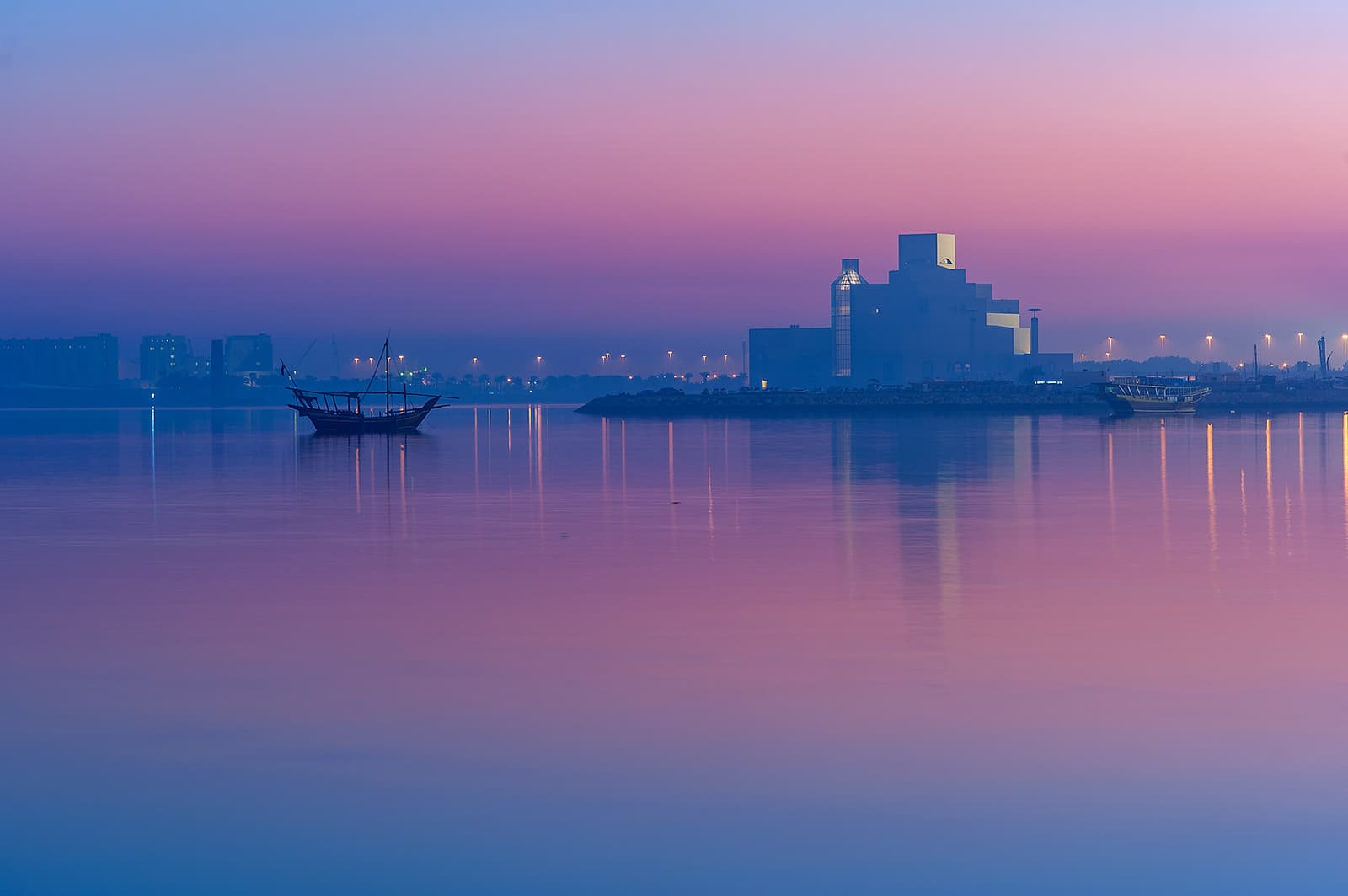
The cover image is a real Wikimedia Commons photograph of the Museum of Islamic Art and the Gulf at dusk, not a generated skyline or travel-poster composite. It gives the right recognition cue: low water, the museum island, and a skyline that appears across distance rather than swallowing the whole frame.[8]
This is a non-food route by design. MIA Park has cafe options and picnic baskets, and dhow rides sit along the Corniche, but those are optional side channels.[1][2] The useful payload is spatial: how Doha's old harbor edge, museum island, public park, dhows, and West Bay towers become readable in the hour after glare drops.
Anchor 1: start in MIA Park, not on the open crescent
MIA Park is the softer opening because it already has a built-in pause. Qatar Museums describes it as open 24 hours a day, with picnic space, a cafe terrace, playgrounds, bicycle rentals near the carousel, frequent events, and Richard Serra's 7 a short walk along the promenade from the museum.[1] That mix matters. The park is not just a foreground for a museum photograph. It is a public edge where families, runners, visitors, and event crowds can use the same shoreline at different speeds.
The practical window is 45-70 minutes before your planned exit, not "whenever evening begins." In winter or shoulder weather, arrive around sunset and leave while the water still has definition. In hot months, push later and make the first 10 minutes a test: if the paving still radiates heat, sit under shade before walking. A recent r/qatar thread about running at MIA Park after Maghrib is useful because it catches the live condition that official pages cannot fully encode: people do try to use the park after dark, but Ramadan or event operations can change access on a specific evening.[4] Official 24-hour language is the baseline; current signs, guards, and Google Maps place status still matter when you arrive.[1][6]
The first local move is to keep the museum as a wall, not a ticket obligation. The museum's galleries deserve their own visit. In this route, the exterior does the job: the Pei geometry, the paved forecourt, the waterline, and the long view back toward West Bay. If the galleries are open and you want to go in, separate that from the night room. Mixing a museum visit with this short waterfront sequence turns a clean hour into a queue-and-cloakroom compromise.
The second local move is to use the park edge before choosing the Corniche. Walk only far enough to find a bench, rail, or open patch where the skyline sits cleanly across the bay. Doha rewards this kind of restraint. The city's waterfront is built for national celebrations, evening dhows, running, family strolling, and commute-adjacent crossing all at once.[2] If you start by trying to consume the whole crescent, those uses blur. If you start in MIA Park, each layer gets a place.
Anchor 2: hold one Corniche segment for West Bay lights
Visit Qatar calls the Corniche a 7 km stretch around Doha Bay and points visitors to nearby metro stations including Westbay QIC, Corniche, and Al Bidda.[2] That is helpful, but it can also mislead. A 7 km waterfront sounds like a linear achievement. For this piece, the stronger move is a short segment: pick the rail between the museum-side waterline and the skyline-facing bend, then stop.
The reason is distance quality. West Bay looks best when there is water between you and the towers. The lit dhows are part of that evening grammar; Visit Qatar specifically notes the dhows lighting up in the evenings around the Corniche.[2] The point is not to book the boat by reflex. The point is to let the boats, the pearl-and-harbor memory, and the high-rise glass sit in the same field of view for 15-25 minutes.
Local community signals point to the same operational reality. A 2025 r/qatar running thread asks where people park when running on the Corniche, which is a small but telling ground-level clue: residents use the waterfront as exercise infrastructure, and access choices shape the experience before the view starts.[5] Google Maps entries for both MIA Park and the Corniche are worth checking the same day for parking, access, and crowd surface, especially on weekends and during events.[6][7]
If you use the metro, make it simple. Visit Qatar's metro guide says trains arrive about every 6 minutes, the system covers more than 76 km, and standard travel is capped at QAR 6 for all-day exploration.[3] Service hours vary by day, with a later Friday start because of Friday prayers.[3] For this route, the metro is best as an entry or exit device, not as a second project. If you are already near Souq Waqif or Msheireb, walking or a short ride can work. If you are staying in West Bay, entering from a Corniche-side station and ending with a taxi can be cleaner than forcing a full backtrack.
8 local moves that make the night work
First, keep the route to 60-90 minutes. MIA Park plus one skyline rail is enough. The full Corniche is a different outing.[2]
Second, start with shade and wind before distance. The first 10 minutes should tell you whether the paving and humidity are still doing the talking.
Third, check current MIA Park access even though the official page says 24 hours. Ramadan, events, and temporary closures can alter the evening, and local runners are already watching those shifts in real time.[1][4]
Fourth, use the museum exterior as the anchor. A gallery visit belongs before or after the route, not inside the same short hour.
Fifth, stand still for the skyline. Give West Bay 15-25 minutes from one rail rather than walking past the best angle while checking a map.[2]
Sixth, let dhows be atmosphere before purchase. If a boat ride fits, take one; if not, the lit boats still do useful visual work from shore.[2]
Seventh, budget low. The core route costs QAR 0 on foot, or up to QAR 6 if you fold it into a standard metro day. Add cafe, taxi, or dhow money only when those are deliberate choices.[1][2][3]
Eighth, use Google Maps as a live surface, not as the author of the walk. It helps with current access and crowding, but the route has only two anchors: MIA Park and one Corniche rail.[6][7]
Non-local trapline: 4 common misses and the better alternative
Mistake 1: trying to complete the 7 km Corniche
Better alternative: treat the Corniche as a bay room, not a line to finish. A short skyline-facing segment gives more Doha texture than a tired march past the best light.[2]
Mistake 2: folding the museum galleries into the same hour
Better alternative: let the Museum of Islamic Art exterior organize the walk, then give the galleries a separate visit. The night-room sequence depends on staying outside long enough for water, stone, and lights to settle.[1][8]
Mistake 3: assuming official 24-hour park language means every evening feels identical
Better alternative: check same-day access, event setup, Ramadan timing, and local signals before committing. The r/qatar runner thread is a reminder that lived park access can change at the edge.[1][4][6]
Mistake 4: treating the metro as a puzzle to optimize
Better alternative: choose one simple entry or exit. The metro is frequent and affordable, but the waterfront walk improves when transport disappears into the background.[3]
Go details
- Best time window: sunset through the first 60-90 minutes after dark; in hot months, shift later and test heat before committing.
- Expected spend: QAR 0-6 for the core public-space route if using foot or standard metro; more only for cafe, taxi, or dhow choices.[1][2][3]
- Queue or reservation reality: no booking for the park or Corniche; the live risk is access, event setup, heat, and weekend crowding.[1][4][6][7]
- Where to stand: begin near the museum-side park edge, then choose one skyline-facing Corniche rail and stay there long enough for the lights to read across the bay.[1][2]
- Navigation cue: do not let the full crescent pull you north by default. Keep the route near MIA Park unless you have already decided on a longer walk.[2]
- Transit cue: the Doha Metro can keep the outing cheap and simple; trains arrive about every 6 minutes, standard all-day travel is capped at QAR 6, and Friday service starts later.[3]
Doha's best short waterfront hour comes from refusing the big itinerary. Start where the museum, park, and water already know how to slow people down. Then take one Corniche rail and let West Bay turn on across the bay. The city becomes clearer when the route stops trying to prove distance and starts holding light.
Sources
- Museum of Islamic Art, "MIA Park" (official Qatar Museums page; 24-hour park access, picnic/cafe/playground/bicycle-rental/event notes, and Richard Serra's 7 near the promenade; accessed April 23, 2026).
- Visit Qatar, "The Doha Corniche" (official tourism page; 7 km crescent, evening dhows, skyline view, metro-station access, and Museum of Islamic Art location on the southern end).
- Visit Qatar, "Travel on the Doha Metro" (official visitor transport page; train frequency, QAR 6 standard daily cap, 76 km system length, and service-hour notes).
- Reddit / r/qatar, "About mia park for running" (March 2026 local community thread on evening/Maghrib park-running access and temporary closure uncertainty).
- Reddit / r/qatar, "Running in Corniche" (June 2025 local community thread showing the Corniche as everyday running infrastructure and parking/access as a planning issue).
- Google Maps search, "MIA Park Doha" (current place-status and community-review surface; accessed April 23, 2026).
- Google Maps search, "Doha Corniche" (current place-status and community-review surface; accessed April 23, 2026).
- Wikimedia Commons, "File:View of the Persian Gulf and the Museum of Islamic Art in Qatar at dusk.jpg" (Alex Sergeev documentary photograph used for the cover image).