Dubai's cleanest old-city move costs less when it stays small. Do not start with a private Creek cruise, a mall-side dinner boat, or a car transfer that tries to solve both banks at once. Start with the public abra between Bur Dubai and Deira, pay the one-dirham fare, sit down, cross the water, and let the city change scale in about five minutes.[2][3][5]
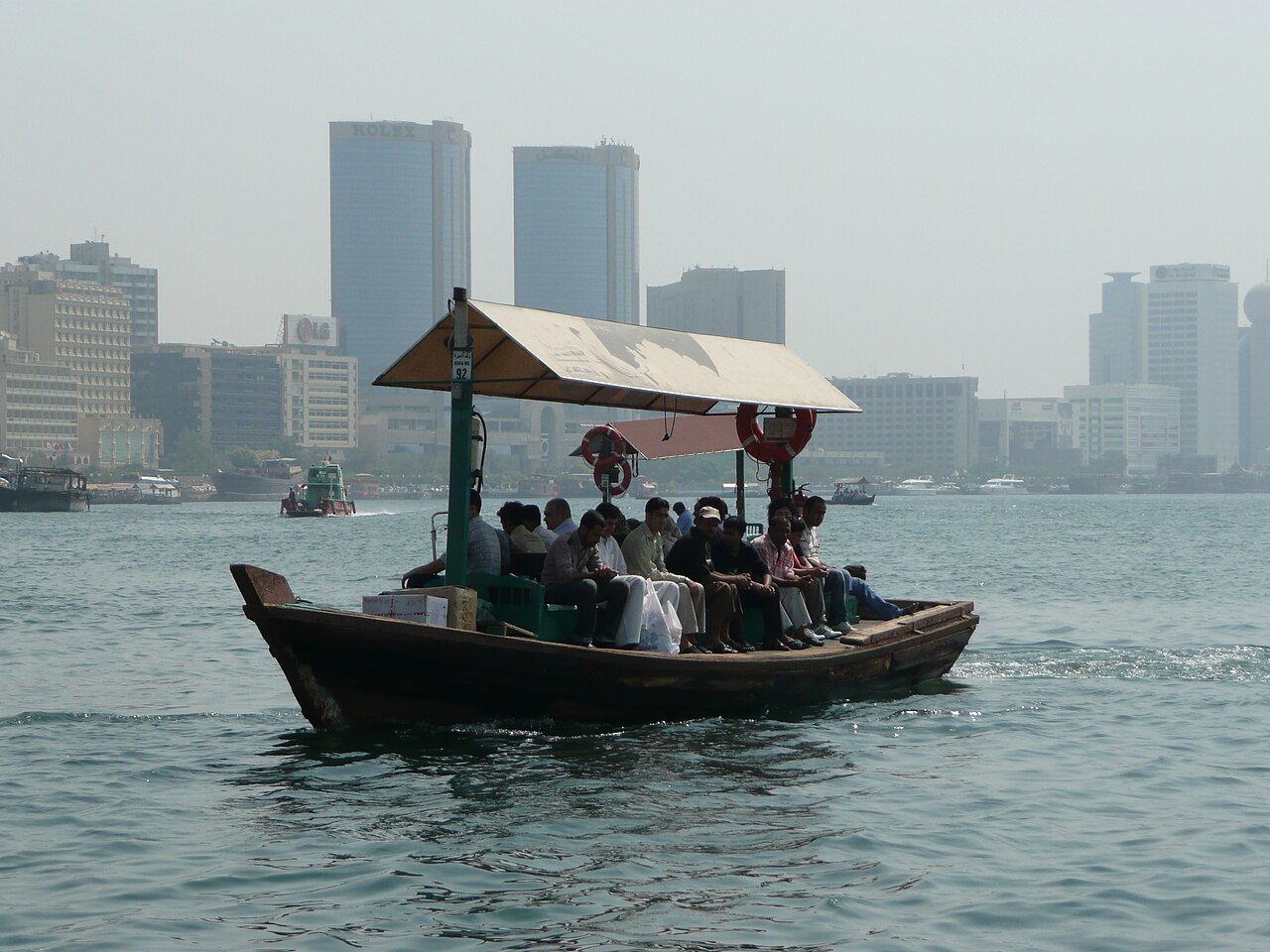
The anchor is one object and one crossing: the traditional motorized abra linking the old commercial banks of the Creek. Visit Dubai frames the abra as a traditional way to traverse Dubai Creek, while local route guides keep the practical geometry plain: one main public crossing runs between Bur Dubai Abra Station and Deira Old Souk Abra Station, and another runs between Dubai Old Souk and Al Sabkha.[1][2][3] For a first-timer, use the Bur Dubai to Deira Old Souk line first. It is short, legible, and immediately puts the Textile Souk side in conversation with the Spice Souk and Gold Souk side without turning either bank into a checklist.
The best window is late afternoon, roughly 17:30 to 18:45 outside the most brutal heat. That is not because the abra becomes romantic only at sunset. It is because Old Dubai is still a walking district before and after the crossing, and recent local route advice is blunt that morning and late afternoon are the comfortable bands for Al Fahidi, Dubai Creek, and the souk edge, especially in warmer months.[4] If you arrive at 13:30 in June, the water may still move, but your route will shrink into shade-hunting and taxi recovery. If you arrive in the later shoulder, you can walk, cross, pause, and return without making the abra carry the whole afternoon.
The fare logic is part of the object. MyBayut's current route guide lists the traditional motorized abra fare at AED 1 per person for a single trip on the main Creek routes, with CR1 running Bur Dubai to Deira Old Souk from 06:00 to midnight and CR2 running Dubai Old Souk to Al Sabkha for 24 hours.[2] Dubai Online gives the same old-school operating feel: the public routes are cheap, frequent, and paid directly to the driver, with no ticket ceremony needed.[3] Treat that simplicity as the point. Bring small cash, then let the station rhythm do its work: wait at the public dock, board the next shared boat, pay, sit, cross.
Eight small moves keep the ride local in shape. First, begin on foot if you can: Al Fahidi or the Bur Dubai souk edge into Bur Dubai Abra Station is the right approach because the crossing then feels like a continuation of old streets, not a separate attraction.[4] Second, carry AED 1 coins or small notes before you reach the dock. Third, look for the public station signage and the RTA map rather than following the first person who offers a "tour." Fourth, keep your bag on your lap and your phone wrist-low while boarding; the boat fills quickly and the step matters more than the shot.
Fifth, sit where you are directed rather than hunting for a perfect side. Abras are balanced by ordinary passenger flow, not by everyone negotiating for the best frame. Sixth, make one clean crossing before deciding whether to add anything else. The first ride is the read; a second ride can be the return. Seventh, if you want a longer private cruise, price it as a different product. MyBayut lists private Creek charter references at AED 60 for 30 minutes and AED 120 for one hour, which is not a scandal, just a different use of the boat.[2] Eighth, on the Deira side, step away from the dock before opening maps or haggling over your next stop. The station edge is working space.
The main non-local trap is mistaking low price for low attention. The one-dirham fare does not mean the route is vague. It means the route is functional enough to be cheap. A Local Guides community post usefully separates the shared AED 1 crossing from private charters and calls the Deira Old Souk to Bur Dubai connection one of the major abra lines, about a five-minute ride each way.[5] That is also how to avoid the common upsell trap. If the pitch sounds like a custom experience before you have even taken the public crossing, you are no longer using the object this article is about.
The second trap is trying to "do Old Dubai" from a car. A car can be useful elsewhere in the city, but for this strip it usually interrupts the logic. Palm Rent's recent Old Dubai guide makes the better compact pattern explicit: Al Fahidi, Dubai Creek, an abra station, Deira souks, and possibly a museum can work as a half-day or relaxed one-day route, with walking and abra forming the experience rather than merely connecting attractions.[4] For this object lens, keep it smaller than that. A practical first pass is 60 to 90 minutes: approach from Al Fahidi or the Bur Dubai side, cross to Deira, breathe for 15 to 25 minutes near the souk edge, then either return by abra or continue by metro/taxi after the water has done its orientation work.
The third trap is chasing the wrong route because "the abra" sounds singular. CR1, between Bur Dubai and Deira Old Souk, is the cleaner first crossing. CR2, between Dubai Old Souk and Al Sabkha, is useful if you are already farther along the Creek or need the 24-hour operating pattern.[2][3] Do not make a heroic distinction out of it. The local move is simpler: know which bank you are on, know which station name matches your next walk, then choose the boat that preserves the route instead of adding a detour for trivia. Place layers such as Komoot are useful here less for commentary than for pin discipline: make sure "Deira Old Souk Abra Station" is the station you actually mean before you walk away from the dock.[6]
The fourth trap is over-filming people at close range. The abra is intimate: low benches, working driver, families, commuters, shoppers, visitors, bags, heat, wind, and water all compressed into one hull. Palm Rent's practical guide includes a simple etiquette rule for Old Dubai: ask before photographing people, private shops, or staff.[4] That applies even more on the boat. Photograph the Creek, the wake, the station, the hull, the skyline edge, your own hands with the fare. Let strangers stay out of your souvenir unless they choose otherwise.
The city-specific texture is why the crossing still matters. Dubai is often read vertically now: towers, view decks, hotel atria, escalators, controlled air. The abra reads it sideways. Deira and Bur Dubai sit across a short working water gap, and the crossing makes the older trading city feel physical again: sacks, shopfronts, station queues, spice smells, textile lanes, engine noise, and the slight bump of the hull at the dock. Dubai Online calls the abra one of the cheapest and fastest ways between Deira and Bur Dubai, but the deeper value is that speed does not erase the old bank-to-bank relationship.[3] It restores it.
For a first ride, keep the instruction this plain: arrive at Bur Dubai Abra Station around 17:45, carry AED 2 if you plan to return the same way, board the public CR1 crossing, sit quickly, cross to Deira Old Souk, walk clear of the dock before making the next decision, and resist turning the boat into a cruise unless you deliberately want to pay for a cruise. The abra is not small because Dubai has outgrown it. It is small because this piece of Dubai still works best at boat scale.
Sources
- Visit Dubai, "Abra Creek Crossing" - official city tourism page for the traditional abra crossing experience on Dubai Creek.
- MyBayut, "Abras in Dubai: Routes, Timings, Fares & More" - local guide updated in 2026 with RTA route names, CR1/CR2 timings, AED 1 fare, and private-charter price references.
- Dubai Online, "Dubai Abras" - local transport guide covering the Deira-Bur Dubai station pairs, trip times, AED 1 fare, payment to the driver, and route operating hours.
- Palm Rent Editorial Team, "Old Dubai Guide: Al Fahidi, Dubai Creek and Traditional Souks," updated May 27, 2026 - recent local route guidance on Old Dubai walking, late-afternoon timing, etiquette, and compact abra-linked planning.
- Local Guides Connect, "The Dubai Creek and the Abra boat service" - community field note on the Deira Old Souk to Bur Dubai crossing, shared AED 1 rides, private charters, and late-evening Creek use.
- Komoot, "Deira Old Souk Abra Station" - map/community place layer used for station-name confirmation and route-pin discipline on the Deira side.
- Wikimedia Commons, "File:Abra with passengers in Dubai Creek 2.jpg" - public-domain real photograph used as the article image.