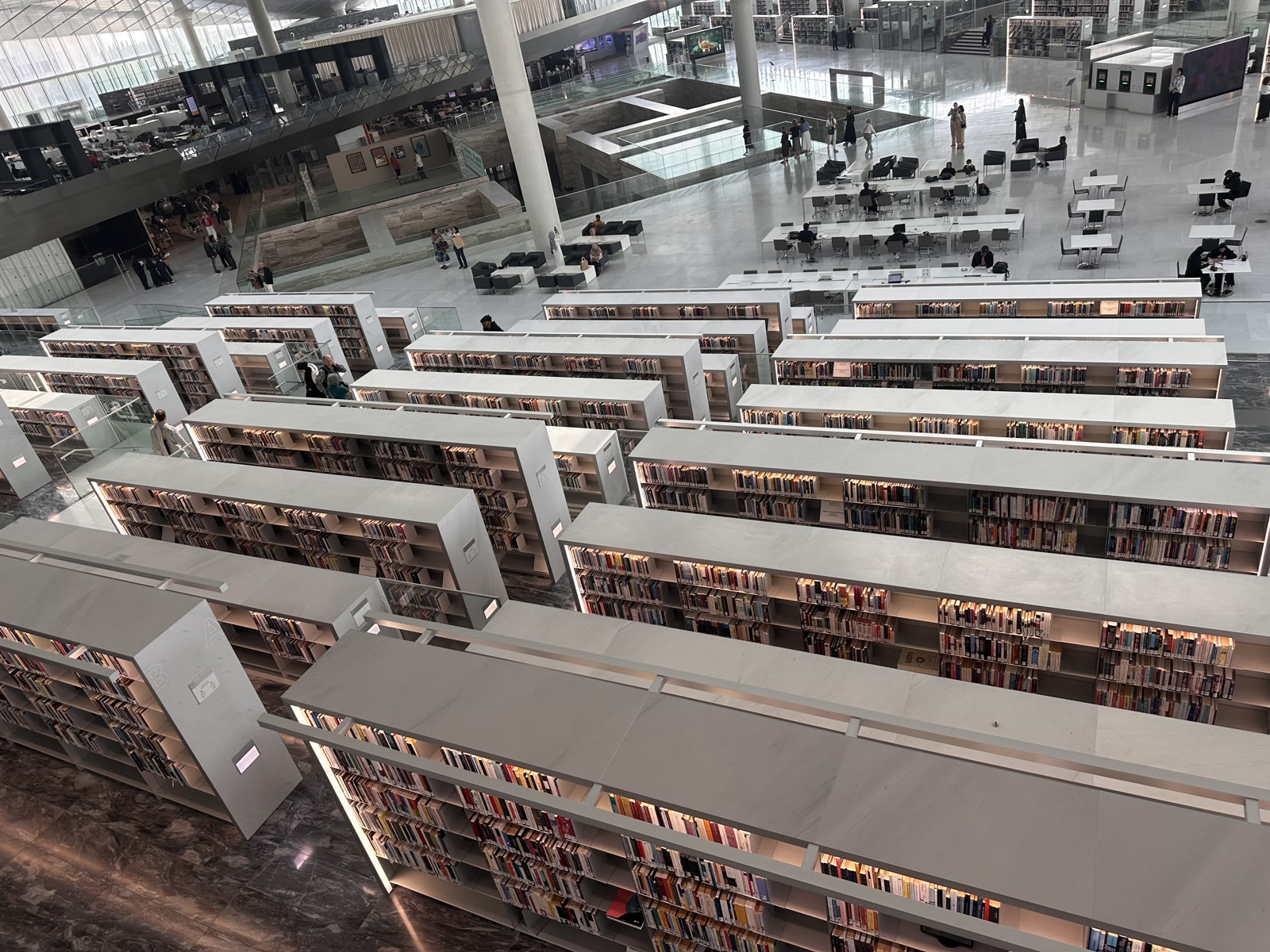
Qatar National Library looks, at first, like a building that asks to be photographed. From the Green Line, you arrive at a pale shell in Education City; inside, long white shelves climb in terraces around a huge central floor. The instinct is to find the highest rail, make the symmetrical image, and move on. That instinct misses the place.
The better visit begins after the photograph. Take ten minutes to understand the room, then give it twenty minutes as a reader. Sit at an open table. Follow one shelf long enough to find a book you did not come for. Watch students settle around power outlets while families angle toward the children's section and researchers disappear below into the Heritage Library. The building becomes legible only when its scale stops being spectacle and starts distributing ordinary concentration.[2][5][6][7]
That distinction is the local payload. Qatar National Library is free and open to residents and visitors as a public place. Its open tables, reading rooms, shelf-side seats, and benches are distinct from the individual and group rooms that carry booking rules.[4][5] It is also a working library with quiet zones, research procedures, closing routines, and people who may spend most of a day here. Arrive as though their use of the room matters more than your image of it.
One room, three speeds
The official building description gives the scale: 45,000 square metres enclosed by a form that architect Rem Koolhaas conceived as two sheets pulled apart and folded diagonally at the corners. Daylight enters through the glass facade, and the shelves rise out of the floor instead of sitting inside a chain of sealed departments. A people-mover system connects the shelving tiers, while self-checkout, RFID sorting, screens, and workstations carry the operational load.[2]
The use numbers keep that scale honest. Reporting from Doha in April 2026, based on the library's annual report, recorded 1.25 million visits in 2025, 29,000 new members, and more than 415,000 print books borrowed during the year.[6] Those figures matter more than an architecture ranking. They show that the room is being used repeatedly, not merely toured once.
The architecture is impressive because it makes different speeds visible at once. The broad central floor supports quick questions, meetings, browsing, and open study. The rising tiers reward a slower wander through the general collection. Below them, marble edges frame the Heritage Library, where manuscripts, maps, globes, early photographs, scientific instruments, archival documents, and printed works dating back to the 15th century change the room's register again.[3] It is not a decorative pit placed beneath a modern library. It is the old record held visibly inside the new public institution.
Use those speeds in that order. Start broad, from an upper tier or bridge, but do not monopolize a rail for a photo session. Descend to the open floor and sit. Only then approach the Heritage Library edge. The sequence turns the building from a futuristic object into an argument: public knowledge is not hidden behind a ceremonial facade, yet preservation still requires boundaries, staff, climate control, and time.[2][3]
The distinction is especially concrete on the day this article is published. The Heritage Library's current notice says its annual inventory runs from June 23 through July 14, 2026, temporarily making one compact-storage category unavailable for physical consultation while reference books remain accessible.[3] The display area can still be meaningful, but a serious request for a rare item is not the same thing as walking downstairs to look. That boundary is not visitor friction. It is how a heritage collection remains usable.
Eight small moves that change the visit
-
Use the station named for the building. Take the Doha Metro Green Line to Qatar National Library station and follow the Library side exit. The official access page recommends this route directly. Parking near the building is limited; its fallback is Oxygen Park's underground car park or the Education City Mosque parking area, followed by the free Education City tram to Multaqa station.[1]
-
Choose the day by the room you need. The main library is open 8:00 a.m.–8:00 p.m. Saturday through Thursday, but only 4:00–8:00 p.m. on Friday. The Heritage Library Reading Room keeps a narrower Sunday–Thursday, 9:30 a.m.–4:30 p.m. schedule and closes on Friday and Saturday.[1][3] For the fullest one-anchor visit, Sunday through Thursday is the clean choice.
-
Carry a day bag, not rolling luggage. The code of conduct excludes large bags, wheeled bags, and shopping carts. It also publishes a conservative dress code that can be enforced at entry, including restrictions on shorts, tank tops, exposed shoulders, and revealing clothing. Light trousers or a long skirt and covered shoulders remove the uncertainty before it reaches the door.[4]
-
Make one photograph, then become a user. The library's reading-space guide maps open tables, reading rooms, shelf-side seats, power outlets, and internet points as ordinary working infrastructure.[5] Give the architecture its wide shot, then sit for twenty minutes. That pause is the difference between seeing a library and consuming a backdrop.
-
Let staff reshelve the books. The house rule is unusually clear: leave used books on the table rather than putting them back yourself. Keep phones silent in quiet areas, speak softly elsewhere, and do not block the shelving aisles.[4] These are small acts, but in an open room sound and obstruction travel farther than they do in a library divided by walls.
-
Bring water with a secure lid. Drinks in closed containers are allowed in most areas, while food and café purchases stay in the café or restaurant premises.[4] That makes a bottle the useful companion for a long visit; an uncovered coffee carried up the terraces is not.
-
Separate three kinds of access. Entry is free, and the official reading-spaces guide lists open tables and shelf-side seats separately from the rooms it directs users to reserve.[4][5] A private study room is different and may need advance booking. Consulting a specific Heritage Library item is different again: the library asks researchers to identify the item and confirm an appointment at least 48 hours ahead, and heritage material remains in-library use only.[3]
-
Check the live notice, not just a saved pin. The official hours page asks visitors to check for updates, and the current Maps place and review surface is useful for same-day wayfinding and crowd texture.[1][7] The 2026 inventory notice is a good example of why: the building can be open while one research service is temporarily narrower.[3]
The visitor trapline
The first common mistake is treating the library as a ten-minute architecture stop. The better alternative is a 10 + 20 visit: ten minutes to read the shell and terraces, twenty in a real seat with a book or notebook. Official reading-space guidance, local usage reporting, and current community reviews all point to a room used for study, family visits, and reading; that lived use is the subject, not visual clutter to crop away.[5][6][7]
The second mistake is arriving on Friday morning because the rest of the itinerary has a gap. The doors do not open until 4:00 p.m. on Friday, and the Heritage Reading Room is closed all day.[1][3] Go Sunday through Thursday if heritage access matters, or accept Friday as a shorter public-room visit rather than trying to force a research visit into it.
The third mistake is assuming that free entry makes every service instant. It does not. Open tables are low-friction; private rooms, equipment, membership borrowing, and rare-item consultation have their own rules.[3][4][5] Decide before leaving whether you want to see the building, spend an hour reading, reserve a room, or consult a named object. Only the last two need more preparation.
The fourth mistake is driving to the front door by default. The library itself warns that nearby parking is limited, while the Green Line delivers you to a station carrying the library's name.[1] If you do drive, use the published overflow-and-tram logic rather than circling Education City. Observe the posted 40 km/h limit inside the district.[1]
Concrete go details
- Best window: Sunday–Thursday, 9:30 a.m.–12:30 p.m., which overlaps the general building and Heritage Reading Room without making the visit depend on an evening state change.[1][3]
- Expected spend: QAR 0 for entry, open seating, shelf browsing, and the public Heritage Library experience; café purchases and transport are optional.[3][4][5]
- Reservation reality: the official guide does not attach a reservation step to the open reading floor. Reserve a private study room if that is the goal; contact the Heritage Library at least 48 hours ahead for a specific rare item.[3][5]
- Where to stand, then sit: take the broad view from an upper shelving tier without blocking the rail, descend toward the central tables, then look into the marble Heritage Library before choosing an open seat.[2][3][4]
- Navigation cue:
Doha Metro Green Line -> Qatar National Library station -> Library side exit -> main public floor -> shelving tier -> Heritage Library edge.[1][2] - Family timing: the Children's Library normally closes at 6:30 p.m., except Friday and Saturday when it stays open until 8:00 p.m. Children are not permitted in the adult bridge and Heritage Library areas, so split the route rather than treating every tier as a family circulation path.[1][4]
- Photography boundary: ordinary visitors should keep photographs brief and non-disruptive; commercial photography or filming requires authorization.[4]
Doha has no shortage of buildings designed to be seen at a distance. Qatar National Library is better at close range, after the geometry has finished announcing itself. Its real grandeur is not the size of the shell. It is the coexistence of a child choosing a book, a student charging a laptop, a visitor learning not to reshelve, and a rare map waiting below under controlled light. The room earns its scale by letting all of them belong.
Sources
- Qatar National Library, "Hours and Location" — official opening hours, Children's Library schedule, Green Line access, limited-parking fallback, Education City tram connection, and 40 km/h district limit.
- Qatar National Library, "Our Building" — official account of the 45,000-square-metre shell, folded-sheet concept, daylight, integrated shelving, people mover, RFID systems, and preservation facilities.
- Qatar National Library, "Heritage Library" — official collection scope, Reading Room hours, June 23–July 14, 2026 inventory notice, 48-hour request procedure, in-library-use boundary, and free public events and services.
- Qatar National Library, "Code of Conduct" — official visitor-access, dress, bag, sound, food and drink, reshelving, child-access, charging, and photography rules.
- Qatar National Library, "Reading and Study Spaces" — official guide to open tables, powered reading areas, individual rooms, group rooms, capacity, and booking boundaries.
- The Peninsula Qatar, "Qatar National Library records highest-ever visits as community engagement surges in 2025" (April 21, 2026) — local reporting on visits, membership, loans, events, and digital use from the library's annual report.
- Google Maps, "Qatar National Library" — current place-status, navigation, photography, and community-review surface for the working public library.
- Wikimedia Commons, "File:Qatar National Library.jpg" — source page for the February 4, 2026 documentary interior photograph used as the article image.