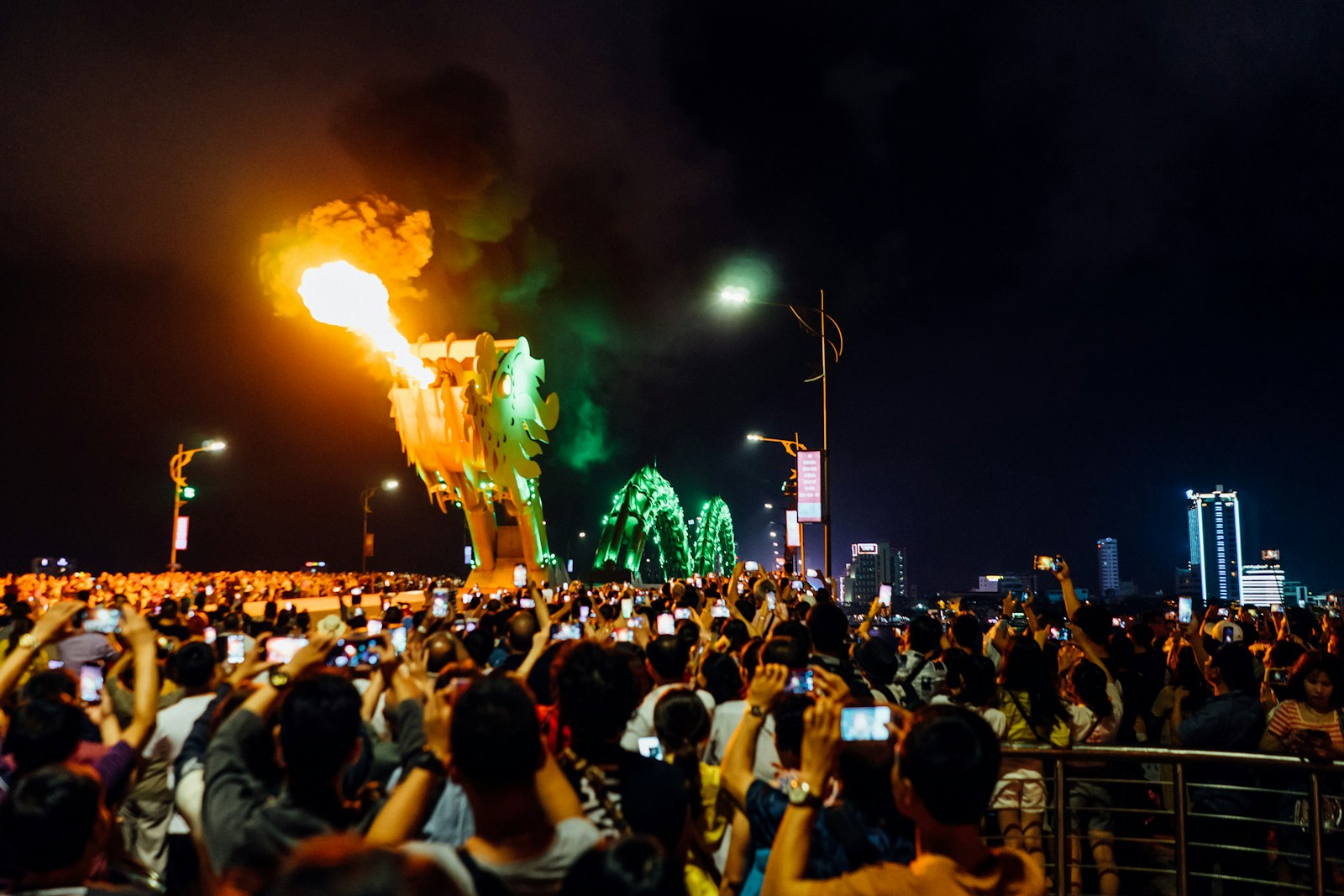
At 20:45 on an ordinary Friday, Saturday, or Sunday, Cầu Rồng is still a road. Scooters stream between the yellow steel ribs, the dragon's head points beyond the east bank, and pedestrians are confined to the two side walks. Then the approaches close, engines give way to feet, and a six-lane crossing becomes a public grandstand. At about 21:00, the dragon breathes fire, pauses, and follows it with water.
The flames are the photograph. The change of use is the Da Nang story.
Do not arrive only for the instant the mouth ignites. Come early enough to see the bridge complete its change of jobs, choose whether you want a close and wet view or a wider and drier one, and stay long enough for traffic to reclaim the deck. This is one object, read in three states: working bridge, weekend stage, working bridge again.
First, make sure tonight is ordinary
First move: check the city's tourism portal on the day you go. Its June 23, 2026 update gives the normal performance as about 21:00 every Friday, Saturday, and Sunday, with extra schedules possible around holidays and major events [1]. That is the current baseline, not an unconditional promise.
The exception matters at publication. The Da Nang International Fireworks Festival runs from May 30 to July 11, 2026, with its final night scheduled from 20:00 to 22:00 on July 11 [2]. If your visit falls on a DIFF night—especially that finale—follow festival traffic and event notices instead of this routine. The city's own schedule flags major events as a reason performance times may vary [1]. The useful lesson is simple: a live city notice outranks a remembered weekend timetable.
Do not solve uncertainty by asking ten old travel posts. Check the official portal, look for a same-day city notice, and ask your accommodation only after those two. If the performance is changed or cancelled, the illuminated bridge is still visible; it simply remains an object rather than becoming the show you expected.
Read the dragon while traffic still owns it
Second move: arrive between 20:00 and 20:20 on a normal show night. Da Nang's official night guide recommends an even earlier 19:30–20:00 arrival for first choice of position and says traffic is stopped at both ends for roughly 15 minutes during the performance [4]. You do not need to hold one railing for 90 minutes. The earlier window is valuable because it lets you walk, orient, and commit before crowd movement narrows your choices.
Use the object itself as the navigation cue. Search for Cầu Rồng, then identify the head at the eastern, An Hải side of the Hàn River. The official city tourism record describes a 666.5-metre bridge with six traffic lanes and two pedestrian ways. Construction began in 2009; the bridge opened on March 29, 2013, with its stylized dragon facing toward the sea [3]. If you can see the tail and are walking toward the head, you are moving east. If the head is already above you, decide whether to stay close or drop to the river edge before the approaches tighten.
That dragon is not decoration pasted onto an anonymous crossing. The official record treats the bridge as an engineering project first: steel beams, arches, and concrete carry a working road beneath a dragon modeled on the Lý-dynasty form [3]. Da Nang's own tourism language calls it a “city of bridges” and places Cầu Rồng among the structures that made the Hàn River part of the city's modern identity [4]. The local texture is precisely this lack of separation. Civic symbol, commuter shortcut, night lighting, and weekend performance all use the same piece of infrastructure.
Third move: walk one short section before choosing a view. Feel the deck vibrate under ordinary traffic, look along the dragon's body instead of only at its face, and notice where barriers and stewards are shaping the later crowd. Do not cross merely to collect both banks. Cross only if the side you are on cannot give you the experience you want.
Choose wet or wide before the road closes
There are two honest readings of the show.
The close reading is on the pedestrian deck near—but not directly in front of—the dragon's head. You see the flame against the body, hear the ignition, feel the heat, and become part of the crowd shown in the cover photograph [7]. You should also assume you may get wet. The official visitor advice recommends choosing your direction carefully and carrying a rain layer or umbrella; the live Google-review surface adds the more important boundary: proximity brings spray, dense sightlines, and a harder exit [4][5].
The wide reading is from the public river edge on Trần Hưng Đạo, offset from the head rather than underneath it. You trade the physical blast for a readable profile, reflections, and room to see flame, dragon, and audience together. Local Da Nang photography notes distinguish the bridge-deck angle from the east-bank river view and recommend claiming a position before 20:30 when photographing the performance [6]. Treat that as local field advice, while letting the official portal govern whether a show is actually scheduled [1].
Fourth move: choose one reading and stop migrating. A common visitor error is trying to improve the angle after the closure begins. The bridge is 666 metres long before detours, barriers, and people are added. A last-minute bank switch can turn a compact spectacle into a sweaty navigation problem. Close and wet is not more authentic than wide and dry; it is simply a different contract.
Fifth move: prepare for the sequence, not just the flame. Keep the phone down through some of the build-up. When the fire starts, take a short clip or a few frames, then look directly. When flame gives way to water, secure the phone and do not bolt through people to escape spray. The cover image is useful evidence here: the performance is as much a photograph of collective attention as of fire. Hundreds of screens rise at once; your best local move is to occupy less space than your excitement wants [7].
Keep a small bag closed and in front, give children and shorter viewers a sightline, and leave the barrier line clear. A tripod on a crowded bridge is an obstacle, not a claim to seriousness. If rain is already falling, the river edge can be slippery; the dry view becomes the sensible view regardless of the picture you imagined.
Let the bridge turn back into a bridge
Sixth move: do nothing for the first few minutes after the water. The crowd loosens quickly, but that does not mean the road is immediately yours. Recent Google reviews on the community listing repeatedly describe a chaotic dispersal as the road reopens [5]. Stay on your chosen pedestrian edge, obey stewards, and wait for an obvious movement pattern instead of stepping into a lane because somebody else has.
Seventh move: walk away before calling a car. Put 300–500 metres between you and the bridge approach, then request a pickup from a legal, legible curb. Do not ask a driver to penetrate a closing barrier or a knot of pedestrians. If you are returning west toward central Hải Châu, keep to your existing bank unless the bridge has clearly reopened to pedestrians. If you are staying east toward the beach side, continue along Trần Hưng Đạo before choosing a pickup point. The ten-minute walk is not dead time; it is the bridge shedding its audience.
Eighth move: turn back once. From a little distance, watch the traffic line re-form under the dragon. This is the view that explains why Cầu Rồng belongs to Da Nang rather than to a theme park. The show does not end with a curtain. The object resumes carrying the city.
The visitor trapline
Mistake one: treating 21:00 as guaranteed. The better alternative is a same-day official check, especially around DIFF, Tết, public holidays, or large river events. The normal Friday-to-Sunday schedule is current, while official event programming shows why the river's operating context can change [1][2].
Mistake two: standing at the head while wanting to stay dry. The better alternative is the offset Trần Hưng Đạo river edge, or a position farther back on the deck with a rain layer. Current community reviews and the official guide both warn that proximity means spray and crowd pressure [4][5].
Mistake three: changing sides at the last minute. The better alternative is to choose close or wide by 20:30, then let the closure happen around you. The bridge's 666.5-metre length and the short operational stop make late repositioning a poor trade [3][4][6].
Mistake four: ordering a ride at the barricade as soon as the water stops. The better alternative is a 10-minute walk away from the approach before pickup. You avoid the reopening conflict and get the final, more revealing view: a spectacle turning back into transport [5].
A compact go plan
- Best normal window: 20:00–21:20 on Friday, Saturday, or Sunday, after a same-day schedule check [1][4].
- Expected spend: 0 VND for the public bridge or river-edge view. There is no ticket and no reservation; paid boats, rooftops, chairs, food, or drinks are optional and unnecessary to complete this reading.
- Crowd reality: there is no formal queue, but the best positions compress before 21:00. Arrive by 20:20 and choose by 20:30 [4][5][6].
- Where to stand: near but not in front of the eastern head for heat, sound, and likely spray; offset on the Trần Hưng Đạo river edge for the wider, drier profile [4][5][6].
- Navigation cue:
Cầu Rồng -> dragon head at the An Hải/east end -> commit to bridge deck or Trần Hưng Đạo river edge -> walk 300–500 metres away before pickup[3][4]. - Time budget: 60–80 minutes on an ordinary night; longer only if you deliberately arrive for the bridge's pre-show traffic rhythm.
Cầu Rồng is not subtle, and pretending otherwise misses its charm. A golden dragon breathes literal fire over a six-lane road. But the object earns its place in the city through the ordinary mechanics around that flourish: a road closes, strangers negotiate shared sightlines, water breaks the pose, people disperse, and traffic returns. Watch all three states and the bridge stops being a stunt. It becomes Da Nang changing tempo in public.
Sources
- Da Nang Tourism Promotion Center, “Key Times to Save for Your Da Nang Travel Itinerary” (June 23, 2026) — current official confirmation of the normal 21:00 Friday–Sunday Dragon Bridge schedule and major-event variation.
- Da Nang Tourism Promotion Center, “DIFF 2026 is scheduled to take place from May 30 to July 11, 2026” (January 7, 2026) — official dates, river setting, and final-night context for the principal 2026 schedule override.
- Da Nang Tourism Promotion Center, “Cầu Rồng phun lửa và nước” (March 14, 2025) — official city record for the bridge's dimensions, traffic and pedestrian layout, Lý-dynasty dragon form, sea-facing design, construction dates, and opening.
- Da Nang Tourism Promotion Center, “Hint: Where should we go in Da Nang at night?” — official operational guidance on early arrival, approximate 15-minute traffic stop, crowd locations, and water-spray preparation.
- Wanderlog, “Dragon fire show” — live local review surface carrying recent Google reports on east-side positioning, early arrival, spray, free access, and post-show dispersal.
- Da Nang Photographers, “The Dragon Bridge Fire Show: What to Expect, Where to Stand, and How to Photograph It” (May 11, 2026) — local field notes distinguishing bridge-deck and Trần Hưng Đạo river-edge views and recommending an early position.
- Unsplash, “People watching fire from the tower at nighttime” — Robson Hatsukami Morgan's real October 2019 photograph of the Dragon Bridge crowd and fire performance, used as the article image.