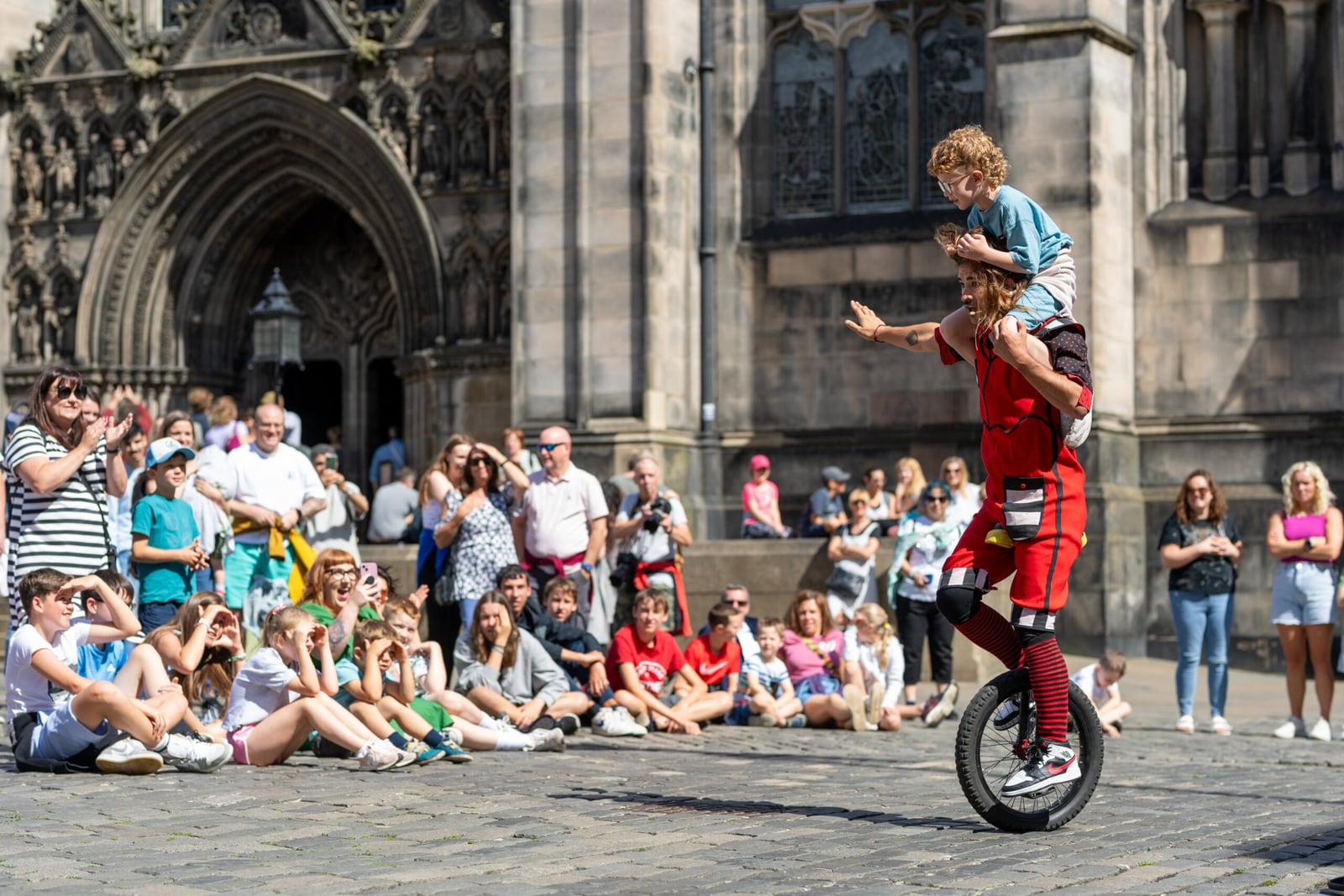
The useful fact about Edinburgh's Fringe Street Events is not that they are free. It is that at 10:00 each morning, the street still does not quite know what it will become. Performers enter a daily draw; only afterward does the Fringe Society publish that day's schedule and place boards at the pitches.[1] The Royal Mile is not an outdoor theatre with a programme engraved above the door. It is a theatre that casts itself again at breakfast.
That uncertainty should change the visit. Do not give the Royal Mile an entire festival day, and do not march up it as though every performer were a sight to collect. Give the street 75 to 90 minutes, choose one circle deliberately, and let the next act remain unknown. In 2026, the main Fringe runs from August 7 through 31, while the Street Events run 11:00–19:00 daily from August 7 through 30. Their official Royal Mile zone stretches along the High Street from Cockburn Street to George IV Bridge, with additional activity at Hunter Square and the Mound Precinct.[1][2][10] This is a close-up route through one seasonal room, not a general Fringe itinerary.
The best version begins just after the draw. Come up from Waverley Station by Cockburn Street, pause before you merge into the High Street, and check the live schedule or the nearest pitch board. Then choose: a compact late-morning pass along the Royal Mile, or a late-afternoon pass that ends at the Mound's scheduled 17:15 finale.[1] Trying to do both while also racing between ticketed shows is how a vivid hour turns into pavement arithmetic.
Why the daily draw belongs here
The Fringe began in 1947, when eight companies arrived uninvited alongside the new Edinburgh International Festival and performed anyway. The Festival Fringe Society followed in 1958, built around an open-access principle: it would help artists and audiences find one another without vetting the artistic programme.[3] The modern street operation is more managed than that origin story suggests—registered performers need insurance, family-friendly material, assigned pitches, and timed slots—but the morning draw preserves a small piece of the original gamble.[4]
It also fits the street. The High Street is the spine of a medieval town, but Cockburn Street is a later intervention: a sinuous 1856 connection cut between the High Street and Waverley Station. It was built to make the steep change of level more usable, overlaying a nineteenth-century route on the Old Town's older grain.[9] During the Fringe it still performs that job, feeding station crowds directly into a street that was never dimensioned for all of them at once.
The result is not merely congestion. It is a peculiar compression of city and stage. A busker can hold a tiny pitch while a church door, a close, a shop entrance, a resident's route, and several hundred other intentions continue around the edge. Officially, busking slots last 30 minutes and circle-show slots 45 minutes, including setup and breakdown.[4] Those limits are not backstage trivia. They explain why the street feels alive: every ring must form, focus, pay, dissolve, and make room for the next one.
The Royal Mile in eight small moves
1. Check after 10:00, not the night before. The act you hope to see may not have its pitch until the daily draw finishes. Use the live Street Events page or the physical board when you arrive, then commit to one or two nearby pitches.[1] A rigid saved itinerary defeats the mechanism that makes the street interesting.
2. Arrive when the pitches are live. The current city listing gives the Street Events' public hours as 11:00–19:00, while the daily draw begins at 10:00.[1][10] An 11:00–13:00 weekday window therefore starts when the programme exists and leaves room before the late-afternoon density. The surrounding traffic restrictions—from 10:30 on the High Street and Cockburn Street—explain why a taxi pin is the wrong arrival plan, but the performance draw, not the road closure, sets the visit's rhythm.[5]
3. Use Cockburn Street as a threshold, not a meeting room. It is the obvious line up from Waverley, which is exactly why the top junction clogs. Agree on a meeting point before the climb. At the High Street, move fully out of the pedestrian stream before opening the schedule. The local rule is brutally simple: do not stop dead, and do not occupy the pavement three or four abreast.[7]
4. Choose a circle and stay for its shape. Join from the outside rather than cutting across the performance space, and watch one act long enough to understand its build. A 45-minute circle show has to gather strangers, establish trust, create a climax, collect contributions, and clear the pitch.[4] Ten distracted phone clips from ten acts reveal less than one complete ring forming and releasing.
5. Carry a small tip budget. Street Events cost £0 to enter, but that does not mean the labor is unpaid. The Fringe Society says performers earn their main income from these audiences and explicitly asks visitors to bring cash, though some artists take cards.[1] Set aside roughly £5–£15 for the acts you genuinely stay to watch. That range is a practical visitor budget, not a compulsory fee or an official rate.
6. Treat flyers as invitations, not litter. Take one when the person or premise actually catches you; decline the rest without theatrics. Edinburgh residents repeatedly point out that visitors are not obliged to accept every flyer and should not let unwanted paper migrate to the pavement or the bins at either end of the street.[7] If a pitch leads you to a ticketed show, leave a real travel gap rather than assuming two nearby venue names mean two nearby doors.
7. Pack for a moving queue. A fold-away rain shell and water bottle work better here than an open umbrella and a full rucksack. Local venue operators recommend water, extra travel and queue time, and offline listening because mobile signal can buckle in the festival crowd; resident advice also warns that umbrellas are awkward in wind and on packed pavements.[7][8] The council's broader guidance adds the permanent facts: central Edinburgh is hilly, cobbled, and unusually busy in festival season.[6]
8. Decide the exit before the street decides for you. For the short version, turn back down Cockburn Street after one complete act and one shorter pitch. For the late version, leave the High Street with at least 15 minutes in hand and move toward the Mound for the daily 17:15 finale.[1] Do not interpret “nearby” as “instant”; the council advises allowing longer journey times and even leaving buses a few stops early when central streets and stops are busy.[6]
The visitor trapline
The first mistake is arriving at 09:00 for “the best acts” because an old blog recommended them. The pitches are allocated that day from 10:00.[1] The better alternative is to arrive after the draw, read what actually exists, and let one unknown act win the hour.
The second is treating the Royal Mile as a normal heritage walk with bonus entertainment. In August, locals specifically warn against expecting to wander aimlessly down the street while studying every facade.[7] If the architecture is the main purpose, come outside Fringe season or before the operational day begins. During Street Events, let performance be the anchor and use the Old Town's stone, closes, and level changes as its live frame.
The third is stopping in the current to compare maps, pose a group, or negotiate lunch. The better alternative is to step completely into a recess or side space, settle the decision, then rejoin in single file. This is etiquette, but it is also stagecraft: when the audience keeps circulation lanes readable, a circle can close without turning every doorway behind it into collateral scenery.[5][7]
The fourth is confusing “free to attend” with “free to produce.” Bring money for the hat, and pay after the act you watched.[1][7] A visitor who films the climax and disappears at the collection has understood the price label but missed the exchange.
Two clean ways to go
For a late-morning street hour, reach the top of Cockburn Street around 11:00, once the daily schedule has posted, then check the board and walk only the official High Street zone toward George IV Bridge. Pick one full circle and one passing busker. Budget 75–90 minutes, £5–£15 in performer contributions, and no reservation. There is no conventional entrance queue; audiences accrete around individual pitches, so the practical choice is either to join the outer ring early or accept a partial view without pushing forward.[1][4][10]
For a finale hour, start on the High Street around 16:15, watch one act, then allow at least 15 minutes to reach the Mound Precinct before the 17:15 finale.[1] This version is louder and denser. It works only if the finale is the destination, not an extra squeezed between two ticket scans.
Three 2026 dates offer a more specific reason to choose the Royal Mile: BSL-interpreted performances are scheduled at West Parliament Square on Sunday August 9, Saturday August 15, and Thursday August 20.[1] The Community Stage is also scheduled beside St Giles' Cathedral on August 27 and 28.[1] Those are programmed exceptions inside a street system otherwise remade each morning.
The navigation cue is compact: Waverley Station -> Market Street -> Cockburn Street -> High Street pitch board -> West Parliament Square. Add -> Mound Precinct only for the finale. Walking or public transport is the stable choice; the Fringe Society discourages driving to the street sites, and the council warns that central services take longer during the festivals.[1][6]
At its best, the Royal Mile does not give you a survey of the Fringe. It gives you the Fringe's operating principle in miniature. A performer draws a timed pitch. Strangers decide whether to stop. A ring gathers without a ticket gate, attention becomes the first currency, and forty-five minutes later the act clears for whatever the morning draw placed next. The right response is not to conquer the programme. It is to arrive after the draw, hold one circle well, and know when to let it go.
Sources
- Edinburgh Festival Fringe, "Fringe Street Events" — official 2026 audience guide to event areas, the 10:00 daily draw, pitch boards, performer contributions, the 17:15 Mound finale, BSL dates, and Community Stage dates.
- Edinburgh Festival Fringe, "What is the Edinburgh Festival Fringe?" — official confirmation of the August 7–31, 2026 festival dates and the free outdoor Street Events.
- Edinburgh Festival Fringe, "History of the Fringe" — official account of the eight uninvited companies in 1947, the 1958 Festival Fringe Society, and its non-vetting principle.
- Edinburgh Festival Fringe, "Take part in the Fringe Street Events" — official performer guide covering registration, insurance, the daily draw, 30-minute busking slots, and 45-minute circle-show slots.
- City of Edinburgh Council, "Summertime Streets 2026" — official dates and operating hours for High Street, Parliament Square, Cockburn Street, St Giles' Street, Lawnmarket, and Cowgate restrictions.
- City of Edinburgh Council, "Getting around the city" — official festival-season guidance on hills, cobbles, walking, public transport, longer bus journeys, tram frequency, and central congestion.
- r/Edinburgh, "Rules of etiquette for tourists at Fringe" (July 23, 2025) — local community discussion of pavement flow, flyering, tipping, rain gear, road awareness, and the limits of Royal Mile sightseeing in August.
- The Skinny, "Resident Advisors: Connie and Andy, Slow Progress" (July 17, 2025) — Old Town operators' local Fringe advice on rain shells, water, extra travel and queue time, pedestrian etiquette, and weak mobile signal.
- City of Edinburgh Council, Old and New Towns of Edinburgh World Heritage Site Management Plan — the 1856 Cockburn Street overlay and its purpose as a more direct connection to Waverley Station.
- Forever Edinburgh, "Edinburgh Festival Fringe" — current City of Edinburgh listing for the August 7–30 Street Events hours and source page for Roberto Ricciuti's 2023 Royal Mile documentary photograph used as the article image.