Riga Central Market is too often filed under "eat here near Old Town." That undersells it. The more useful visit is a 60-90 minute street microcosm: enter the market as architecture, keep the shopping tempo short, then use the Spikeri underpass and Daugava promenade as the release valve before the bus-station edge and Old Town loops pull you back into traffic.[1][3][4]
The place has enough food to distract anyone, but the non-food reason to come is the civic machinery. The market's own history page traces the project from a Riga City Council decision on 18 December 1922 through eight years of construction, with former German army Zeppelin hangars from Vainode cut down into pavilions of 20.5 metres in height and 35 metres in width.[2] The official account also notes the project's scale: 6 million bricks, 2,460 tonnes of steel, a 2-hectare underground city, and a 337-metre traffic lane below the pavilions.[2] LiveRiga adds the everyday city reading: the market sits in the middle of town next to the Daugava and central rail and bus stations, and its pavilions have become part of Riga's identity rather than a leftover industrial shell.[3]
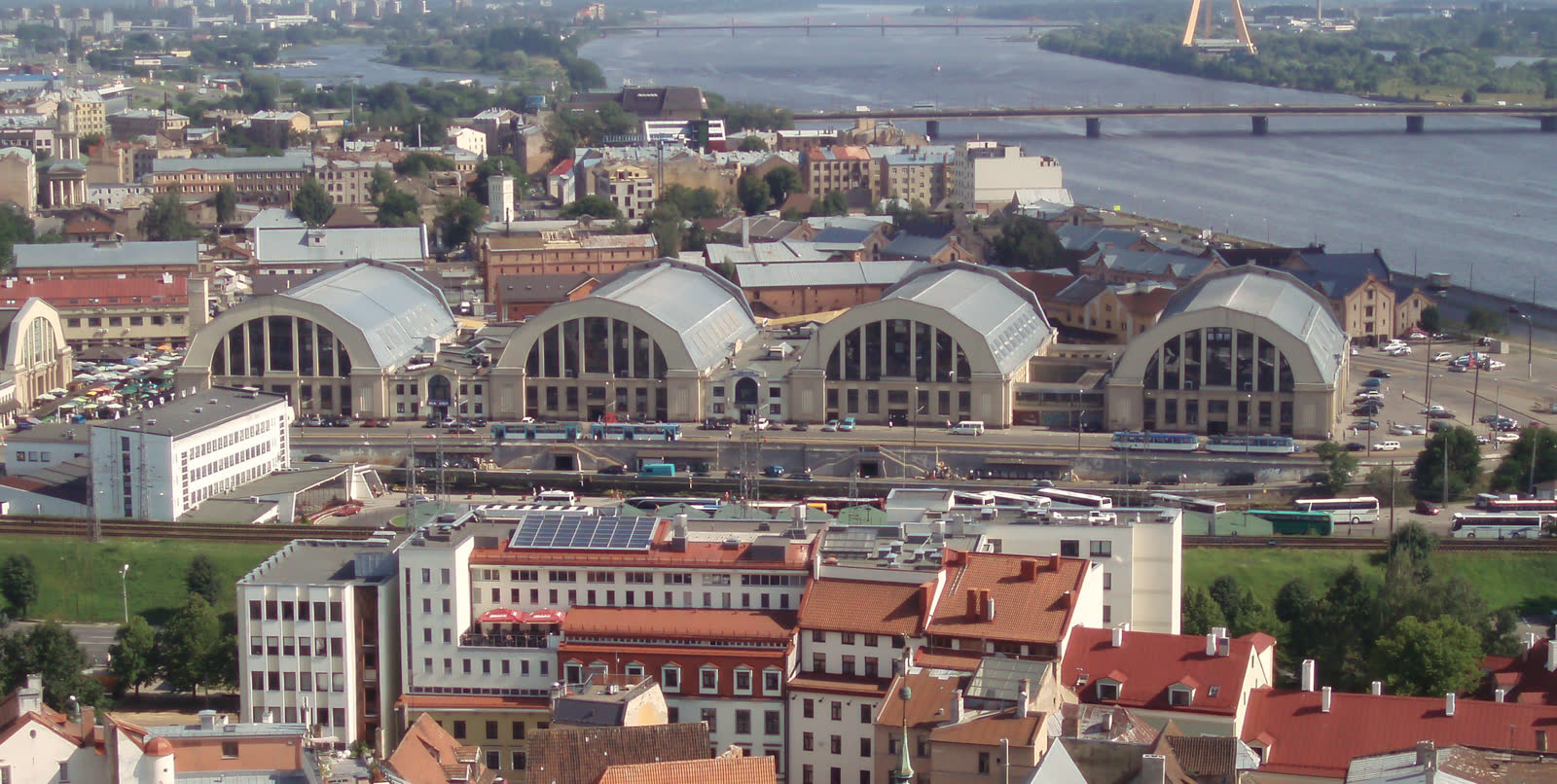
The cover image is a real Wikimedia Commons photograph of the Central Market hall, not a generated travel visual or a map graphic. It shows the right recognition cue for this route: the repeated arched roofs, the broad paved foreground, and the way the building reads more like working infrastructure than a picturesque food hall.[8]
Anchor 1: use the hangars before the stalls use you
Start in the morning, but do not make it a dawn race. The official working-hours page lists the market territory from 7:00 to 18:00, most pavilions from around 7:00 or 7:30 to 18:00 Monday through Saturday, and a shorter Sunday pattern to 17:00 for the main pavilions.[1] The same page flags a practical rule that visitors miss: pavilion sanitary day falls on the first Monday of each month, while outdoor trade continues.[1] If the whole point is to read the roof volume, doorways, and vendor halls, that first-Monday closure changes the stop.
The best ordinary window is 8:30-10:30. Earlier than that, the market can still feel like setup; later, visitors and lunch decisions start to thicken the aisles. Give yourself 20 minutes outside before you buy anything. Stand back far enough to see the sequence of roofs, then enter only one or two halls. The move is not to sample every category. It is to let the pavilions show how Riga turned military aviation hardware into grocery infrastructure.
Once inside, keep a narrow loop. The market can be huge in a way that becomes numb: fish, meat, vegetables, dairy renovation notices, outdoor stalls, flower traffic, station pedestrians, and people simply crossing through the area. LiveRiga's description of the market as a place where residents buy fish, rye bread, produce, plants, household goods, and craft items is accurate, but it is also the warning label.[3] If you arrive with a checklist appetite, the building disappears behind errands.
This is where community evidence is useful because it cuts against brochure polish. A recent r/Riga photo thread about Rigas Centraltirgus has locals describing the area as visually rough, dated, and still strongly marked by the post-Soviet 1990s feel, even while other commenters recognize the strange charisma of the "winged" market roofs.[7] That is not a reason to avoid it. It is the reason to visit in daylight, stay attentive to the station-edge environment, and avoid writing the place into a falsely tidy postcard.
Anchor 2: take the Spikeri release instead of bouncing back to Old Town
The better second anchor is not another hall. It is the short release toward Spikeri and the Daugava. Spikeri's own development page describes the quarter and riverfront as a revived shoreline project, with cobbled passages, benches, trees, playgrounds, a skate park, performance space, a wide Daugava promenade, viewing areas, a quayside, and a reconstructed underground pedestrian tunnel connecting the city centre to the riverside.[4] It also gives one of the most useful numbers for the walk: the project created a 1.3 km bikeway and embankment square.[4]
That tunnel is the local move because it changes the mood without adding a new attraction. Visitors often finish the market and drift back toward Old Town or the station concourse. The more Riga-specific move is to leave the pavilions by the Spikeri side, cross through the underpass, and let the Daugava stretch the route open. You get benches, river air, brick warehouses, and enough distance to see why the market sits where it does.
Keep the promenade as a 20-30 minute decompression, not a second itinerary. There is no ticket, no reservation, and no queue. The expected spend for the full route can be EUR 0-12: free if you only walk and look, a few euros if you buy fruit, bread, coffee, or something small before the river. If you are chaining the stop with public transport, Rigas Satiksme's ticket page confirms a 90-minute time ticket category for buses, trams, and trolleybuses, which is enough for a simple approach or exit without turning the morning into fare math.[5]
Google Maps remains useful here as a current place-status layer, but use it as a floor, not as the route designer. The Central Market pin will surface opening details, review density, and recent visitor texture; it will also tempt you into every nearby food stall, station shop, and Old Town detour.[6] Decide before you start that the route has only two anchors: the hangars and the Daugava edge.
8 local moves that make the hour work
First, check the first-Monday sanitary rule before you go. If your Riga morning lands on that date, the outdoor area may still function, but the pavilion read changes.[1]
Second, arrive after opening but before lunch pressure. The strongest window is about 8:30-10:30, when the market is active and the route has not become a snack hunt.
Third, spend the first 20 minutes outside and just inside the doors. The roof sequence and building scale are the point; food decisions can wait.[2][8]
Fourth, choose one or two halls only. The market rewards constraint. Fish, bread, produce, and household goods all compete for attention, and the architecture is easier to see when you stop trying to consume every aisle.[3]
Fifth, treat roughness as information, not failure. Local community comments about the area's dated and unpolished feel match the station-edge reality; daylight and a narrow route make that texture legible rather than stressful.[7]
Sixth, exit toward Spikeri, not automatically toward Old Town. The underpass and riverfront were rebuilt precisely to make the city-centre-to-Daugava move work.[4]
Seventh, budget small. The core walk costs nothing, and a practical spend range is EUR 0-12 unless you decide to shop heavily.[1][3]
Eighth, use a 90-minute ticket only if transit is part of the frame. If you are already central, walking is cleaner. If you are approaching by tram, bus, or trolleybus, the time-ticket category keeps the transfer window simple.[5]
Non-local trapline: 4 common misses and the better alternative
Mistake 1: treating Central Market as only a lunch stop
Better alternative: read the former Zeppelin hangars first, then buy one small thing if it fits the morning. The roof volume, construction history, and station-side working rhythm are the Riga-specific payload.[2][3]
Mistake 2: arriving late on Sunday or the first Monday of the month
Better alternative: check official hours and sanitary-day rules before committing. Pavilion access is central to this route, so timing matters more than it would for a normal street walk.[1]
Mistake 3: leaving by the same side you entered
Better alternative: use the Spikeri underpass and Daugava promenade as the second anchor. It gives the market a river edge and prevents the stop from collapsing into Old Town repetition.[4]
Mistake 4: expecting a polished heritage market
Better alternative: visit in daylight and let the rough edges stay visible. Local community reaction makes clear that Central Market is working city fabric, not a sanitized attraction shell.[7]
Go details
- Best time window: 8:30-10:30, Monday through Saturday, with extra caution around the first Monday sanitary-day rule.[1]
- Expected spend: EUR 0-12 for the core walk and a small purchase; more only if you intentionally shop.
- Queue or reservation reality: no booking for the market or promenade; the operational risk is opening hours and pavilion closure, not a line.[1]
- Where to stand: start outside the halls, far enough back to read the arched sequence, then enter one or two pavilions before exiting toward Spikeri.[2][8]
- Navigation cue: after the market, look for the Spikeri-side pedestrian connection to the Daugava rather than drifting back to the bus-station or Old Town side.[4]
- Transit cue: if you approach by public transport, a 90-minute Rigas Satiksme time-ticket category covers ordinary bus, tram, and trolleybus transfers.[5]
Riga's Central Market is strongest when it is allowed to stay a little unresolved. One hour is enough: hangars first, a brief working-market pass, then Spikeri and the Daugava to widen the frame. The city feels less like a postcard from that angle and more like a machine that still has people moving through it.
Sources
- Riga Central Market, "Working hours" (official current hours for pavilions, outdoor territory, farmers' night market, and first-Monday sanitary-day rule; accessed April 23, 2026).
- Riga Central Market, "History" (official market history: 1922 decision, eight-year construction, former Zeppelin hangars, dimensions, materials, basements, UNESCO context).
- LiveRiga, "Riga Central Market" (Riga Investment and Tourism Agency overview of market role, Daugava location, station access, products, history, and working hours).
- Spikeri, "Spikeri Quarter Development" (official project description of the Spikeri quarter, reconstructed pedestrian tunnel, Daugava promenade, benches, quayside, and 1.3 km bikeway).
- Rigas Satiksme, "Types and prices of tickets" (official ticket categories, including the 90-minute time ticket and code ticket).
- Google Maps search, "Riga Central Market" (current community-review and place-status surface; accessed April 23, 2026).
- r/Riga, "Some photos from Rigas Centraltirgus last weekend" (local community thread, 2025; recent ground-level reactions to Central Market's visual texture and station-edge feel).
- Wikimedia Commons, "File:Riga Central Market Hall.jpg" (David Holt / MrPanyGoff; real photograph of Riga Central Market hall used for the cover image).