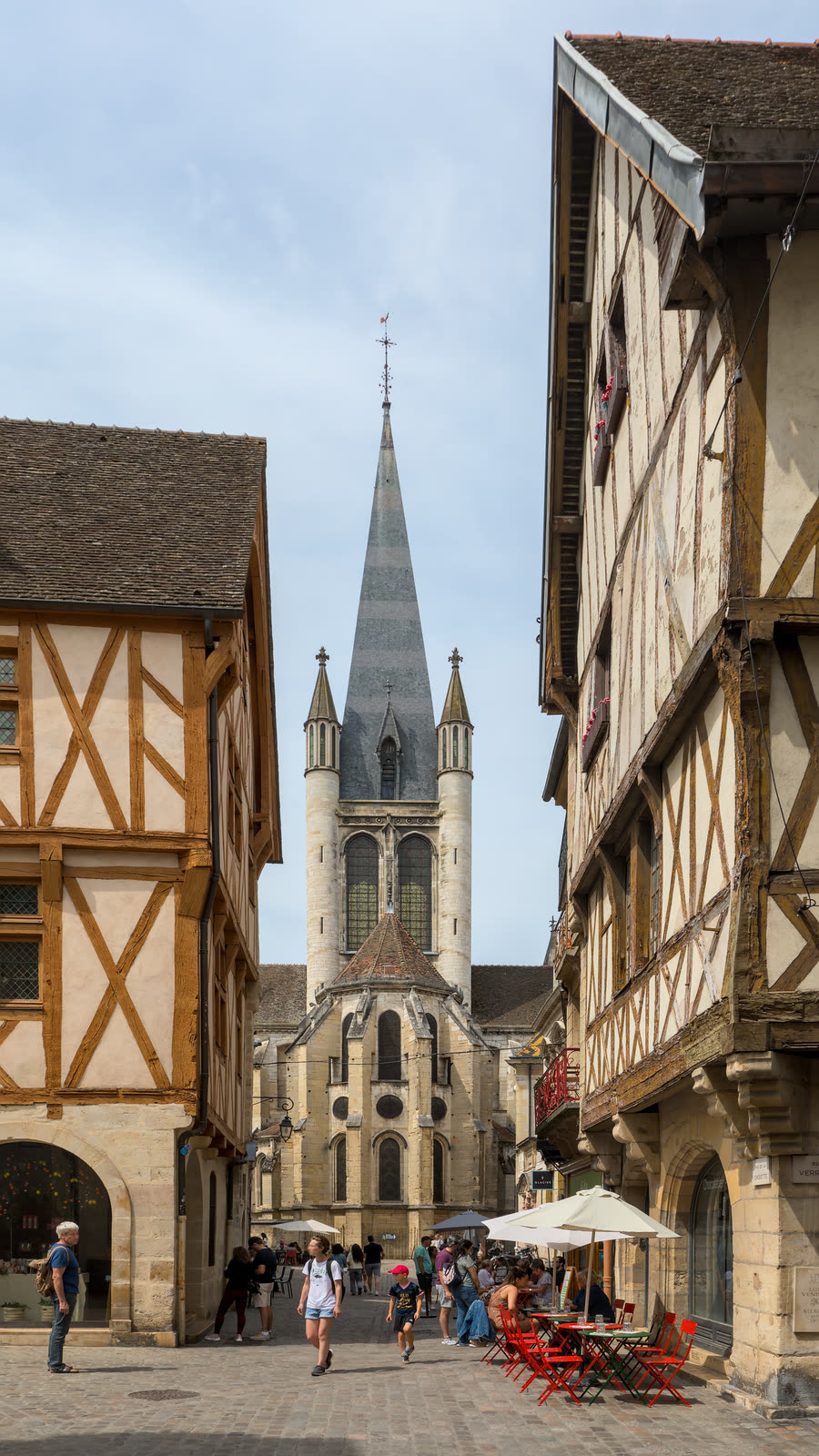
Dijon's most useful first ritual is small enough to miss and particular enough to remember. On the north wall of Notre-Dame, a stone owl has been rubbed nearly featureless by generations of left hands. The wish is only half the custom. Local folklore adds a nearby salamander that can spoil it, turning the direction of departure into part of the ceremony [2][5][7].
Give this one street and one object 25–35 minutes, ideally before 10:00 if you plan to add interiors [4]. Expect to spend €0; the optional official Owl Trail booklet starts at €4. No ticket or reservation is required for the outdoor route. If you want the full 22-stop circuit, allow at least one hour before entering any museum or church [1][4]. The compact version below is not a claim to have “done Dijon.” It is a way to learn how the city asks you to move.
The ritual is current, not embalmed folklore. In an August 2026 r/dijon thread, a commenter still sent a visiting family to the owl to make a wish—and immediately added the warning about the salamander [5]. A firsthand walking guide updated in January 2026 likewise treats the owl as the hinge of the historic-center route, not a decorative aside [4].
Eight moves, one north wall
Move 1 — decide whether you are walking the trail or meeting the owl. The official circuit has 22 stages, takes about one hour and uses bronze owl arrows across the protected center [1]. Its proper starting point is Jardin Darcy. If you have the hour, begin there and let the route earn Notre-Dame gradually. If you have only half an hour, reverse this one fragment: enter Rue de la Chouette from the Rue Verrerie / Maison Millière end east of the church, then walk west. Dijon’s municipal guide explicitly gives the ritual order as salamander first, owl second; a location note explains that walking west-to-east puts the salamander after the owl instead [9][10].
Move 2 — finish the approach before 10:00 when you can. The recent firsthand guide recommends a morning start before 10 for anyone who wants to enter the route's churches, museums and courtyards rather than merely pass their doors [4]. For this tighter outdoor ritual, treat that as a useful reference rather than an opening-hour rule. Later is not wrong; if several people gather around the hand-sized carving, wait off the walking line and take a brief turn.
Move 3 — follow owls, not every piece of metal in the pavement. The directional markers are triangular and carry the owl; stop plaques are rectangular and numbered [1][4]. An r/dijon discussion about other bronze-looking discs supplies the useful local correction: some round street markers define café-terrace limits rather than a historical walk [6]. When the trail seems to point in three directions at once, look for the bird before opening a map.
Move 4 — let the church turn from backdrop into wall. From the eastern approach, Notre-Dame first appears by its apse and roofline—the recognition view in the cover photograph [12]. It was built between 1220 and 1240 on an unusually tight urban plot [3]. As you walk west along its north side, stop looking for a grand entrance and lower your gaze. The owl sits on the buttress of a later chapel, where Gothic monument collapses into a palm-polished patch of stone [2][3]. Save the western facade and its 1383 Jacquemart bell-striker for the exit [3].
Move 5 — find the salamander before touching anything. This is folklore, not a heritage-site rule, and accounts vary in their embellishments. The stable local version is simple: the owl receives the wish; encountering the nearby salamander afterward risks cancelling it [5][7]. The municipal walking guide therefore instructs visitors to notice the salamander and then touch the owl [9]. On this east-to-west approach, look for the small creature first, pass it, then continue roughly one metre to the owl [10]. The order lets you play the local game without pretending the stone controls causality.
Move 6 — use the left hand and make one quiet touch. The tourist office explains the left hand as the hand on the same side as the heart [1][2]. Place it on the owl, make the wish if you want one, and move on. The loss of detail is the physical record of repetition: the bird is legible now less by feathers or eyes than by the behavior gathering around it [2]. A long polishing performance adds nothing and blocks a narrow pedestrian edge.
Move 7 — keep the wall moving. Stand close enough to reach the carving, but leave the lane behind you open. If another person is already at the owl, wait a step away rather than forming a semicircle across the street. If you need a photograph, take it after the touch, from the wall side, and give the next person the object. The best etiquette here is measured in seconds, not signs.
Move 8 — keep walking west. The superstition gives the ritual its unusually good urban ending: you cannot simply reverse out while staring at your phone. Continue beyond the owl toward Place Notre-Dame and Rue des Forges, leaving the salamander behind you to the east [9][10]. Now look up at the western facade and Jacquemart. The point is not magical compliance. It is that one tiny carving has made you notice which wall you are beside and which way the street runs.
The church is older than the bird
The owl feels ancient because touch has erased its surface, but its age is not the church's age. Dijon's official heritage account dates Notre-Dame's main construction to 1220–1240, while the tourist office places the owl on a chapel associated with the late 15th century [2][3]. Its origin and meaning remain uncertain. It may resemble an eagle-owl, a little owl associated with Athena, a ducal pun or something more prosaic; the official sources do not force a verdict [2][3].
That uncertainty improves the visit. A neat origin story would turn the owl into an answer. Instead, Dijon has made it a habit. The object migrated from an obscure carving to a touched charm, a city mascot and finally the icon stamped into a navigation system. Twenty-two route stops now borrow authority from a bird whose own identity cannot be settled [1][2].
The nearby Jacquemart makes the contrast sharper. It arrived as a civic gift in 1383 and still marks time from a tower [3]. The owl marks movement from arm's height. One is a machine the whole square can hear; the other works only when a passerby closes the final few centimeters with a hand. Dijon keeps both as public clocks, but they measure different things.
Four ways visitors flatten the ritual
| Easy mistake | Better local move |
|---|---|
| Assume the owl arrows show the shortest way to the owl. | A Dijon city guide says it regularly encounters lost visitors who make that mistake. Give the official loop its full one-hour minimum, or navigate directly to the compact fragment [4][8]. |
| Follow every bronze disc in the pavement. | Track triangular owl arrows and numbered stop plaques; local discussion identifies other round markers as terrace boundaries [4][6]. |
| Approach west-to-east because the western facade is easier to find. | For the folklore-safe compact route, begin at the Rue Verrerie end and walk east-to-west, meeting the salamander before the owl [8][9][10]. |
| Touch first and discover the salamander second. | Follow the municipal order: salamander, owl, one brief left-hand touch, then continue west toward the facade [1][5][7][9]. |
Pocket version
- Anchors: Rue de la Chouette and the owl on Notre-Dame's north buttress—one pedestrian seam, one hand-sized object.
- Best window: finish the approach before 10:00 when possible, especially if you want interiors; verify each door separately [4].
- Time needed: 25–35 minutes for the compact approach, church exterior, salamander sequence and exit; one hour minimum for all 22 principal trail stops, excluding entries [1][4].
- Expected spend: €0 for the outdoor ritual; €4 for the optional official booklet. The tourist office also promotes an app [1][4].
- Queue and reservation: no reservation and normally no formal queue. If several people gather at the owl, wait off the walking line and take a turn measured in seconds.
- Navigation cue: for the full route, start at Jardin Darcy. For the compact version, enter Rue de la Chouette from the Rue Verrerie / Maison Millière end, walk west past the salamander and owl, and let the western facade be the finish [9][10].
- Where to stand: against the buttress for the touch, never across the lane for the photograph.
- Same-day check: use the official route page for the current booklet/app offer and the live community map pin for access photographs or temporary street disruption [1][11].
Rue de la Chouette looks substantial in the cover photograph: timber, stone, café chairs, a church rising at the end of the frame [12]. The object that organizes it is almost absent from that view. That is exactly right. Dijon's owl does not dominate the street. It waits at its edge and rewards the one thing a quick visitor usually withholds: directional attention.
Sources
- Dijon Métropole Tourist Office, “Le Parcours de la Chouette” — official route page for the 22 stages, one-hour duration, €4 starting price, bronze arrows, left-hand custom, app and Jardin Darcy start.
- Dijon Métropole Tourist Office, “Once upon a time there were animals” — official account of the late-15th-century owl, uncertain identity, worn stone, left-hand custom and use as the city's pedestrian-route symbol.
- Ville de Dijon Patrimoine, “L'église Notre-Dame” — municipal bilingual heritage guide to the 1220–1240 construction, narrow plot, 1383 Jacquemart, owl buttress and unresolved meaning.
- Jen Ciesielski, “The Dijon Owl Trail: A Complete Guide (from a Local)” (updated January 19, 2026) — recent walked account of marker shapes, route sequence, three extensions, morning timing, booklet and app.
- r/dijon, “Touristes de passage : que faire en famille proche Dijon ?” (August 16, 2026) — recent local-community confirmation that the owl wish and salamander warning remain part of how residents introduce the city.
- r/dijon, “What are these bronze markers in the streets?” (October 4, 2024) — local-community distinction between owl trail markers, historic-route signs and round café-terrace boundary markers.
- Le Bonbon Dijon, “Top 4 des légendes à (re)découvrir en Bourgogne” — local press account of the left-hand wish, salamander warning and the story's status as enduring urban legend rather than documented fact.
- Jondi, “Dijon: Si vous cherchez la chouette, ne suivez pas la chouette!” — Dijon city guide on visitors misreading the trail as the shortest route to the carving, plus the direct Notre-Dame navigation cue.
- Ville de Dijon, “Balade contée du vieux Dijon” — municipal walking guide specifying the folklore-safe order at Rue de la Chouette: notice the salamander, then touch the owl.
- Charles.Louis, “Dijon / Église Notre-Dame - Le petit dragon” — photographic field note placing the creature about one metre to the owl's left and explaining why west-to-east meets it after the wish.
- Google Maps, “La Chouette de Dijon” — live community navigation, photograph and temporary-access surface for the north side of Notre-Dame.
- Wikimedia Commons, “File:Dijon - Rue de la Chouette.jpg” — source page for Benjism89's real August 6, 2025 street photograph used as the cover image.