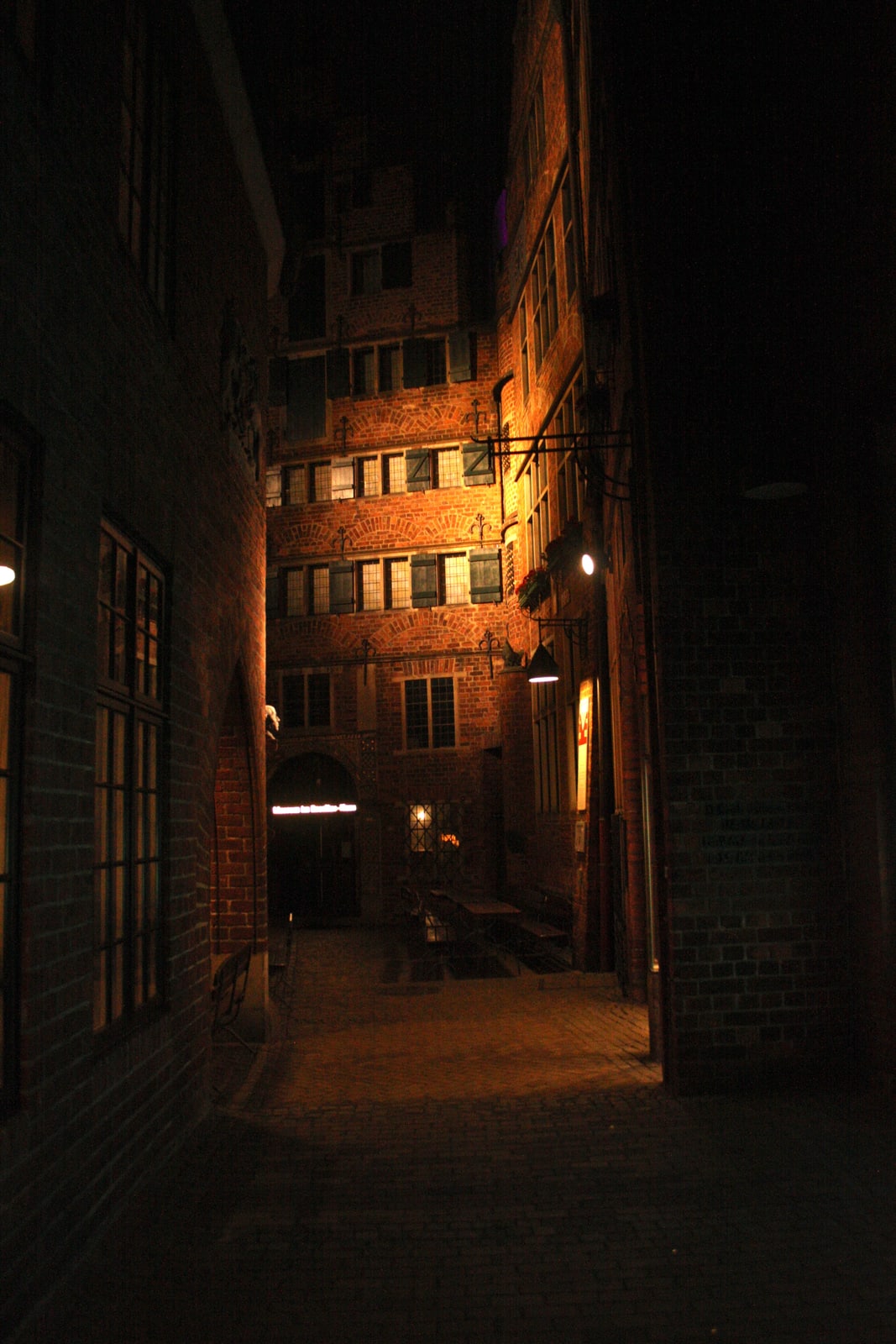
At 18:00, Bremen's final scheduled porcelain-bell performance begins. In late August, that is still broad daylight. The useful night visit begins later, when Böttcherstraße has lost its shopping-hour momentum and its brickwork has gained shadows: enter from the Marktplatz beneath the gold Lichtbringer, walk the entire 108 metres to the Martinistraße end, then reverse the passage once [1][2].
On August 28, 2026, sunset in Bremen is at 20:23 and civil twilight ends at 20:59 [7]. For an August 28 visit, 20:35–21:15 is a clean reference window; on any other date, rebuild the window from that day's sunset. Allow 35–50 minutes, expect to spend €0, and do not reserve anything. Bremen City's local directory lists the pedestrian street itself as open around the clock; museums, shops, the tourist office and private rooms keep their own hours [4]. Night access is not a promise of an interior.
The cover photograph is unusually current: it was made here after dark on July 3, 2026 [8]. It is the right recognition image because this is not a skyline walk or an old-town sweep. The whole article stays inside one short passage. Darkness does not make Böttcherstraße older. It makes the effort required to manufacture its age easier to see.
Enter under the gold, but do not stop under it
First move: approach from the Marktplatz. From the Domsheide stop, follow signs toward the Rathaus and cross the square to the narrow entrance opposite it; Bremen's official visitor information lists tram lines 2, 3, 4, 6 and 8 and buses 24 and 25 at Domsheide [2]. The recognition cue is the gilded relief above the mouth of the lane. If you can see a broad ordinary shopping street, you are at the wrong end.
Stand outside the opening for the first look. Do not plant yourself beneath the arch, where every person entering has to bend around you. The relief is Bernhard Hoetger's Lichtbringer, installed in 1936 [3]. At night it behaves like a bright seal on a dark envelope. Register it, then step through. Its meaning needs the rest of the street before it needs a photograph.
Second move: make the first pass without collecting details. Walk from the market entrance to Martinistraße in about three minutes, keeping the middle of the narrow lane available for other pedestrians. Böttcherstraße began as the link between the market and the Weser used by barrel makers—the Böttcher who gave it its name [1]. Even now, the route makes more sense as a connector than as a tiny open-air museum.
At the south end, turn around rather than adding another attraction. This is the third move. The outward pass tells you how short the street is; the return lets you see how aggressively each facade works to slow those 108 metres down. Arches, gables, brick ribs, courts and sculpture keep interrupting what should be a simple walk to the river.
The bells belong to daylight
On the return, stop at the edge of the small court in front of the Haus des Glockenspiels. This is the fourth move, and the best place to stand. Hold the wall side rather than the centre, keep shop thresholds clear, and leave the rotating tower visible to anyone else who has arrived.
Do not wait for music. The official schedule is 12:00, 15:00 and 18:00 from January through March, then hourly from 12:00 to 18:00 from April through December; frost can stop the delicate Meissen porcelain bells [2]. The mechanism uses 30 bells, while 10 carved panels in the adjoining tower rotate through figures associated with ocean crossings [2]. At night, both are silent objects.
That silence is useful. A common visitor error is to arrive after sunset and assume that a famous clock must perform after dark. A local r/bremen thread makes the practical correction: check the playing time, because the businesses around it also close early [10]. If sound matters, hear the performance scheduled for 18:00 as a daytime visit, leave, and return after sunset. In late August the gap is more than two hours [2][7][10]. Do not spend it loitering in a 108-metre lane or treating a closed doorway as a seat.
The fifth move is to look at the walls after the mechanism has failed to entertain you. A recent r/bremen visitor singled out Böttcherstraße's history and its English-language plaques as reasons the passage rewards attention [5]. Use those plaques. A phone summary can tell you that the architecture is Expressionist; the labels make it harder to mistake the whole ensemble for a lucky medieval survival.
The set is older in parts than as a whole
The route is old. Most of the street you see is not. The Böttcherstraße company describes a deliberately composed “city within the city,” planned as a visitor attraction from the beginning and rebuilt under coffee merchant Ludwig Roselius with architects Eduard Scotland, Alfred Runge and Bernhard Hoetger [1]. The museums date the near-total transformation to 1922–1931 [3]. Only the Roselius-Haus carries a substantially older core: its foundations may reach the fourteenth century, while the house was rebuilt in 1588 and later reshaped to match Roselius's ideal of an old Bremen patrician home [3].
This is the place-specific fact that changes the night. The medieval feeling is not false in the simple sense; it is constructed from an old route, one old house, craft memory and a twentieth-century program. The brick does not merely preserve Bremen. It stages an argument about Bremen.
That argument darkens beneath the Lichtbringer. The museums state plainly that Hoetger conceived the 1936 facade relief as a homage to Hitler, even though Hitler publicly rejected Böttcherstraße's culture that same year [3]. This is not politically innocent decoration or a debate sealed in the past: a June 2026 walk by Bremen's Historical Society was still framed around the street's history and current debates [6].
Sixth move: return to the relief only after reading that context. The gold has not changed, but its glow should. Do not flatten the story into either “Nazi monument” or “art the Nazis hated.” Patron, artist, regime and later preservation do not line up so neatly. The tension is part of the object in front of you [3][6]. Night makes the relief visually dominant; the plaques keep dominance from becoming admiration by default.
Keep the room public
Seventh move: photograph from an edge, not from the centre line. The July 2026 Commons photograph proves that a real night image can keep the street's brick and window light without turning the passage into a private set [8]. Make one frame, then lower the camera. A tripod that forces people into thresholds is too large for the room.
Eighth move: check the live pin before leaving, not instead of looking. Google Maps is useful here as a current community surface for the correct entrance, recent photographs and same-day access signals [9]. It is not a license to repeat review clichés. The more accurate night reading is a short, intentionally theatrical twentieth-century ensemble built on a genuinely old urban seam [1][3].
If you need to sit, do it before or after the passage on public seating around the Marktplatz rather than on a shop step. If an event, delivery or guided group occupies the carillon court, continue the loop and return once. The street is open; every particular patch of it is not owed to your photograph.
What the night postcard leaves out
| Easy assumption | Better local reading |
|---|---|
| The famous carillon will play after dark. | Its final scheduled performance begins at 18:00, with a frost exception. The community advice is to check the clock, not wait under it [2][10]. |
| The medieval atmosphere proves that the whole street is medieval. | The old route and Roselius-Haus sit inside an ensemble made mostly in 1922–1931; the medieval-looking effect is part of the design [3][4][9]. |
| A 108-metre lane is a one-pass photo shortcut. | The local community values its history and English plaques. Walk through once for the connector, then reverse for the labels and constructed details [1][5]. |
| A 24-hour listing means the interiors are open. | It describes street access. The same local surfaces separate the lane from shops that close earlier, so verify every door independently [4][10]. |
Pocket version
- Anchor: Böttcherstraße only, from its Marktplatz entrance to Martinistraße and back—216 metres of deliberate out-and-return walking before pauses [1].
- Reference window: 20:35–21:15 on August 28, 2026. On another date, begin about 10 minutes after sunset and give the brick at least part of civil twilight [7].
- Time needed: 35–50 minutes, including both passes, the carillon court and the return reading of the Lichtbringer.
- Expected spend: €0 for the public exterior. Shops, museums, tours, food and drink are separate choices, not required parts of the route [4].
- Queue and reservation: neither for the street. A tour or special event can create a temporary group at the carillon court; wait at the edge or make the second pass first [6][9].
- Transit cue: use Domsheide, then walk to the Rathaus side of the Marktplatz; do not navigate only to a business inside the lane [2].
- Recognition cue: the narrow market-side mouth beneath Hoetger's gilded Lichtbringer [3].
- Where to stand: outside the market entrance for the first frame, along the edge of the Glockenspiel court for the middle pause, and back outside the entrance for the final reading. Do not sit in thresholds.
- Same-day check: the live street pin, any event notice, and the specific hours of any interior you intend to add [4][6][9].
Böttcherstraße does not become more authentic after dark; it becomes more legible as construction. The bells are quiet, the shops no longer organize the pace, and gold tries to seize the whole story above the entrance. Walk the passage twice and the old seam stops blending into the modern set. What remains is neither medieval relic nor harmless Expressionist fantasy, but a charged brick room whose machinery is finally visible.
Sources
- Böttcherstraße GmbH, “Geschichte der Böttcherstraße Bremen” — official history of the 108-metre market-to-Weser connector, barrel-making name, Roselius patronage, architects and purpose-built visitor ensemble.
- Bremen.de, “Glockenspiel” — official city visitor page for the 30 Meissen bells, 10 rotating panels, seasonal performance schedule, frost exception and Domsheide transit lines.
- Museen Böttcherstraße, “Architektur” — museum account of the 1922–1931 transformation, Roselius-Haus layers, 1936 Lichtbringer and the relief's politically charged intent and reception.
- Bremen City, “Böttcherstraße” — local city-centre directory listing round-the-clock street access, Domsheide as the stop, and the ensemble's present businesses and museums.
- r/bremen, “Lucked into a week in Bremen. Couple of questions.” (April 2026) — recent community thread noting Böttcherstraße's history and English-language plaques.
- Historische Gesellschaft Bremen, “Vom Lichtbringer bis zu Robinson Crusoe” (June 17, 2026) — recent local historical walk framing Böttcherstraße through both its history and continuing public debates.
- Time and Date, “Sunrise and sunset times in Bremen, August 2026” — publication-date sunset and civil-twilight boundaries used for the night window.
- Wikimedia Commons, “File:Böttcherstraße - Bremen - Nacht (2026-07-03).jpg” — source page for Sneeuwvlakte's real July 3, 2026 night photograph used as the article image.
- Google Maps, “Böttcherstraße, Bremen” — live community navigation, photograph and access-review surface for the pedestrian passage.
- r/bremen, “I will be visiting your city in a month…” (September 2024) — local community advice to check the Glockenspiel schedule and expect Böttcherstraße's shops to close around 18:00.