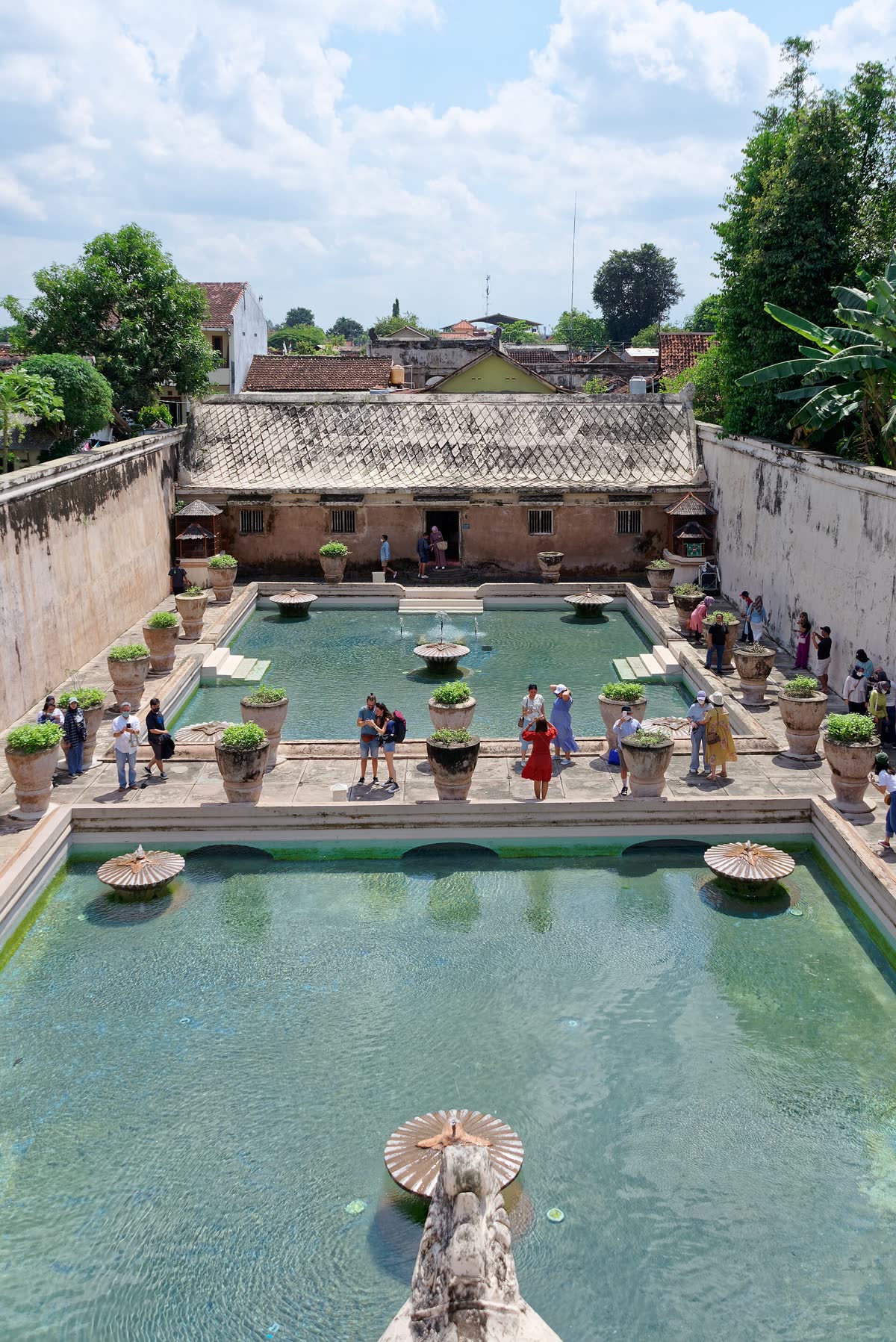
Taman Sari is at its worst when it becomes a ten-minute photo stop after the Kraton. The better version is tighter and slower: make the Water Castle the only anchor, arrive when the gates open, and read the bathing pool as one preserved fragment of a larger royal garden that once used water, walls, tunnels, islands, and neighborhood edges as one system.
This is a place portrait, not a full Yogyakarta itinerary. Do not pair it with Borobudur, Prambanan, Malioboro, three cafes, and a batik-shopping sprint in the same breath. Pair it, if anything, with the Kraton, because the walk from the palace area to Taman Sari is roughly 10 minutes in the recent visitor-guide framing, and the two sites explain the same court city at different scales.[5] The Kraton is the governing center. Taman Sari is the controlled retreat that shows how leisure, water, defense, ritual, and neighborhood life got folded into the palace world.
Best window: 9:00-10:15. A recent 2026 visitor guide lists Taman Sari as open 09:00-15:00 daily and gives the standard foreign-visitor ticket as IDR 15,000, while noting the Kraton-to-Water-Castle walk as about 10 minutes.[5] Treat those figures as planning anchors, then recheck locally before going because small heritage-site hours and ticket rules can change. The useful duration is 60-90 minutes. Less than that and you will only collect the pool shot; much more and the site starts to blur unless you take a guide.
Local move one: enter early, but do not rush to the center of the pool court. Pause at the threshold and notice how enclosed the famous bathing complex feels. Kraton Jogja's own account says Tamansari began as a palace garden under Sri Sultan Hamengku Buwono I, with construction starting in 1758 and important parts completed in 1765.[1] It also describes a complex of more than 10 hectares with 57 buildings: halls, bathing pools, hanging bridges, canals, artificial lakes, artificial islands, a mosque, and underground passages.[1] The pool is not a standalone ruin. It is the surviving, photogenic piece of a vanished hydraulic landscape.
Local move two: keep the name in your head. The palace source translates Tamansari as a beautiful garden, and explains why it was called Water Kasteel: pools and water once surrounded it.[1] That matters because the present-day approach can feel oddly dry and urban. You are walking through a living neighborhood around a former water palace, not into a sealed archaeological park.
Local move three: let the UNESCO axis widen the frame without making the visit abstract. Indonesia's official tourism site describes the Cosmological Axis of Yogyakarta and its Historic Landmarks as a UNESCO World Heritage Site recognized in 2023, stretching about six kilometers north-south from Mount Merapi toward the Indian Ocean with the palace at its core.[2] For Taman Sari, that means the palace garden is not just a pretty old bath. It belongs to a city plan where court, ritual, mountain, sea, and everyday movement still talk to one another.
Local move four: use a guide if you want the site to become three-dimensional. Jadesta, the Indonesian tourism-village platform, says the Taman Sari tourism village has 65 guides trained in foreign-language and storytelling programs.[3] If you skip a guide, make your own discipline: pool court first, then archways and upper angles, then the neighborhood edge. Do not chase every doorway just because it looks like a shortcut.
Local move five: walk the Patehan lanes as lanes, not as a backstage shortcut. The city tourism-village page places Kampung Wisata Tamansari in Patehan, Kraton district, and describes it as a supporting neighborhood for the Taman Sari attraction and the wider Yogyakarta Sultanate palace area.[4] That is the social fact many visitors miss. The site is embedded in residents' streets. Keep voices down in the narrow lanes, step aside for motorbikes, ask before photographing people, and do not block doorways while composing pool-to-arch photos.
Local move six: arrive from the Kraton side if heat and traffic allow, but do not romanticize walking from everywhere. Jadesta gives practical access numbers: from Tugu Station the Taman Sari tourism village is about 3.7 km and roughly 14 minutes by local transport depending on traffic, while from Yogyakarta International Airport it is about 43.4 km and 60-90 minutes after the airport-rail or road transfer.[3] The better move is to walk only the short heritage-zone segment and use a becak, ride-hail, taxi, or andong when the distance is really transport, not atmosphere.
Local move seven: choose the pool-court angle quickly, then look away from it. Wanderlog's review surface describes the place through old pools, tunnels, stone structures, historic architecture, morning heat avoidance, and the need to go beyond the pool area into the small local streets around it.[6] You do not need to overcorrect into a lecture. Just take the recognition shot, then spend the next 20 minutes noticing plaster, stairs, guard-like apertures, and the way walls compress sound and movement.
Local move eight: leave by respecting the neighborhood pace. Jadesta notes the access roads are mostly paved, while the tourism area itself includes stone-textured historic streets that shape the feel of the place.[3] That is your exit cue. Slow down before the last turn, buy water only if you need it, and let the transition back into Patehan register. Taman Sari's present form is part monument, part settlement edge, part guided-tour economy.
The non-local trapline is simple. Mistake one is treating Taman Sari as "the pool with arches." Better: hold the pool as the clearest remaining sign of a larger garden that once included lakes, canals, islands, a mosque, and tunnels.[1] Mistake two is walking from Malioboro in the midday heat because the map distance looks manageable. Better: use local transport for the dull distance and save your walking attention for the Kraton-to-Taman-Sari approach.[3][5] Mistake three is expecting a silent museum. Better: expect a lived-in heritage pocket, with residents, guides, vendors, motorbikes, and visitors sharing a small area.[3][4] Mistake four is arriving after lunch and wondering why the site feels flat. Better: make the 09:00 opening your discipline and leave before the strongest heat and photo congestion set the tone.[5][6][7]
Concrete go details: target 9:00 arrival, budget 60-90 minutes, carry small cash for the ticket and optional guide, and plan around an IDR 15,000 foreign-visitor ticket benchmark while checking the current gate price on arrival.[5] Use the Kraton as the walking partner, not Malioboro as the walking start. From Tugu Station, think local transport over the 3.7 km / 14-minute access estimate; from YIA, think airport rail or road transfer plus a final local ride over the 43.4 km / 60-90-minute city-entry reality.[3] Inside, stand back from the pool before stepping down, keep narrow passageways moving, and do not photograph residents as if the kampung were part of the attraction.
The specific Yogyakarta detail worth carrying out is that Taman Sari is not preserved as a cleanly isolated royal fantasy. Kraton Jogja notes serious damage after the 1867 earthquake, later renovation beginning in 1977, and renewed restoration after the 2006 earthquake.[1] The city and tourism-village sources show what happened around the remaining fabric: Patehan kept living around the old water palace.[3][4] That makes the visit more interesting, not less. The best hour at Taman Sari is the one where the famous pool stops being the whole story and becomes the first door into Yogyakarta's palace city.
Sources
- Kraton Jogja, "Tamansari" - official palace history covering construction, water-garden design, scale, functions, earthquake damage, and restoration context.
- Indonesia.travel, "The Cosmological Axis of Yogyakarta and its Historic Landmarks" - official Indonesia tourism page on the 2023 UNESCO-listed cultural landscape and approximately six-kilometer axis.
- Jadesta, Indonesian Ministry of Tourism, "Desa Wisata Taman Sari" - tourism-village access, transport, guide, and neighborhood infrastructure details.
- Kampung Wisata Kota Yogyakarta, "Kampung Wisata Tamansari" - local city tourism-village page placing Tamansari in Patehan and explaining its support role around the Water Castle and Kraton.
- Time Travel Turtle, "Visit the Taman Sari Water Castle in Yogyakarta in 2026" - recent visitor guide used for practical hour, ticket, and Kraton-walk planning anchors.
- Wanderlog, "Taman Sari Tourist Village" - review and planning surface used for crowd, morning, pool, tunnel, local-street, and typical-visit-duration signals.
- Google Maps, "Taman Sari Water Castle Yogyakarta" - live navigation and community-review surface for current pinning, access checks, and recent visitor flow signals.
- Wikimedia Commons, "Taman Sari Water Castle, Yogyakarta, 20220818 1043 8976.jpg" - real photographic source used for the article image.