Galle Face Green is the rare Colombo place that becomes clearer when you do less. Do not arrive with a city-tour appetite. Do not make it a food crawl, even though the isso vade carts and ice-cream stops will tempt you. The better move is to use the green as an evening ritual: one open lawn, one ocean edge, one line of old and new hotels, and enough local life to let the capital's scale relax in front of you.
The scope is deliberately tight. Stay with Galle Face Green, then decide whether to walk a short north-south promenade line or simply hold your position until the light changes. Colombo Municipal Council describes the promenade as a 5-hectare ribbon between Galle Road and the Indian Ocean and calls it the largest open space in Colombo.[1] Sri Lanka Tourism folds it into the city's ordinary visitor grammar: after shopping, temples, markets, and museums, "Galle face" is still where Colombo retires for wade, kottu, and sea air.[2] That official framing matters because it keeps the place from becoming just a viewpoint. It is civic breathing room.
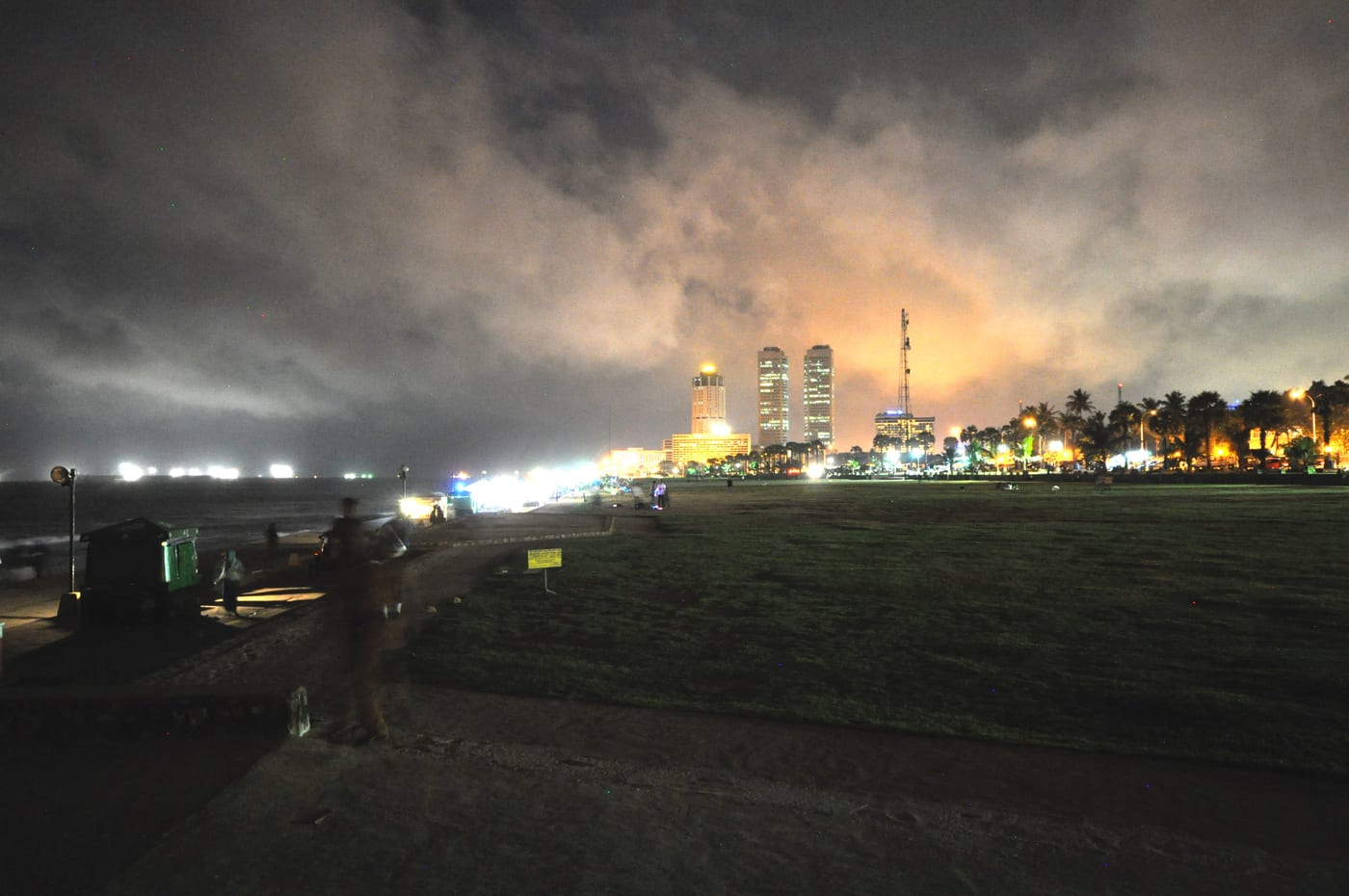
Best window: arrive around 16:45-17:15, earlier if you need a quiet first read and later if your only goal is sunset. Give it 45-75 minutes. Trip.com currently frames the place as a half-kilometer oceanfront promenade and recommends the evening sunset window; TripAdvisor's recent visitor reviews point to the same rhythm, with families, kites, sea breeze, snacks, and heavier evening crowding all showing up repeatedly.[4][5] In practice, the local move is to beat the peak by half an hour. If you enter at full sunset with everyone else, the green becomes a crowd management problem before it becomes a room.
Start from the landward side, not the seawall. Local move one: orient yourself by the old Galle Face Hotel line and Galle Road before you look at the water. That little reset stops the place from flattening into "sea on one side, city on the other." Local move two: cross only when the road gives you a clean pedestrian moment. The green feels soft once you are inside it, but the traffic edge is still Colombo traffic.
Local move three: walk the lawn diagonally first. The temptation is to race to the water rail. Hold back for two minutes and watch how the room divides itself. Couples and families claim the grass. Children and kite sellers pull attention upward. Food vendors concentrate movement near the promenade. Office workers and hotel guests take straighter paths. The useful reading is not one object; it is the choreography.
Local move four: if the wind is up, treat it as the main event. A recent Google Local Guides Colombo sunset roundup calls out Galle Face Green for its wide open space, sea breeze, street food, and family-and-friends evening use; Tripadvisor's visitor-review pattern says the same thing in less polished language.[4][6] At Galle Face, breeze is not atmosphere, it is the reason people stay outside after a hot day. It decides whether the kites look effortless, whether food smoke drifts, and whether your own walk feels cooling or abrasive. Carry a light layer in the southwest monsoon season and do not assume the sea edge will be calmer than the city behind you.
Local move five: stand on the promenade after you have already watched the lawn. The Indian Ocean is the obvious view, but the better recognition cue is the turn back toward the city: the historic hotel, the towers, the road lights, the vendors, and the constant small negotiations of people sharing a narrow edge. Sri Lanka Tourism's cruise-port page lists "Stroll in Galle Face Green" beside Pettah, the National Museum, Independence Square, and Gangarama Temple, which is exactly the right rank. It is not a monument stop. It is the reset between monument stops.[3]
Local move six: keep your spending optional. The core experience costs 0 Sri Lankan rupees. Add a snack or drink only if the vendor line is moving and you can eat without blocking the promenade. A practical range is 0-2,000 Sri Lankan rupees for a solo visit depending on tuk-tuk approach, snacks, and drinks; there is no reservation, ticket, or queue that improves the green itself. If someone tries to make the visit feel like a purchasable package, step back. The public room is already the thing.
Local move seven: choose your standing point by behavior, not only by view. If people are flying kites, stand behind the action, not under the line. If families have settled on the grass, walk around the edge rather than cutting through mats and children's play space. If the promenade is compressed, slow down and let faster walkers pass seaward. Galle Face is informal, but it is not empty. The etiquette is simple: leave the local evening intact.
Local move eight: if you want a short route, make it 30-40 minutes rather than heroic. Walk one way along the water, pause for the light, then return through the lawn or along the road edge. If you are linking from Fort or the old city, keep the final approach short enough that you still arrive before dusk. If you are coming from Bambalapitiya, the TripAdvisor review pattern confirms what the map already suggests: a short bus or tuk-tuk hop is more realistic than pretending every Colombo neighborhood folds neatly into a sunset walk.[4]
The visitor mistakes are predictable. Mistake one is arriving at noon because the green is "open." Better: use late afternoon, when the heat loosens and the room starts to fill. Mistake two is treating the place as only a street-food strip. Better: read the lawn, kites, hotel line, and sea edge first; then eat if it still fits. Mistake three is blocking the promenade for sunset photos. Better: take the picture, move inland, and let the walking lane breathe. Mistake four is overpacking the same evening with Pettah, Gangaramaya, Lotus Tower, Galle Face, and a hotel dinner. Better: make Galle Face the slow hinge, not the fifth checkbox.
There is one small historical fact worth carrying into the walk: modern Galle Face is much smaller than the colonial-era open ground that once held sports and leisure, but the present 5-hectare strip still performs the important part of that old civic job.[1] It gives a dense capital a public edge where no one has to buy a table to belong. That is why the evening works. Colombo does not explain itself here through a skyline, a temple, or a curated heritage trail. It explains itself through use: breeze, grass, road, ocean, vendors, families, kites, and the patient discipline of doing one simple public thing well.
Sources
- Colombo Municipal Council, "Colombo" - official city page describing Galle Face Green as a 5-hectare promenade between Galle Road and the Indian Ocean and the largest open space in Colombo.
- Sri Lanka Tourism, "12 Things to Do in Colombo" - official tourism page placing Galle Face in Colombo's visitor circuit and describing it as the city's playground for kottu or wade.
- Sri Lanka Tourism, "Cruise - Colombo Port" - official visitor page listing Galle Face Green among core Colombo stops.
- Tripadvisor, "Galle Face Green - All You Should Know Before Going" - recent visitor-review signal on sunset timing, free access, family crowds, kites, street food, and evening congestion.
- Trip.com, "Galle Face Green Travel Guide 2026" - current visitor listing used for the half-kilometer promenade framing and evening sunset confirmation.
- Google Local Guides Connect, "Sunset Views in Colombo You Shouldn't Miss" - recent community source describing Galle Face Green as a popular Colombo sunset place with wide open space, sea breeze, street food, and family/friend use.
- Achilli Family, "Galle Face Green," Wikimedia Commons - real photographic source used for the article image.