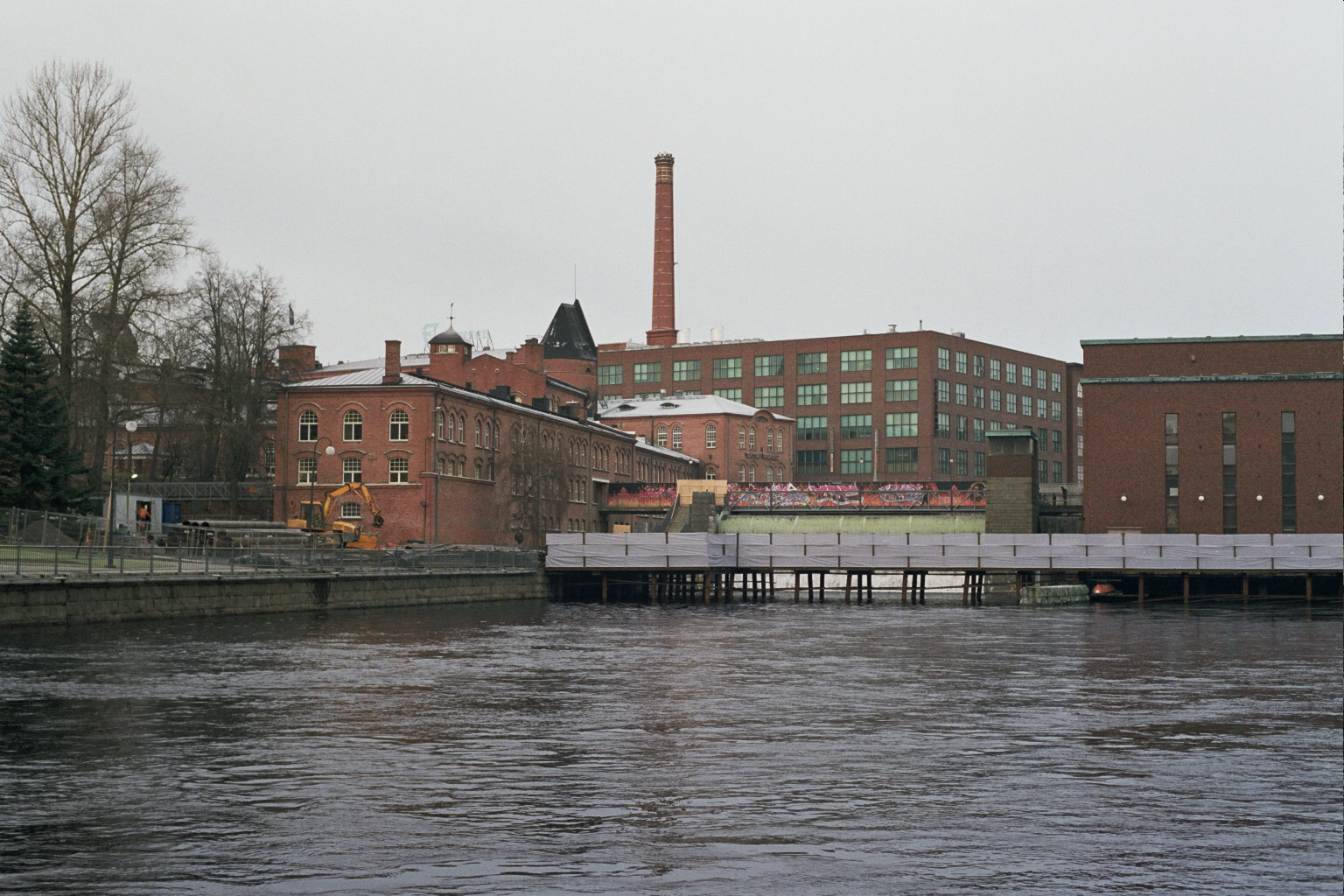
Tampere becomes legible when you stop treating the centre as a route between attractions and let one short industrial seam do the explaining. The clean version is this: start on the Tammerkoski side, cross toward the Finlayson Area, walk through the red-brick passages slowly enough to notice the factory gates, then come back to the rapids before deciding whether to add a museum, cafe, cinema, or roof walk. The point is not to "do" Finlayson as a shopping-and-museum cluster. The point is to use it as the hinge that shows why Tampere grew here in the first place.[1][2][3]
This is a street microcosm, not a full heritage day. Tampere was founded in 1779 on the banks of Tammerkoski, and Visit Tampere's current industrial-heritage guide, edited in April 2026, still frames the rapids and surrounding red-brick buildings as the national landscape that shapes the city centre.[1] Finlayson gives that landscape a body. The cotton factory was founded in 1820 by James Finlayson, and the official area page says Tampere grew around it; today the district contains more than 100 businesses, including shops, restaurants, cafes, museums, a cinema, offices, events, tunnels, and a rooftop walkway.[2][3]
Those facts change how to walk. If you arrive thinking "old factory converted into amenities," you will drift too quickly. If you arrive thinking "city engine turned into public passage," the same bricks become more useful. The best first stop is not a ticket counter. It is a pause where the water and the factory mass are both visible. Look at how close the industrial buildings sit to the rapids. Then cross into Finlayson and let the scale tighten: lanes, gates, courtyards, signs, thick walls, modern doors inside older shells. That compression is Tampere's best local lesson.
The strongest time window is late afternoon into early evening, roughly 16:30 to 18:30 in spring, summer, or early autumn. The route is central enough to work at midday, but the red brick is better when the light starts to angle across the factory walls, and the rapids feel less like background noise once the workday flow thins. Budget 60 to 75 minutes for the core loop: 10 minutes at the water, 25 to 35 minutes moving through Finlayson, another 10 minutes back at Tammerkoski, and a final optional stop if the area has caught you. The expected spend for the core route is EUR 0. Finlayson itself is an open district, and the Finnish Labour Museum Werstas is described by the area page as a free museum if you decide to add one indoor layer.[3]
Local knowledge here is mostly about resisting overfitting. First, use the rapids as your orientation line, not a map app arrow. The whole city-centre logic is water plus industry.[1] Second, enter Finlayson from the side that lets you notice the gates and brick passage before you start choosing businesses. Third, do not make the first cafe or restaurant the anchor. The official and community descriptions both note a strong mix of restaurants and cafes, but those are the reward after the spatial read, not the reason to come.[2][4][5] Fourth, if weather turns, switch the sequence rather than abandoning it: use the indoor options, then return to the bridge or river edge when the rain eases.
Fifth, keep the add-ons honest. The roof walk and guided tours sound tempting because they promise a more explicit story, but the ground-level loop already works. Tampere Tourist Guides lists industrial-past walking tours that include the Finlayson cotton mill and the old red-brick factory buildings, usually around 1.5 hours; that is a separate, slower product, not something to improvise halfway through a 60-minute city walk.[6] Sixth, treat the Stable Yards as a texture detour only if you have the time. Visit Tampere ties them to the 19th-century factory world and Wilhelm von Nottbeck's horse stables, now occupied by small craft shops and a cafe, which makes them a good soft landing after the harder brick-and-water sequence.[1]
Seventh, use the bridge view twice. Before Finlayson, it gives the factory district a reason. After Finlayson, it lets you test what changed in your eye. Eighth, if you want a sit-down pause, choose a bench or low-friction edge where you can still see movement through the district. Sitting too deep inside a venue turns the route back into a normal cafe stop; sitting near the passage keeps the factory-city rhythm visible.
The visitor trapline is predictable. The first mistake is treating Tampere as only a lake-and-sauna city. Visit Finland's Tampere page does emphasize lakes, public saunas, and relaxed urban culture, but it also names the old red-brick industrial buildings beside Tammerkoski as one of the city's defining ingredients.[7] The better move is to read the industrial core first, then let the lakes and saunas become a second register later.
The second mistake is making Finlayson a checklist of indoor things. The Google Maps place layer is useful for live orientation and current visitor photos around Finlayson, while Wanderlog's review surface highlights the contrast between historic factory fabric and current restaurants, museums, cinema, and everyday activity.[4][5] The better alternative is to walk the district as a working conversion, not as a mall with older walls.
The third mistake is overcommitting to paid or scheduled activity before seeing whether the weather and light are doing the work for free. The roof walk, guided tours, museums, and cinema all have a place. But the highest-yield first pass is still public and compact: rapids, bridge, factory gate, brick passage, courtyard, back to water. If that sequence lands, choose the add-on after. If it does not, a paid layer will not fix the route.
Concrete details are simple. Best window: 16:30-18:30, or earlier in winter when daylight is short. Expected spend: EUR 0 for the core walk; extra only for cafes, roof walk, cinema, or guided tours. Reservation reality: no reservation for the public district walk; book separately only if you want a formal tour or rooftop experience.[3][6] Queue reality: the core route has none, but indoor venues and events can change the feel. Where to stand: start at the Tammerkoski bridge view, then pause again inside Finlaysoninkuja or near a factory gate before choosing any venue. Navigation cue: Tammerkoski rapids -> bridge view -> Finlayson Area passages -> optional Stable Yards / Werstas / cafe -> return to the water.
Tampere does not need a large itinerary here. One rapid, one factory area, one short loop through red brick and reused industrial space are enough to make the city stop feeling like a list of Nordic lifestyle labels. Finlayson works because it keeps the mechanism visible: water powered industry, industry built the centre, and the centre now lets people walk through the old engine without pretending it was always a leisure district.
Sources
- Visit Tampere, "Industrial heritage of Tampere - get to know the history" - current official guide, edited April 22, 2026, covering Tammerkoski, the 1779 founding, Finlayson, Stable Yards, Tampella, and the red-brick national-landscape framing.
- Visit Tampere, "Finlayson Area" - official destination page for location, business-and-cultural-hub framing, Tammerkoski setting, 1820s cotton-mill origin, more than 100 businesses, tunnels, Factory Garden, and rooftop walkway.
- Finlayson Area official site, "About the Finlayson area" - official area history and current-use page covering the 1820 factory, city-growth claim, daily workplace role, free events, Werstas, Spy Museum, roof walk, restaurants, and cafes.
- Google Maps search, "Finlayson Area Tampere" - live local place-status and community-photo/review surface for same-day orientation around the district.
- Wanderlog, "Finlaysonin alue" - aggregated community-review page using Google review material on Finlayson's lively current use, factory history, museums, restaurants, cinema, chimney, and courtyard texture.
- Tampere Tourist Guides, "Guided walking and bus tours in Tampere" - local guide page describing 2026 industrial walking tours along Tammerkoski and through the Finlayson cotton-mill and red-brick factory areas, typically 1.5 hours.
- Visit Finland, "Tampere - where soothing lake views meet urban culture" - national tourism context for Tampere's lakes, public saunas, locals, and red-brick industrial buildings next to the Tammerkoski River.
- Wikimedia Commons, "File:Tammerkoski in Tampere Nov2011 001.jpg" - documentary photographic source for the article image, showing industrial buildings along Tammerkoski and former Finlayson factory structures.