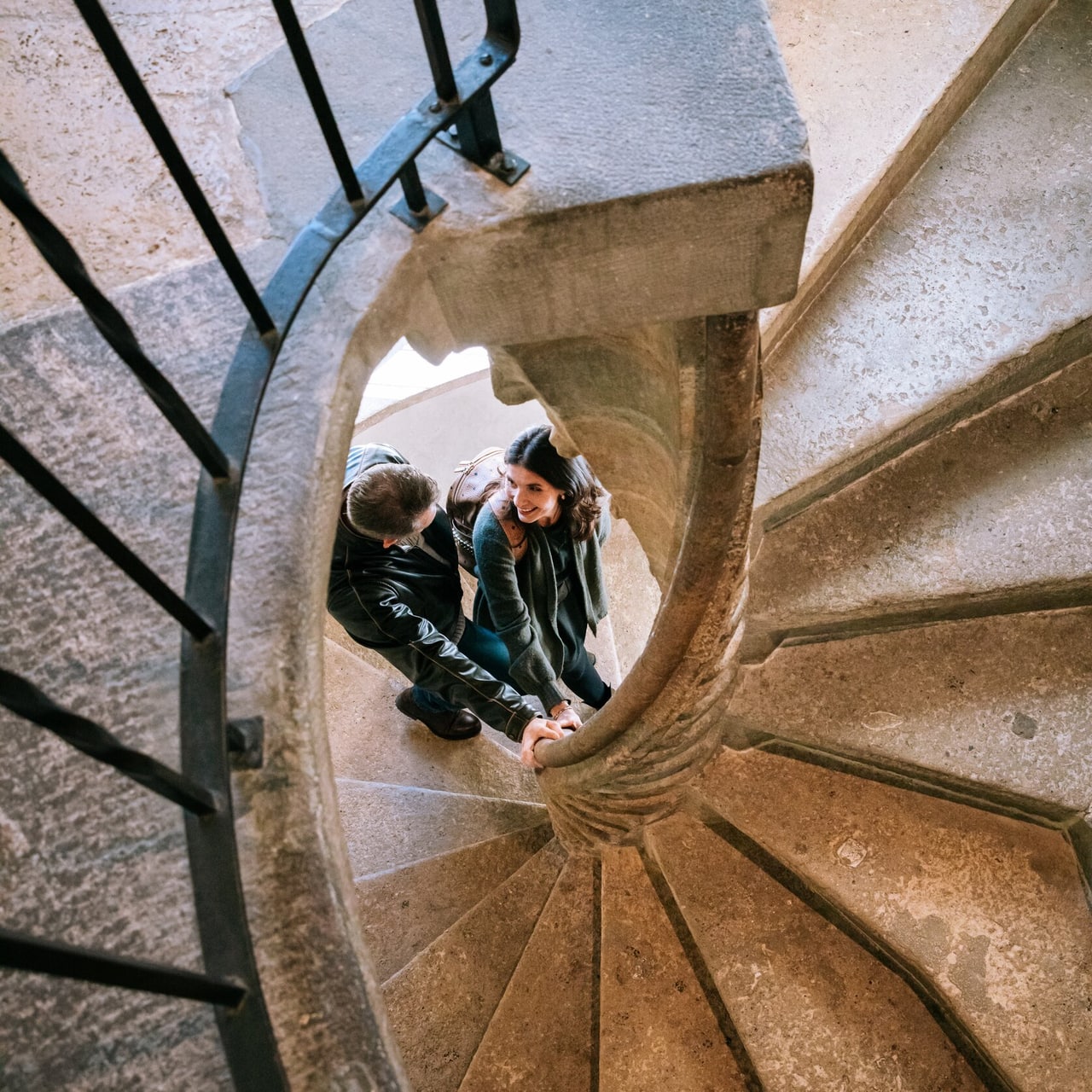
In Graz, a staircase can briefly return the person you have just lost. Take one flight inside the Grazer Burg while a companion takes the other: the stone curves separate you, then bring your paths together before dividing again. The pleasure is in that meeting. WERKGRUPPE GRAZ’s architectural account describes a building experienced through movement and encounters; the shared steps make its argument tangible.[1]
The Doppelwendeltreppe dates to 1499, under Maximilian I. Its maker’s name is unknown. Austrian writer Michaela Tebaldi records two affectionate names: Versöhnungsstiege, the reconciliation staircase, and Busserlstiege, the kissing staircase. Each reunion gives the second nickname its opportunity.[6] You need neither an imperial biography nor a romantic companion to enjoy it. You need time to notice where two routes become one.
Find the small door
Start with Hofgasse 15, the courtyard entrance given by the independent local guide stadt-graz.at and confirmed by Graz Tourismus.[2][3] The word “castle” can send a visitor’s imagination uphill. WERKGRUPPE GRAZ explicitly identifies that misconception: this Burg sits within the old town, and its staircase tower retreats to the back of the first courtyard. Look for the modest tower entrance beside the archway, rather than expecting a grand ceremonial stair on the street frontage.[1]
That inconspicuous approach has consequences. In an October 31, 2025 r/graz discussion, one contributor says they lived in the city for fifteen years before a visitor introduced them to the stairs. Another remembers a school visit and expresses surprise that some residents do not know their location.[4] These are individual recollections, but they make a useful point: save the exact entrance before setting out. Fame in photographs does not make a small door obvious.
There is also a practical reason to follow signs once inside. MeinBezirk’s June 6, 2025 report said the Burg’s renovation would preserve staircase access while altering circulation through the courtyards. It described weekday restrictions on a passage elsewhere in the complex and warned that routes would change as work progressed.[5] A barrier across a courtyard is therefore a cue to look for the signed visitor route. Do not interpret an old photograph of an open passage as permission to walk through a work area.
Let the flights explain themselves
Leave the camera down for the first ascent. Choose a branch, follow its curve, and notice the point at which the neighboring flight joins yours. At that junction, continuing upward offers another choice of direction. The geometry becomes understandable through your feet: two paths, a common stretch, then two paths again. The local architectural account describes precisely this alternation between a single route and a double one.[1]
If you come together, try opposite branches when the stairs are clear. Keep walking normally; the reunion supplies the surprise without anyone racing ahead to stage it. Traveling alone works too. Follow one curve upward, then watch how another visitor arrives from the other side. The person provides a moving reference point that a photograph cannot.
The local guide’s less glamorous observation is especially useful: the passage can be tight, and taller visitors may need to duck.[2] Keep your attention on the next tread and the overhead stone before looking through the stairwell. For a photograph, stop where you have room and let others pass first. The shared steps are the feature everyone has come to experience, so occupying their meeting point for a long portrait interrupts the object itself.
A third visitor mistake is expecting the exaggerated confusion of an online photograph. In the same r/graz thread, one commenter says the image is more dizzying than the actual place; others remember the stairs as familiar or even unremarkable.[4] Go to test that difference. Once you have followed a flight, look back at its underside: a puzzling sweep of stone now belongs to a route you understand.
Give it a small, complete visit
Access checked September 21, 2026: the official tourism page lists 07:30–20:00 daily, with free admission. Budget €0 for the staircase itself; the published listing offers ordinary free access without a reservation step.[3] There is no ticket purchase to organize around. Nor is there a reliable published queue estimate: if a group occupies the narrow flights, let it clear before beginning your own ascent.
My suggested window is 08:30–09:30, with 15–25 minutes allowed inside. These are planning allowances, not measured crowd forecasts. Daylight gives you a useful first look, and the extra minutes leave room for a second reading of the stone instead of an immediate photo-and-exit. Graz Tourismus describes the flights meeting and separating across three storeys.[3] Treat the landings as chances to understand the changing view, not simply checkpoints toward the top.
The Burg still houses the Styrian regional government.[3] Keep the visit within the public route and respect closed doors. Back in the courtyard, the small entrance may look even more ordinary. What has changed is your sense of the space behind it: enough room for separation, a turn, and another meeting.
Sources
- WERKGRUPPE GRAZ, “Die Grazer Doppelwendeltreppe” — local architectural reading of the courtyard approach, intersecting flights and experience of walking them.
- stadt-graz.at, “Doppelwendeltreppe in der Grazer Burg” — independent Graz visitor guide; entrance, narrow passages and headroom.
- Graz Tourismus, “Grazer Burg & Doppelwendeltreppe” — official opening hours, free entry, address, three-storey configuration, government use and article photograph; checked September 21, 2026.
- r/graz, “Die Unendlichkeit in Stein gemeißelt: Doppelwendeltreppe in der Grazer Burg” — October 31, 2025 local community discussion; residents’ recollections and the difference between photography and a visit.
- Angelika Kern, MeinBezirk, “Doppelwendeltreppe trotz Baustelle zugänglich” — June 6, 2025 local reporting on preserved staircase access and changing courtyard routes during renovation.
- Michaela Tebaldi, Reisen, “Die Grazer Doppelwendeltreppe – auch Busserlstiege genannt” — November 25, 2020; date, unknown maker and the staircase’s vernacular names.