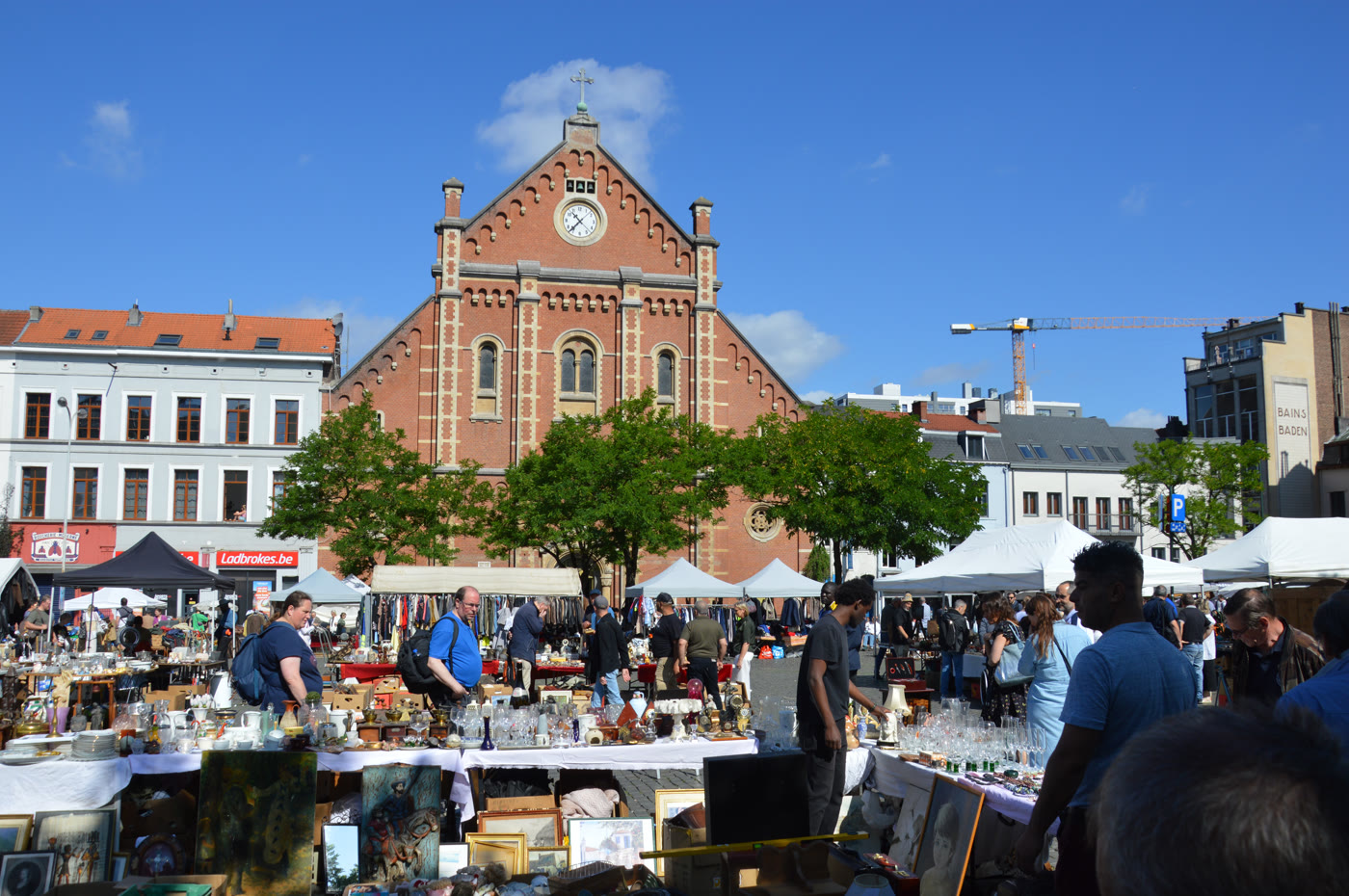
Brussels has grander Sunday panoramas than this and more famous flea markets in Europe, but not many routes that explain the city so quickly. The useful move is compact: start in the Marolles at Place du Jeu de Balle, let the market set the rhythm, then finish above it at Place Poelaert by taking the glass lift on Rue de l'Epee.[1][2][3] One anchor is the square where the district still bargains in public. The other is the elevated edge where Lower Brussels suddenly lays itself flat enough to read.
That order matters because the Marolles is not a neighborhood that improves when you approach it as a checklist. Visit Brussels' current local guide, published on 8 January 2026, frames it as Brussels' most authentic quarter, running from Chapel Church up to the Palace of Justice, and describes Sundays as the day when residents and visitors both flood in for the flea market.[1] A second, newer Marolles feature on the same official site, published on 10 March 2026, adds the deeper local texture: this is a popular district with a rebellious memory, a folklore-heavy identity, and a long habit of pushing back when the upper city tries to flatten it.[4] That is why the route works best from below to above. You begin inside the neighborhood's street logic and only then take the overview.
As of Friday, 10 April 2026, the current official pages give you one useful warning: they do not describe the market clock in exactly the same way.[1][2] Visit Brussels says bargain hunters are on the square from 7:00, with the market open until 14:00 on weekdays and an hour later on weekends.[1] The City of Brussels markets page says the market has more than 300 stalls and lists hours as 9 a.m. to 2 p.m. on weekdays and 9 a.m. to 3 p.m. on weekends and public holidays.[2] Instead of treating that mismatch as a problem, use it as local guidance. The no-regret arrival is around 9:00 a.m. on Sunday: the square is already alive, the traders are fully set, and you do not build the day on a literalist reading of two official clocks.
Image context: the cover uses a real Wikimedia Commons photograph of the flea market at Place du Jeu de Balle. It is the right documentary image for this piece because the route begins with the square functioning as an actual market room, not as scenery.[8]
Why this Sunday hinge works better than a market-only wander
The first advantage is compression. Place du Jeu de Balle already gives you Brussels in miniature: old objects, practical bargaining, mixed-language chatter, locals crossing the square as if it were a shortcut instead of an attraction, and the Marolles habit of making reuse feel ordinary rather than curated.[1][2][5] If you stop there, you get the district's texture but not its shape. The lift to Place Poelaert solves that.
The second advantage is vertical logic. The City of Brussels market page does the route-mapping for you almost by accident: after the square, it tells you to continue along Rue Blaes and Rue Haute, then notes that a panoramic view at the foot of the Palace of Justice is easily reached by the glass lift in the Marolles on Rue de l'Epee.[2] That is the exact hinge this article is built on. Instead of treating the upper city and the lower quarter as separate visits, you use one vertical transfer to connect them.
The third advantage is that Place Poelaert is not just a "viewpoint." Visit Brussels' panoramic-vistas page says the square is where young Brussels residents flock when the sun comes out, and that the view of Lower Brussels is especially strong at sunset.[3] The site also reminds you why that overlook feels slightly tense rather than purely pretty: the Law Courts were planted here for strategic reasons above a neighborhood considered rebellious.[3] From the market below to the terrace above, the route becomes a small lesson in Brussels power geography.
Start with the square, not with brunch
The Marolles punishes the wrong opening move. If you arrive and sit down immediately, the district turns into a generic Sunday quarter with coffee, vintage shops, and good intentions. If you walk the square first, it still behaves like itself.[1][2] The official local guide is blunt: the flea market is the neighborhood's main attraction, and the early-bird proverb applies here for a reason.[1]
The right approach is to enter the market as a browser, not as a collector with a shopping mission. The City of Brussels market page describes the square as an "old market" full of second-hand objects, furniture, textiles, and accessories.[2] That wording matters. This is not a tightly filtered antiques fair. It is a rummage environment. The best first twenty minutes are spent crossing one full side of the square without buying anything, just calibrating stall density, object mix, and how aggressively the morning is already moving.
Google Maps community listings for both Place du Jeu de Balle and Place Poelaert reinforce that these are still active urban rooms rather than dead landmarks.[5][6] A local Reddit thread on Brussels flea markets is even more revealing in its uncertainty: one resident says the Marolles market is daily, another says it feels much bigger on weekends, and that disagreement itself tells you the right thing to expect.[7] Sunday is not the day for empty-square romanticism. It is the day when the market becomes most legible as a shared city habit.
Use Rue Haute and Rue Blaes as the seam, not the destination
The route between the two anchors is short enough that it should stay transitional. The official Sunday-in-the-Marolles guide recommends Rue Haute and Rue Blaes because that is where the neighborhood's vintage and antique strip concentrates.[1] The City market page repeats the same corridor after the square.[2] That overlap matters because it keeps you from improvising badly. Once you leave the market, do not disperse into the district at random. Hold the seam.
This is where the Marolles' Sunday personality changes from open-air rummage to storefront memory. Visit Brussels describes Rue Haute and Rue Blaes as the concentration of vintage and antique shops that give the quarter its singular feel.[1] The newer Marolles feature broadens the backdrop: the district sits inside Brussels' historical center, still animated by folklore, historical anecdotes, and a reputation for indomitable locals.[4] You feel that in the walk. The streets do not read as polished heritage; they read as a place that survived being looked down upon.
The common visitor mistake is to turn this seam into a shopping sprint. Better to treat it as a pacing strip. Window-shop, note what kind of vintage is dominating today, and keep the climb in mind. The point of the route is not to maximize purchases per block. It is to let the district unfold horizontally before the city explains itself vertically.
Finish with the lift, then let Place Poelaert do the long pause
The last move is what makes the route a ritual instead of a browse. Visit Brussels says it plainly: to end the day with a view of the Marolles from above, take the lift to Place Poelaert.[1] The City of Brussels market page is even better because it names the access point the way a useful local note should: the glass lift in the Marolles on Rue de l'Epee.[2]
Do not overdramatize the lift. That is the local trick. It is not a scenic ride in the funicular sense. It is a piece of civic plumbing that suddenly changes scale. You leave a square governed by rummaging and bargaining, rise one clean step, and arrive beneath the oversized mass of the Palace of Justice. From there, the city is no longer a maze of blocks but a layered basin.
This is where the sunset logic becomes important. Visit Brussels calls Place Poelaert a classic view and says the square is particularly beautiful at sunset, when Lower Brussels opens below you.[3] That is why this route should not end at noon unless weather forces it. The market can be a morning act; the overlook is an evening act. What ties them together is the sense that Brussels is a city of abrupt altitude changes, social contrasts, and neighborhoods that make more sense once you read them from both sides.
8 local moves that make this Brussels Sunday land
- Treat 9:00 a.m. as the safest start even though the official pages disagree. Visit Brussels says the market is alive from 7:00; the city market page lists Sunday hours as 9:00-15:00.[1][2]
- Do one full market lap before buying anything. The square works as a rummage field, not a stall-by-stall checklist.[2]
- Assume Sunday is the fullest reading of the market, not the quietest. The official Sunday guide and local Reddit comments both point to a busier weekend character.[1][7]
- Use Rue Blaes and Rue Haute as your connecting seam. Both official pages push you onto those streets for vintage, antiques, and onward movement.[1][2]
- Keep at least one eye on the upper-city finish while you shop. The route is better when the market feels like the lower chamber of a two-level Sunday, not the whole story.[2][3]
- Take the glass lift from Rue de l'Epee instead of muscling the slope without purpose. The lift is the cleanest way to convert the neighborhood walk into a civic overlook.[2]
- Hold your longest pause for Place Poelaert, not for the market edge. The square below is for motion; the terrace above is for duration.[3][6]
- If the weather is clear, protect the sunset window. Visit Brussels explicitly marks Place Poelaert as strongest when the day is dropping and the lower city starts glowing.[3]
Non-local trapline: 4 common mistakes and the better move
Mistake 1: building the morning around a perfect treasure-hunt fantasy
Better alternative: arrive expecting volume, repetition, and rummaging. The market's charm is that it is a working second-hand square with 300+ stalls, not a neatly edited antiques salon.[2]
Mistake 2: using the Marolles only as a breakfast district
Better alternative: do the market first. The neighborhood's official Sunday script starts with the square for a reason.[1]
Mistake 3: drifting sideways after the flea market and never making the upper-city connection
Better alternative: take the Rue Blaes or Rue Haute seam and commit to the Rue de l'Epee lift.[1][2]
Mistake 4: treating Place Poelaert as a generic photo stop
Better alternative: stay long enough to understand why the overlook matters. It is not only scenic; it is the spatial proof of the Marolles' position below the Palace of Justice and inside Brussels' long social argument.[3][4]
Concrete go details
- Best window: 9:00 a.m. to 11:30 a.m. for the market, then return for sunset at Place Poelaert if you want the full two-act version.[1][2][3]
- Expected spend: EUR 0 if you only walk, browse, and use the public lift; the route does not require a ticketed attraction.[1][2]
- Queue and reservation reality: no reservation layer for either anchor; Sunday crowd pressure is about density on the square, not pre-booking.[1][2][5][6]
- What to do: browse the market first, keep your middle walk on Rue Blaes and Rue Haute, then take the Rue de l'Epee lift to finish above the district.[1][2]
- Navigation cue:
Place du Jeu de Balle -> Rue Blaes / Rue Haute seam -> Rue de l'Epee glass lift -> Place Poelaert. - Transit anchors: Bus 48 and 52 stop at Jeu de Balle; Tram 3, 4, 51, 82 serve Lemonnier; Metro 2 and 6 reach Porte de Hal, which also connects to Tram 3 and 4 and Bus 48 and 52.[2]
- Numeric anchors worth keeping: 7:00, 9:00, 14:00, 15:00, 300+ stalls, Bus 48/52, Tram 3/4/51/82, Metro 2/6.[1][2]
Brussels is easy to flatten into monuments above and neighborhoods below. This Sunday refuses that split. The square at Jeu de Balle gives you the city's bargaining, reuse, and local pressure. The lift to Poelaert gives you its altitude, control, and panorama. Held in that order, the Marolles stops being a charming detour and starts reading like one of Brussels' clearest civic arguments.
Sources
- Visit Brussels, "Sunday in the Marolles" (published 8 January 2026; current local guide used here for Sunday rhythm, 7:00 early-bird note, Rue Haute/Rue Blaes seam, and the lift-to-Poelaert finish).
- Markets from the City of Brussels, "Place du Jeu de Balle market" (official market page covering 300+ stalls, listed opening hours, transit access, Rue de l'Epee lift note, and Rue Blaes/Rue Haute continuation).
- Visit Brussels, "The best views in Brussels" (Place Poelaert section used for the sunset view claim and the historical note about the Law Courts above the Marolles).
- Visit Brussels, "The little hidden secrets of the Marolles" (published 10 March 2026; used for the district's rebellious local identity and historical-center framing).
- Google Maps community listing, "Place du Jeu de Balle, Brussels."
- Google Maps community listing, "Place Poelaert, Brussels."
- Reddit r/brussels thread, "Flea Market Brussels" (local community discussion used as a weekend-size signal rather than as an authority on official hours).
- Wikimedia Commons file page for the documentary photograph used as the cover image, "Flea market at Place du Jeu de Balle, Brussels, 2024.jpg".