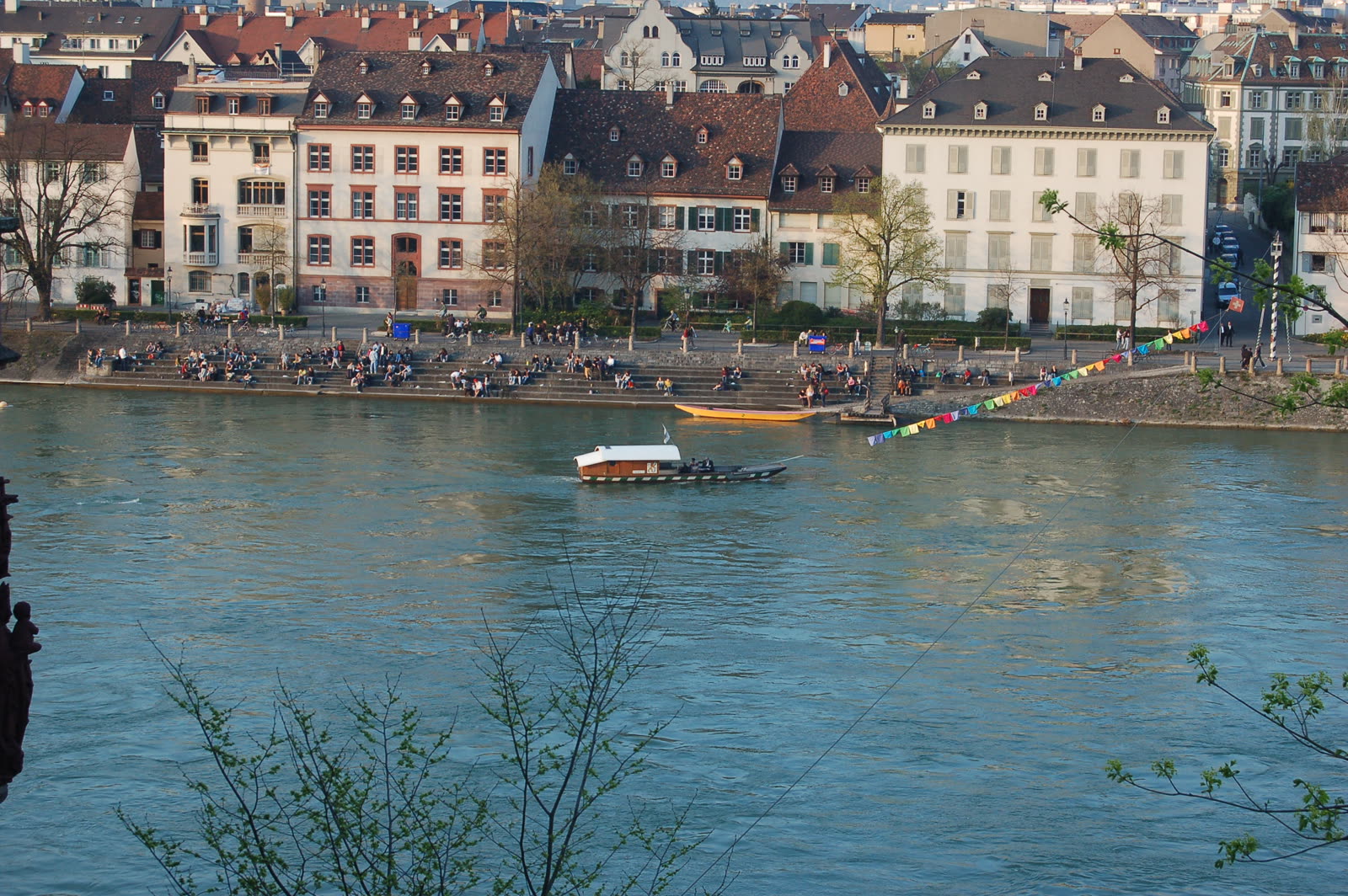
Basel has louder night moves than this, but not many that explain the city so quickly. The useful sequence is small and exact: take the Münster ferry from Kleinbasel to Grossbasel, then walk straight up to the Pfalz.[1][2] One anchor is a working cable ferry that still crosses by the force of the Rhine itself. The other is the terrace above the river where the cathedral edge, the old town, and the water finally sit in one frame.[1][3]
That order matters because the ferry is not a scenic extra pasted onto the old town. Basel's tourism board is explicit about what makes these boats distinctive: the four ferries are attached to a long wire cable and move purely through the river current.[1] On the Münster ferry in particular, the official tip is even more precise. If you ride from Kleinbasel to Grossbasel, you get the best view of the cathedral; if you do not want the climb afterward, you can simply stay on the boat and ride back.[1] That tells you everything about the route logic. Basel wants to be read from the water first and from the terrace second.
The Leu ferry's own site turns that atmosphere into practical detail. As of Sunday, March 29, 2026, the last Sunday in March, Basel's ferries are back on summer time.[1][2] The Münster ferry currently runs daily from 9:00 a.m. to 8:00 p.m. in summer, daily from 11:00 a.m. to 5:00 p.m. in winter, and charges CHF 2.00 per adult crossing, with CHF 1.00 for children, dogs, and bicycles.[2] That is important because this is not a one-off heritage prop. It is a civic habit with a timetable, a fare, and repeat local use.
The upper half of the route works because the cathedral precinct keeps the evening from collapsing into pure panorama. BaselLive's current Münster profile still treats the church as one of the city's defining landmarks rather than a background object, and the official cathedral hours page shows why the place keeps an active rhythm: in summer the church opens Monday to Friday 10:00-17:00, Saturday 10:00-16:00, and Sunday/holidays around 11:30-17:00, while the cloister stays open daily from 8:00 until dark, at the latest 20:00.[3][4] Even when the church interior is closed, the hill above the landing is still part of Basel's evening operating system.
Image context: the cover uses a real Wikimedia Commons photograph of the Münster ferry on the Rhine. It is the right image for this piece because the route is not about a generic cathedral lookout. It is about the short crossing that makes the terrace feel earned.[7]
Why this crossing works better than a bridge-first evening
The first advantage is that the ferry gives the city a better opening sentence than a bridge does. Walk over Wettsteinbrücke or Mittlere Brücke and you stay in traffic logic. Board the Münster ferry and the rhythm changes immediately: you ring, step aboard, release from the bank, and let the river do the work.[1] The crossing is brief, but it creates just enough interruption to make the old town ahead feel like an arrival rather than a continuation.
The second advantage is directional. Basel's own advice is clear that the Kleinbasel-to-Grossbasel direction is the one that frames the Münster best.[1] That is a small piece of local knowledge, but it changes the outcome. Start on the Grossbasel side and you still get a charming crossing; start on the Kleinbasel side and the cathedral sits in front of you the whole way, which is exactly what the route needs before the climb.
The third advantage is that the terrace above the landing is quieter than the city's bigger evening surfaces. Google Maps community listings for both the Münster ferry and the Pfalz still read like active local places rather than dead postcard stops.[5][6] That matters. This night room works because people keep using it for short pauses, repeated crossings, and low-key after-work decompression, not because someone declared it an attraction and left it there.
Use the ferry as the opening room
The cleanest version begins on the Kleinbasel bank while the summer timetable is still generous. Because the ferries switch to summer hours on the last Sunday in March, Friday, April 10, 2026 falls inside the 9:00 a.m.-8:00 p.m. operating band for the Münster ferry.[1][2] That makes the late part of the day ideal: the office edge has softened, the water is still bright enough to hold detail, and the cathedral comes forward rather than disappearing into night.
One local correction matters here. Do not treat the boat like a museum exhibit you admire from shore before deciding whether to commit. The official instruction is simpler than that: ring the bell on the landing pier and step aboard.[1] Basel's ferries work best when you accept their ordinary-use logic. Hesitation is tourist behavior; the bell is local behavior.
Fare logic is equally small and worth getting right. For a one-off crossing, the adult price is just CHF 2.00.[2] The 20-ride pass at CHF 36.00 is useful only if you are in Basel long enough to repeat the habit or traveling with people who will actually use the booklet.[2] This is the kind of route where over-optimizing the ticket is a waste of attention. The right move is to buy the simple crossing and protect the evening light.
Let the Pfalz hold the long pause
Once the ferry lands on the Grossbasel side, keep moving uphill. The route gets weaker if you loiter too long at the landing. The point is not to squeeze every possible river angle out of the lower bank; the point is to let the cathedral terrace become the second chamber.
This is where the night-room logic sharpens. The ferry gives you motion, current, and approach. The Pfalz gives you duration. The cathedral's official hours page is useful not because you have to go inside, but because it shows how active the precinct still is as a real place with changing daily access patterns rather than a sealed monument.[3] If the church is open, you can fold a short interior look or cloister pass into the outing. If it is closed, the terrace still works as the main pause because the route was never about ticketed entry in the first place.
The better pause is not in the middle of Münsterplatz churn but on the river-facing edge. Basel is compact enough that the view does not need much decoding: Rhine below, Kleinbasel opposite, bridges bracketing the scene, cathedral mass at your back. The value is not maximal spectacle. It is proportion. The crossing has made the city small enough to read and quiet enough to sit with.
8 local moves that make this Basel night room land
- Start in Kleinbasel, not Grossbasel. Basel's official ferry guidance says the Kleinbasel-to-Grossbasel direction gives the best Münster view.[1]
- Use the bell immediately instead of milling on the landing. The official how-to is literally to ring and board.[1]
- Treat April 10, 2026 as summer-timetable territory. The summer schedule starts on Sunday, March 29, 2026, the last Sunday in March.[1]
- Keep the ferry as a single-purpose crossing, not a fare puzzle. One adult ride is CHF 2.00; the CHF 36.00 20-ride booklet only pays off if you truly repeat the habit.[2]
- If you want the cathedral interior, remember the church clock, not just the ferry clock. Summer openings are 10:00-17:00 on weekdays, 10:00-16:00 on Saturday, and around 11:30-17:00 on Sunday and holidays.[3]
- If the church is closed, keep the plan. The exterior terrace remains the point; the outing does not depend on interior access.[1][3]
- Use one long stop at the Pfalz instead of three short ones on the way up. This route gets its force from compression.
- Respect river conditions. Basel.com notes that the ferries do not run once Rhine level exceeds 7.9 metres.[1]
Non-local trapline: 4 common mistakes and the better move
Mistake 1: starting on the wrong bank because the route looks symmetrical
Better alternative: begin in Kleinbasel so the cathedral stays in front of you through the crossing.[1]
Mistake 2: walking a bridge and calling it the same experience
Better alternative: use the ferry. The current-driven crossing is the whole reason the terrace later feels like a second room rather than just another viewpoint.[1][2]
Mistake 3: planning only around the ferry and forgetting the cathedral precinct has its own clock
Better alternative: if you want an interior add-on, protect the Münster opening hours first; if not, keep the outing exterior and unburdened.[3]
Mistake 4: overcomplicating the ticket for a one-evening move
Better alternative: pay the simple CHF 2.00 adult crossing and spend your attention on timing, direction, and light.[2]
Concrete go details
- Best window: in summer, board between 6:15 p.m. and 7:30 p.m. so the ferry still runs inside its 9:00 a.m.-8:00 p.m. band and the Pfalz catches the softer part of evening.[1][2]
- Expected spend: CHF 2.00 for one adult crossing; CHF 4.00 if you decide to ride back instead of walking a bridge later.[2]
- Queue and reservation reality: no reservation layer; you ring the pier bell and board when the boat comes in.[1]
- Where to stand or sit: stand through the crossing on the Kleinbasel-to-Grossbasel run, then save the real pause for the river-facing edge above the ferry landing.[1][6]
- Navigation cue:
Kleinbasel landing -> Münster ferry "Leu" -> Grossbasel bank -> uphill to the Pfalz. - Numeric anchors worth keeping: 4 ferries, 9:00-20:00, 11:00-17:00, CHF 2.00, CHF 1.00, CHF 36.00, 10:00-17:00, 10:00-16:00, 11:30-17:00, 8:00-20:00, 7.9 metres.[1][2][3]
Basel can look overly tidy if you approach it only from streets and squares. This route fixes that. The ferry lets the river speak first, the terrace lets the city settle afterward, and the whole sequence is short enough that it still feels like one continuous evening act instead of a checklist.
Sources
- Basel.com, "Rhine river ferries in Basel (Switzerland)" - official overview covering the current-driven ferry system, Münster ferry direction tip, nearby Pfalz climb note, and FAQ details on seasonal timetable changes, high-water cutoff, and boarding by bell.
- Münster-Fähre "Leu", official ferry site - current fares and operating hours, including the 2026 summer timetable notice and CHF 2.00 adult crossing price.
- Basler Münster, "Öffnungszeiten" - official cathedral hours page with summer opening times, 2026 short-notice closures, and cloister access hours.
- BaselLive, "Das Basler Münster ist der grösste Kirchenbau ..." - local Basel city-guide profile for the cathedral and its place in the city's landmark structure.
- Google Maps community listing, "Münster-Fähre Leu, Basel."
- Google Maps community listing, "Pfalz, Basel."
- Wikimedia Commons file page for the documentary photograph used as the cover image, "Basler Münsterfähre.jpg".